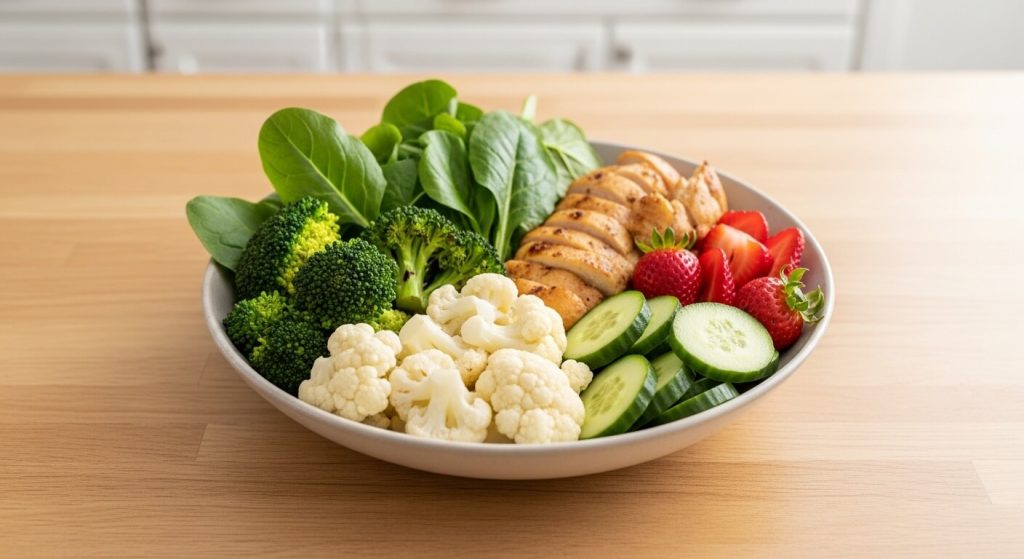
The idea behind high-volume eating has an unusually solid footing: the federal advisory report that underpins the Dietary Guidelines says in plain words that lowering the calories per gram of your food lets you eat a filling amount while taking in less energy. Below is what that looks like in actual foods, with calories per 100 g from our own database rather than from a listicle.
The short version
- Energy density is calories per gram. Lower it and the same plate carries fewer calories.
- Portion size and energy density affect intake independently and additively — they are two separate levers.
- In a controlled study, people on a high-energy-density diet ate nearly twice the calories of those on a low-energy-density one.
- Water content does most of the work. That is why vegetables, fruit, soup and lean seafood dominate the tables below.
- Nothing here burns fat. It changes how many calories fit into a portion that satisfies you.
What energy density actually is
The 2025 Dietary Guidelines Advisory Committee scientific report defines it as the amount of energy per weight (g) of food or drink, and states that portion size and energy density are independent and additive in their effects on energy intake in adults and older adults. Its conclusion is the sentence this whole approach rests on: reducing food energy density may promote weight management by allowing individuals to eat satiating quantities of food while consuming less energy.
The size of the effect comes from a National Academies review on the NIH’s NCBI Bookshelf: subjects on the high-energy-density diet consumed nearly twice as many calories as those on the low-energy-density diet. The same chapter explains the mechanism — foods with a low energy density require that a greater bulk of food be consumed for a given level of energy intake, and that bulk affects eating rate, gastric distension, and intestinal stimulation.
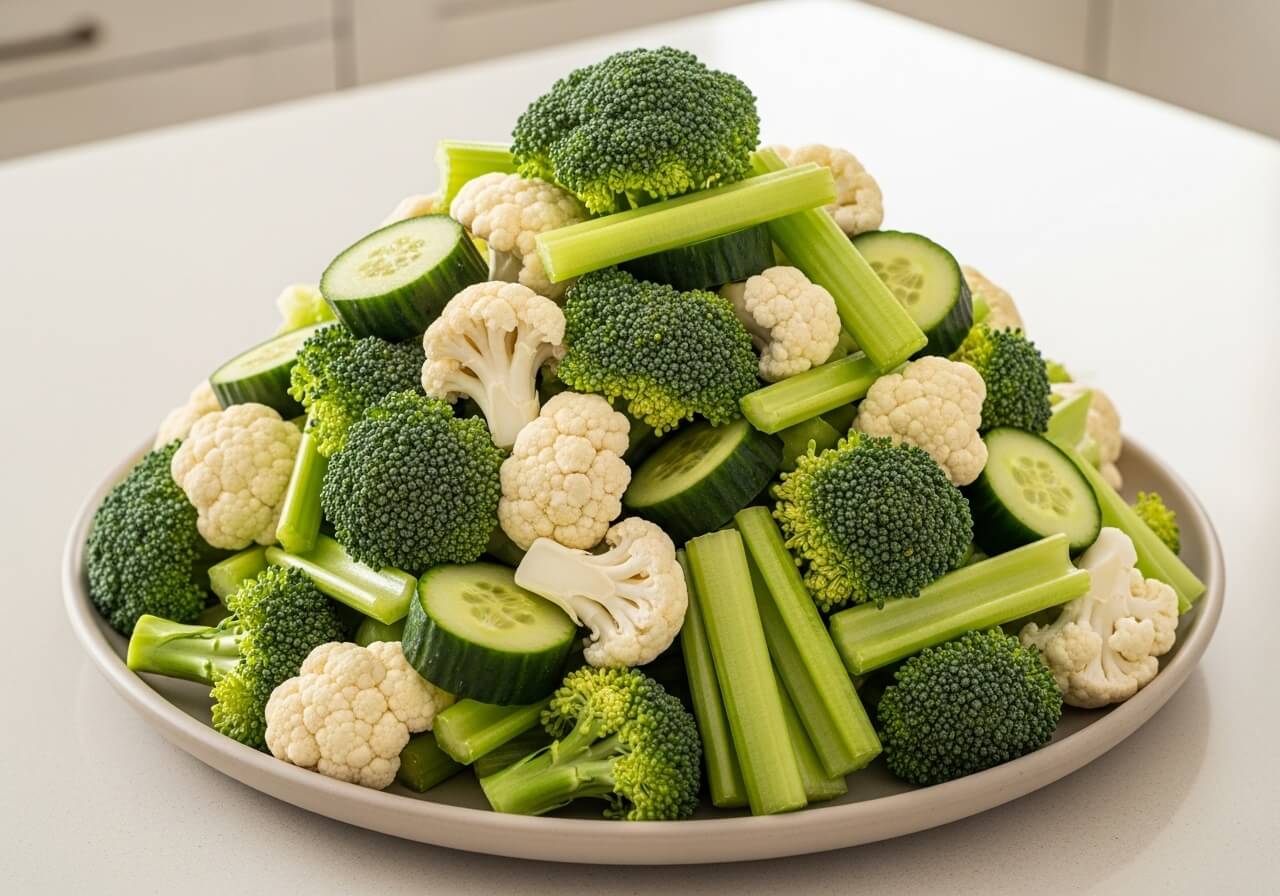
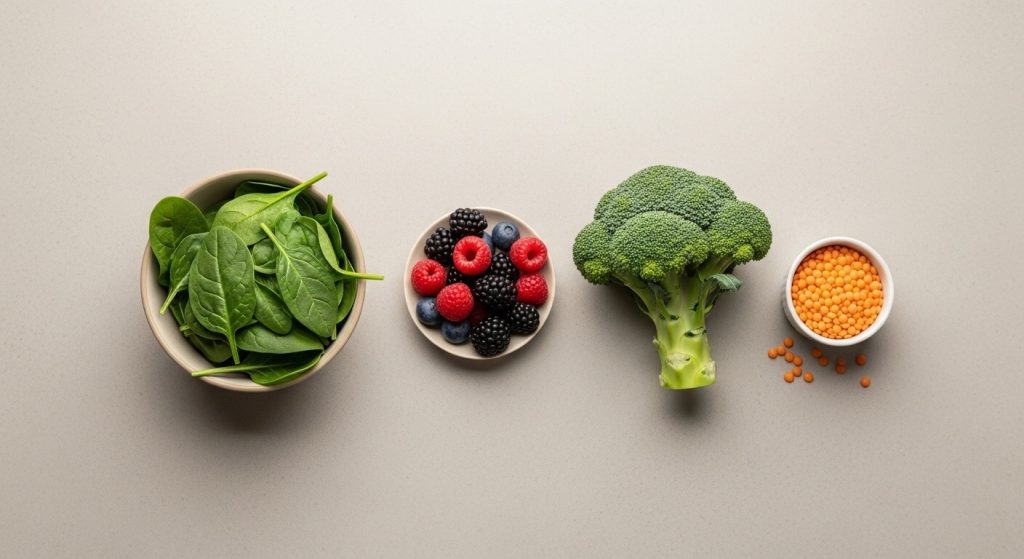
Vegetables: 16 to 22 calories per 100 g
| Food | Calories /100 g | Fiber, g |
|---|---|---|
| Cucumber | 16 | 0.5 |
| Napa cabbage | 16 | 1.2 |
| Celery | 17 | 1.6 |
| Romaine lettuce | 17 | 1.8 |
| Canned tomatoes | 18 | 1.9 |
| Summer squash | 19 | 0.8 |
| Bok choy | 20 | 1.3 |
| Radishes | 20 | 1.3 |
| Snap beans, canned | 21 | 1.9 |
| Roma tomato | 22 | 1.0 |
Half a kilo of cucumber is about 80 calories. That is the whole trick, and it is why volume approaches feel effortless compared with portion-cutting.
Fruit: sweetness at 30 to 57 calories per 100 g
| Food | Calories /100 g | Fiber, g |
|---|---|---|
| Watermelon | 30 | 0.4 |
| Grapefruit | 32 | 0.7 |
| Cantaloupe | 34 | 0.8 |
| Strawberries | 36 | 2.0 |
| Honeydew melon | 37 | 0.8 |
| Blackberries | 43 | 5.3 |
| Navel orange | 47 | 2.0 |
| Pear | 57 | 3.1 |
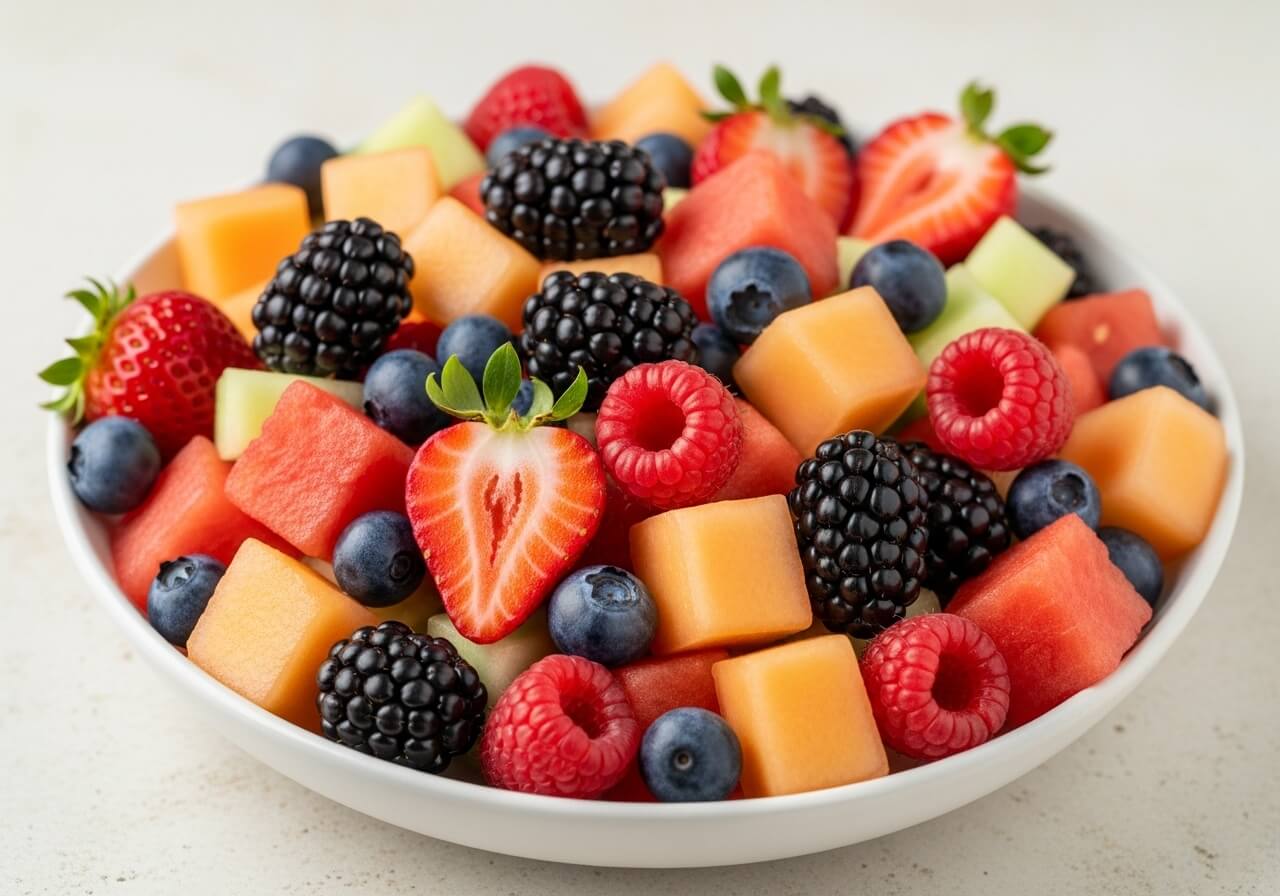
Blackberries are the standout: 5.3 g of fiber for 43 calories per 100 g. Compare that with the dry staples in our fiber content tables, where similar fiber comes attached to three or four times the calories.
Protein at low energy density
| Food | Calories /100 g | Protein, g |
|---|---|---|
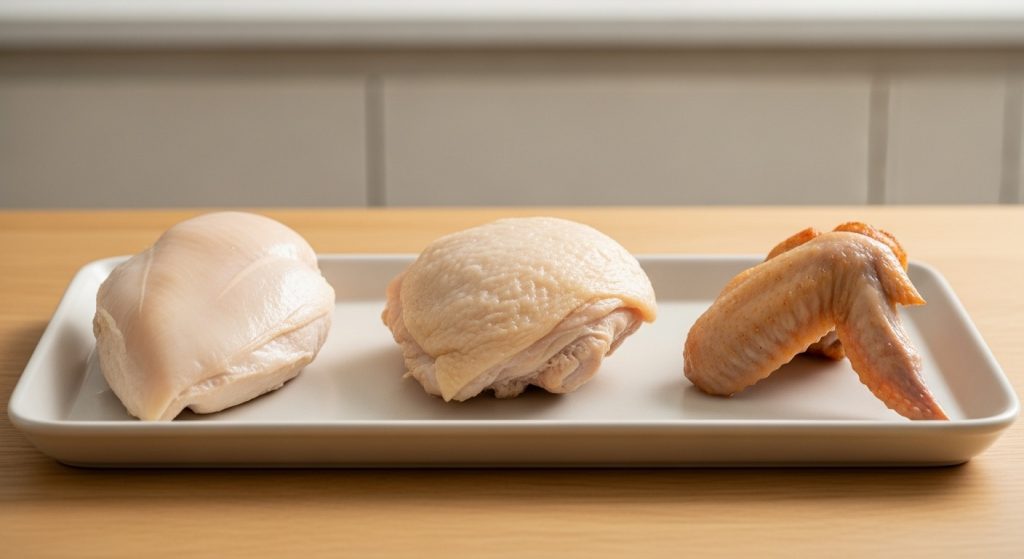
| Pollock | 56 | 12.3 |
| Lobster tail | 59 | 13.0 |
| Cod, Pacific | 61 | 14.2 |
| Sea scallops | 66 | 13.5 |
| Snow crab | 69 | 15.5 |
| Shrimp | 71 | 15.6 |
| Mahi mahi | 84 | 19.8 |
| Tuna, canned in water | 90 | 19.0 |
Seafood happens to be the food group USDA says Americans under-eat, so this table closes two gaps at once — see the documented shortfalls.
Two habits with their own findings
Start with soup. The Bookshelf review reports that meals that included soup were associated both with lower caloric intakes within the meals and with lower daily caloric intakes than those meals without soup — not just at that meal, across the day.
Put fiber earlier. The same source: high-fiber foods consumed either at breakfast or lunch significantly reduce intake at the next meal when compared to low-fiber foods, and it lists why — high-fiber foods take longer to eat, some fibers such as guar gum and pectin slow gastric emptying.
One nuance that cuts against the intuitive advice: the same review notes that in some studies the 24-h intake was higher following liquid food than solid food consumption. Volume from a smoothie is not obviously the same as volume from a plate.
What we are not claiming
- That any of these foods burns fat or boosts metabolism. No federal source names a fat-burning food, and FTC treats fat-blocking claims as ones that can never be true.
- That drinking water before meals reduces intake. We looked; the review we could reach discusses liquid versus solid food, and its finding points the other way.
- Specific satiety rankings between foods. No official source publishes a satiety index, so we are not reproducing one.
- That protein is proven to control appetite. ODS says only that protein and other dairy components “might modulate appetite-regulating hormones” — a hypothesis, stated as one.
- Calorie figures for cooked versions. Values here are per 100 g of the food in the state named on its card. Cooking changes both weight and density.
FAQ
What are high-volume, low-calorie foods? Foods with few calories per gram — mostly water and fiber. Vegetables, fruit, broth-based soups and lean seafood.
Does eating more volume help with weight? The federal advisory report says lowering energy density may support weight management by letting you eat satisfying amounts on fewer calories.
Which vegetable has the fewest calories? In our database, cucumber and napa cabbage at 16 kcal per 100 g.
Is soup before a meal actually useful? The National Academies review reports lower calorie intake both within the meal and across the day when the meal included soup.
Can I just drink my vegetables instead? Possibly not equivalent — the same review found higher 24-hour intake after liquid foods than solid ones.
What to do with this
Put numbers to it: estimate your daily energy needs with the TDEE calculator and calorie calculator, then set a sensible gap with the calorie deficit calculator and build meals around the foods above.
Change one component per meal rather than the whole meal. Swap the side, start with soup, add a bowl of the fruit table to breakfast. The calories per 100 g in these tables come from our Nutrition Facts cards, each with the USDA record it was taken from — check any of them before you trust a number here.
Educational content, not medical advice.
This content is for educational purposes only and is not medical advice. Always consult a qualified healthcare professional for personalised guidance.