Two things about pumpkin seeds are backed by US federal sources. One is magnesium, where they top the government’s own list. The other is zinc, where they clear the bar by exactly one rounding place. Everything else you have read about them — prostate health, sleep, hair, parasites, blood sugar — has no federal source at all, and in one case a federal agency says the opposite.
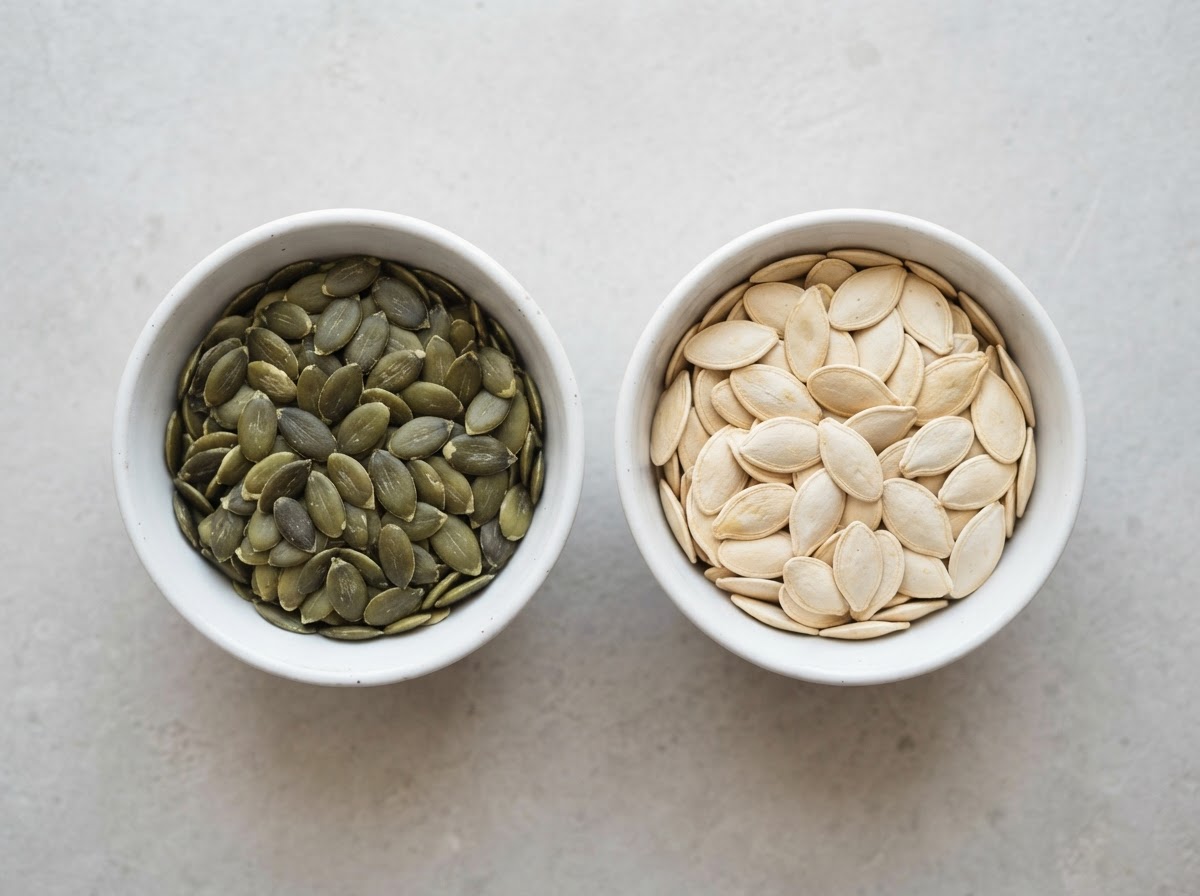
There is also a problem with nearly every pumpkin seed article on the internet, including the nutrition tables they copy from each other: they do not say whether they mean the green shelled kernels or the whole seeds with the husk on. Those are two different foods with two different USDA entries, and the numbers are not close.
Key takeaways. One roasted ounce carries 156 mg of magnesium — 37% of the Daily Value and the single highest row in the NIH’s magnesium food table, above chia, almonds and spinach. Zinc is 2.2 mg, exactly 20% DV, which is the FDA threshold for calling a food a “high source”. But pumpkin seeds do not appear in the NIH’s iron, phosphorus or copper food tables at all — so “an excellent source of iron” is not something a federal source supports. Shelled kernels have more than twice the magnesium of whole seeds per 100 g, and four times the fat. And no federal source supports any therapeutic claim made for this food.
Kernels or whole seeds? They are not the same food
USDA’s FoodData Central lists these separately, and the gap is large enough that a single figure for “pumpkin seeds” is close to meaningless. Per 100 grams:
| Per 100 g | Kernels, dried (pepitas) | Whole seeds, roasted (with shells) |
|---|---|---|
| Calories | 559 | 446 |
| Protein | 30.2 g | 18.6 g |
| Fat | 49 g | 19.4 g |
| Carbohydrate | 10.7 g | 53.8 g |
| Fiber | 6 g | 18.4 g |
| Magnesium | 592 mg | 262 mg |
| Iron | 8.82 mg | 3.31 mg |
| Phosphorus | 1,230 mg | 92 mg |
| Zinc | 7.81 mg | 10.3 mg |
| Copper | 1.34 mg | 0.69 mg |
| Manganese | 4.54 mg | 0.496 mg |
The shell is the explanation for most of it: whole seeds carry 18.4 g of fiber and 53.8 g of carbohydrate per 100 g against the kernels’ 6 g and 10.7 g, because you are partly eating husk. That husk dilutes the fat and the magnesium.
But notice that it does not run in one direction. Zinc is higher in the whole-seed entry (10.3 mg against 7.81 mg), and so is fiber by a wide margin. These are two separate USDA entries from different sample sets, not two measurements of the same batch, so the honest reading is not “shells dilute everything” — it is that “pumpkin seeds contain X” is not a statement worth making until you say which product you mean.
One observation of our own, clearly labeled as ours: the Office of Dietary Supplements figures in the next section are given per ounce and say only “pumpkin seeds, roasted”, without specifying kernels or whole. Converted to an ounce, the kernel entry gives about 2.2 mg of zinc and the whole-seed entry about 2.9 mg. The Office of Dietary Supplements figure is 2.2 mg. That arithmetic is ours and the NIH does not perform it — but it suggests the official per-ounce rows describe shelled kernels, which is what most people buy.
Magnesium: this is the real headline
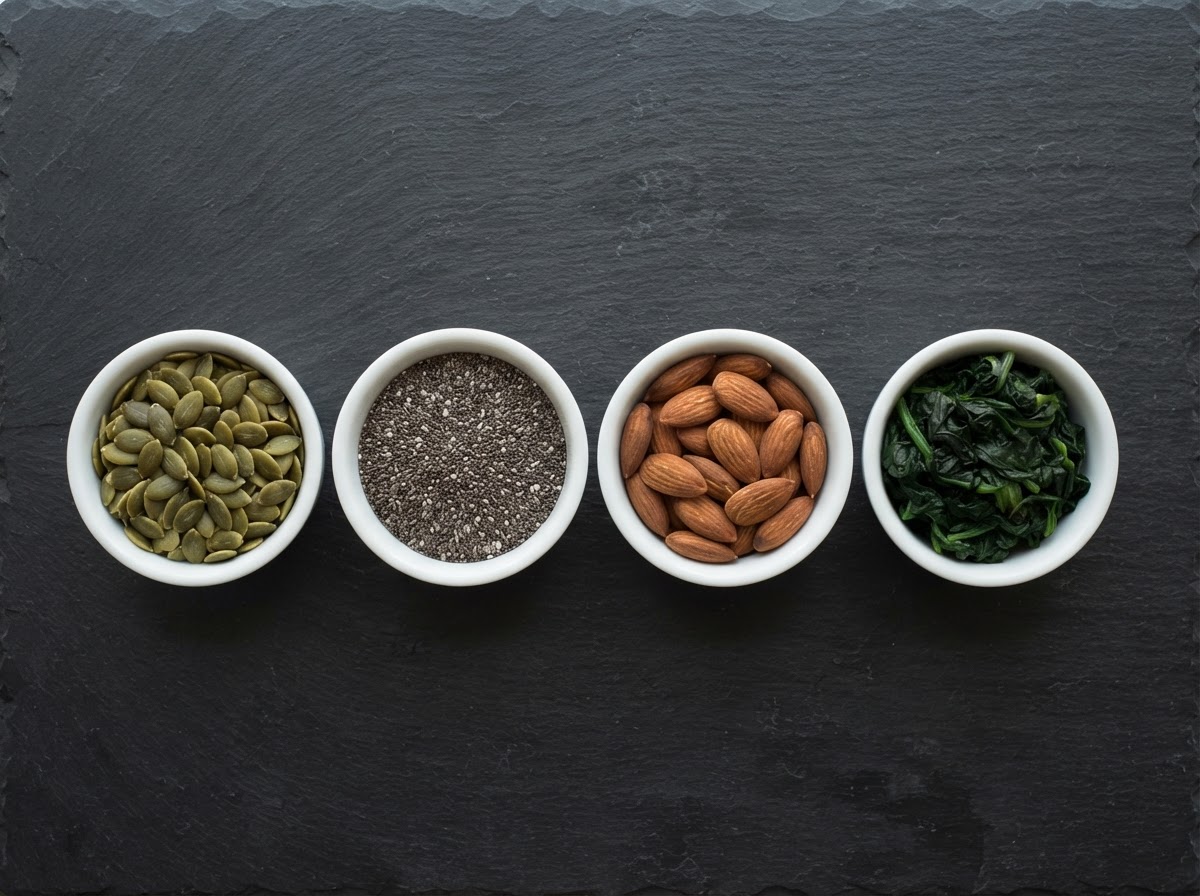
The NIH Office of Dietary Supplements publishes a food-source table for magnesium, and pumpkin seeds are the first row in it:
| Food | Magnesium per serving | % DV |
|---|---|---|
| Pumpkin seeds, roasted, 1 ounce | 156 mg | 37 |
| Chia seeds, 1 ounce | 111 mg | 26 |
| Almonds, dry roasted, 1 ounce | 80 mg | 19 |
| Spinach, boiled, ½ cup | 78 mg | 19 |
Two things follow. First, pumpkin seeds beat the foods people actually associate with magnesium — chia, almonds and spinach — and not narrowly. Second, in the whole 30-row table only two foods reach the FDA’s 20% threshold for a “high source”, and pumpkin seeds and chia are those two. Almonds and spinach fall just under at 19%.
For context, the adult magnesium RDA is 400–420 mg for men and 310–320 mg for women, so one ounce covers a real fraction of a day. Our article on foods high in magnesium has the full table.
One thing we checked and did not find: the ODS magnesium fact sheet contains no statement about phytates interfering with magnesium absorption. That caveat exists for zinc, and it should not be carried across.
Zinc: a high source, at exactly the threshold, and not all of it counts
Pumpkin seeds appear in the ODS zinc table at 2.2 mg per roasted ounce, 20% of the Daily Value. The table’s own footnote sets the rule: “Foods providing 20% or more of the DV are considered to be high sources of a nutrient.” So they qualify — by rounding, with nothing to spare.
That is more impressive than it sounds in context. Of the 26 foods in that table, only seven clear 20%, and the ones above pumpkin seeds are oysters and beef. Among plant foods, only oats does the same: lentils manage 12%, chickpeas 11%, peanuts 7%. Our guide to foods high in zinc covers the rest.
Now the caveat the marketing leaves out, in the ODS’s own words: “Phytates, the storage form of phosphorus in plants, bind some minerals such as zinc in the intestine and form an insoluble complex that inhibits zinc absorption.” And the size of the effect: “The amount of zinc absorbed from food ranges from 5% to more than 50%, depending on the amount of plant-based foods (and thus of phytate) in the diet.”
A tenfold range. Pumpkin seeds are a seed, and seeds carry phytate, so the 2.2 mg on the label and the zinc that reaches you are not the same number — and no federal source says by how much for this food specifically.
One correction to a claim you will see everywhere. A great many articles state that the Office of Dietary Supplements says vegetarians need up to 50% more zinc. We went looking for that sentence and reproduced the fact sheet’s entire vegetarian section verbatim. It is not there. The current version, updated 6 January 2026, says only that people on vegetarian and vegan diets “usually have lower dietary intakes of zinc and lower serum zinc levels”, and that they “might benefit” from soaking beans, grains and seeds before cooking, and from supplements. Those are hedges, not a requirement multiplier. ODS does print a multiplier — but for iron, where “the requirement for iron is 1.8 times higher for people who follow vegetarian diets”.
The minerals pumpkin seeds are credited with and do not officially have
This is the part that surprised us. The Office of Dietary Supplements publishes a food-source table for each mineral. We checked three of them for pumpkin seeds, and the results were consistent:
Iron: not in the table. We read it twice, the second time backwards from the last row, and counted the 33 rows ourselves. No seed of any kind appears in it. The only nuts are cashews (2 mg, 11% DV) and pistachios (1 mg, 6%). Pumpkin seeds are routinely described as an excellent source of iron; the federal food table for iron does not list them.
Phosphorus: not in the table, though cashews (139 mg) and sesame seeds (57 mg) are.
Copper: not in the table, though cashews (629 mcg, 70% DV), sunflower seed kernels (615 mcg, 68%) and sesame seeds (147 mcg) are.
Be careful what this does and does not mean. USDA’s composition data, above, clearly shows iron, phosphorus and copper in pumpkin seed kernels. What the ODS tables tell you is which foods the Office of Dietary Supplements chose to present as notable sources — and for these three minerals, pumpkin seeds did not make the list while other nuts and seeds did. If you want one sentence: they are a magnesium and zinc food, not an iron food.
There is a small labeling quirk worth knowing while we are here. The same NIH boilerplate says, for iron, “FDA requires food labels to list iron content” — but for zinc and magnesium, “FDA does not require food labels to list [the nutrient] content unless [it] has been added to the food.” So the mineral pumpkin seeds are best at is the one least likely to be printed on the package. Our guide to what food labels actually mean covers the rest of that vocabulary.
The six claims, and what federal sources actually say
We checked each of these against the agencies whose job it would be to say something. In five cases nothing exists; in one, an agency states the opposite.
Prostate health and enlarged prostate
This is the most repeated claim about pumpkin seeds, and it has the clearest answer. NIDDK’s page on benign prostatic hyperplasia says: “Researchers have not found eating, diet, or nutrition to cause or prevent BPH.” It adds that diet changes “could help treat or lessen some of your symptoms” — and what it then suggests is limiting drinks before bedtime and reducing alcohol and caffeine. The words “pumpkin”, “seed”, “zinc” and “supplement” do not appear on that page at all.
Note the phrasing: NIDDK attributes the finding to researchers collectively, not to itself. The nearest thing NCCIH has is its page on saw palmetto, where a 2023 review of 27 studies found the herb “provides little or no benefit for BPH symptoms” — and pumpkin is not mentioned there either.
Sleep
The story is that pumpkin seeds are rich in tryptophan, which becomes melatonin. NCCIH’s pages on melatonin and on sleep do not mention pumpkin, and they discuss tryptophan only as a dietary supplement — never as a food. In fact, no food appears on NCCIH’s sleep page as a sleep aid; the only food-related advice there is the negative kind, about avoiding caffeine, nicotine, alcohol and large meals before bed.
Parasites
Here a federal agency contradicts the claim outright rather than staying silent. CDC, on soil-transmitted helminths: “Only prescription drugs can treat soil-transmitted helminth infections.” It names albendazole and mebendazole. No food or dietary remedy of any kind appears on that page.
Blood sugar
NCCIH’s page on diabetes and dietary supplements does not mention pumpkin or seeds. Its general verdict, with the hedge intact: “For most supplements, there isn’t evidence to support a beneficial effect on diabetes or its complications.”
Antioxidants
NCCIH’s page on antioxidant supplements does not mention pumpkin seeds. What it does say is more interesting than a flat no: there is extensive evidence that people who eat more vegetables and fruit have lower risks of chronic disease, but the current evidence does not support the idea that antioxidant supplements prevent cancer — and the benefit of whole foods may be due to other substances in them. Note the page is about supplements, despite what its web address suggests.
Pumpkin seed oil for hair loss
Here we have to be honest about a different thing. MedlinePlus’s medical encyclopedia — which is produced by A.D.A.M. and hosted by the National Library of Medicine, not an agency position — lists nine treatments for hair loss, from minoxidil and finasteride to hair transplants. No seed or seed oil is among them. But unlike the claims above, there is research on this; it simply sits in journal databases that this site does not treat as federal sources. So the right way to put it is that no US federal health source supports the claim, not that it has been disproved.
And a small tell: the word “pumpkin” is not an entry in NCCIH’s Health Topics A–Z index at all. The agency whose remit is exactly this sort of question has never published on it.
Portions, and the one place the government names pumpkin
USDA’s MyPlate is the only federal page in this article that names pumpkin by name, and it does so as a portion rule: half an ounce of seeds — chia, flax, pumpkin, sesame, sunflower or squash — counts as one ounce-equivalent of protein foods. It also notes that Americans generally meet their protein needs from meat, poultry and eggs but “do not meet the recommendations for seafood or nuts, seeds, and soy products.”
The Dietary Guidelines for Americans, 2025–2030 never say “pumpkin” — we checked three times. But seeds appear in two places that matter here. In the vegetarian and vegan section, as a protein food to vary. And in the section on older adults, which makes the case for this food better than any marketing could: “Some older adults need fewer calories but still require equal or greater amounts of key nutrients such as protein, vitamin B12, vitamin D, and calcium. To meet these needs, they should prioritize nutrient-dense foods such as dairy, meats, seafood, eggs, legumes, and whole plant foods (vegetables and fruits, whole grains, nuts, and seeds).”
Fewer calories, same nutrients. That is the pumpkin seed argument, made by the guidelines without naming the seed.
Safety
CDC lists “Whole or chopped nuts and seeds” among choking hazards for infants and toddlers, along with spoonfuls of nut and seed butters and breads containing seeds or kernels. It gives no age cut-off on that page, so neither will we — the guidance is about infants and toddlers learning to chew.
Separately, pumpkin seeds are a food like any other and have been recalled: the FDA announced a recall of packaged organic pumpkin seeds over possible Salmonella in May 2025, with no illnesses reported at the time. Worth knowing, not worth worrying about.
Nothing federal addresses whether the shells are worth eating, or whether roasting changes the nutrient content. Both ODS figures are specified for roasted seeds, which tells us what roasted seeds contain and nothing about what roasting did.
FAQ
Are pumpkin seeds good for you?
For magnesium, unusually so: one roasted ounce gives 156 mg, 37% of the Daily Value, and that is the top row of the Office of Dietary Supplements’ own magnesium food table. For zinc they qualify as a high source at exactly 20% DV. Beyond those two minerals, federal sources make no claims for them.
Are pumpkin seeds a good source of iron?
Not according to the NIH’s iron food table, which does not list them — or any other seed. USDA composition data does show iron in the kernels, but the agency that publishes “which foods are notable sources of iron” did not include them.
Do pumpkin seeds help the prostate?
No federal source says so. NIDDK’s position on enlarged prostate is that “Researchers have not found eating, diet, or nutrition to cause or prevent BPH.”
Should I eat the shells?
No federal source addresses it. What the USDA data shows is that whole seeds with shells are a different food from kernels — much higher in fiber and carbohydrate, much lower in fat and magnesium per 100 g.
How many pumpkin seeds is a serving?
The Office of Dietary Supplements figures are per ounce. USDA’s MyPlate counts half an ounce of seeds as one ounce-equivalent of protein foods. No federal source gives a recommended daily quantity of pumpkin seeds.
Do pumpkin seeds help you sleep?
Nothing federal supports it. NCCIH’s sleep and melatonin pages never mention pumpkin, and they treat tryptophan only as a supplement, not as something you get usefully from a food.
What to do with this
Buy them for magnesium. On the government’s own table they are the best single food for it, ahead of every nut and green people normally think of, and one ounce is a meaningful share of a day’s requirement. The zinc is a genuine bonus, with the honest caveat that phytates mean you absorb somewhere between a twentieth and half of the zinc in a plant-heavy diet.
Ignore the rest. And when you compare a nutrition label against a number you read somewhere, check whether it was written for kernels or for whole seeds — on magnesium alone the two differ by more than a factor of two.
Related: foods high in magnesium, foods high in zinc, chia seeds benefits, flaxseed benefits.
This content is for educational purposes only and is not medical advice. Always consult a qualified healthcare professional for personalised guidance.