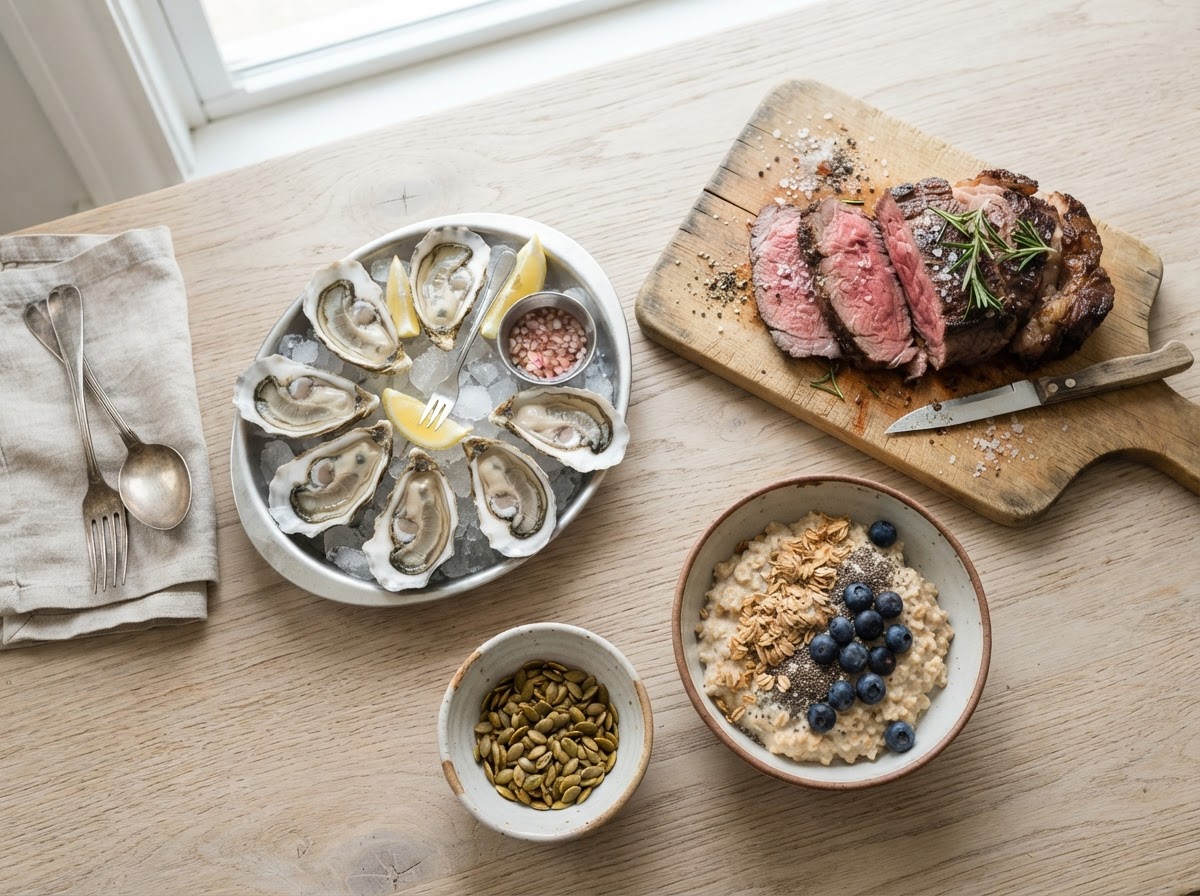
The Office of Dietary Supplements list of zinc foods has a cliff in it. Oysters sit at the top with 291% of the Daily Value in a three-ounce serving. The next food down, beef sirloin, has 35%. One eighth. No other nutrient table in this series is shaped anything like that.
And then the same fact sheet does something unusual: having named oysters the richest zinc food there is, it immediately points at beef instead — because beef is what Americans actually eat. That one sentence is most of what you need to know about foods high in zinc.
Below: the full table of 26 foods, the seven that clear the federal threshold and the two plants among them, why the number on a label is not the number that reaches you, which group is genuinely short of zinc, and the awkward fact about zinc and immunity.
Key takeaways. Adult men need 11 mg of zinc a day, women 8 mg. Of 26 foods on the Office of Dietary Supplements list, 7 clear the FDA’s 20% “high source” bar, and only two of those are plant foods — pumpkin seeds, at exactly 20%, and cooked oats. Absorption runs anywhere from 5% to more than 50% depending on what else is on the plate, the widest range of any mineral we have covered. On average both sexes already exceed the RDA; the group that doesn’t is teenage girls, where 20.9% fall short against 1% of boys the same age. And the Office of Dietary Supplements fact sheet has no section on zinc and immunity at all — its only statement linking zinc dose to immunity is a warning that too much reduces it.
How much zinc adults need
The NIH Office of Dietary Supplements publishes the recommended intakes.
| Age | Male | Female | Pregnancy | Lactation |
|---|---|---|---|---|
| 1–3 years | 3 mg | 3 mg | — | — |
| 4–8 years | 5 mg | 5 mg | — | — |
| 9–13 years | 8 mg | 8 mg | — | — |
| 14–18 years | 11 mg | 9 mg | 12 mg | 13 mg |
| 19+ years | 11 mg | 8 mg | 11 mg | 12 mg |
Two things in that table are worth a second look. The adult requirement is flat — it does not rise with age, unlike magnesium. And lactation asks for more than pregnancy, which is the reverse of the usual pattern. A pregnant 18-year-old needs 12 mg, more than an adult man.
The upper limit for adults is 40 mg a day. ODS states one exclusion from it: the limits do not apply to people receiving zinc as medical treatment, who should be under a doctor’s care.
There is also a quirk in the labeling number that nobody mentions. The FDA Daily Value for zinc is 11 mg — identical to the adult male RDA, and about 40% above the adult female one. So a woman reading a percentage on a package is measuring herself against a man’s requirement.
Not that she will often get the chance. As with magnesium, ODS notes that the FDA does not require labels to list zinc unless zinc has been added to the food. It is a voluntary nutrient on the panel.
The Office of Dietary Supplements list of zinc foods, in order
Table 2 from the ODS zinc fact sheet, in full. The %DV column runs against the Daily Value of 11 mg.
| Food | Serving | Zinc | %DV |
|---|---|---|---|
| Oysters, Eastern, farmed, raw | 3 oz (85 g) | 32 mg | 291 |
| Oysters, Pacific, cooked | 3 oz (85 g) | 28.2 mg | 256 |
| Beef, bottom sirloin, roasted | 3 oz (85 g) | 3.8 mg | 35 |
| Blue crab, cooked | 3 oz (85 g) | 3.2 mg | 29 |
| Breakfast cereals fortified with 25% of the DV | 1 serving | 2.8 mg | 25 |
| Oats, cooked with water | 1 cup | 2.3 mg | 21 |
| Pumpkin seeds, roasted | 1 oz (28 g) | 2.2 mg | 20 |
| Pork, centre loin chops, broiled | 3 oz (85 g) | 1.9 mg | 17 |
| Turkey breast, roasted | 3 oz (85 g) | 1.5 mg | 14 |
| Cheese, cheddar | 1.5 oz (43 g) | 1.5 mg | 14 |
| Shrimp, cooked | 3 oz (85 g) | 1.4 mg | 13 |
| Lentils, boiled | ½ cup | 1.3 mg | 12 |
| Sardines, canned in oil, with bone | 3 oz (85 g) | 1.1 mg | 10 |
| Greek yogurt, plain | 6 oz (170 g) | 1.0 mg | 9 |
| Milk, 1% milkfat | 1 cup | 1.0 mg | 9 |
| Peanuts, dry roasted | 1 oz (28 g) | 0.8 mg | 7 |
| Rice, brown, cooked | ½ cup | 0.7 mg | 6 |
| Egg | 1 large | 0.6 mg | 5 |
| Kidney beans, canned | ½ cup | 0.6 mg | 5 |
| Bread, whole wheat | 1 slice | 0.6 mg | 5 |
| Salmon, cooked | 3 oz (85 g) | 0.5 mg | 5 |
| Broccoli, cooked | ½ cup | 0.4 mg | 4 |
| Rice, white, cooked | ½ cup | 0.3 mg | 3 |
| Bread, white | 1 slice | 0.2 mg | 2 |
| Cherry tomatoes, raw | ½ cup | 0.1 mg | 1 |
| Blueberries, raw | ½ cup | 0.1 mg | 1 |
Worth saying what is not on that list, because the usual suspects are missing: cashews, chickpeas, dark chocolate, baked beans, chicken, Swiss cheese and wheat germ appear in most “high zinc foods” articles and in none of the Office of Dietary Supplements table. We have no official figure for any of them, so we are not going to print one.
The cliff — and why the Office of Dietary Supplements points at beef anyway
The gap between the first two rows and the third is the most dramatic thing in this series. Oysters really are, as ODS puts it, the food that contains more zinc per serving than any other. A single three-ounce serving carries 32 mg, against an adult upper limit of 40 mg a day.
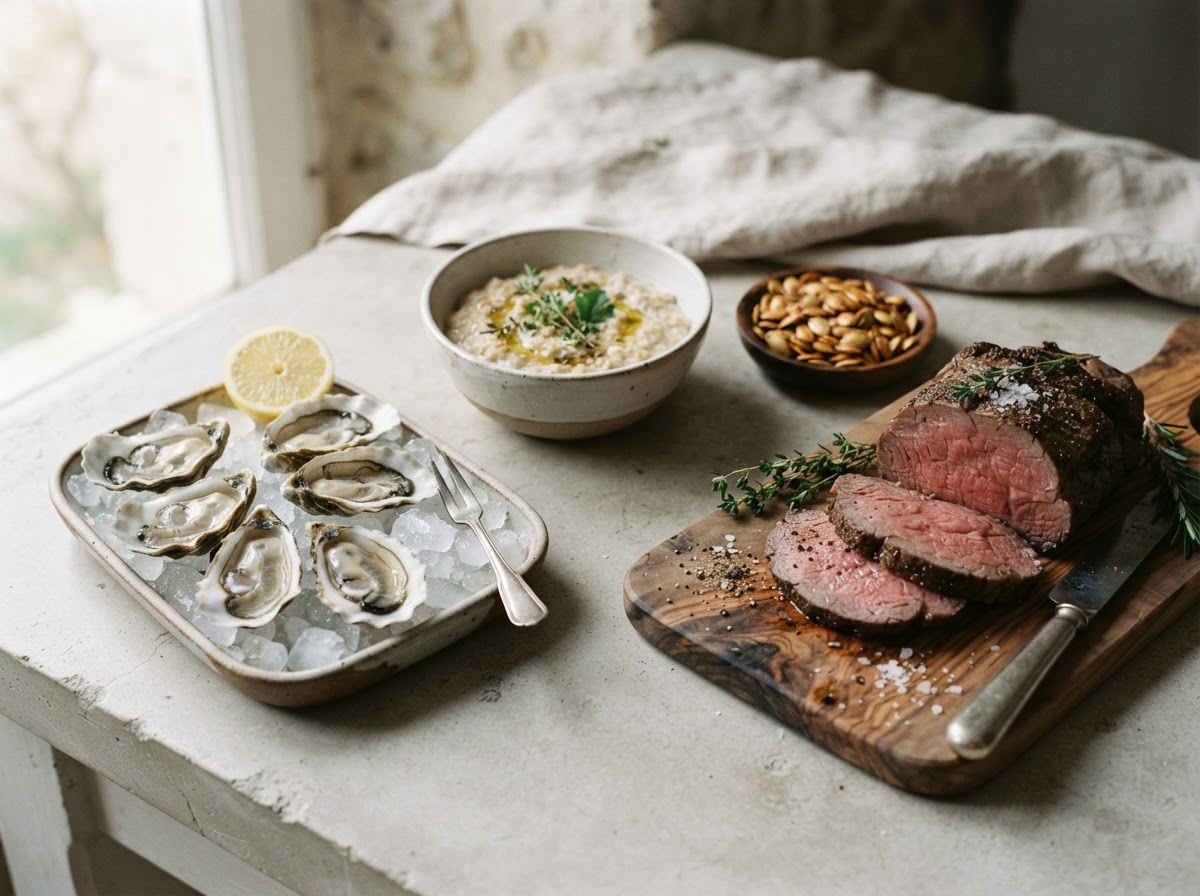
But the sentence does not end there. It continues: but beef contributes 20% of zinc intakes from food in the United States because it is commonly consumed. A fifth of all the zinc Americans get comes from beef, not because beef is concentrated — it is at 35% DV — but because people eat it on Tuesdays.
That is the honest shape of the subject. The superfood is real and almost irrelevant. A food you eat twice a year contributes nothing to your intake, whatever its number.
Seven foods clear the bar. Two of them are plants.
FDA’s rule on the Nutrition Facts panel: 5% DV or less per serving is low, 20% or more is high. ODS repeats the threshold in its own table footnote — along with the clause that usually gets dropped, that foods providing lower percentages also contribute to a healthful diet.
Seven of the 26 foods clear 20%: both oyster rows, beef sirloin, blue crab, fortified cereal, cooked oats and pumpkin seeds. Pumpkin seeds land on exactly 20 — they clear it by rounding, with nothing to spare.
And that is the whole plant-based showing. Lentils are at 12%, peanuts 7%, kidney beans 5%, whole wheat bread 5%, broccoli 4%. The plant-based zinc listicle does not really survive contact with the government’s own threshold — a point that matters more for zinc than for other minerals, because of what comes next.
The number on the label is not the number in you
Zinc has the widest absorption range of any mineral we have written about. ODS: the amount absorbed from food runs from 5% to more than 50%, depending on how much plant food — and therefore how much phytate — is in the diet. Magnesium runs 30–40%. Potassium is around 90%. Zinc can be a tenfold difference between one diet and another.
Phytates are the reason. They bind zinc in the intestine and form an insoluble complex that blocks absorption, which is why ODS says zinc from beans, nuts and whole grains is less available than zinc from animal foods, and why vegetarian diets in particular deliver less of what is on the label. We go through the mechanics in what genuinely changes nutrient absorption, including what soaking and fermenting do and do not buy you.
There is a second sentence that deserves attention because it works against the obvious response. As zinc intakes rise, ODS says, the amount absorbed also rises — but the fraction absorbed drops. Doubling the zinc on the plate does not double the zinc in you. It is a brake on the eat-more-oysters reflex, and it is the agency’s own.
Who is actually short of zinc
Here the numbers are unusually specific, and they do not support a general alarm.
Average intake from food is 13 mg a day for men against an 11 mg requirement, and 9.2 mg for women against 8 mg. On average, both sexes already exceed the RDA.
Fifteen per cent of US adults come in below the Estimated Average Requirement. But the figure that matters is broken out by age and sex: among boys aged 14 to 18, 1% fall below it. Among girls the same age, 20.9% do. A twentyfold gap inside one age band.
That is a far more useful finding than a flat national percentage, because it names a group. And ODS adds the global context: zinc deficiency measured by blood concentration is much more common in low- and middle-income countries than in the United States.
What zinc is actually backed for
Shortening a cold — yes, with conditions. This is the one popular zinc claim with a federal source behind it. ODS: supplemental zinc in lozenge or syrup form appears to reduce the duration, but not the severity, of cold symptoms when taken shortly after a cold develops. Three qualifiers in one sentence, and all three matter. The same page says trial results have been inconsistent, and reports a 2024 Cochrane review finding roughly a two-day reduction in people who already have a cold, with little to no difference in preventing one — conclusions the review itself rated as low to very low certainty of evidence.
One thing that gets left out of every lozenge recommendation: the trial regimens ran to about 13 mg every two to three waking hours, which is roughly 70 to 100 mg a day against a 40 mg upper limit. That is short-course trial dosing under supervision, not a daily habit.
Macular degeneration — real, and not transferable. The AREDS trial found a 25% lower risk of advanced AMD over five years, and it is genuinely important research. But read the formulation: 80 mg of zinc a day, twice the adult upper limit and seven times the RDA, plus 2 mg of copper — included precisely because zinc at that dose causes copper deficiency. AREDS2 got the same effect at 25 mg, still triple the RDA. This is a supervised pharmacological intervention for an eye disease. It is not a reason to eat more oysters, and anyone with AMD should be discussing the actual formulations with their clinician.
Childhood diarrhea. ODS reports that zinc supplementation shortens diarrhea in children over six months by about half a day, and that the World Health Organization and UNICEF recommend a short course to treat it. Note the authorship — that recommendation is WHO’s and UNICEF’s, reported by NIH, and it is aimed overwhelmingly at settings where zinc deficiency is common.
Wound healing — a distinction worth holding. ODS says zinc deficiency in older adults can delay wound healing. It does not say zinc supplements speed healing in someone who is not deficient, and we could not find a federal source that does.
Zinc and immunity: the inversion
Zinc is sold, more than anything else, for immunity. So this is worth stating carefully.
The ODS zinc fact sheet’s health section covers the common cold, macular degeneration and a handful of other topics. It has no subsection on immune function at all. Immunity appears twice on the page: once in the sentence listing what zinc does in the body, and once — in the section on getting too much.
That second mention is the one nobody quotes. ODS: if used for weeks, doses of 50 mg or more — typically from supplements, or from overuse of zinc-containing denture adhesive creams — can interfere with copper absorption, reduce immune function, and lower HDL cholesterol.
So the only statement on the page linking a zinc dose to immune function says that too much makes it worse. That is not an argument against zinc. It is an argument against the aisle.
What no federal source says
That zinc raises testosterone. The word does not appear on the ODS zinc fact sheet, in the StatPearls chapter on zinc deficiency, or — checked specifically, because it is where such a claim would live — on the ODS fact sheet for supplements and athletic performance. What does exist is the reverse direction: zinc deficiency is listed as a cause of hypogonadism. Deficiency impairing function is not the same as supplementation improving it in someone who has enough.
That zinc treats acne. Not on ODS, not on MedlinePlus, not in StatPearls. The only skin material on any of them describes the rash of zinc deficiency, which is a different thing.
That white spots on fingernails mean zinc deficiency. Nails do not appear as a deficiency sign on any of the sources we checked. StatPearls does describe transverse striations — of hair, in a sentence about the scalp.
None of this proves these things do nothing. It describes how much evidence a reader is actually being offered, which is none from the agencies that review it.
Supplements, medicines and the copper problem
If you take zinc alongside anything else, three interactions are on the record. Quinolone and tetracycline antibiotics may bind with zinc in the gut, blocking both; ODS gives an unusually specific window — take the antibiotic at least two hours before, or four to six hours after, the zinc. Zinc reduces the absorption of penicillamine, used for rheumatoid arthritis and Wilson disease, and the two should be at least an hour apart. Thiazide diuretics increase zinc loss in urine.
On excess, ODS names copper as what high-dose zinc depletes; MedlinePlus goes further and names copper, iron and magnesium. High intakes can also cause nausea, headaches and stomach upset.
One product-specific caution: MedlinePlus states that people using nasal sprays and gels containing zinc may have side effects such as losing their sense of smell. Notably, the ODS fact sheets mention such products without mentioning that risk — two NIH properties, different content.
FAQ
Which foods are highest in zinc?
Oysters, by an enormous margin — 32 mg in three ounces, 291% of the Daily Value. After that the list drops steeply: beef sirloin 3.8 mg, blue crab 3.2 mg, fortified cereal 2.8 mg, cooked oats 2.3 mg, pumpkin seeds 2.2 mg.
Can vegetarians get enough zinc?
It takes more attention. Only two plant foods on the Office of Dietary Supplements list reach the 20% threshold, and phytates in beans, nuts and whole grains lower how much of that zinc is absorbed — which is why ODS notes that zinc bioavailability is lower from vegetarian diets. Soaking and fermenting help; how much, no federal source will say.
Does zinc stop you getting sick?
Not on the evidence any US agency publishes. Zinc lozenges taken at the start of a cold appear to shorten it without making it milder, and the reported review found little to no difference in preventing colds. The fact sheet has no section on zinc and immune function.
How much zinc is too much?
The adult upper limit is 40 mg a day. ODS’s concern is specifically about supplements and zinc-containing denture creams used over weeks at 50 mg or more, not about food.
Is a zinc supplement worth taking?
That depends on whether you are short, and most American adults are not — average intakes exceed the RDA for both sexes. The clear exception in the data is teenage girls. Anyone in a named risk group — inflammatory bowel disease, bariatric surgery, pregnancy, vegetarian diets, alcohol use disorder — is a different conversation, and one for a clinician.
What to do with this
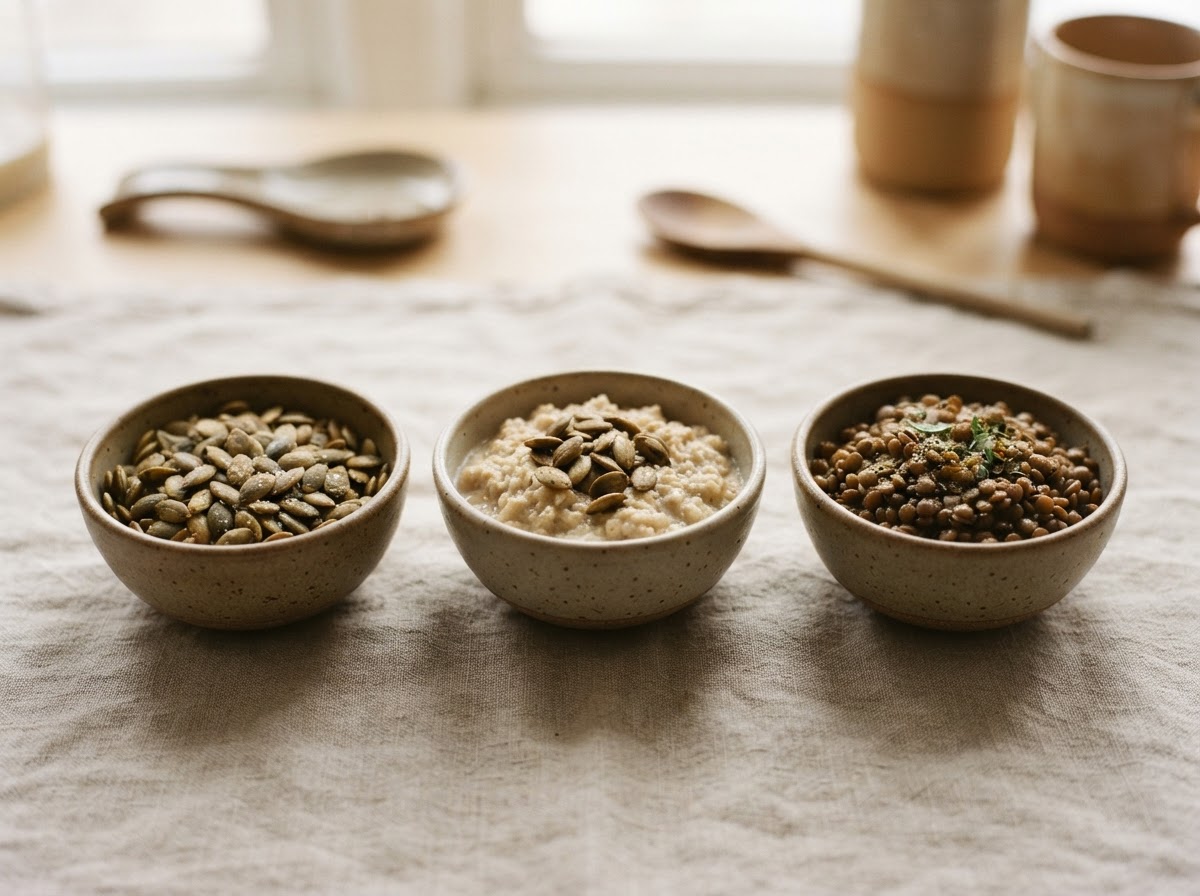
If zinc is genuinely a concern for you, the practical answer is dull and effective: some animal protein most days, or, without it, pumpkin seeds, oats and lentils regularly rather than occasionally, with beans and grains soaked. Oysters are a treat, not a strategy.
And if you are buying zinc for immunity, the source you are implicitly citing does not have a section on it — but does have a sentence about 50 mg a day reducing immune function. Worth knowing before the checkout.
Related: foods high in magnesium, foods high in potassium and our iron-rich foods comparison.
Educational content, not medical advice. If you take antibiotics, penicillamine or a diuretic, or you are considering zinc above the amounts in food, discuss it with your clinician.
This content is for educational purposes only and is not medical advice. Always consult a qualified healthcare professional for personalised guidance.