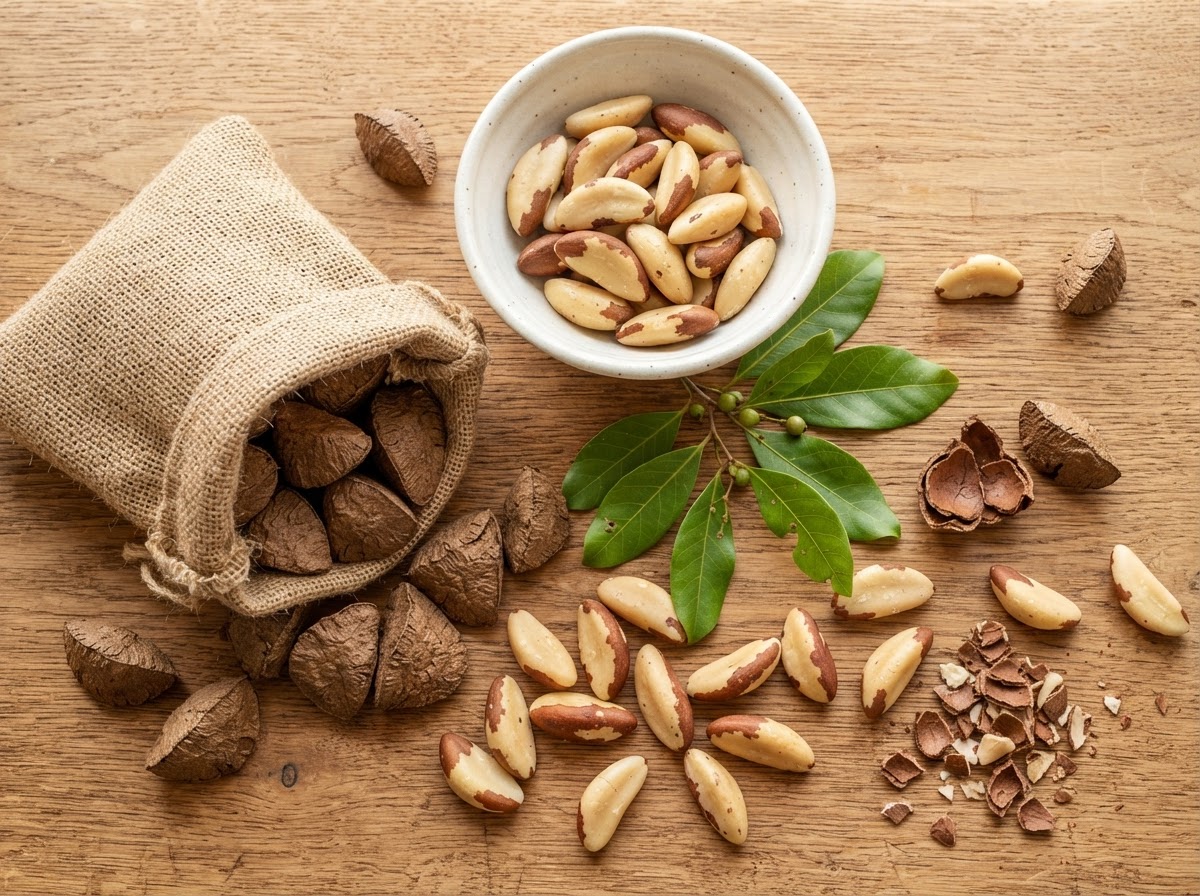
A single Brazil nut carries 68–91 mcg of selenium. The daily target for an adult is 55 mcg. So one nut, most days, is the whole job — and the ceiling above it is closer than the marketing suggests.
Below: what selenium actually does, how much you already get without trying, why Brazil nuts sit in a category of their own, where the upper limit falls, and which of the popular Brazil nut claims the federal sources will and will not back.
Key takeaways. The selenium RDA for adults is 55 mcg a day. The average American already takes in 108 mcg from food and drink alone, which is why NIH says selenium deficiency is “very rare in the United States and Canada”. Brazil nuts average 544 mcg per ounce — 989% of the Daily Value — and the adult upper limit for all sources combined is 400 mcg. Selenium is genuinely essential; a supplement on top of a normal American diet is where the evidence stops supporting the idea.
What selenium actually does
Selenium is not a vitamin and it does not act on its own. It gets built into proteins. The NIH Office of Dietary Supplements describes it as “a constituent of 25 selenoproteins, including thioredoxin reductases, glutathione peroxidases, and selenoprotein P,” and says those selenoproteins “play critical roles in thyroid hormone metabolism, DNA synthesis, reproduction, and protection from oxidative damage and infection.”
That sentence is the honest version of every headline you have read about this mineral. Thyroid, fertility, antioxidant defense — the connections are real at the level of biochemistry. What does not follow from them is that more selenium produces more of any of those effects, and the section further down on what the trials found is where that distinction gets expensive.
How much you need, and how much you are probably already getting
| Group | RDA, selenium |
|---|---|
| Adults 19–50 | 55 mcg/day |
| Adults 51–70 | 55 mcg/day |
| Adults 71+ | 55 mcg/day |
| Pregnancy | 60 mcg/day |
| Lactation | 70 mcg/day |
| Upper limit, adults | 400 mcg/day, all sources combined |
Now the number that reframes the whole topic. the Office of Dietary Supplements reports that “the average daily selenium intake in people age 2 years and older from foods and beverages is 108 mcg,” rising to 116 mcg once supplements are counted. Adult men average 132 mcg from food and drink, adult women 94 mcg.
The typical American is therefore running at roughly twice the requirement before anyone opens a jar of nuts. Deficiency does exist — NIH links it to Keshan disease, “an endemic cardiomyopathy that was first identified in 1935 in parts of China where the soil is low in selenium,” and to Kashin-Beck disease, “a type of osteoarthritis… in certain low-selenium and low-iodine areas.” Both are geographic, tied to soil, and not a North American problem.
Why Brazil nuts are in a category of their own
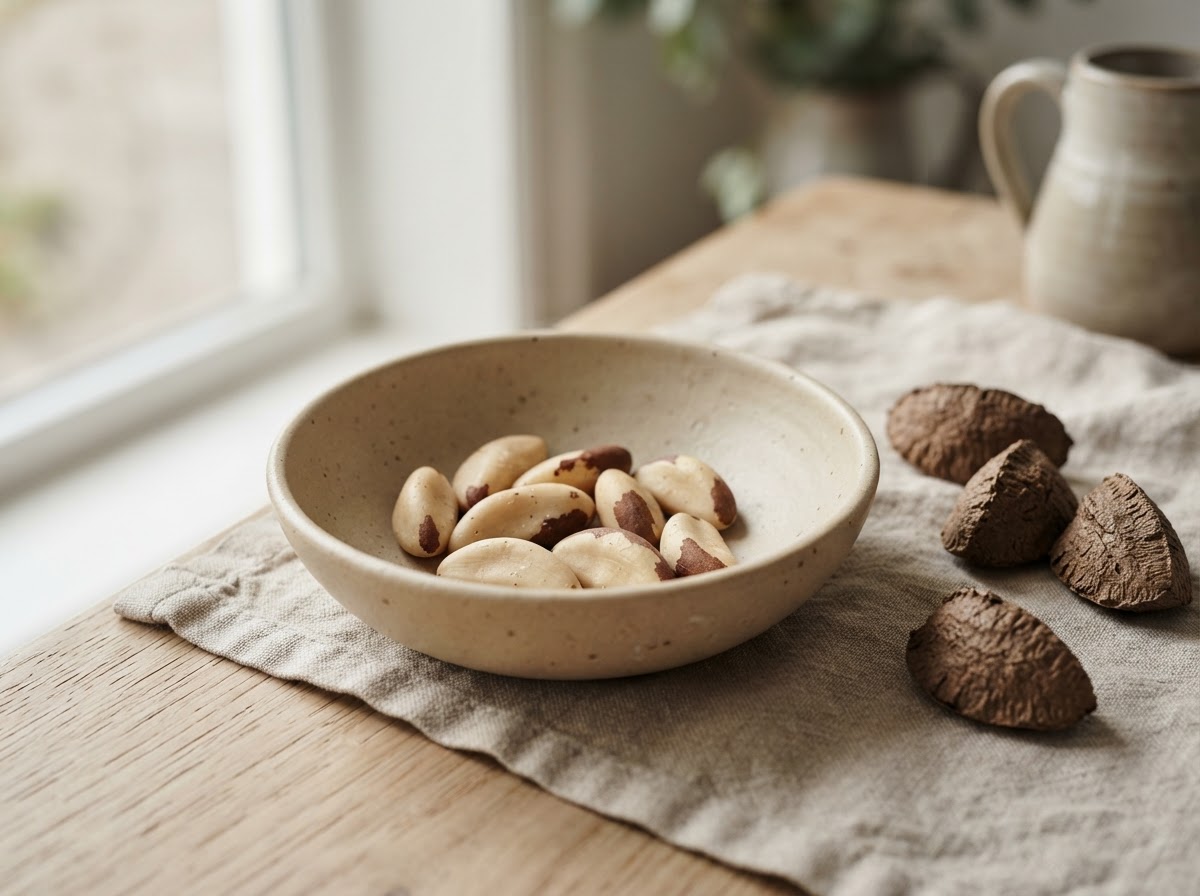
Every other food on the selenium list is measured in tens of micrograms. Brazil nuts are measured in hundreds. NIH’s food table puts one ounce — six to eight kernels — at 544 mcg, or 989% of the Daily Value. Nothing else in the table comes within a factor of five.
Two qualifications matter before you build a habit on that figure.
The first is that it is an average, and the Office of Dietary Supplements says so plainly: Brazil nuts “have an average of 544 mcg selenium/ounce, but values from other analyses vary widely.” The reason is agricultural — “the selenium concentrations of plant-based foods vary by geographic location because the amount and form of selenium in the soil and other factors can influence the selenium content of these foods.” Two bags from two regions are not the same product, and nothing on the label tells you which one you bought.
The second is the per-nut figure. NIH’s consumer sheet states that Brazil nuts “contain very high amounts of selenium (68–91 mcg per nut) and can cause you to go over the upper limit if you eat too many.”
The arithmetic NIH does not do for you
No federal source states a safe number of Brazil nuts per day. That is a real gap, not an oversight on our part, and anyone quoting you an exact number is quoting themselves. What can be done honestly is to put the published figures next to each other:
- One nut at 68–91 mcg already exceeds the 55 mcg daily requirement.
- The 400 mcg upper limit is reached somewhere between the fifth and the sixth nut — before you have eaten a full ounce.
- That ceiling covers all sources combined, so the 94–132 mcg an average adult already gets from ordinary food counts against it.
Read that as arithmetic, not as a recommendation. It is the reason the handful-as-a-snack habit is the one use of this food that deserves a second thought.
Where selenium comes from if you never touch a Brazil nut
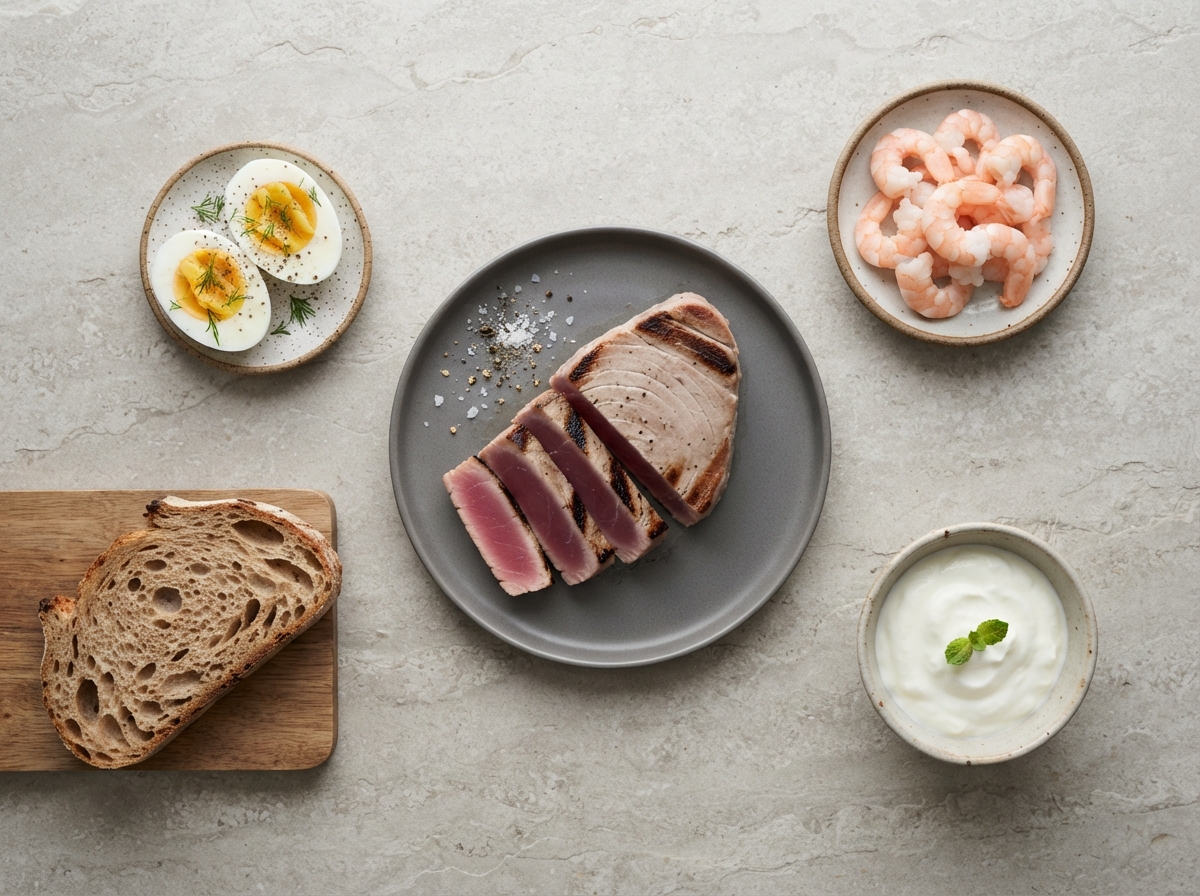
NIH’s summary is that “Brazil nuts, seafood, meat, poultry, and organ meats are the richest food sources of selenium.” Set the nuts aside and the rest of the list is unremarkable food, which is precisely why intakes are as high as they are. Figures below are NIH’s, per the serving shown.
| Food | Serving | Selenium | %DV |
|---|---|---|---|
| Brazil nuts | 1 oz (28 g), 6–8 nuts | 544 mcg | 989% |
| Tuna, yellowfin, cooked | 3 oz (85 g) | 92 mcg | 167% |
| Shrimp, cooked | 3 oz (85 g) | 42 mcg | 76% |
| Beef steak, bottom round, roasted | 3 oz (85 g) | 37 mcg | 67% |
| Cod, Pacific, cooked | 3 oz (85 g) | 24 mcg | 44% |
| Ham, roasted | 3 oz (85 g) | 24 mcg | 44% |
| Cottage cheese, 1% milkfat | 1 cup | 20 mcg | 36% |
| Egg, hard-boiled | 1 large | 15 mcg | 27% |
| Mushrooms, portabella, grilled | ½ cup | 13 mcg | 24% |
| Rice, brown, long-grain, cooked | 1 cup | 12 mcg | 22% |
| Bread, whole-wheat | 1 slice | 8 mcg | 15% |
| Yogurt, plain, low fat | 1 cup | 8 mcg | 15% |
| Lentils, boiled | 1 cup | 6 mcg | 11% |
| Spinach, frozen, boiled | ½ cup | 5 mcg | 9% |
| Pistachios, dry roasted | 1 oz (28 g) | 3 mcg | 5% |
A tuna sandwich on whole-wheat with a cup of yogurt clears the 55 mcg target twice over. That is the mechanism behind the 108 mcg average — not supplements, ordinary lunch. Worth noting that pistachios sit at 3 mcg an ounce: “nuts are high in selenium” is a statement about one nut, not about nuts.
What the trials found, in NIH’s own words
This is where the gap between the biochemistry and the marketing shows up, so the wording below is quoted rather than summarised.
| Claim you have seen | What NIH actually says |
|---|---|
| Selenium for thyroid health | “Although selenium is involved with normal thyroid function, more research is needed to understand the role of selenium supplements in thyroid disease, particularly by gender and selenium status.” |
| Selenium prevents cancer | “More research is needed to fully understand the relationship between selenium status and cancer risk and to determine whether selenium supplements can help prevent any form of cancer.” |
| Selenium for heart health | “Overall, clinical trial evidence does not support the use of selenium supplementation for reducing the risk of CVD, particularly in healthy people who obtain sufficient selenium from food.” |
| Selenium for memory and aging | “Selenium may play a role in maintaining healthy brain function, but clinical evidence does not support the use of selenium supplementation in replete individuals for reducing the risk of cognitive decline and dementia in older adults.” |
Two of those four are not hedges at all — they are negative findings. The FDA has issued letters of enforcement discretion covering qualified health claims titled “Selenium and a Reduced Risk of Site-specific Cancers” and “Selenium and Certain Cancers,” and the word doing the work there is qualified: a qualified claim is one the agency permits with caveats precisely because the evidence fell short of the standard for an authorised one.
Too much: what selenosis looks like
The upper limit exists because chronic excess has a defined clinical picture. the Office of Dietary Supplements describes selenosis as “most commonly characterized by hair loss and nail brittleness or loss,” with other signs including “a garlic odor in the breath, a metallic taste in the mouth, skin rash, nausea, diarrhea, fatigue, irritability, and nervous system abnormalities.” The consumer sheet adds discoloured teeth to the list, and notes that “extremely high intakes of selenium can cause severe problems, including difficulty breathing, tremors, kidney failure, heart attacks, and heart failure.”
Garlic breath and a metallic taste are the two worth knowing, because they arrive early and they are odd enough to be noticed. If you eat Brazil nuts daily and something tastes like coins, that is information.
One drug interaction is documented rather than theoretical: the Office of Dietary Supplements notes that cisplatin, a chemotherapy agent, “can reduce selenium levels in hair and serum.” Anyone in cancer treatment should be taking selenium questions to their oncology team rather than to a nut aisle. Supplements, if they are on the table at all, come as “selenomethionine, selenium-enriched yeast, sodium selenite, and sodium selenate” — and our guide to supplements and vitamins covers how to read those labels.
FAQ
How many Brazil nuts should I eat a day?
No authoritative source answers this with a number, which is itself the answer worth having. What is documented: one nut supplies 68–91 mcg against a 55 mcg requirement, and the adult ceiling for all sources combined is 400 mcg a day. NIH’s only direct guidance is that eating too many “can cause you to go over the upper limit.”
Are Brazil nuts good for your thyroid?
Selenium is required for thyroid hormone metabolism — that much is settled biochemistry. Whether extra selenium helps a thyroid condition is not: the Office of Dietary Supplements says “more research is needed to understand the role of selenium supplements in thyroid disease.” Requirement and treatment are different questions, and the second one has no answer yet.
Do I need to worry about selenium deficiency?
In the United States or Canada, almost certainly not. the Office of Dietary Supplements calls deficiency “very rare” in both countries, and average intake runs at roughly double the RDA. The documented deficiency diseases are tied to specific low-selenium soils in other parts of the world.
Do Brazil nuts boost testosterone?
Nothing on NIH, FDA or MedlinePlus supports it. Selenium is listed as important for reproduction, and severe deficiency is associated with male infertility — but that is a statement about a deficiency state, not about raising a hormone in someone who is already replete.
Should I take a selenium supplement instead?
That is a question for whoever knows your diet and your bloodwork. What the evidence says is that supplementing a person who already gets enough from food has not shown the benefits it is sold for — NIH’s cardiovascular and cognitive statements both specify “healthy people who obtain sufficient selenium from food” and “replete individuals” for exactly that reason.
What to do with this
If you like Brazil nuts, eat Brazil nuts — they are a good food and one a day is a reasonable habit. What the numbers argue against is the specific ritual of eating a handful daily for the selenium, because the target was met at nut one and the ceiling is five nuts away. And if you were considering a selenium supplement on top of an ordinary American diet, the intake figures are the part to sit with: you are most likely already at double the requirement.
Related: walnuts vs Brazil nuts and Brazil nuts vs macadamia nuts for the calorie and fat side of the comparison; nutrient bioavailability and food combinations for why the number on a label is not the number you absorb; and iron-rich foods for a mineral where the American picture runs the other way.
Educational content, not medical advice.
This content is for educational purposes only and is not medical advice. Always consult a qualified healthcare professional for personalised guidance.