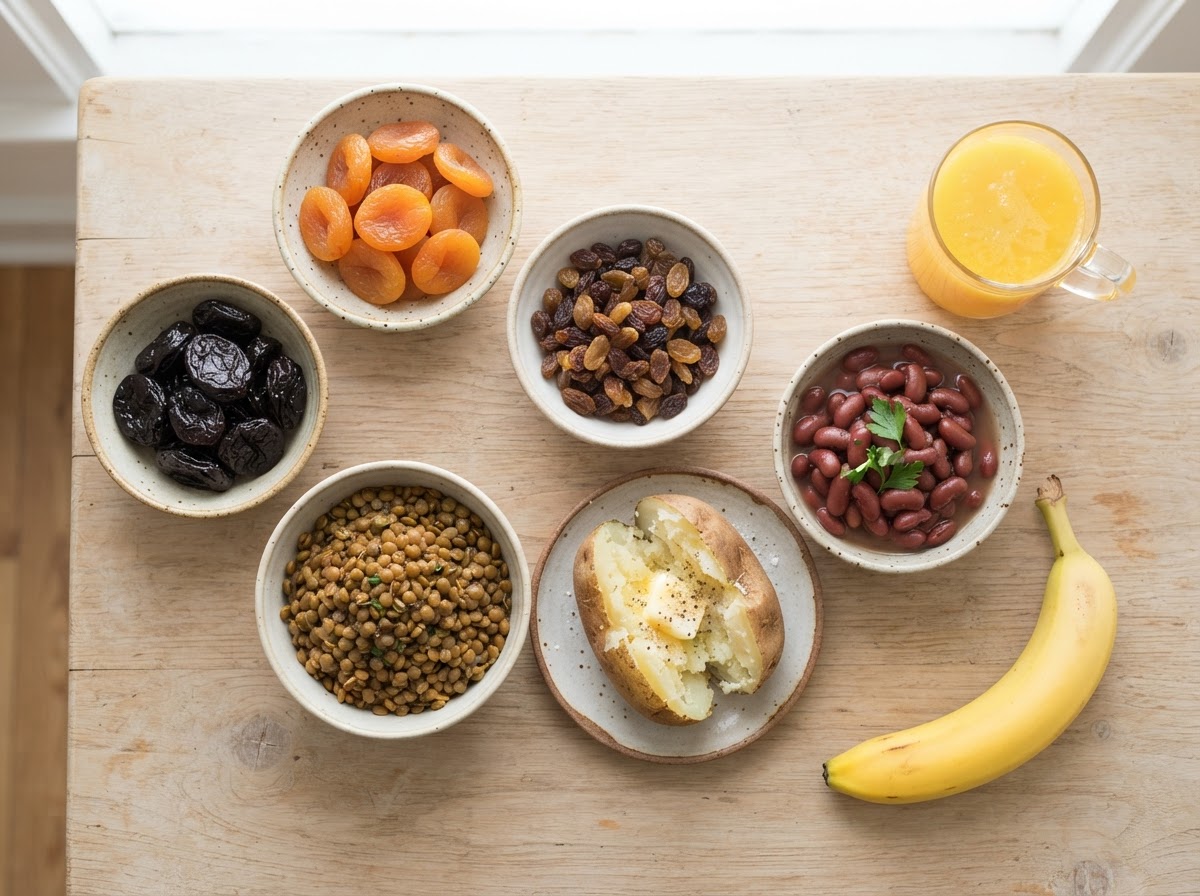
Search for foods high in potassium and you will be handed a banana. On the National Institutes of Health’s own list of selected potassium sources, the banana is tenth — behind dried apricots, cooked lentils, acorn squash, prunes, raisins, a baked potato and a can of kidney beans. And there is a stranger fact buried in the same table: not one of its 39 foods reaches the threshold that the federal agencies themselves use to call a food a “high” source of anything.
Below: the adult intake numbers as they were revised in 2019, the full the Office of Dietary Supplements table in descending order, why the banana ranks where it does, what the 20% rule really measures, what the sodium-potassium evidence does and does not promise, and the group of people for whom every recommendation on this page is reversed.
Key takeaways. The Adequate Intake for potassium is 3,400 mg a day for men 19 and over and 2,600 mg for women. The Daily Value printed on food labels is a different, higher number — 4,700 mg — so a food’s %DV understates how much of your actual target it covers. Dried apricots (755 mg per half cup) and cooked lentils (731 mg per cup) top the Office of Dietary Supplements list; a medium banana sits tenth at 422 mg. No upper limit has been set for potassium from food, and in people with normal kidney function a high dietary intake is not considered a risk — but for people with chronic kidney disease or on certain blood pressure medicines, the advice is the opposite.
How much potassium adults are supposed to get
A committee at the National Academies of Sciences, Engineering, and Medicine revised the potassium reference intakes in 2019. There is no RDA for potassium — the evidence was judged insufficient to set one — so what exists is an Adequate Intake, a level assumed to be enough. The NIH Office of Dietary Supplements publishes the full table; the adult rows are these.
| Age | Male | Female | Pregnancy | Lactation |
|---|---|---|---|---|
| 1–3 years | 2,000 mg | 2,000 mg | — | — |
| 4–8 years | 2,300 mg | 2,300 mg | — | — |
| 9–13 years | 2,500 mg | 2,300 mg | — | — |
| 14–18 years | 3,000 mg | 2,300 mg | 2,600 mg | 2,500 mg |
| 19–50 years | 3,400 mg | 2,600 mg | 2,900 mg | 2,800 mg |
| 51+ years | 3,400 mg | 2,600 mg | — | — |
The same committee declined to set a Tolerable Upper Intake Level. ODS explains why: case reports of heart abnormalities from very high supplement doses exist, but the committee found no evidence that high potassium intakes cause hyperkalemia in adults with normal kidney function, and so set no UL. In its words, “in healthy people with normal kidney function, high dietary potassium intakes do not pose a health risk because the kidneys eliminate excess amounts in the urine.”
One caveat travels with those numbers and is easy to miss: ODS states plainly that the Adequate Intakes do not apply to people whose potassium excretion is impaired by kidney disease or by medication. That exception is not a footnote for a small group, and it is dealt with properly further down.
The Office of Dietary Supplements list of potassium foods, in order
This is Table 2 from the ODS potassium fact sheet, reproduced in full and in descending order. The %DV column is calculated against the FDA Daily Value of 4,700 mg, not against the Adequate Intake — a distinction that turns out to matter.
| Food | Serving | Potassium | %DV |
|---|---|---|---|
| Apricots, dried | ½ cup | 755 mg | 16 |
| Lentils, cooked | 1 cup | 731 mg | 16 |
| Squash, acorn, mashed | 1 cup | 644 mg | 14 |
| Prunes, dried | ½ cup | 635 mg | 14 |
| Raisins | ½ cup | 618 mg | 13 |
| Potato, baked, flesh only | 1 medium | 610 mg | 13 |
| Kidney beans, canned | 1 cup | 607 mg | 13 |
| Orange juice | 1 cup | 496 mg | 11 |
| Soybeans, mature seeds, boiled | ½ cup | 443 mg | 9 |
| Banana | 1 medium | 422 mg | 9 |
| Milk, 1% | 1 cup | 366 mg | 8 |
| Spinach, raw | 2 cups | 334 mg | 7 |
| Chicken breast, boneless, grilled | 3 oz (85 g) | 332 mg | 7 |
| Yogurt, fruit variety, nonfat | 6 oz (170 g) | 330 mg | 7 |
| Salmon, Atlantic, farmed, cooked | 3 oz (85 g) | 326 mg | 7 |
| Beef, top sirloin, grilled | 3 oz (85 g) | 315 mg | 7 |
| Molasses | 1 tbsp | 308 mg | 7 |
| Tomato, raw | 1 medium | 292 mg | 6 |
| Soymilk | 1 cup | 287 mg | 6 |
| Yogurt, Greek, plain, nonfat | 6 oz (170 g) | 240 mg | 5 |
| Broccoli, cooked, chopped | ½ cup | 229 mg | 5 |
| Cantaloupe, cubed | ½ cup | 214 mg | 5 |
| Turkey breast, roasted | 3 oz (85 g) | 212 mg | 5 |
| Asparagus, cooked | ½ cup | 202 mg | 4 |
| Apple, with skin | 1 medium | 195 mg | 4 |
| Cashew nuts | 1 oz (28 g) | 187 mg | 4 |
| Rice, brown, medium grain, cooked | 1 cup | 154 mg | 3 |
| Tuna, light, canned in water, drained | 3 oz (85 g) | 153 mg | 3 |
| Coffee, brewed | 1 cup | 116 mg | 2 |
| Lettuce, iceberg, shredded | 1 cup | 102 mg | 2 |
| Peanut butter | 1 tbsp | 90 mg | 2 |
| Tea, black, brewed | 1 cup | 88 mg | 2 |
| Flaxseed, whole | 1 tbsp | 84 mg | 2 |
| Bread, whole wheat | 1 slice | 81 mg | 2 |
| Egg | 1 large | 69 mg | 1 |
| Rice, white, medium grain, cooked | 1 cup | 54 mg | 1 |
| Bread, white | 1 slice | 37 mg | 1 |
| Cheese, mozzarella, part skim | 1½ oz (43 g) | 36 mg | 1 |
| Oil (olive, corn, canola or soybean) | 1 tbsp | 0 mg | 0 |
Food names above link to our own cards where we hold a card for that food; the potassium figures themselves are the NIH values, not ours. Our food cards carry calories and macronutrients, not minerals, so nothing in the table has been recalculated.
Why the banana is tenth
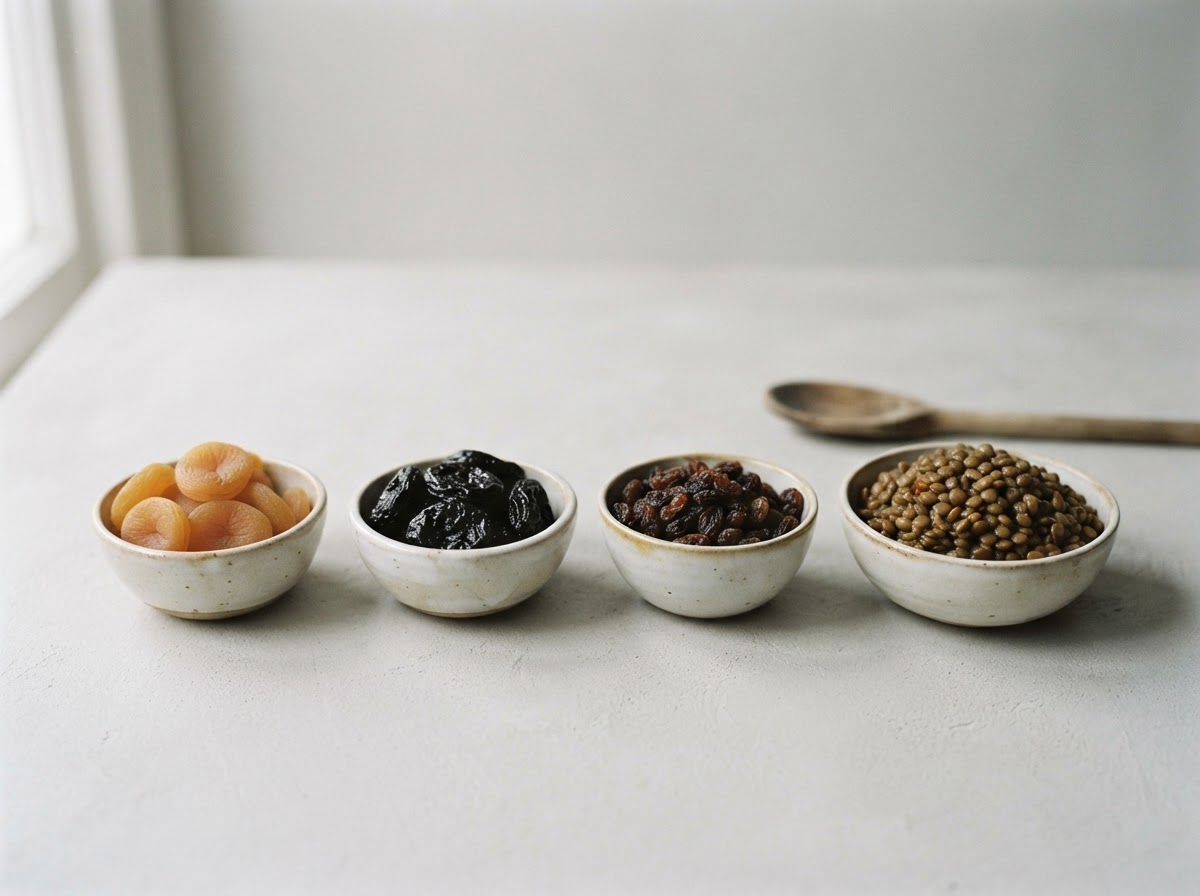
Nothing is wrong with the banana. A medium one carries 422 mg, which is real — roughly 12% of a man’s 3,400 mg Adequate Intake and 16% of a woman’s 2,600 mg. It is tenth because the foods above it are either dehydrated or dense.
Drying is the whole story for three of the top five. Half a cup of dried apricots is a great many apricots with the water removed; the same is true of prunes and raisins. Legumes and starchy vegetables do it differently — a cup of cooked lentils, a cup of mashed acorn squash or a medium baked potato is simply a larger, denser portion than one banana.
The practical reading is that the banana’s reputation comes from convenience rather than concentration. It is portable, it needs no preparation, and it is the only item near the top of this list that people eat without deciding to.
The 20% rule, and the awkward fact about this list
The FDA sets the Daily Value for potassium at 4,700 mg for adults and children 4 and over, and uses a rule of thumb on the Nutrition Facts label: 5% DV or less per serving is low, 20% DV or more is high. ODS repeats the threshold in the footnote to the very table above — foods providing 20% or more of the DV are high sources, but lower percentages also contribute to a healthful diet.
Run that against the table and the result is uncomfortable for the phrase “foods high in potassium”: the highest entries, dried apricots and lentils, reach 16%. Nothing on the Office of Dietary Supplements’ own list of selected potassium sources is technically a high source by the FDA’s own definition.
That is less damning than it sounds, and the reason is the gap between the two reference numbers. The 4,700 mg Daily Value is a labeling figure; the 3,400 and 2,600 mg Adequate Intakes are what the 2019 committee concluded adults need. Measured against a woman’s Adequate Intake, half a cup of dried apricots is not 16% of the day — it is 29%. Against a man’s, 22%. The same food, the same milligrams, a different denominator.
There is a second threshold worth knowing because it is the one with legal force. For a food to carry the FDA’s potassium health claim on its label, it must supply at least 350 mg of potassium per reference amount customarily consumed, along with 140 mg or less of sodium, 3 g or less of total fat, 1 g or less of saturated fat, no more than 15% of calories from saturated fat, and 20 mg or less of cholesterol. Several foods in the table clear 350 mg in the serving ODS lists — though a reference amount and the serving in that table are not always the same portion, so the two cannot be read off against each other directly.
Potassium, sodium and blood pressure: what is actually claimed
This is where most potassium articles overreach, so it is worth being exact about what the federal wording says. The FDA’s authorised health claim for potassium-containing foods reads: “Diets containing foods that are good sources of potassium and low in sodium may reduce the risk of high blood pressure and stroke.” The claim is a notified one, which means that when a manufacturer uses it, it must appear exactly in that form — the “may” is not a hedge someone added.
ODS puts the mechanism more directly, and keeps the same hedge: low potassium intakes increase the risk of hypertension, especially when combined with high sodium intakes, while higher potassium intakes may help decrease blood pressure, partly by increasing vasodilation and urinary sodium excretion.
The numbers attached to that come from eating patterns and from trials, not from single foods. The DASH eating pattern lowers systolic blood pressure by an average of 5.5 mmHg and diastolic by 3.0 mmHg, and it supplies three times more potassium than the average American diet. In an AHRQ review of 13 randomised trials that mostly enrolled people with hypertension, replacing sodium chloride with potassium-containing salt substitutes reduced systolic pressure by a mean of 5.58 mmHg and diastolic by 2.88 mmHg; a NASEM analysis of 16 trials of potassium supplements found 6.87 and 3.57 mmHg. Those are averages across trial populations, most of whom already had raised blood pressure, and the salt substitute studies changed two things at once — the potassium went up and the sodium went down. None of it is a promise about what a bowl of lentils does to one person’s reading. If the sodium half of that pairing is the part you want, we cover it separately in sodium, potassium and blood pressure.
Are Americans actually short of potassium?
On the averages, yes, though modestly. ODS reports that in adults 20 and over, average daily potassium intake from foods is 3,016 mg for men and 2,320 mg for women — about 384 mg and 280 mg below the respective Adequate Intakes. That is roughly one baked potato, or one cup of lentils, or one banana plus a tomato.
Both the shortfall and its official status come with an edition to attach. ODS grounds the concern in the 2015–2020 Dietary Guidelines for Americans, which identified potassium as a nutrient of public health concern. The 2020–2025 edition’s online materials use a slightly different phrase, listing calcium, potassium, dietary fiber and vitamin D as “dietary components of public health concern for the general U.S. population,” and attributing the shortfall to low intakes of nutrient-dense foods across food groups. Different editions, different wording, same direction.
And one more edition change, because it is recent. The Dietary Guidelines for Americans, 2025–2030, published in January 2026, drop the language altogether: they do not name potassium, and the phrase “dietary components of public health concern” does not appear in them. The shortfall itself has not been revised — the Adequate Intakes and the average intakes above are ODS’s and they stand. What changed is that the guidelines no longer put potassium on a list of concerns.
What no federal source we could find states is a percentage of the population falling below the Adequate Intake, so we are not going to invent one. Averages are what exist.
The people for whom this article is backwards
Everything above assumes kidneys that excrete potassium normally. When they do not, the same mineral becomes a hazard, and the guidance inverts.
ODS is explicit that in people with impaired urinary potassium excretion — from chronic kidney disease, or from medicines such as ACE inhibitors and potassium-sparing diuretics — even dietary potassium intakes below the Adequate Intake can cause hyperkalemia. The NIDDK puts the same point in patient terms: chronic kidney disease can make it harder for the kidneys to remove potassium from the blood, and blood levels can become very high. Hyperkalemia can be asymptomatic; NIDDK’s patient handout notes that people often do not feel any different when their potassium is high, which is the reason it is a blood test rather than a symptom.
Two specific traps follow. The first is salt substitutes, which usually replace sodium chloride with potassium chloride and whose potassium content ranges from about 440 mg to 2,800 mg per teaspoon; NIDDK’s advice to people with CKD is to use herbs and spices instead and to watch for potassium chloride on ingredient lists. The second is supplements, which in the other direction are mostly beside the point: potassium-only products typically cap out at 99 mg, about 2% of the Daily Value, and NHLBI’s DASH guidance says outright to get potassium from food sources rather than supplements.
If you have kidney disease, or take an ACE inhibitor, an ARB or a potassium-sparing diuretic, the list in this article is a list to discuss with the clinician managing that, not one to work through.
FAQ
Is one banana enough potassium for the day?
No, and nothing on the list is. A medium banana’s 422 mg is about 12% of a man’s 3,400 mg Adequate Intake and 16% of a woman’s 2,600 mg. Potassium is a mineral you accumulate across the day from several ordinary foods, not one you solve with a single item.
Does cooking destroy the potassium in vegetables?
We could not find a general-population statement from any US federal health source that ordinary cooking meaningfully lowers the potassium you get from food. The one place leaching appears in federal material is clinical guidance for chronic kidney disease, where soaking and double-boiling vegetables is a deliberate technique for reducing potassium in a renal diet. That is the opposite problem from the one this article addresses, and it should not be repurposed as a general cooking tip.
Can you get too much potassium from food?
No upper limit has been set. The 2019 committee found no evidence that high potassium intakes cause hyperkalemia in adults with normal kidney function, and ODS states that in healthy people the kidneys eliminate the excess in urine. High-dose supplements are a different matter — the FDA requires a warning about small-bowel lesions on some potassium salts containing more than 99 mg per tablet.
Why does the label say 4,700 mg when the target is 3,400?
Because they are two different kinds of number. The Daily Value is a single labeling reference the FDA sets for the whole population 4 and over so that one percentage can be printed on every package. The Adequate Intakes are the age- and sex-specific amounts the 2019 NASEM review concluded adults need. When you read a %DV for potassium, you are seeing progress toward 4,700 mg, which is more than either adult Adequate Intake.
What are the biggest potassium sources in the American diet?
Not the top of the table. ODS reports that milk, coffee, tea, other nonalcoholic beverages and potatoes are the top sources of potassium in the diets of US adults — a function of how much of them people drink, not how concentrated they are.
What to do with this
If you are aiming at the Adequate Intake rather than at the label percentage, the arithmetic is less intimidating than the %DV column suggests. The average shortfall is a few hundred milligrams, which one dense item covers: a cup of lentils, a baked potato eaten as a side rather than a garnish, half a cup of dried fruit, or a cup of kidney beans in something you were cooking anyway.
Spreading it matters more than chasing a single food, because every serving in that table is a single-digit or low-teens percentage of the day. And if the reason you are reading this is blood pressure, the sourced evidence is about patterns — the DASH pattern, and the sodium that sits on the other side of the ledger — rather than about any one item on the list.
Related: sodium, potassium and blood pressure, daily sodium intake guidelines and our iron-rich foods comparison.
Educational content, not medical advice. If you have kidney disease or take medication that affects potassium, discuss any dietary change with your clinician.
This content is for educational purposes only and is not medical advice. Always consult a qualified healthcare professional for personalised guidance.