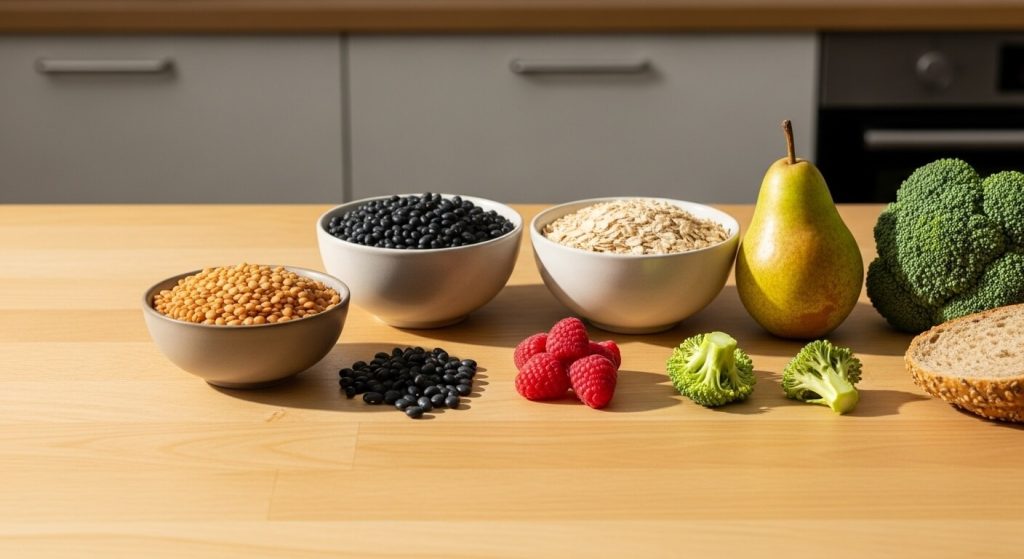
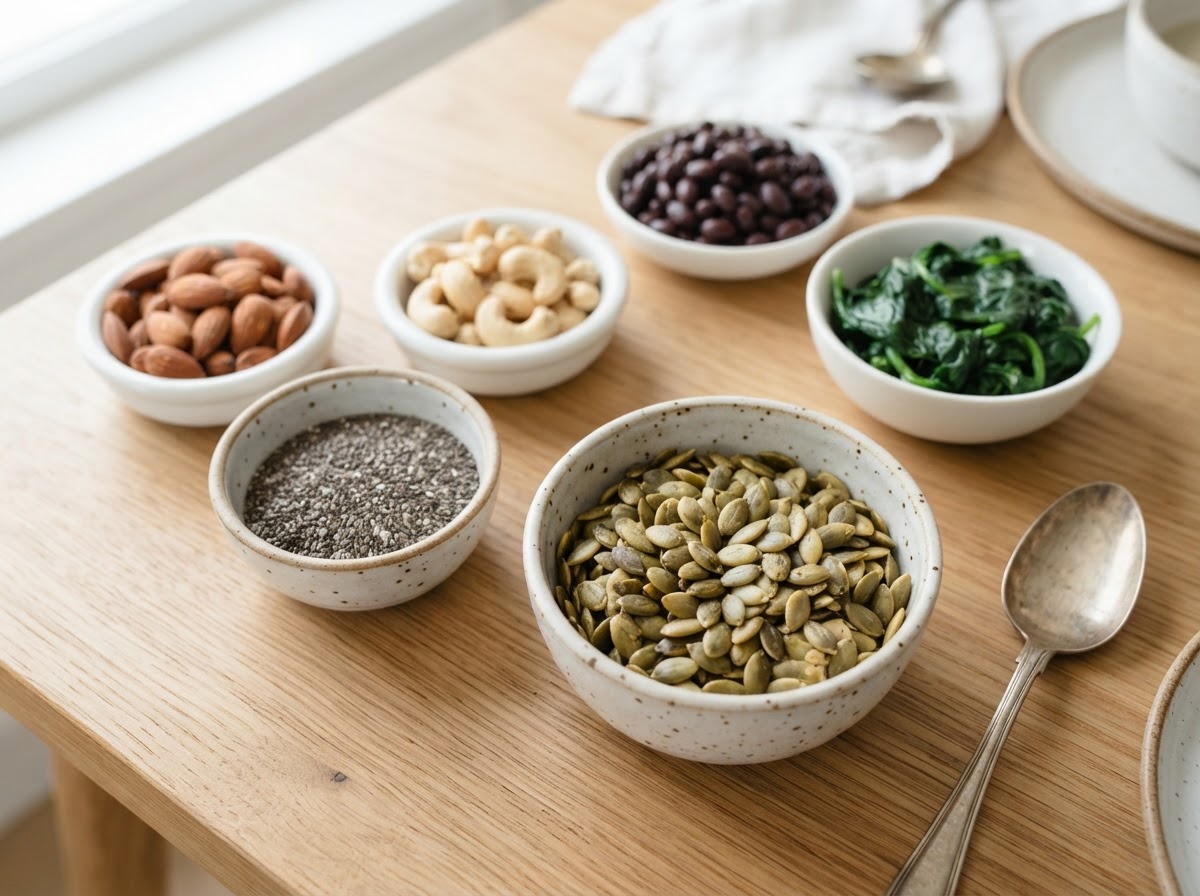
The government keeps a list of foods high in magnesium. It runs to thirty items, and by the government’s own labeling rule, exactly two of them are actually high in magnesium: pumpkin seeds and chia seeds. Spinach and almonds — the two foods every article on this subject leads with — land on 19% of the Daily Value, one percentage point below the threshold. And you cannot check any of this on a package, because magnesium is not a nutrient the FDA requires labels to carry.
Below: the full the Office of Dietary Supplements table in order, what the adult targets actually are, why the supplement ceiling sits below the recommended intake without contradicting it, whether the American shortfall is real, and the short list of things magnesium is genuinely backed for — which does not include the one thing it is mostly sold for.
Key takeaways. Adult men need 400 mg a day to age 30 and 420 mg after; women 310 mg and 320 mg. About 48% of Americans take in less than their estimated requirement, though ODS also says outright that symptomatic deficiency in otherwise healthy people is uncommon. Of thirty foods on the Office of Dietary Supplements list, only pumpkin seeds (37% DV) and chia seeds (26% DV) clear the FDA’s 20% “high source” bar. The upper limit of 350 mg applies to supplements and medication only, never to food. And the single thing a US federal source will endorse magnesium for is migraine prevention, at the formal grade “probably effective”.
How much magnesium adults actually need
Magnesium has a full RDA rather than the looser Adequate Intake used for some minerals, and the NIH Office of Dietary Supplements publishes the table.
| Age | Male | Female | Pregnancy | Lactation |
|---|---|---|---|---|
| 1–3 years | 80 mg | 80 mg | — | — |
| 4–8 years | 130 mg | 130 mg | — | — |
| 9–13 years | 240 mg | 240 mg | — | — |
| 14–18 years | 410 mg | 360 mg | 400 mg | 360 mg |
| 19–30 years | 400 mg | 310 mg | 350 mg | 310 mg |
| 31–50 years | 420 mg | 320 mg | 360 mg | 320 mg |
| 51+ years | 420 mg | 320 mg | — | — |
Two quirks are worth noticing. The requirement rises with age in adults rather than falling, which is unusual. And pregnancy raises it while lactation does not — the lactation figures are identical to the non-pregnant ones in every age band.
There is an upper limit too, and this is where most coverage goes wrong. ODS sets it at 350 mg for everyone from age nine up — a number lower than the RDA for adult men. That looks like nonsense until you read the sentence attached to it: “The ULs only include magnesium from dietary supplements and medications; they do not include magnesium found naturally in food and beverages.” The two numbers measure different things. Eat 500 mg of magnesium from food and nothing is wrong; swallow 500 mg of it as a pill and you are above the ceiling.
The Office of Dietary Supplements list of magnesium foods, in order
This is Table 2 from the ODS magnesium fact sheet in full, in descending order. The %DV column runs against the FDA Daily Value of 420 mg.
| Food | Serving | Magnesium | %DV |
|---|---|---|---|
| Pumpkin seeds, roasted | 1 oz (28 g) | 156 mg | 37 |
| Chia seeds | 1 oz (28 g) | 111 mg | 26 |
| Almonds, dry roasted | 1 oz (28 g) | 80 mg | 19 |
| Spinach, boiled | ½ cup | 78 mg | 19 |
| Cashews, dry roasted | 1 oz (28 g) | 74 mg | 18 |
| Peanuts, oil roasted | ¼ cup | 63 mg | 15 |
| Cereal, shredded wheat | 2 large biscuits | 61 mg | 15 |
| Soymilk, plain or vanilla | 1 cup | 61 mg | 15 |
| Black beans, cooked | ½ cup | 60 mg | 14 |
| Edamame, shelled, cooked | ½ cup | 50 mg | 12 |
| Peanut butter, smooth | 2 tbsp | 49 mg | 12 |
| Potato, baked with skin | 3.5 oz (99 g) | 43 mg | 10 |
| Rice, brown, cooked | ½ cup | 42 mg | 10 |
| Yogurt, plain, low fat | 8 oz (227 g) | 42 mg | 10 |
| Breakfast cereals fortified with 10% of the DV | 1 serving | 42 mg | 10 |
| Oatmeal, instant | 1 packet | 36 mg | 9 |
| Kidney beans, canned | ½ cup | 35 mg | 8 |
| Banana | 1 medium | 32 mg | 8 |
| Milk | 1 cup | 27 mg | 6 |
| Salmon, Atlantic, farmed, cooked | 3 oz (85 g) | 26 mg | 6 |
| Halibut, cooked | 3 oz (85 g) | 24 mg | 6 |
| Raisins | ½ cup | 23 mg | 5 |
| Bread, whole wheat | 1 slice | 23 mg | 5 |
| Avocado, cubed | ½ cup | 22 mg | 5 |
| Chicken breast, roasted | 3 oz (85 g) | 22 mg | 5 |
| Beef, ground, 90% lean, pan broiled | 3 oz (85 g) | 20 mg | 5 |
| Broccoli, chopped and cooked | ½ cup | 12 mg | 3 |
| Rice, white, cooked | ½ cup | 10 mg | 2 |
| Apple | 1 medium | 9 mg | 2 |
| Carrot, raw | 1 medium | 7 mg | 2 |
One absence is conspicuous. Dark chocolate, the food that opens almost every competing list, is not in the Office of Dietary Supplements table at all — so we have no official figure for it and are not going to invent one. Food names above link to our own cards where we hold one; the magnesium values are the NIH’s, since our cards carry macronutrients rather than minerals.
Only two foods clear the bar — and the label will not tell you
The FDA uses a simple rule on the Nutrition Facts panel: 5% DV or less of a nutrient per serving is low, 20% DV or more is high. ODS repeats the same threshold in the footnote to the table above, adding that foods providing lower percentages also contribute to a healthful diet.
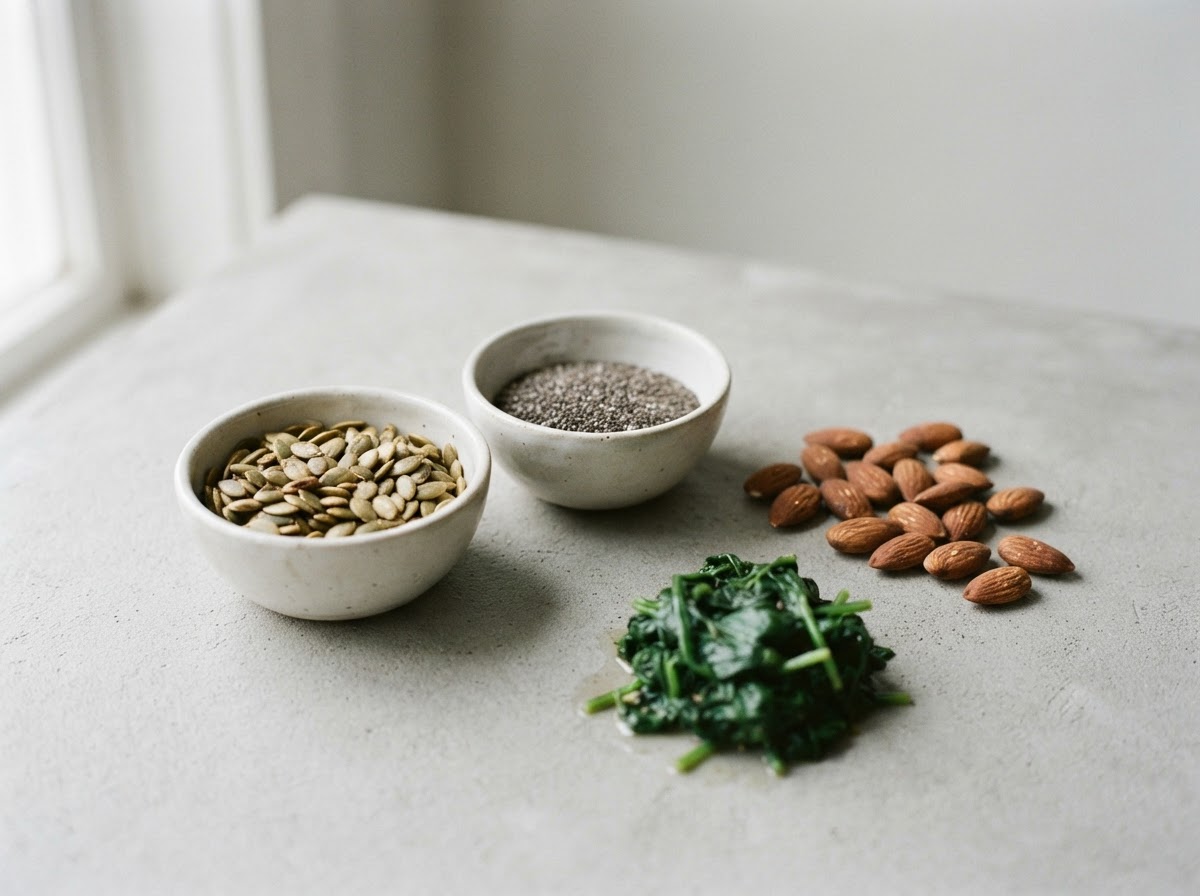
Apply it. Pumpkin seeds at 37% and chia seeds at 26% are high sources of magnesium. Nothing else on the list is. Almonds and boiled spinach sit on 19%, cashews on 18%, and twenty-two of the thirty entries are at or below 10%. That is not an argument against spinach; it is an argument against the idea that any single food solves magnesium.
The second half of the problem is stranger. The same ODS footnote states that the FDA does not require food labels to list magnesium content unless magnesium has been added to the food. Potassium is mandatory on the panel; magnesium is voluntary. So magnesium is a nutrient readers are told to get more of and generally cannot see on the package — which is the practical reason a table like the one above is worth having.
Is the shortfall real?
Yes, and unusually for this subject there is a number. ODS reports that an analysis of NHANES data from 2013–2016 found 48% of Americans of all ages take in less magnesium from food and beverages than their respective Estimated Average Requirements, with men aged 71 and over and adolescents of both sexes most likely to fall short.
Now the sentence that almost never travels with that statistic, from the same fact sheet: symptomatic magnesium deficiency due to low dietary intake in otherwise healthy people is uncommon, because the kidneys limit how much is excreted in urine. Both statements are true and both are ODS’s. Half the country is below a laboratory benchmark; frank deficiency with symptoms is still unusual. What actually produces deficiency, ODS says, is habitually low intake combined with something else — certain health conditions, chronic alcoholism, or particular medications.
There is one more honesty note here. Intake data exist; status data do not. ODS states plainly that no current data on magnesium status in the United States are available, and that the standard blood test has little correlation with total body magnesium anyway. So “get tested for magnesium” is weaker advice than it sounds.
It is not the soil. It is the mill.
The most repeated explanation for modern magnesium shortfall is soil depletion — that crops carry less magnesium than they used to because farmland is exhausted. We could not find the word “soil” anywhere on the ODS magnesium fact sheet, on MedlinePlus, or in either relevant StatPearls chapter.
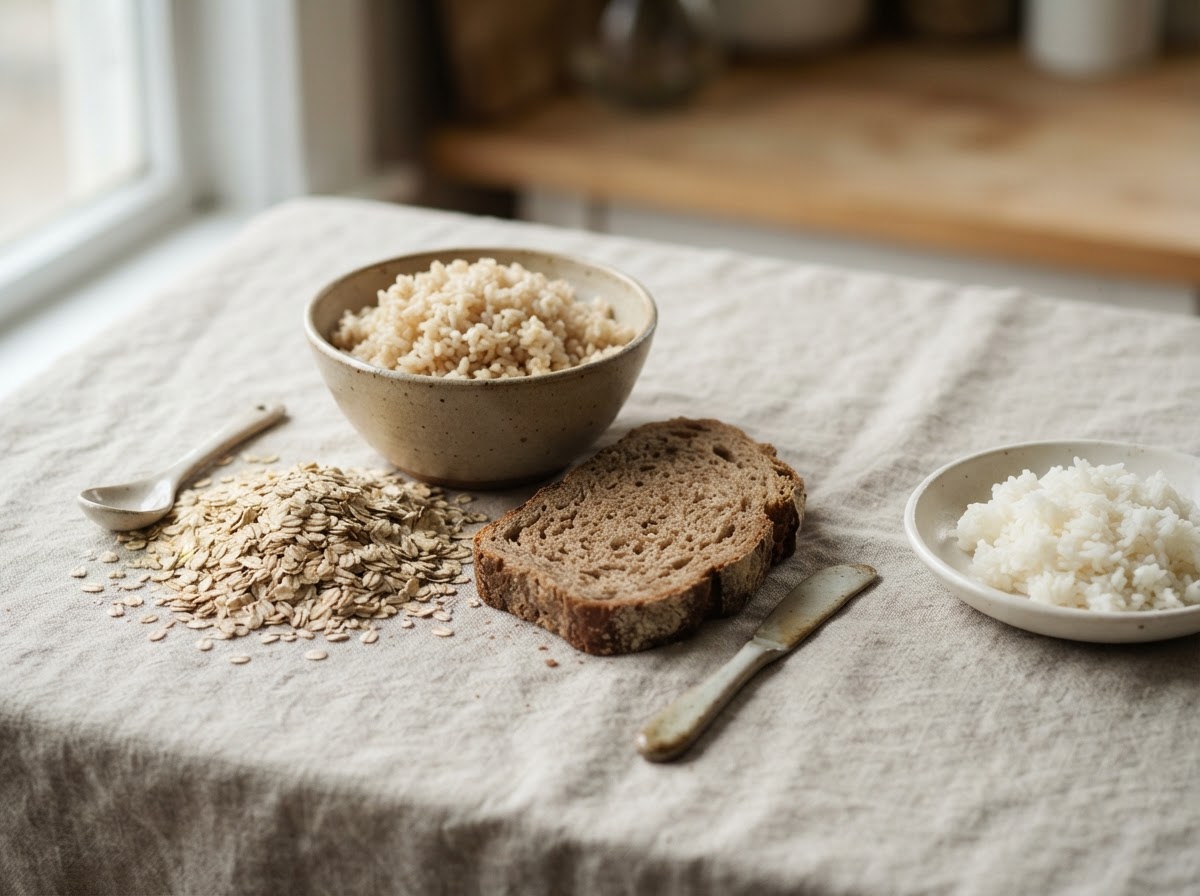
What ODS does name is processing: some types of food processing, such as refining grains in ways that remove the nutrient-rich germ and bran, substantially lower the magnesium content. The magnesium is in the parts of the grain that milling takes out. You can see it in the table — brown rice 42 mg per half cup against white rice at 10 mg, a fourfold gap between two versions of the same grain.
That version of the story is better than the soil version in every way that matters: it is sourced, it explains the numbers in front of you, and it hands you something to do about it.
A related myth runs the other way. The claim that fiber and phytates block magnesium absorption has no support on any federal page we checked — “phytate” does not appear on the ODS magnesium fact sheet at all. ODS leans the opposite way: in general, it says, foods that contain dietary fiber provide magnesium. Fibrous food is where magnesium lives, not what steals it. About 30% to 40% of dietary magnesium is typically absorbed, and the main things that change that are age and disease, not the bean you ate it with. We cover the interactions that are documented separately.
What magnesium is actually backed for
ODS’s health section covers four areas, and the honest summary is that three of them are hedged into near-silence and one is not.
Blood pressure. There is an FDA qualified health claim, issued in January 2022. “Qualified” is the operative word: it is not an approved claim but a letter saying the agency does not intend to object, and every permitted wording carries its own disclaimer. One of the three reads: “Consuming diets with adequate magnesium may reduce the risk of high blood pressure (hypertension). However, the FDA has concluded that the evidence is inconsistent and inconclusive.” There is no cleaner version available — the FDA did not authorise one. ODS, looking at the same evidence, says magnesium supplementation only marginally lowers blood pressure. Note the split: FDA’s claim is about diets and risk; ODS’s verdict is about supplements and measured millimeters of mercury.
Type 2 diabetes. Diets with higher amounts of magnesium are associated with a significantly lower risk of diabetes — associated, which is observational language and not a claim that magnesium lowers risk. On treatment, ODS quotes the American Diabetes Association directly: there is insufficient evidence to support the routine use of magnesium to improve glycemic control.
Bone. The strongest sentence available carries three hedges at once: a small number of studies suggest that increasing magnesium intake from food or supplements might increase bone mineral density in postmenopausal women. We are not going to strip any of the three.
Migraine. Here the language changes. The American Academy of Neurology and the American Headache Society concluded that magnesium therapy is probably effective for migraine prevention. “Probably effective” is a formal evidence grade in the AAN’s classification, not a casual turn of phrase, and it is the most positive federally-published statement about magnesium supplementation that exists. Three of four small, short-term, placebo-controlled trials found modest reductions in migraine frequency at doses up to 600 mg a day — well above the 350 mg supplemental upper limit, under trial supervision, which is not a licence to self-dose there.
What no federal source says about magnesium
This section exists because the gap between what magnesium is sold for and what any US health agency has actually written about it is the widest we have encountered in this series. Each of the following was searched for across the ODS magnesium fact sheet, MedlinePlus, and the StatPearls chapters on magnesium and hypomagnesemia.
Sleep. Neither “sleep” nor “insomnia” appears on the ODS magnesium fact sheet. The health section covers hypertension, type 2 diabetes, bone and migraine; sleep is not among them, and no other federal page we checked raises it. This is the single most common reason magnesium is bought.
Leg cramps. The phrase does not appear either. Muscle cramps do appear — inside the list of what happens as magnesium deficiency worsens, alongside numbness, tingling, seizures and abnormal heart rhythms. That deficiency can cause cramps is not the same statement as magnesium relieving cramps in someone who is not deficient, and only the first is sourced.
Anxiety. Absent. The nearest word on the page is “depression”, and it appears in the list of signs of magnesium toxicity — too much, not too little.
Magnesium oil, sprays and Epsom baths. Nothing: not “transdermal”, not “topical”, not “Epsom”, not skin absorption, on any of the pages checked. The only route into the body that ODS describes is swallowing it.
An absence of official statements is not proof that something does not work. It is, though, a fair description of how much evidence a reader is actually being offered — and it is worth setting beside the one thing that is graded, which is migraine prevention.
If you are considering a supplement
ODS names oxide, citrate and chloride as common forms, and says small studies have found magnesium in the aspartate, citrate, lactate and chloride forms is absorbed more completely and is more bioavailable than magnesium oxide and magnesium sulfate. Keep “small studies have found” attached to that — it is the entire federal basis for advice the supplement aisle treats as settled. Glycinate, the form most heavily marketed today, is not named at all, so there is nothing sourced we can tell you about it.
The tidy “soluble good, oxide bad” framing also breaks on the next sentence. The forms most commonly reported to cause diarrhea, ODS says, are magnesium carbonate, chloride, gluconate and oxide — chloride appearing on both lists at once. Different endpoints, not a contradiction, but it does mean absorption and tolerance are separate questions.
High doses from supplements or medications often cause diarrhea with nausea and abdominal cramping. Side effects from high intake are otherwise uncommon except in people with significantly reduced kidney function — and again, that 350 mg ceiling applies to pills, not to plates.
Medications that pull magnesium down
Four interactions are documented on the ODS fact sheet, and one of them involves a drug class millions of people take without thinking about it.
Prescription proton pump inhibitors, such as esomeprazole magnesium and lansoprazole, can cause hypomagnesemia when taken for prolonged periods — ODS specifies typically more than a year. Chronic treatment with loop and thiazide diuretics can increase magnesium loss in urine and lead to depletion. In the other direction, magnesium-rich supplements or medications can decrease absorption of oral bisphosphonates used for osteoporosis, and magnesium forms insoluble complexes with tetracycline and quinolone antibiotics. Gastrointestinal disease matters too: the chronic diarrhea and fat malabsorption seen in Crohn’s disease and coeliac disease can lead to magnesium depletion over time, and deficits also occur with insulin resistance and type 2 diabetes.
FAQ
Which foods are highest in magnesium?
Pumpkin seeds, by a wide margin — 156 mg in a single ounce, 37% of the Daily Value. Chia seeds are second at 111 mg. After that the drop is steep: almonds and boiled spinach are at 80 and 78 mg, and everything below peanuts is under 15% DV per serving.
Why is the upper limit lower than the recommended amount?
Because they measure different sources. The 350 mg upper limit covers magnesium from supplements and medications only; ODS says explicitly that it does not include magnesium found naturally in food and beverages. The 420 mg RDA is a total dietary target. There is no ceiling on magnesium from food for people with normal kidney function.
Does magnesium help you sleep?
No US federal health source we checked makes that claim. The ODS magnesium fact sheet does not mention sleep or insomnia at all. That is not proof it does nothing; it does mean the claim is not coming from the agencies that review this evidence.
Has food really lost magnesium over time?
Not through soil, as far as any federal source says — the word does not appear. ODS names grain refining, which removes the germ and bran where the magnesium sits. The brown-versus-white rice gap in the table above is that effect in miniature.
Can I get too much magnesium from food?
Not in the ordinary sense. The upper limit does not apply to food, and MedlinePlus notes that side effects from high intake are uncommon except in people with significantly reduced kidney function. Supplements are the other matter — signs of magnesium toxicity, ODS says, usually develop only after serum concentrations exceed a threshold far beyond what eating produces.
What to do with this
The arithmetic is less forbidding than the %DV column suggests. An ounce of pumpkin seeds and a half cup of black beans is over 200 mg before anything else on the plate. Swapping white rice for brown quadruples that item. Seeds, legumes, nuts and whole grains is the whole answer, and it is the same answer the table gives when you read it top to bottom.
If the reason you are here is sleep or cramps, the sourced position is that those claims have no federal backing, while the one use that does — migraine prevention — is graded only “probably effective” and involves doses above the supplemental limit. That is worth knowing before spending anything.
Related: foods high in potassium, our iron-rich foods comparison and what genuinely changes nutrient absorption.
Educational content, not medical advice. If you take a proton pump inhibitor, a diuretic or medication affecting kidney function, discuss magnesium with your clinician rather than adjusting it alone.
This content is for educational purposes only and is not medical advice. Always consult a qualified healthcare professional for personalised guidance.