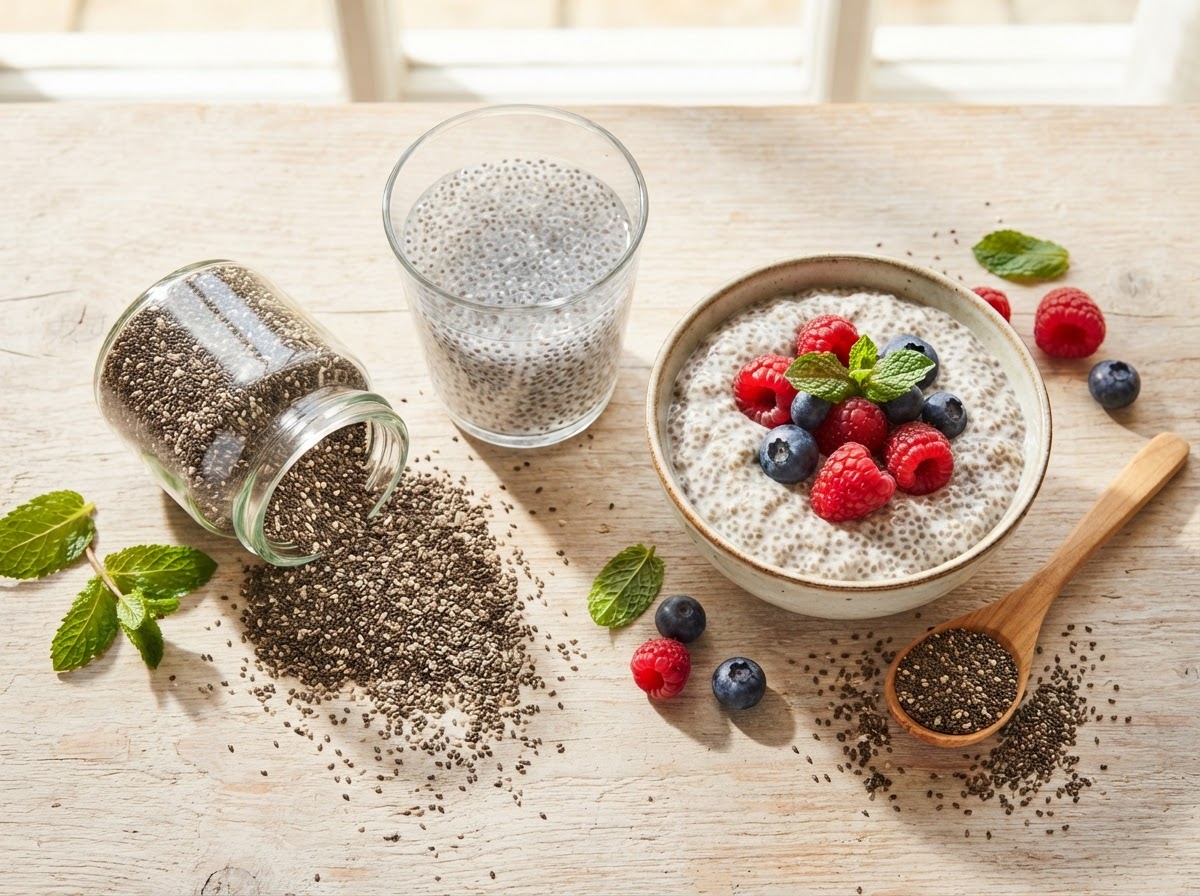
Chia is sold on two promises: fiber and omega-3. One of them holds up cleanly. The other is true in a narrow, technical sense that the packaging does not explain, and the gap between those two facts is most of what is worth knowing about this seed.
Below: what a tablespoon actually contains, why the fiber case is the strong one, what the Office of Dietary Supplements says happens to chia’s omega-3 once you swallow it, and the short list of things no federal source will claim on chia’s behalf.
Key takeaways. USDA’s fiber list puts chia at 4.1 g of fiber per tablespoon against a 28 g Daily Value, and fiber is one of four nutrients the Dietary Guidelines name as under-consumed in the US. Chia is genuinely dense in the omega-3 ALA — but NIH reports that ALA converts to EPA and DHA at rates “less than 15%”, so chia is not a swap for oily fish. No official source says chia causes weight loss, lowers cholesterol, or is a complete protein.
What is actually in it
USDA’s entry for dried chia seeds, per 100 g:
| Per 100 g | Amount |
|---|---|
| Energy | 486 kcal |
| Protein | 16.5 g |
| Total fat | 30.7 g |
| — of which ALA (omega-3) | 17.8 g |
| Carbohydrate, by difference | 42.1 g |
| Dietary fiber | 34.4 g |
| Calcium | 631 mg |
Two honest notes on that table. It is per 100 g, not per serving — a tablespoon is roughly a tenth of that, and we are not going to do the division for you, because USDA publishes standard portions separately and those are the numbers to quote. And this particular record sits in USDA’s SR Legacy dataset, which USDA itself flags: “SR Legacy, released in April 2018, is the final release of this data type and will not be updated.” The analytical work behind the calcium figure dates to 2003. It is the best official number available; it is not a fresh one.
Two labels we are deliberately not putting on that table. Chia is not a “complete protein” as far as any official source is concerned — USDA publishes the amino acid values but applies no such term, and stitching the two together would be our invention. And 631 mg of calcium per 100 g is real USDA data, but the Dietary Guidelines’ own list of calcium food sources does not include chia, so we are not going to call it a calcium food.
Note also what dominates the carbohydrate column. Of 42.1 g of carbohydrate, 34.4 g is fiber. That single ratio is the whole reason chia behaves the way it does in a glass of water.
The fiber case, which is the strong one
The Dietary Guidelines’ own food-sources-of-fiber list gives chia seeds 4.1 g of fiber per tablespoon. FDA sets the Daily Value for fiber at 28 g, so a tablespoon is a bit under a sixth of the day in one spoonful — and FDA’s own rule of thumb is that “20% DV or more of a nutrient per serving is considered high.”
Worth flagging a discrepancy rather than quietly picking the flattering number: MedlinePlus states that “just 1 tablespoon of chia seeds will give you 20% of your recommended daily fiber,” which is a higher share than 4.1 g against 28 g produces. Two federal pages, two different reference points. The USDA gram figure is the one to build on; the MedlinePlus percentage is the one you will see quoted elsewhere.
Either way the direction is the same, and it matters because fiber is not a nutrient Americans have in hand. The Dietary Guidelines Advisory Committee put it this way: “current underconsumption of vitamin D, calcium, dietary fiber, and potassium is of public health concern.” Chia is an unusually efficient way to close part of that gap, and unlike most fiber advice it does not require anyone to change what they eat — only to add a spoonful to it.
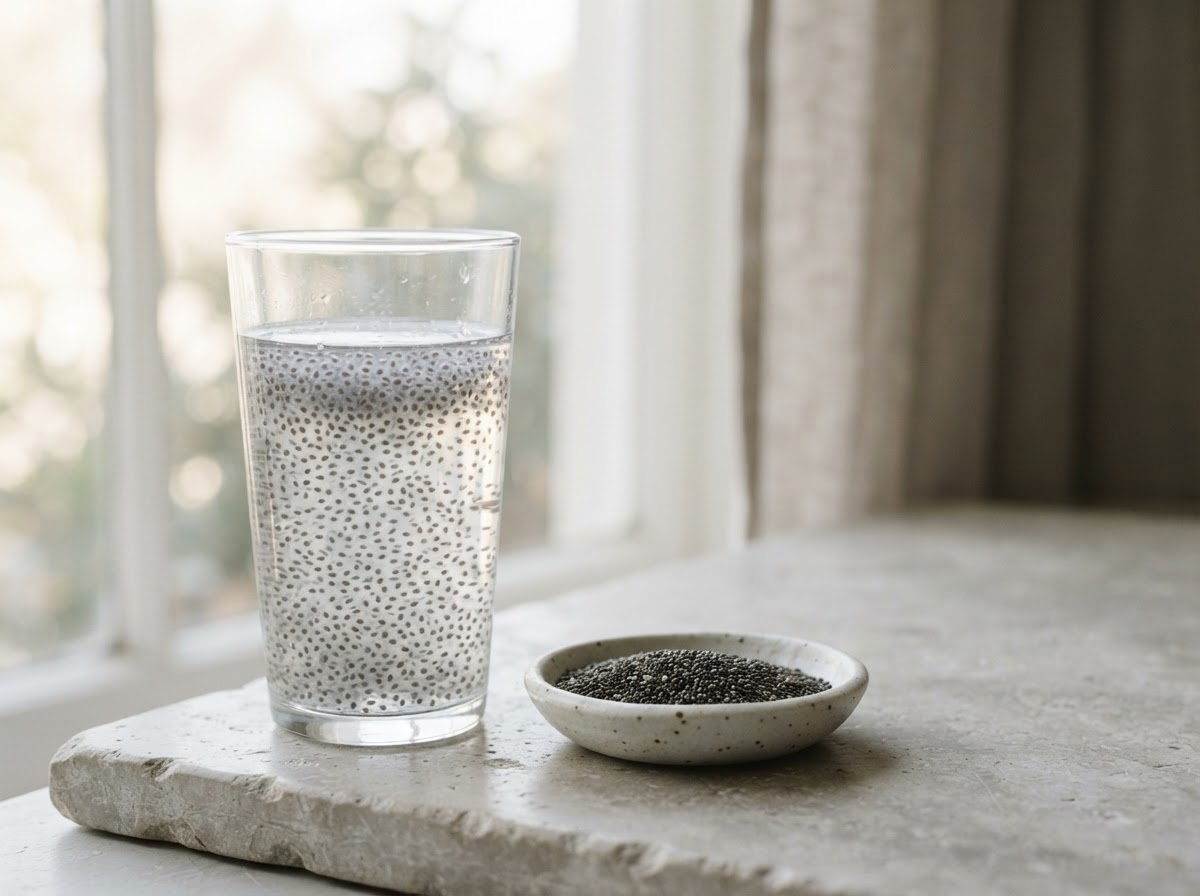
The mechanism is visible in a glass. MedlinePlus describes it plainly: “The seeds expand quite a bit and form a gel when they come into contact with water,” and “this gel adds bulk to your stool, which keeps bowel movements regular and helps prevent constipation.” On fullness the same page is careful, and the hedge is theirs, not ours: “the added bulk also may help you feel fuller so you eat less.”
That is as far as the official record goes, and it is worth knowing where it stops. No federal page claims chia causes weight loss. On blood pressure, heart health and blood sugar, MedlinePlus frames all three as open questions rather than findings — researchers “are looking at” whether chia’s fatty acids “can improve” them. Cholesterol is not mentioned on any federal page we could find.
If fiber is the reason you are here, our guides to high-fiber foods and soluble versus insoluble fiber put chia in context against everything else on the shelf.
The omega-3 case, which is weaker than the label suggests
Chia is genuinely one of the densest plant sources of omega-3 there is. the Office of Dietary Supplements lists chia seeds at 5.06 g of ALA per ounce, against an Adequate Intake for ALA of 1.6 g a day for adult men and 1.1 g for adult women. An ounce of chia is roughly triple a man’s daily adequate intake. That part of the marketing is accurate.
Here is the part that is not on the bag. ALA is not the omega-3 that most of the research is about. The long-chain forms, EPA and DHA, are, and the body has to make those from ALA itself. NIH’s wording: “ALA can be converted into EPA and then to DHA, but the conversion (which occurs primarily in the liver) is very limited, with reported rates of less than 15%.”
Read that against the 5.06 g and the picture changes shape. Chia will comfortably cover your ALA requirement. It is not a replacement for salmon or other oily fish, which supply EPA and DHA directly rather than asking the liver to build them at a conversion rate in the single-to-low-double digits. Anyone eating chia specifically to avoid fish should know that is the trade they are making.
Chia against the other seeds people compare it to
| Food | What it is actually good at |
|---|---|
| Chia seeds | Fiber density and ALA; gels in liquid; no grinding needed |
| Flaxseed | Also ALA-rich — but MedlinePlus notes chia, “unlike flaxseeds,” does not need to be ground |
| Walnuts | the Office of Dietary Supplements names walnuts alongside chia as an ALA source |
| Salmon | Supplies EPA and DHA directly — no conversion step |
| Oats | A bulk fiber source rather than a concentrated one — a bowl, not a spoonful |
That last row is the useful distinction. Chia is a fiber concentrate. Most foods on a fiber-content list ask you to eat a volume of something; chia asks you to stir in a spoon.
How to actually use it
MedlinePlus is blunt about the effort involved: “there is no preparation needed — unlike flaxseeds, chia seeds do not need to be ground for maximal benefit.” Chia is a mint-family seed, nearly flavourless, and it goes into things rather than being eaten as a thing.
- Stirred in. A tablespoon into yogurt, oatmeal or a smoothie adds 4.1 g of fiber and changes nothing about the taste.
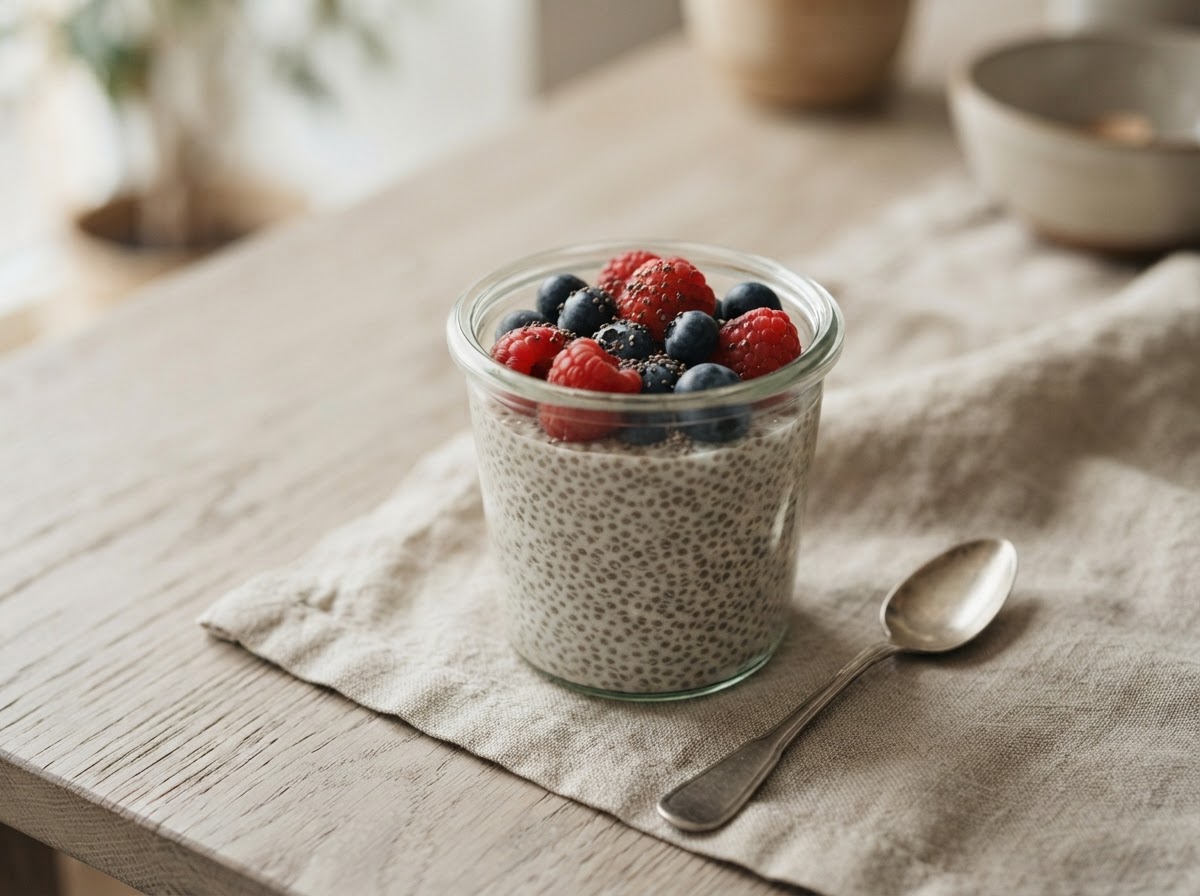
- Soaked. Left in liquid it thickens into pudding. MedlinePlus’s own recipe refrigerates it at least four hours. No official source claims soaking changes the nutrition — it changes the texture.
- Baked in. It survives heat and disappears into the crumb.
One practical caution that is ours rather than a federal agency’s: a seed that gels on contact with liquid behaves differently dry than wet, and it is sensible to let it hydrate in food or drink rather than swallowing a dry spoonful. We flag that as reasoning from the gel property, not as a rule any official source issues: we searched FDA, MedlinePlus, CDC and NCCIH and found no choking warning tied to chia on any of them.
FAQ
How much chia should I eat a day?
No federal source sets an amount. What is documented is that a tablespoon supplies 4.1 g of fiber against a 28 g Daily Value, and an ounce supplies 5.06 g of ALA against an Adequate Intake of 1.6 g for men and 1.1 g for women. A tablespoon a day is a meaningful contribution to fiber; an ounce a day is already well past the ALA requirement.
Do chia seeds help you lose weight?
Nothing official supports it. The only relevant sentence on any federal page is the hedged one about bulk possibly helping you feel fuller. If chia helps anyone eat less, it is by displacing something else in the bowl, and that is a portion story rather than a seed story.
Do I need to grind chia like flaxseed?
No, and this is one of the few places chia has a documented edge. MedlinePlus states directly that chia, unlike flaxseed, does not need grinding for maximal benefit.
Is chia a good omega-3 source if I do not eat fish?
It is a good ALA source, and ALA is an essential fatty acid with its own requirement, which chia will meet several times over. It is a poor route to EPA and DHA, because the Office of Dietary Supplements puts the conversion at “less than 15%.” Those are two different questions and chia answers only the first one well.
Chia or flaxseed?
Both are ALA-dense. The documented practical difference is preparation: flaxseed needs grinding, chia does not. On fiber, USDA’s standard-portion list is the place to compare them serving by serving rather than trusting a headline.
What to do with this
Buy chia for the fiber, not for the omega-3 headline. A tablespoon in something you already eat is a genuine, cheap, tasteless contribution to a nutrient the Dietary Guidelines say Americans are short of — and that is a better reason than any of the claims on the front of the bag. If you were counting on it to replace fish, the conversion figure is the number to sit with.
Related: why fiber intake matters and high-volume, low-calorie foods for the fullness question chia only partly answers; flaxseed and walnuts for the other plant ALA sources.
Educational content, not medical advice.
This content is for educational purposes only and is not medical advice. Always consult a qualified healthcare professional for personalised guidance.