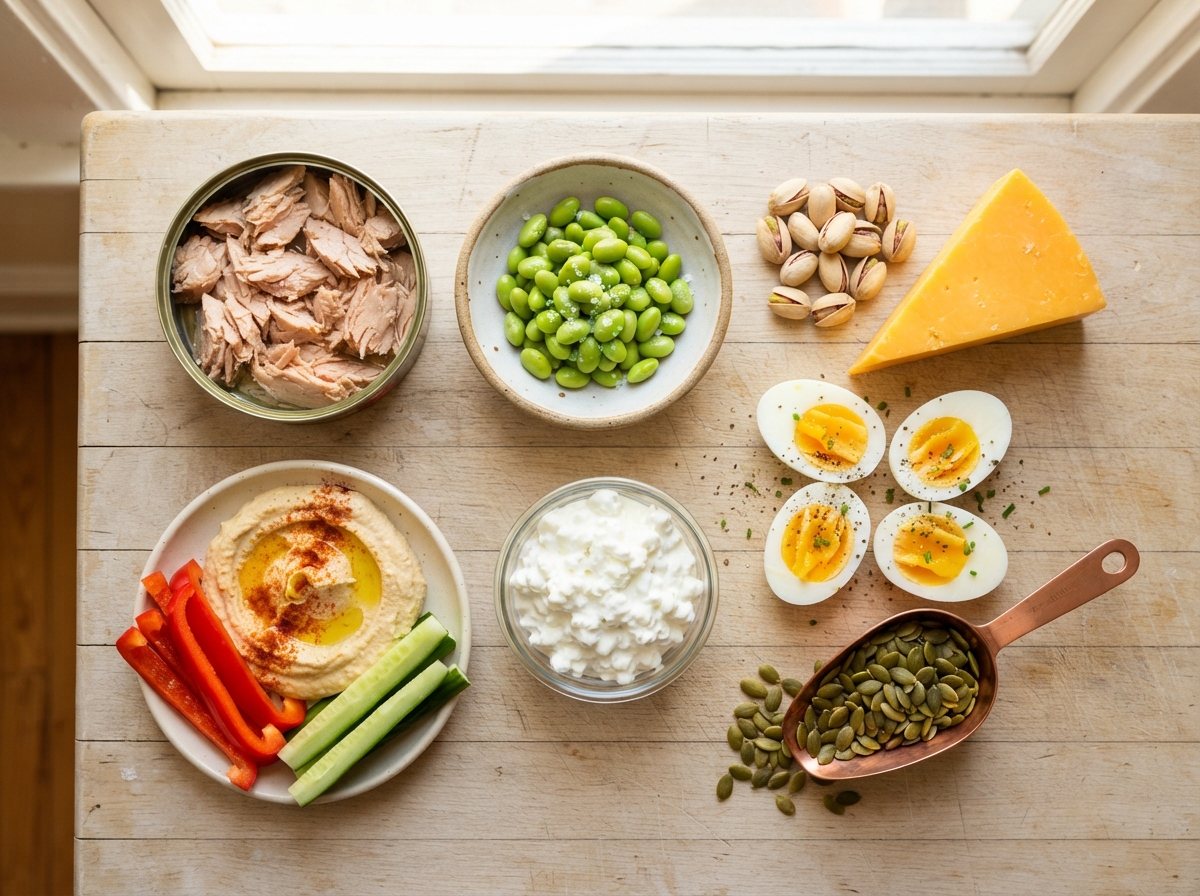
Almost every high-protein snack list answers a question most readers do not have. The federal intake data says 57% of Americans already meet or exceed the daily recommendation for protein foods. What they miss is not protein — it is where the protein comes from. Seafood: 88.4% below recommendation. Beans, peas and lentils: 83% below. Nuts and seeds: 62% below.
Which makes the snack the most useful slot in the day to fix, because it is the one eating occasion where nobody is cooking a plan. Below: how much protein you actually need, a five-second label test, what our own nutrition cards say about sixteen snackable foods, and two claims about protein we are not going to make.
Key takeaways. The DRI tables put the protein RDA at 46 g a day for adult women and 56 g for adult men, on a basis of 0.8 g per kg of body weight. FDA sets the Daily Value for protein at 50 g, and a package may only say “high” protein if it carries 20% or more of that per serving. The gap in the American diet is in seafood, beans and nuts — not in total grams.
How much protein you actually need
Three numbers, all from official tables rather than from anyone’s opinion.
| Measure | Value | Source |
|---|---|---|
| RDA, adult women 19–50 | 46 g/day | DRI reference tables |
| RDA, adult men 19–50 | 56 g/day | DRI reference tables |
| Basis | 0.8 g protein per kg of body weight | DRI reference tables |
| Acceptable range | 10–35% of calories | MedlinePlus, DRI tables |
| Daily Value on labels | 50 g | FDA |
| Athletes | 1.2–2.0 g/kg body weight | NIH ODS |
MedlinePlus puts the range plainly: “the daily recommended intake of protein for healthy adults is 10% to 35% of your total calorie needs.” That is a wide band, and the width is the point — there is no single correct number, and the lower end of it is not a deficiency.
If you train, NIH’s figure is higher: athletes need “0.55 to 0.9 g/lb body weight [1.2 to 2.0 g/kg body weight].” MedlinePlus attaches the caveat that usually gets left off: “it is a myth that a high-protein diet alone will promote muscle growth. For muscle building, you need strength and resistance training.” And bluntly: “eating more protein than your body needs does not improve performance or your health.” Our guide to how much protein per meal goes further into how to spread it.
The label test that takes five seconds
This is the most practical thing in the article, and it is regulated rather than editorial. Under federal labeling rules a product may call itself “high,” “rich in” or an “excellent source of” a nutrient only if it contains “20 percent or more of the RDI or the DRV per reference amount customarily consumed.” “Good source,” “contains” and “provides” sit lower, at “10 to 19 percent.”
Put that next to the 50 g Daily Value and the arithmetic is one step: 20% of 50 g is 10 g, and 10% is 5 g. We are flagging that as our arithmetic on two published figures, not as a quoted rule — no federal page prints the grams. But it gives you a test that works on any packet in any aisle: 10 g of protein per serving is the line a product has to clear to call itself high-protein. Turn the bar over and check. Most of them do not.
The same FDA page gives the general reading rule: “20% DV or more of a nutrient per serving is considered high,” and “5% DV or less of a nutrient per serving is considered low.”
Sixteen snackable foods, from our own cards
These come from our own nutrition database rather than from a round-up, so the basis is consistent: grams of protein per 100 g, with calories alongside, because the two move together and the second column is usually the one that decides whether something is a snack or a meal.
| Food | Protein / 100 g | Calories / 100 g |
|---|---|---|
| Pumpkin seeds | 29.9 g | 555 |
| Ground turkey | 27.1 g | 220 |
| Cheddar cheese | 23.3 g | 408 |
| Salmon | 22.3 g | 130 |
| Peanut butter | 21.9 g | 588 |
| Pistachios | 20.5 g | 598 |
| Almonds, dry roasted | 20.4 g | 620 |
| Tuna, light | 19.0 g | 90 |
| Shrimp | 15.6 g | 71 |
| Egg, whole | 12.3 g | 150 |
| Edamame | 11.9 g | 121 |
| Cottage cheese, low fat | 11.0 g | 84 |
| Greek yogurt, plain nonfat | 10.3 g | 61 |
| Ricotta cheese | 7.8 g | 157 |
| Hummus | 7.4 g | 229 |
| Black beans, cooked | 6.9 g | 118 |
Read the two columns against each other and the list sorts itself into two different foods. Pumpkin seeds, nuts and peanut butter are protein-dense and calorie-dense — 100 g of almonds is 620 calories, which is not a snack, it is most of a meal. Tuna, shrimp, cottage cheese, Greek yogurt and edamame carry their protein at a quarter of the calorie cost. If a snack is meant to fit inside a day rather than reshape it, the bottom half of that table is where it lives.
The part the lists get wrong
The 2025 Dietary Guidelines Advisory Committee’s protein working document is unusually direct about where the American diet actually falls down:
“Fifty-seven percent of individuals in the U.S. meet or exceed these daily recommendations for the total Protein Foods group, but most do not align with subgroup recommendations for Meats, Poultry, and Eggs (54% exceeding recommendation); Seafood (88.4% below recommendation); Nuts and Seeds (62% below recommendation); and Beans, Peas, and Lentils (83% below recommendation).”
And the summary line: “intakes of Meats, Poultry, and Eggs exceed recommendations while intakes of Beans, Peas, and Lentils, Nuts, Seeds, and Soy Products, and Seafood fall short of recommendations.”
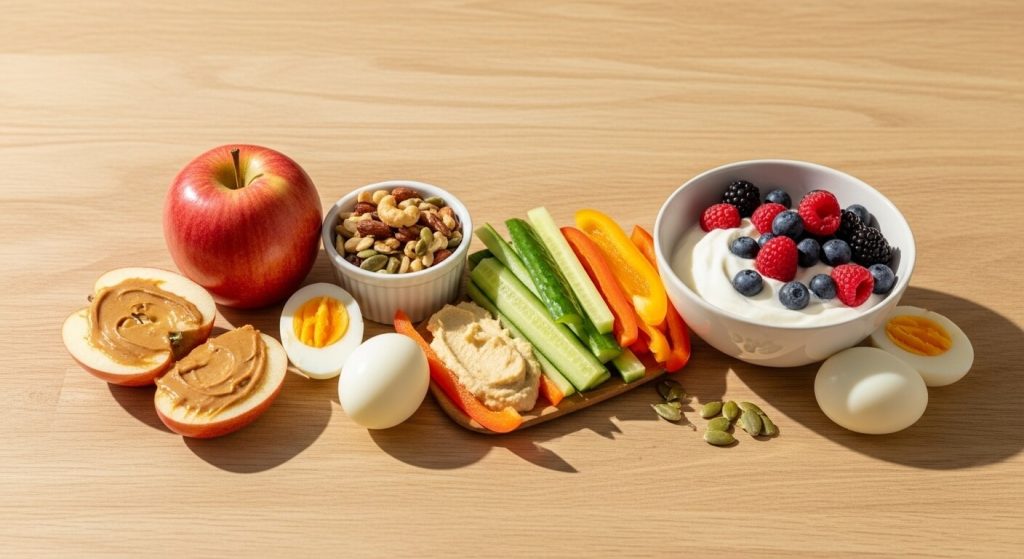
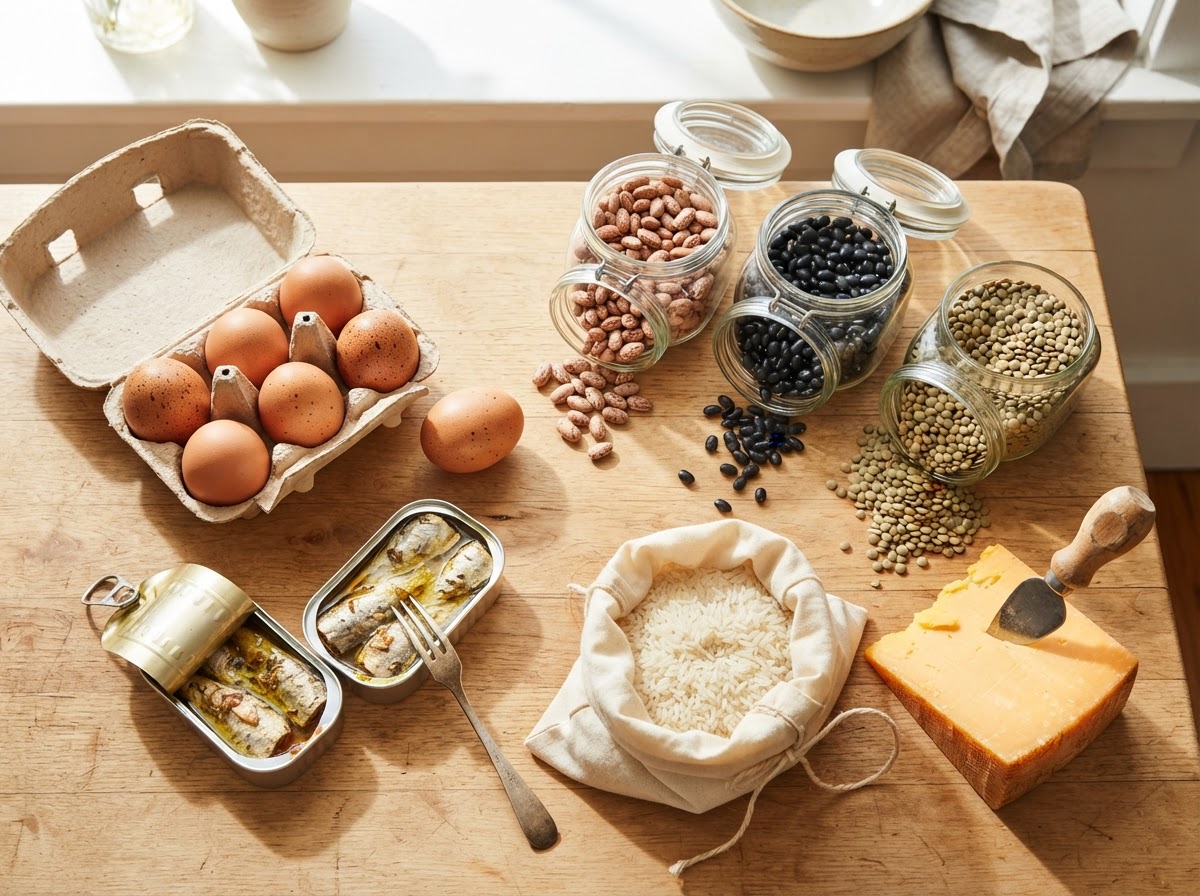
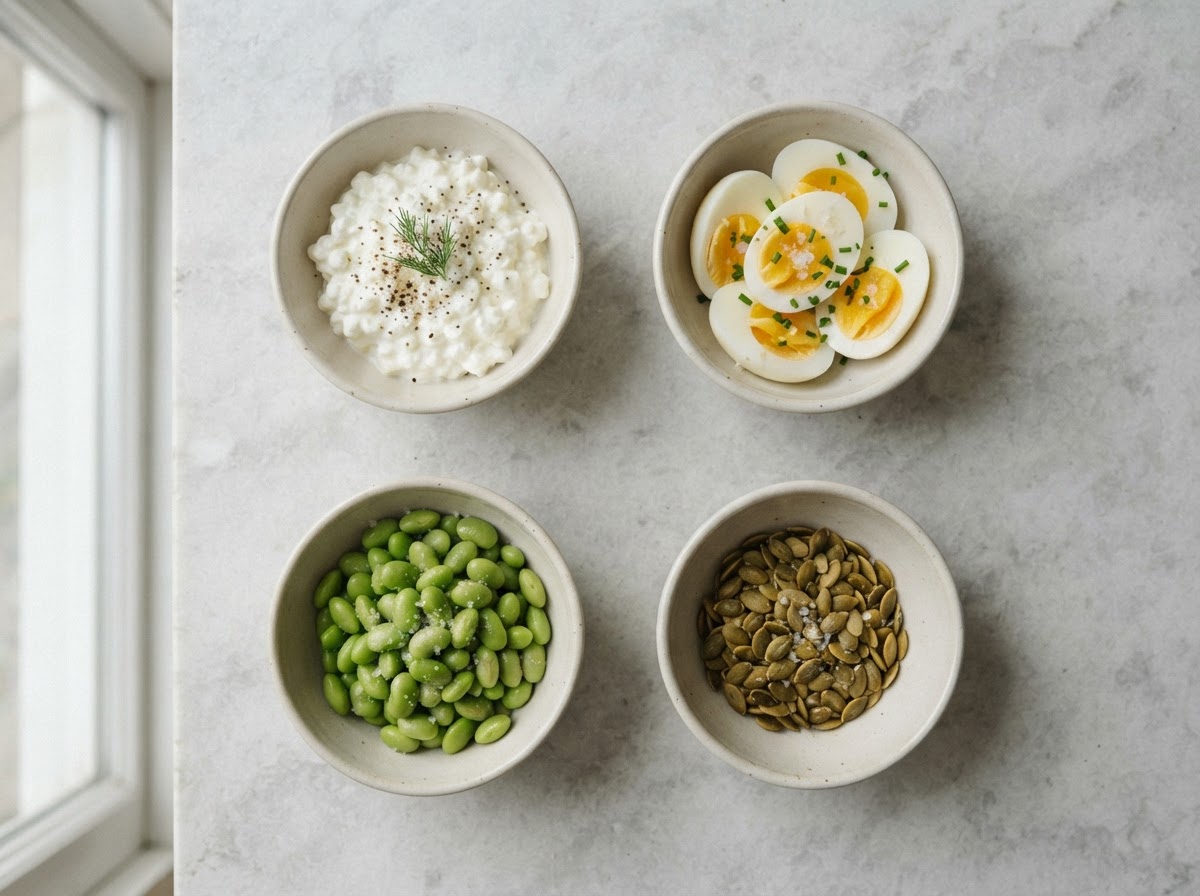
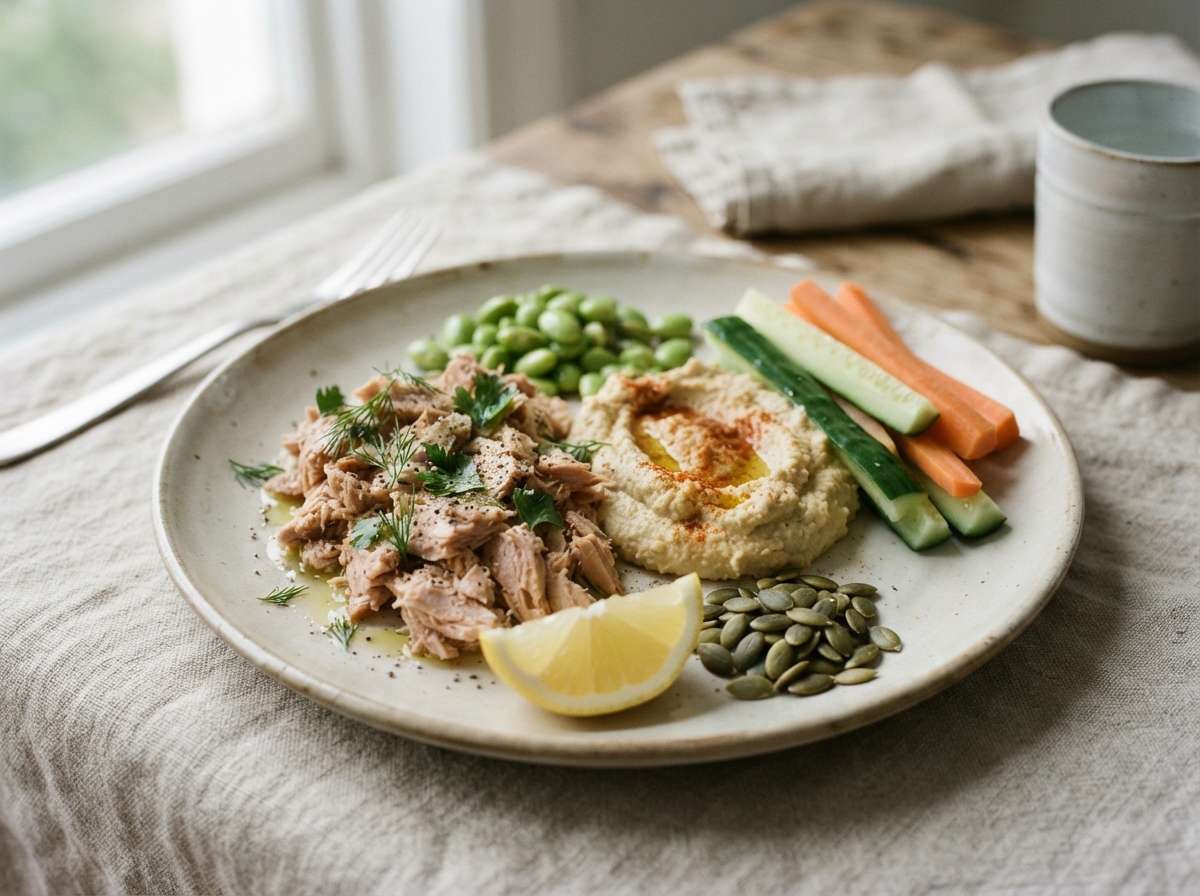
So the protein snack that actually changes something is not another chicken-based bar. It is tuna or shrimp, hummus or black beans, pumpkin seeds or edamame — the three groups nearly everyone is short on. Our list of high-protein vegetarian foods is built almost entirely out of those two under-eaten subgroups.
The pattern at 2,000 calories asks for 5.5 ounce-equivalents of protein foods a day, with 8 ounce-equivalents of seafood and 5 of nuts, seeds and soy across the week. One ounce-equivalent, as USDA defines it: “1 ounce lean meat, poultry, or seafood; 1 egg; ¼ cup cooked beans or tofu; 1 Tbsp peanut butter; ½ ounce nuts or seeds.” Two tablespoons of peanut butter and a small tin of tuna in a week is not a heroic intervention, and it moves two of the three deficits.
What we are not claiming
- That protein keeps you full. This is the load-bearing claim in almost every high-protein snack article, and we searched for it on MedlinePlus, CDC, NIDDK, NHLBI and the Dietary Guidelines material without finding a single statement to that effect. NIDDK’s weight-management page mentions protein only as a food group. We are not going to assert as fact something no federal source will say.
- That protein protects muscle while you lose weight. Same search, same result: nothing on any official page.
- That older adults need more protein than the RDA. The DRI tables print the same 46 g and 56 g for ages 51+ and 70+ as for younger adults. No official source we could reach states an age-specific increase.
- That there is an upper limit for protein. No Tolerable Upper Intake Level has been published for protein, but no federal page says so in a sentence either, so we are reporting the absence rather than dressing it up as a finding. The one documented caution is MedlinePlus’s, written for athletes overshooting: excess protein “will be stored as body fat or burned for energy,” “can increase the chance for dehydration,” “can lead to loss of calcium” and “can put an added burden on the kidneys.”
- That 10 g is an official threshold. It is 20% of the 50 g Daily Value, which is the regulated cutoff for a “high protein” label. The multiplication is ours.
FAQ
How much protein should a snack have?
There is no official answer, but there is a useful line: 10 g per serving is 20% of the 50 g Daily Value, which is the threshold a product must clear to advertise itself as high in protein. Below about 5 g and it cannot even claim to be a “good source.”
Am I getting enough protein?
Statistically, probably. The federal intake data shows 57% of Americans meeting or exceeding the total protein foods recommendation, and the recommended amount itself is 46 g a day for women and 56 g for men. If you are eating meat, dairy or eggs daily, the total is rarely the problem.
What are the best high-protein snacks?
By protein density, pumpkin seeds, cheese and nuts. By protein per calorie — which is what most people actually want — Greek yogurt, cottage cheese, tuna, shrimp and edamame. By what is missing from the average American diet, anything built on seafood, beans or seeds.
Do high-protein snacks help you lose weight?
We cannot point to a federal source saying so. What is documented is that total calories still count, and our piece on healthy snacks for weight loss covers what the graded evidence does and does not support on snacking generally.
Do I need protein powder or bars?
Nothing in the requirement figures suggests a supplement is necessary to reach 46 or 56 g a day from ordinary food. If you use one anyway, the label test applies to it exactly as it does to a packet of chips. Our review of protein powder for muscle gain goes through the category.
What to do with this
Stop optimising the number and start optimising the source. Pick snacks from seafood, beans and seeds, because those are the three groups the national data says nearly everyone is short on, and the snack is the easiest place in the day to slot them in. Use 10 g per serving as the bar for anything sold to you as high-protein. And if a product is telling you it will keep you full, notice that it is making a claim the federal record does not support.
Related: high-protein breakfast ideas for the other under-planned eating occasion; affordable high-protein foods if cost is the constraint; everything you need to know about protein for the fundamentals; and nutrient-dense snack ideas for options that are not built around protein at all.
Educational content, not medical advice.
This content is for educational purposes only and is not medical advice. Always consult a qualified healthcare professional for personalised guidance.