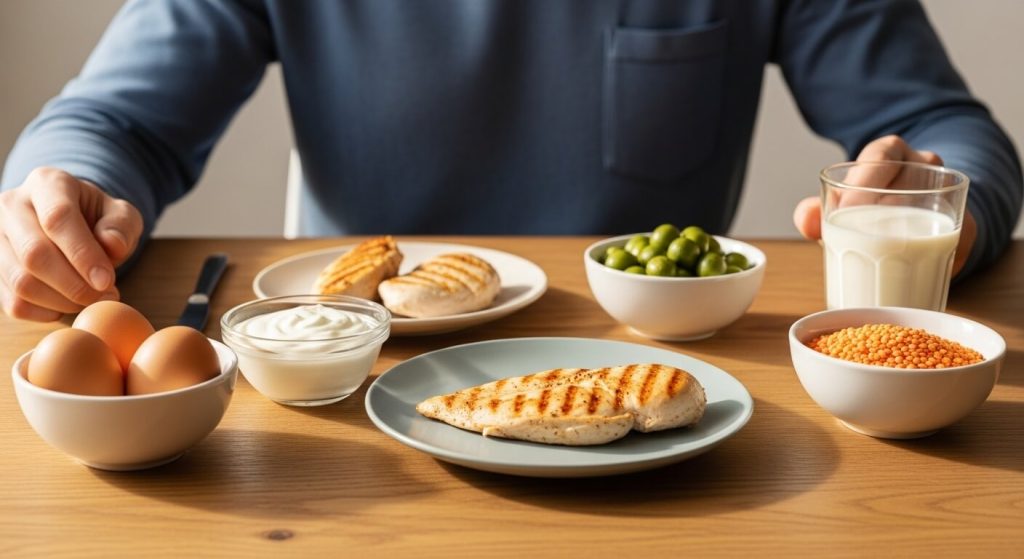
Most protein advice stops at the daily total. But two people eating 130 g a day can eat it very differently — one in a single evening meal, the other spread across four — and the position stands have something specific to say about which works better.
This is the dose-and-frequency question: how much protein per meal, how often, and whether the last meal of the day is a special case. Every figure below is quoted from a published position stand.
The per-meal dose
Two independent position stands, two slightly different framings of the same answer.
The International Society of Sports Nutrition: “general recommendations are 0.25 g of a high-quality protein per kg of body weight, or an absolute dose of 20–40 g.”
The joint stand from the Academy of Nutrition and Dietetics, Dietitians of Canada and the American College of Sports Medicine: “this translates to a recommended protein intake of 0.25-0.3g/kg BW or 15 to 25 g protein across the typical range of athlete body sizes.”
| Bodyweight | 0.25 g/kg | 0.3 g/kg |
|---|---|---|
| 60 kg (132 lb) | 15 g | 18 g |
| 70 kg (154 lb) | 18 g | 21 g |
| 80 kg (176 lb) | 20 g | 24 g |
| 90 kg (198 lb) | 23 g | 27 g |
Is there a ceiling?
Not an absorption ceiling — that idea has no source behind it. What the ACSM stand actually says is narrower: “higher doses (i.e., >40 g dietary protein) have not yet been shown to further augment MPS.”
Read that carefully. It is a statement about muscle protein synthesis not increasing further, not a claim that protein above 40 g is wasted, unabsorbed or excreted. A 60 g steak dinner is not a mistake; it simply may not stimulate more synthesis than a 40 g one would have.
The “your body can only use 30 g of protein per meal” claim is not in any position stand. No source describes an absorption cap. If you have been building your day around avoiding that number, you were solving a problem that does not exist.
How often
ISSN recommends protein be “evenly distributed, every 3–4 h, across the day.” ACSM/AND/DC give a slightly wider window: “0.3 g/kg BW after key exercise sessions and every 3 to 5 hours over multiple meals.”
For a waking day of about 16 hours, every three to four hours means four to five protein-containing eating occasions. Not six small meals, not one large one. Filling one of those gaps usually means a snack, and the grams in sixteen common ones are counted on their own page.
| Time | Occasion | Target |
|---|---|---|
| 7:00 | Breakfast | 20–30 g — this is the meal most people underfill |
| 11:00 | Snack or early lunch | 20–25 g |
| 14:30 | Lunch | 25–35 g |
| 18:30 | Dinner | 25–40 g |
| 21:30 | Pre-sleep, optional | 30–40 g — see below |
Breakfast is where the pattern usually breaks. A typical cereal-and-toast breakfast supplies well under 10 g, which means the first protein dose of the day often arrives at lunch — leaving a long gap after an overnight fast.
Quality within the dose
The amount is only half of it. ISSN specifies that each dose should “contain 700–3000 mg of leucine and/or a higher relative leucine content, in addition to a balanced array of the essential amino acids (EAAs).”
Note that this is a range, not a threshold. The popular “2.5 g leucine trigger” is a single number invented from a range that spans more than fourfold. The ACSM stand gives a parallel figure for essential amino acids: muscle protein synthesis is optimised by “~10 g essential amino acids in the early recovery phase (0 to 2 hours after exercise).”
Which foods carry a full essential amino acid profile is covered in complete amino acid foods, and how much of a food’s protein you actually absorb in protein bioavailability and absorption.
Pre-sleep protein
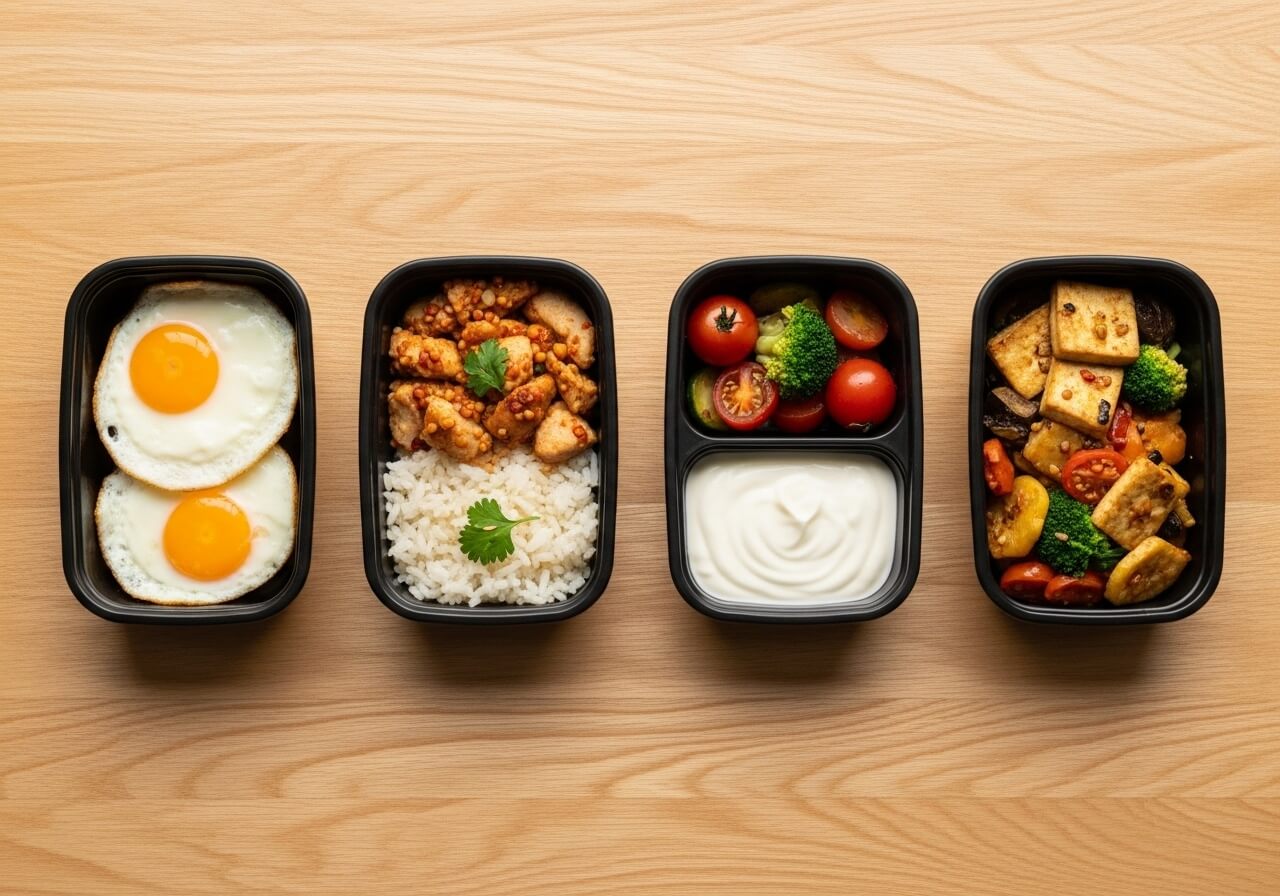
This one has a specific dose attached. ISSN: “pre-sleep casein protein intake (30–40 g) provides increases in overnight MPS and metabolic rate.”
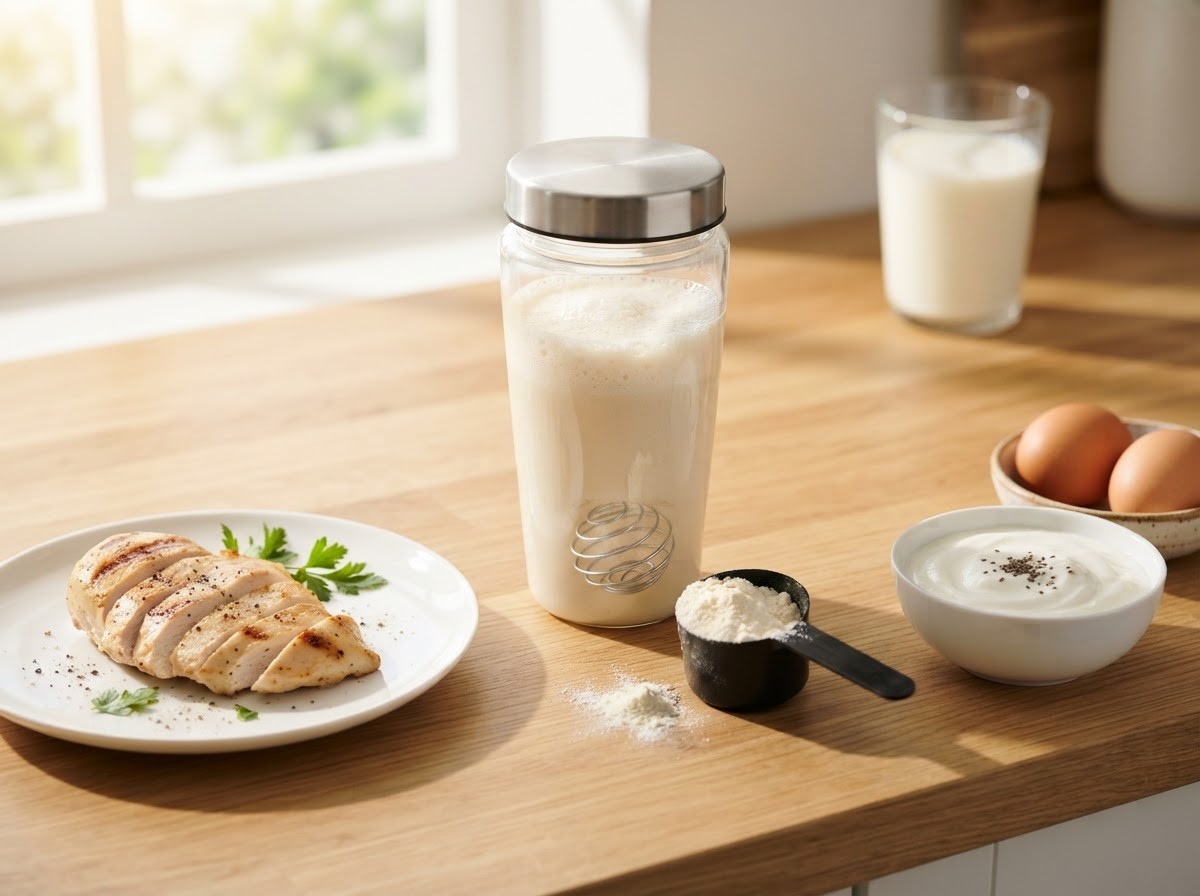
It is the one timing recommendation in the protein literature with a concrete number and a concrete protein type. Casein is used because it digests slowly; dairy foods high in casein include cottage cheese, Greek yogurt and milk.
Whether it translates into more muscle over months is less settled than the overnight synthesis finding — we go into that in nutrient timing: what the evidence actually supports.
Where the total still wins
Distribution is a refinement, not the main lever. The daily total comes first: ISSN puts it at “1.4–2.0 g protein/kg body weight/day” for most exercising people; ACSM/AND/DC at “1.2 to 2.0 g/kg/d.” Higher intakes have one evidenced use — “higher protein intakes (2.3–3.1 g/kg/d) may be needed to maximize the retention of lean body mass” while in a calorie deficit.
And on the window everyone worries about, ISSN is direct: “the anabolic effect of exercise is long-lasting (at least 24 h), but likely diminishes with increasing time post-exercise,” so the “optimal time period during which to ingest protein is likely a matter of individual tolerance, since benefits are derived from pre- or post-workout ingestion.”
Order of importance: hit the daily total first. Then spread it across four to five occasions. Then, if you want, add a pre-sleep dose. Getting the total right and the distribution wrong beats the reverse by a wide margin.
The narrower question of the post-exercise window is handled in the recovery window: myth vs reality, and what to build the meal itself from in what to eat after a workout.
Hitting the dose from food
USDA figures for standard portions, so you can see what 20–40 g looks like:
| Food | Protein |
|---|---|
| Roasted turkey breast, 3 oz | 25.6 g |
| Cooked wild coho salmon, 3 oz | 23.3 g |
| Plain low-fat yogurt, 6 oz container | 8.9 g |
| One large egg | 6.3 g |
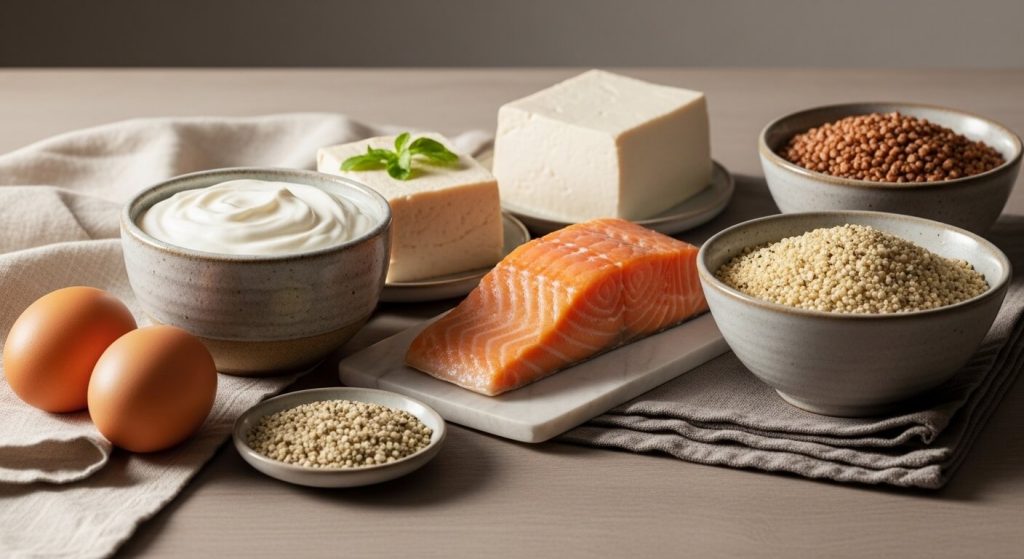
So a three-egg breakfast is about 19 g — a dose for a 70 kg person, not for a 90 kg one. Two eggs plus a yogurt gets there. A 3 oz portion of meat or fish clears it on its own.
ISSN is clear that powders are optional: it is “possible for physically active individuals to obtain their daily protein requirements through the consumption of whole foods,” with supplementation described as “a practical way of ensuring intake.” Budget options are in affordable high-protein foods.
Four claims we are not making
| Common claim | What the stands say |
|---|---|
| “Your body can only absorb 30 g of protein per meal” | No source describes an absorption cap. ACSM says only that doses over 40 g have not been shown to further increase MPS |
| “You must hit 2.5 g of leucine per meal” | ISSN gives a range of 700–3000 mg, not a threshold |
| “Eat 1 g of protein per pound of bodyweight” | ≈2.2 g/kg exceeds both stands’ ranges. The 2.3–3.1 g/kg figure applies only to preserving lean mass while dieting |
| “Miss the 30-minute window and the session is wasted” | ISSN: the anabolic effect “is long-lasting (at least 24 h)” |
FAQ
How much protein should I eat per meal?
ISSN gives 0.25 g per kilogram of bodyweight, or 20–40 g in absolute terms. The ACSM/AND/DC stand gives 0.25–0.3 g/kg, or 15–25 g across typical athlete body sizes.
How often should I eat protein?
Every three to four hours per ISSN, or every three to five hours per ACSM — four to five protein-containing occasions across a waking day.
Is more than 40 g wasted?
Not wasted — simply not shown to increase muscle protein synthesis further. That is a narrower statement than the absorption cap people usually mean.
Does protein before bed help?
ISSN states that pre-sleep casein of 30–40 g increases overnight muscle protein synthesis and metabolic rate. Whether that produces more muscle over months is less settled.
Does distribution matter more than the daily total?
No. The daily total is the primary variable — 1.4–2.0 g/kg per ISSN, 1.2–2.0 per ACSM. Distribution is a refinement on top of it.
Do I need protein powder to hit these doses?
No. ISSN states requirements can be met through whole foods and describes supplementation as a practical convenience. A 3 oz portion of fish or poultry supplies over 20 g on its own.
What about breakfast?
It is usually the weakest dose of the day. A typical cereal or toast breakfast is well under 10 g, which pushes the first real dose to lunch after an overnight fast.
This content is for educational purposes only and is not medical advice. Always consult a qualified healthcare professional for personalised guidance.