“Does plant protein build muscle as well as animal protein?” is usually answered yes or no. The trials give a more precise answer, and the precision is the useful part: it depends on which plant protein, and on whether total protein is equated. Get those two things right and the gap largely disappears.
The short version
- Soy versus milk protein: no difference. Across 17 trials, SMD −0.02, p = .80.
- Animal versus non-soy plant protein: a real gap. SMD −0.58 across 5 trials, favouring animal.
- Strength shows no difference in any of the three meta-analyses — only muscle mass separates them, and only slightly.
- Match total protein and the gap closes. Vegans and omnivores at 1.6 g/kg/day gained the same over 12 weeks.
- A bigger dose sometimes compensates — 60 g of wheat protein matched 35 g of whey. Soy at 40 g did not match whey at 20 g.
- Soy does not lower testosterone. Two meta-analyses found no effect on any hormone measured.
What the meta-analyses found
| Analysis | Comparison | Result for muscle mass |
|---|---|---|
| 2021, 16 trials | Animal vs plant, absolute lean mass | +0.22 kg (95% CI −0.02 to 0.46) — not significant |
| 2021, same | Animal vs plant, percent lean mass | +0.50% (0.05 to 0.95) — significant |
| 2025, 30 trials | Plant vs animal, overall | SMD −0.20 (−0.37, −0.03), p = .02 — favors animal |
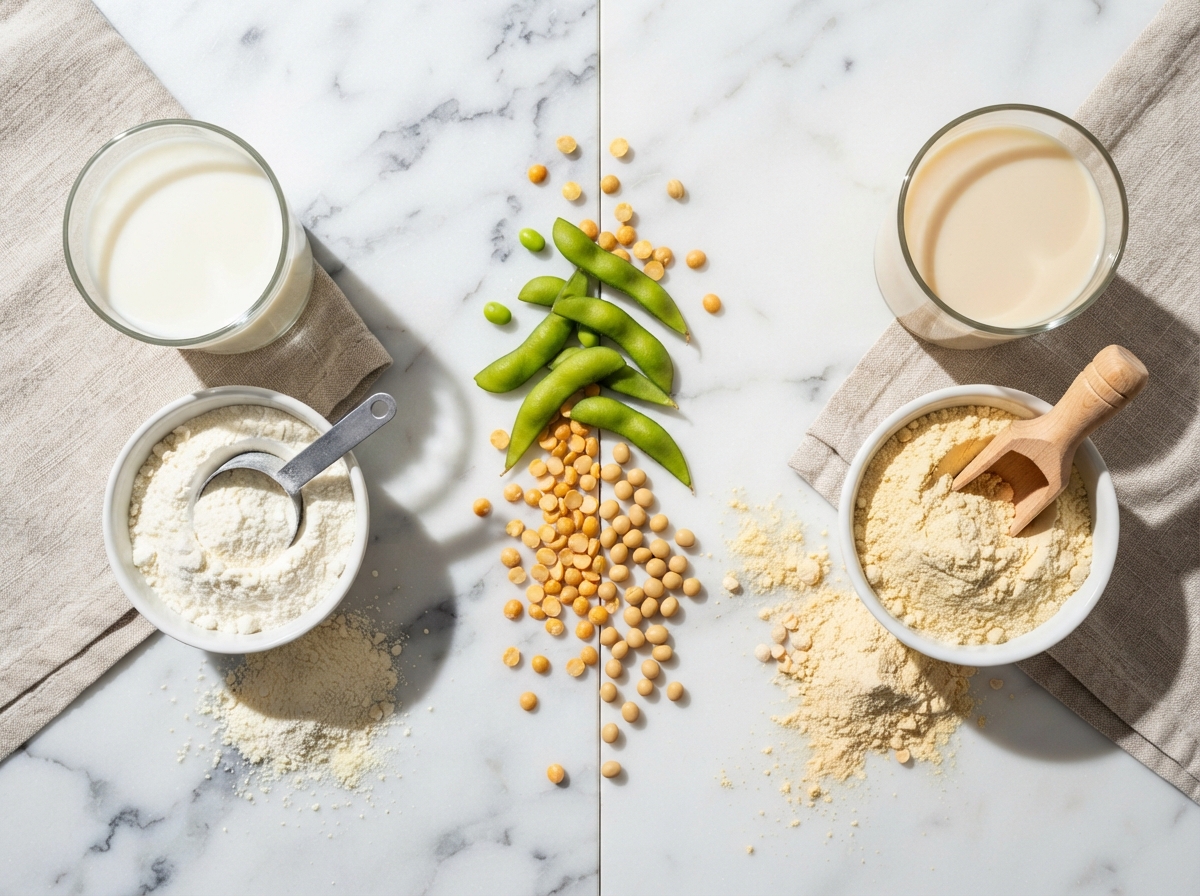
| 2025, 17 trials | Soy vs milk protein | SMD −0.02 (−0.20, 0.16), p = .80 — no difference |
| 2025, 5 trials | Animal vs non-soy plant | SMD −0.58 (−1.06, −0.09), p = .02 — favors animal |
| 2026, 18 trials, 1,893 people | Plant vs animal, lean body mass | SMD 0.26 (−0.58 to 0.90), p = 0.58 — no difference |
Two things jump out of that table. First, the effect is small even where it is statistically significant — half a percentage point of lean mass. Second, and more usefully, the difference is driven by non-soy plant proteins. The 2025 review’s own conclusion is carefully worded: “Animal protein may have a small beneficial effect over non-soy plant protein for muscle mass.” Our lean body mass and FFMI calculator puts a number on your own lean mass to compare against.
On strength, all three analyses agree there is nothing to see. The 2021 meta-analysis tested squat one-rep max, grip strength, knee extension and knee flexion and found “protein source did not affect changes in strength outcomes.” The 2026 analysis found the same for upper- and lower-body strength, gait speed and physical performance, concluding that plant protein “did not result in differences in body composition, muscle strength, physical performance, or cardiometabolic risk parameters.”
The trial that matters most: matched protein, real vegans
Meta-analyses of supplement studies are one thing. A controlled trial in people who actually eat this way is another.
Nineteen habitual vegans and nineteen omnivores, matched for age and body mass, trained twice a week for twelve weeks. Both groups were brought to 1.6 g of protein per kg per day — vegans topping up with soy protein isolate, omnivores with whey. The results:
| Outcome | Vegans | Omnivores |
|---|---|---|
| Leg lean mass | +1.2 ± 1.0 kg | +1.2 ± 0.8 kg |
| Vastus lateralis cross-sectional area | +2.2 ± 1.1 cm² | +2.8 ± 1.0 cm² |
| Leg-press 1RM | +97 ± 38 kg | +117 ± 35 kg |
All gains were significant within each group, and none of the between-group differences were. The authors’ conclusion: “A high-protein (~1.6 g kg⁻¹ day⁻¹), exclusively plant-based diet is not different than a protein-matched mixed diet in supporting muscle strength and mass accrual.”
That number, 1.6 g/kg/day, is not arbitrary. A separate meta-analysis of 49 trials and 1,863 participants found gains from protein supplementation plateau at 1.62 g/kg/day regardless of source.
Why a gap exists at all
Two mechanical reasons, both measurable.
Digestibility. Around “85–95% of the protein in egg whites, whole eggs, and chicken is absorbed, compared with only ~50–75% of the protein in chickpeas, mung beans, and yellow peas.” Fiber and polyphenolic tannins are named as the reason.
Leucine content. Whey is about 11% leucine, casein 8%, egg 7% — against soy at roughly 7%, wheat 6% and hemp 5%. The practical consequence, from a study measuring protein isolates directly: to supply the 2.7 g of leucine in 25 g of whey, “between 20 and 54 g of plant-based protein needs to be consumed” depending on the source.
Does eating more of it close the gap?
Sometimes — and the exception is instructive. Increasing wheat protein to 60 g, matching the leucine in 35 g of whey, “we observed a robust increase in muscle protein synthesis rates.” But soy did not behave the same way: 40 g of soy “did not compensate for the lesser muscle protein synthetic response when compared with the ingestion of 20 g whey protein isolate.”
So “just eat more of it” is a real strategy with limits. The review names three: eat a greater amount, use blends of plant proteins to balance the amino acid profile, or fortify with the specific amino acid that is short.
What about pea protein?
The largest trial of pea protein randomised 161 people to pea, whey or placebo at 50 g a day for twelve weeks. Biceps thickness increased more with pea than placebo, with the clearest effect in those starting from the weakest baseline — +20.2% for pea against +8.6% for placebo. Against whey the difference did not reach significance, and strength increased equally in all groups.
Read honestly: pea beat nothing, and did not differ from whey — but the headline result came from a subgroup analysis, so treat it as encouraging rather than decisive.
The soy and testosterone question
Since soy is the plant protein with the best data for muscle, the hormone claim attached to it matters. It does not survive contact with the evidence.
A 2010 meta-analysis of 15 placebo-controlled groups found “no significant effects of soy protein or isoflavone intake on T, SHBG, free T, or FAI … regardless of statistical model.” A 2021 update covering 41 clinical studies — 1,753 participants for total testosterone alone — reached the same conclusion: “regardless of dose and study duration, neither soy protein nor isoflavone exposure affects TT, FT, E₂ or E₁ levels in men.”
What this means if you are training
- Total protein first. 1.6 g/kg/day is where the pooled data stops improving. Reaching it matters more than what it is made of.
- Prefer soy among plant proteins where a supplement is involved — it is the one with no measured disadvantage against milk protein.
- Use blends. Combining plant sources balances the amino acid profile, and is one of the three strategies the researchers name.
- Expect to eat somewhat more. Lower digestibility and lower leucine mean the same grams on a label do slightly less work.
FAQ
Can you build muscle on plant protein alone?
Yes. In the only protein-matched controlled trial in habitual vegans, gains in lean mass, muscle size and strength were statistically indistinguishable from omnivores over twelve weeks.
Is soy as good as whey?
For muscle mass across 17 trials, soy against milk protein came to SMD −0.02, p = .80 — no difference. In acute muscle protein synthesis studies whey has the edge, but that is a short-term surrogate rather than a hypertrophy outcome.
Is pea protein worth using?
The evidence is positive but thinner than for soy. In the main trial it beat placebo and did not differ significantly from whey.
Do I need more protein if I eat plants?
Somewhat. The Academy of Nutrition and Dietetics puts the bar at “at least 1.5 g protein/kg/day” for plant-protein athletes, and one practical review suggests 1.7–2.0 g/kg for vegans. That is a modest uplift, not a doubling.
Does soy affect hormones in men?
Two meta-analyses covering dozens of studies found no effect on total or free testosterone, SHBG, oestradiol or oestrone, at any dose or duration tested.
Where this fits
How protein sources are scored in the first place — PDCAAS, DIAAS and why the label caps them — is in protein quality. The practical side of hitting these targets without animal products is in building muscle on a plant-based diet, and the nutrients that need attention beyond protein are in nutrients to watch on a plant-based diet.
Every figure here is linked to its source in the text: the International Society of Sports Nutrition position stand, and peer-reviewed meta-analyses and trials in the British Journal of Sports Medicine, Nutrition Reviews, Nutrients, Sports Medicine, Frontiers in Nutrition, Amino Acids, the Journal of the International Society of Sports Nutrition and Reproductive Toxicology. Checked against those sources on 2 September 2026. Educational information, not medical advice — see our medical disclaimer.
This content is for educational purposes only and is not medical advice. Always consult a qualified healthcare professional for personalised guidance.