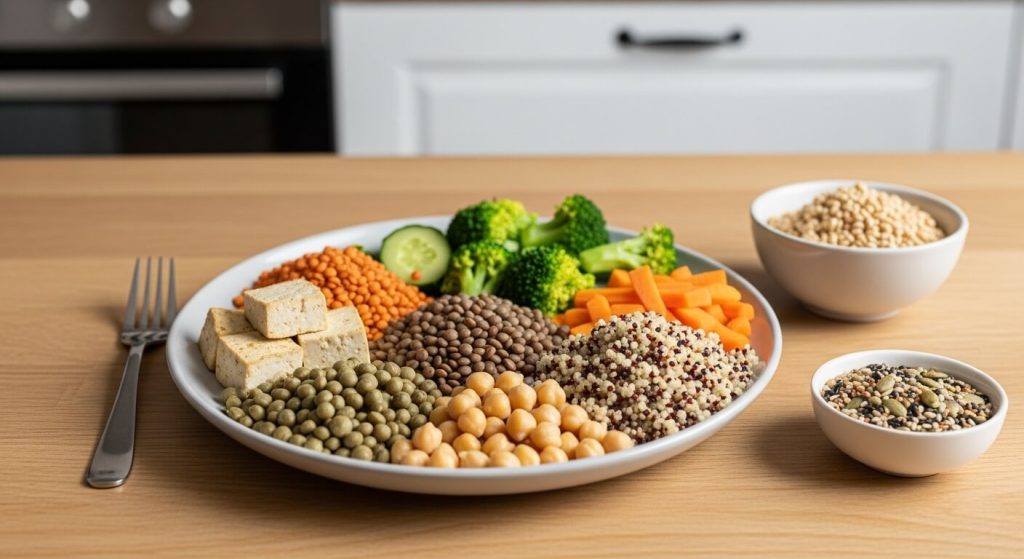
Building muscle without animal products is an arithmetic problem, not a biological one. The controlled trials say the outcomes match once total protein matches. The work is in reaching that total from foods that are less protein-dense and slightly less digestible — which is a planning task with a known answer.
The short version
- Aim for at least 1.5 g of protein per kg per day — the Academy of Nutrition and Dietetics figure for plant-protein athletes.
- 20–40 g per meal, every three to four hours. Distribution does more than any single food choice.
- Lean on soy. It is the one plant protein with no measured disadvantage against milk protein for muscle mass.
- Blend your sources. Combining plant proteins is one of three strategies researchers name for closing the amino acid gap.
- Expect to eat a bit more. Chickpeas, mung beans and yellow peas are absorbed at roughly 50–75%, against 85–95% for eggs and chicken.
- The Dietary Guidelines now warn that vegan diets show shortfalls including protein — planning is the answer, not avoidance.
Your daily target, from four sources
| Source | Target | Applies to |
|---|---|---|
| Dietary Guidelines 2025–2030 | 1.2–1.6 g/kg/day | General adult population |
| Academy of Nutrition and Dietetics, 2025 | “at least 1.5 g protein/kg/day” | Plant-protein athletes seeking size or strength |
| ISSN position stand | 1.4–2.0 g/kg/day | Most exercising individuals |
| Practical vegan-athlete review | 1.7–2.0 g/kg/day | Vegans; up to 2.7 during weight loss |
The Academy’s sentence is the one to hold onto: “For healthy active adults and athletes desiring gains in muscle size and/or strength, there does not appear to be a detriment to MPS nor hypertrophy and strength outcomes when plant-protein ingestion achieves at least 1.5 g protein/kg/day.” At 75 kg that is about 113 g a day.
Note what changed at the top of that table. The current Dietary Guidelines for Americans 2025–2030 set a general population target of 1.2–1.6 g/kg — well above the 0.8 g/kg figure most articles still quote.
Per meal, and how often
The ISSN gives the shape: “0.25 g of a high-quality protein per kg of body weight, or an absolute dose of 20–40 g”, containing 700–3000 mg of leucine, “evenly distributed, every 3–4 h, across the day.”
Leucine is where plant sources need a little more volume. Whey is about 11% leucine against roughly 7% for soy and 5% for hemp — so to match the leucine in 25 g of whey, “between 20 and 54 g of plant-based protein needs to be consumed” depending on which one you pick. Soy sits at the good end of that range; hemp at the expensive end.
Building the total from real food
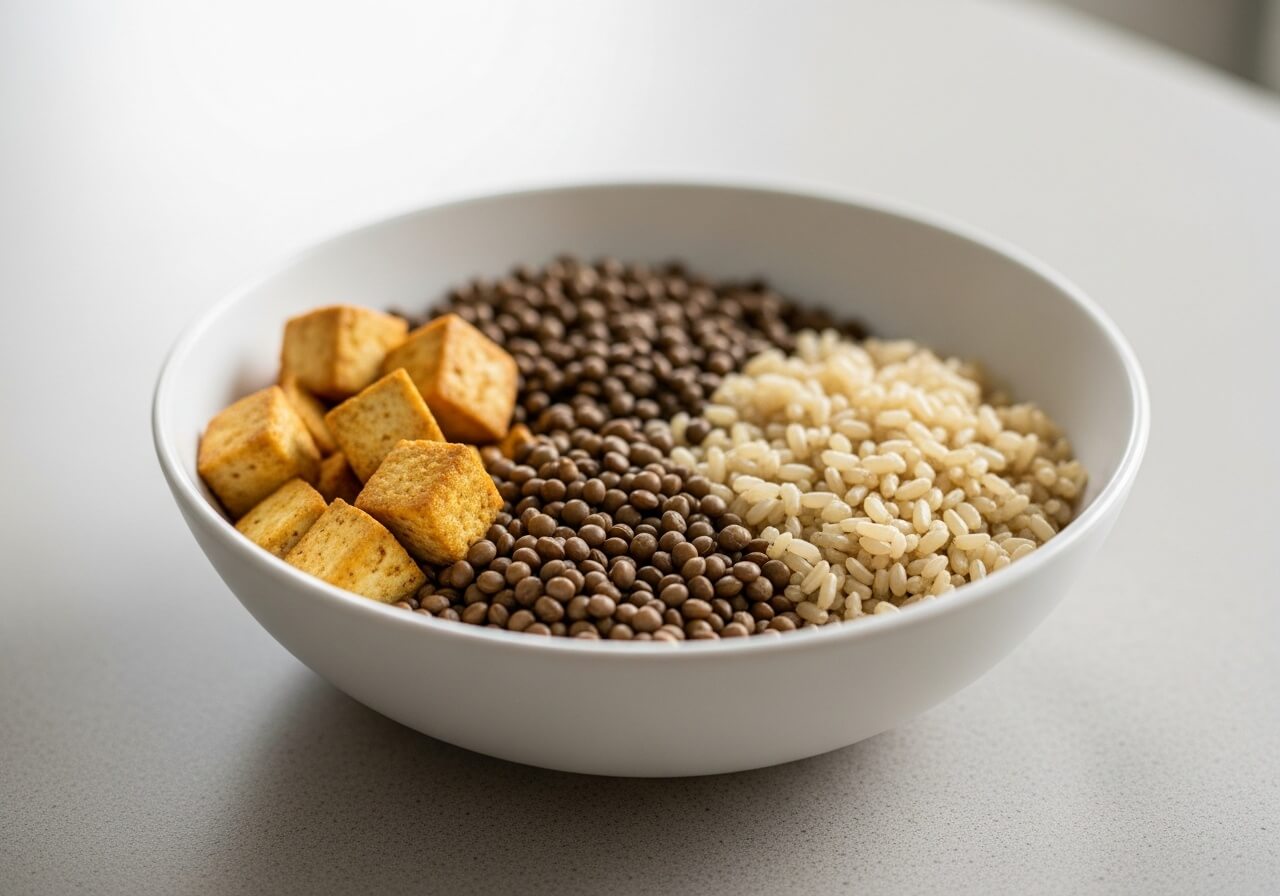
USDA’s Protein Foods framework counts in ounce-equivalents rather than grams, which is more useful than it sounds — it already accounts for how these foods are actually served. Daily targets are 5 to 6½ ounce-equivalents for women aged 19–59 and 6½ to 7 for men, before any training adjustment.
| One ounce-equivalent equals |
|---|
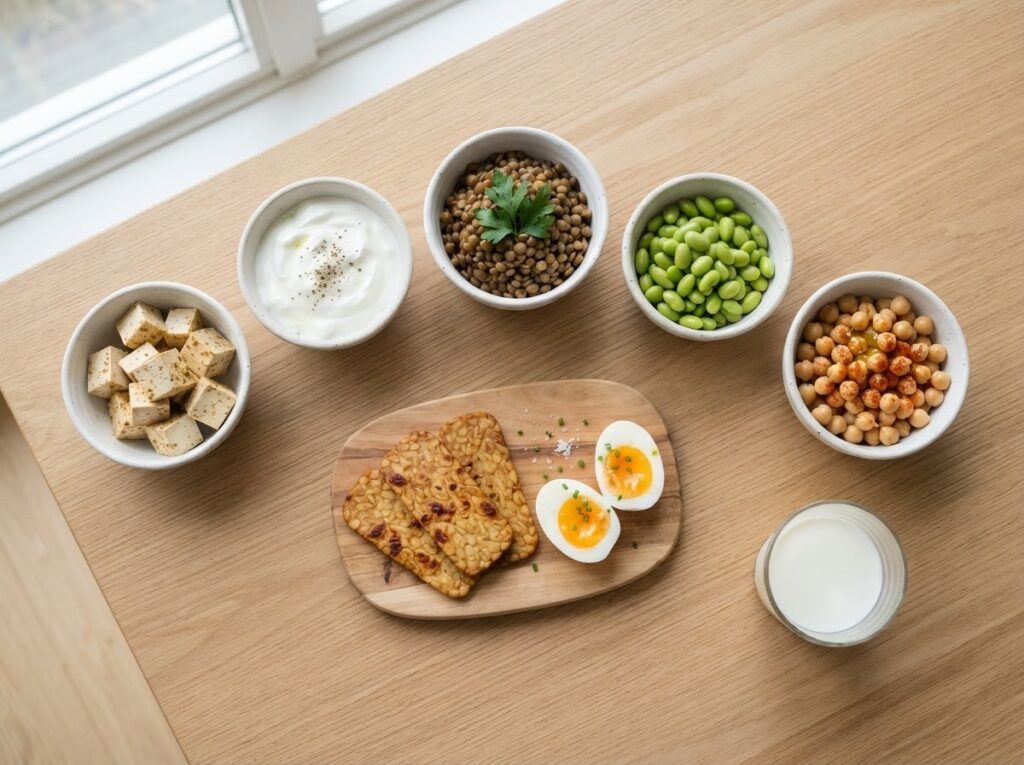
| ¼ cup of cooked beans, peas or lentils |
| ¼ cup of baked or refried beans |
| ¼ cup of frozen edamame |
| ¼ cup (about 2 oz) of tofu |
| 1 ounce of cooked tempeh |
| 6 tablespoons of hummus |
| 1 falafel patty |
| ½ ounce of nuts — 12 almonds, 24 pistachios or 7 walnut halves |
| ½ ounce of seeds — chia, flax, pumpkin, sesame, sunflower or squash |
| 1 tablespoon of nut or seed butter, or tahini |
Why we are not printing a grams-per-serving table. Protein figures for these foods vary by preparation, brand and water content, and the widely copied numbers on the internet often trace back to nothing checkable. USDA’s ounce-equivalents are published, consistent and directly usable. For a specific product, the Nutrition Facts panel on the package is the accurate source — how to read it is in our 30-second label guide.
Which plant proteins to lean on
Soy first. Across 17 trials, soy against milk protein produced no difference in muscle mass. Every other plant source has thinner evidence, and pooled across five trials the non-soy plant proteins do lag animal protein. Tofu, tempeh, edamame and soy milk are the workhorses.
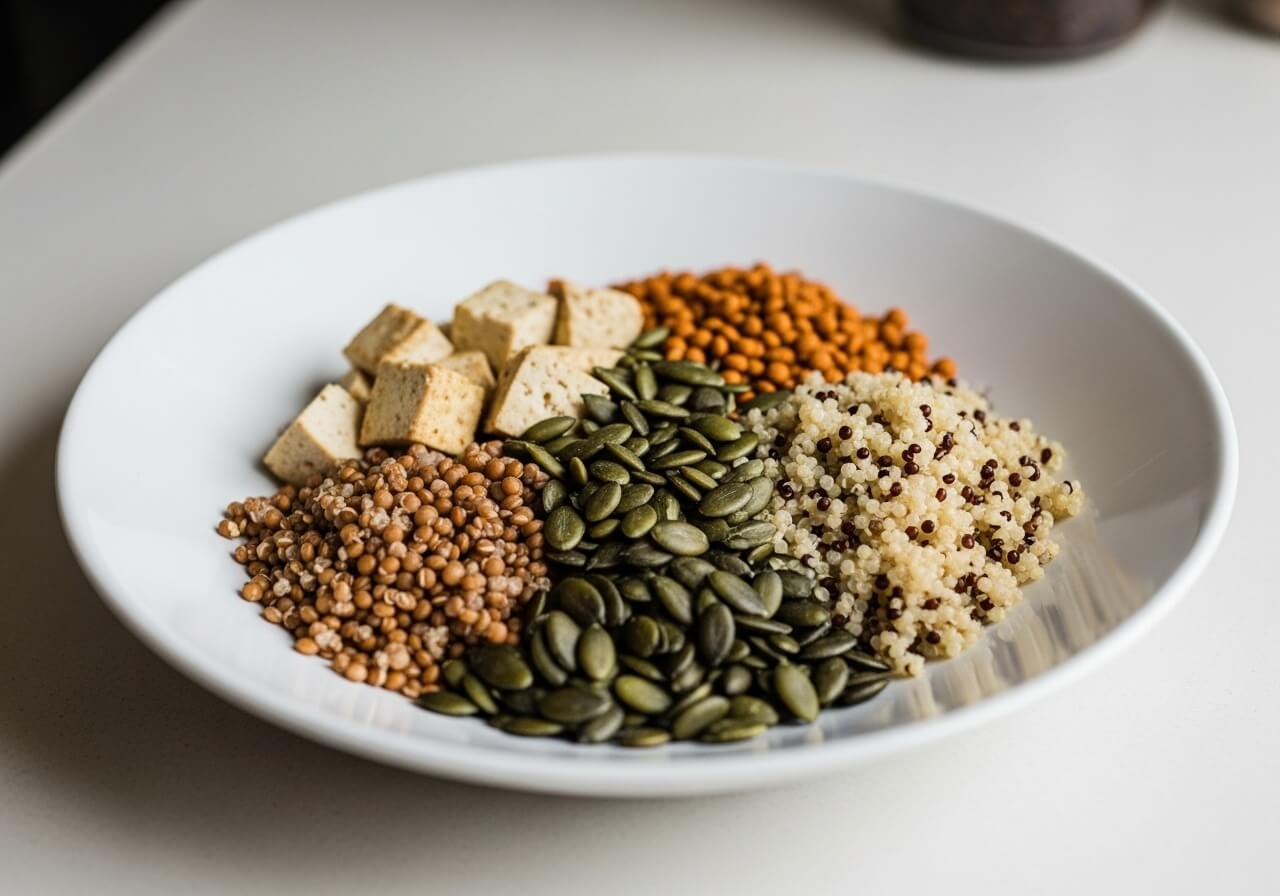
Then blend. Researchers name three ways to close the amino acid gap: eat a greater amount, use “specific blends of plant-based proteins to create a more balanced amino acid profile”, or fortify with the missing amino acid. Blending is the one you can do with a shopping list — grains are short on lysine, legumes on methionine and cysteine, and together they cover each other.
And the Academy makes the point that this happens naturally: “protein sources are rarely eaten individually in plant-based meals; rather they are normally ingested as part of a meal that includes multiple protein-containing foods.” You do not need to engineer combinations — beans with rice, hummus with bread, tofu with noodles already does it.
Four mistakes that actually cost you
- Missing the total. Everything above is downstream of hitting 1.5 g/kg or more. The evidence that plant and animal protein perform alike is conditional on matched intake.
- Relying on one source. A diet built mostly on rice and oats is short on lysine. Legumes and soy fix it.
- Assuming powder is required. It is a convenience. In the vegan trial, soy protein isolate was used simply to top participants up to target.
- Ignoring digestibility. Absorption of about 50–75% from legumes against 85–95% from eggs and chicken means the number on the label is not the number your body gets.
One thing the guidelines add
The 2025–2030 edition is direct about the risk: “Pay careful attention to potential nutrient gaps when consuming a vegetarian or vegan diet”, listing shortfalls in vitamins A, D, E, B6 and B12, riboflavin, niacin, choline, calcium, iron, magnesium, phosphorus, potassium, zinc — and protein.
That is not an argument against the diet; it is an argument for planning it. Which nutrients need attention, at what doses, and where supplementation is genuinely necessary rather than optional, is covered in nutrients to watch on a plant-based diet.
FAQ
How much protein do I need to build muscle without animal products?
At least 1.5 g per kg per day per the Academy of Nutrition and Dietetics, and the controlled trial that matched vegans with omnivores used 1.6 g/kg. Practical vegan-athlete guidance goes to 1.7–2.0.
Do I need protein powder?
No — it is a tool for closing the gap when food alone falls short. Where a supplement is used, soy has the strongest evidence among plant options.
Do I have to combine proteins at every meal?
No. Plant meals normally contain several protein foods anyway, and the balance across the day is what matters. The detail is in our guide to protein quality.
Is soy safe for men?
Two meta-analyses covering dozens of studies found no effect of soy protein or isoflavones on testosterone, free testosterone, SHBG or oestrogens at any dose tested.
Why do plant proteins need larger servings?
Lower digestibility and lower leucine content. Matching the leucine in 25 g of whey takes 20 to 54 g of plant protein depending on the source.
Where this fits
The evidence comparing the two protein types head to head is in plant vs animal protein for muscle. How protein quality is scored is in protein quality, and the micronutrients that need planning are in nutrients to watch on a plant-based diet.
Every figure here is linked to its source in the text: the Dietary Guidelines for Americans 2025–2030, USDA MyPlate, the Academy of Nutrition and Dietetics 2025 position paper, the International Society of Sports Nutrition position stand, and peer-reviewed research in Sports Medicine and Amino Acids. Checked against those sources on 2 September 2026. Educational information, not medical advice — see our medical disclaimer.
This content is for educational purposes only and is not medical advice. Always consult a qualified healthcare professional for personalised guidance.