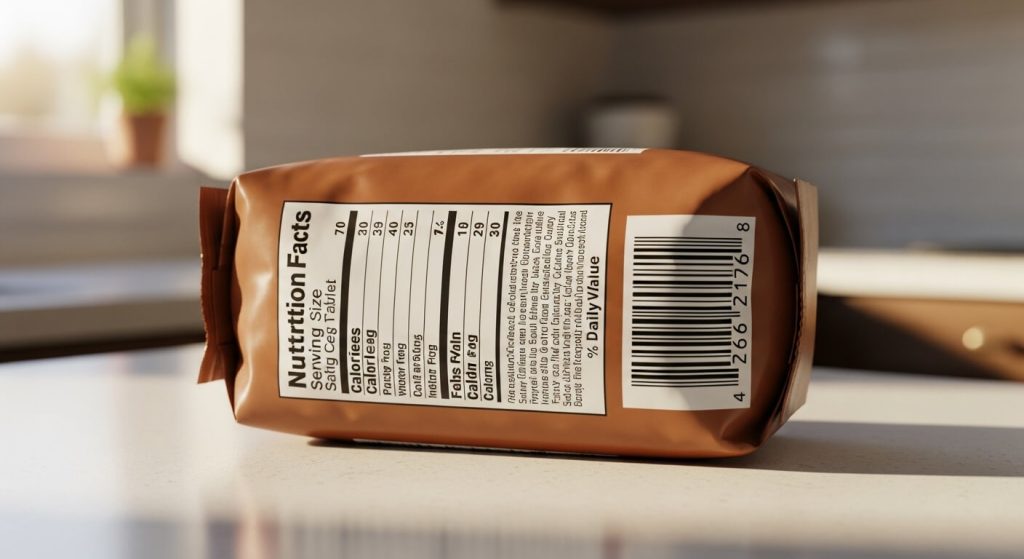

Most of a nutrition label is noise. To read one quickly you need four things: the serving size, the % Daily Value column, three nutrients to limit, and four to get more of. The FDA’s own shortcut does most of the work — “5% DV or less of a nutrient per serving is considered low, and 20% DV or more of a nutrient per serving is considered high.” Everything below is the 30-second version, built from FDA rules rather than opinion.
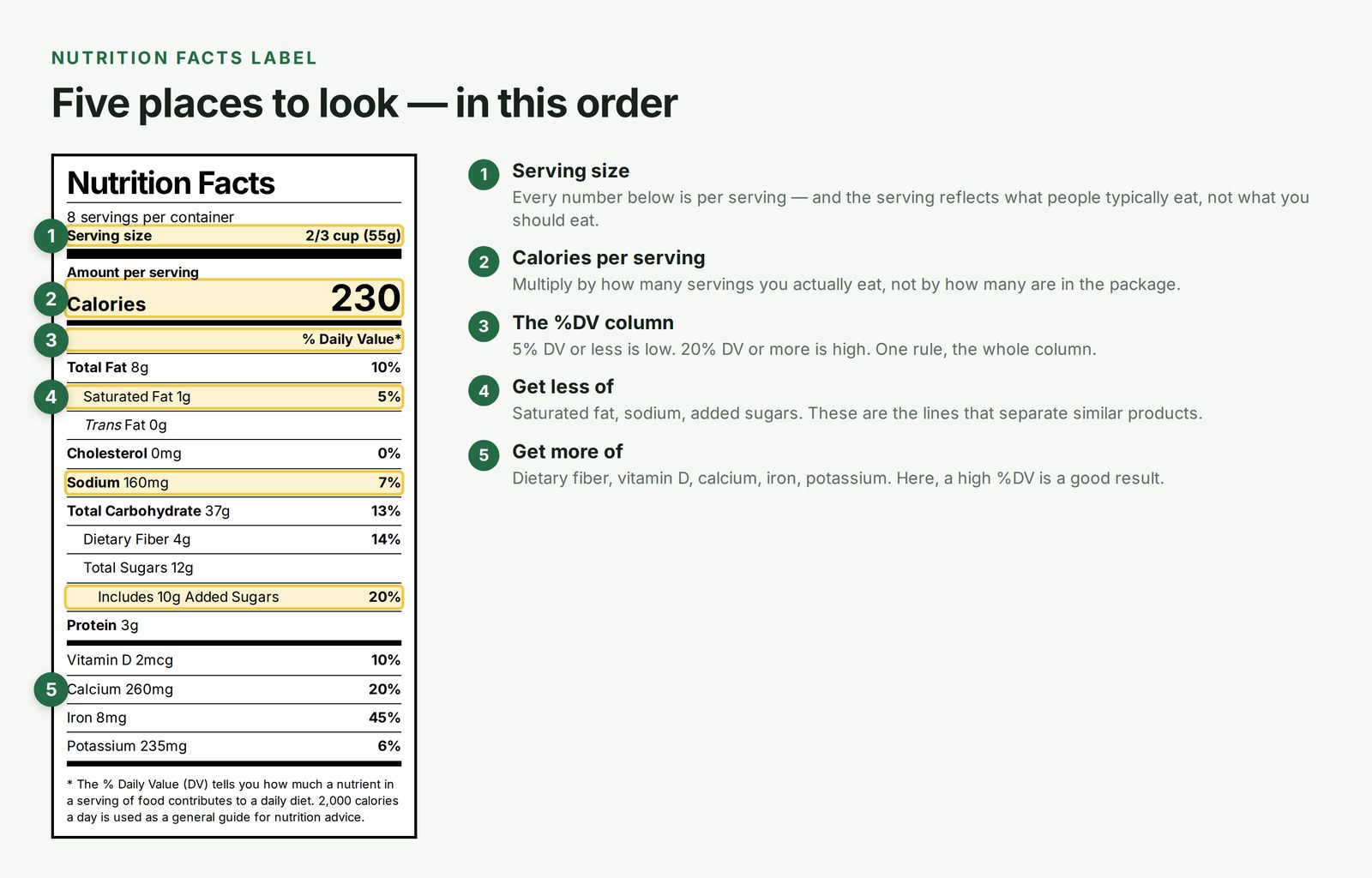
The 30-second version
- Serving size first. Every number on the label is per serving, and the serving is based on what people typically eat — not on what you should eat.
- Use the 5/20 rule. 5% DV or less is low. 20% DV or more is high. That single rule replaces most label math.
- Get less of: saturated fat, sodium, added sugars. Get more of: dietary fiber, vitamin D, calcium, iron, potassium.
- Total Sugars has no %DV — only Added Sugars does, and its Daily Value is 50 g.
- Ingredients are listed by weight, heaviest first. That order tells you what the product mostly is.
- “0 g” can mean “almost zero.” Under FDA rounding rules, less than 0.5 g of fat per serving is declared as zero.
Step 1: Check the serving size before you read anything else
The serving size sits at the top of the label because it sets the scale for every number underneath it. Eat two servings and you double the calories, the sodium and the added sugars.
The part most people get wrong: the serving size is not advice. By FDA rule, “serving sizes must be based on the amount of food people typically consume, rather than how much they should consume” — and “the serving size is not a recommendation of how much to eat or drink.”
Package size decides how the label is printed — the full rules are in our guide to serving size on a nutrition label. Every food category has a reference amount set by the FDA, and the container is measured against it:
| Package holds | What the label shows | Typical example |
|---|---|---|
| More than 150% and less than 200% of the reference amount | One serving — the whole container | A 20 oz bottle of soda |
| 200% to 300% of the reference amount | Two columns — per serving and per package | A pint of ice cream |
| More than that | Per serving only — you do the multiplying | A family-size bag of chips |
Step 2: Use the 5/20 rule — the only percentage worth memorizing
The %DV column tells you “how much a nutrient in a single serving of an individual packaged food or dietary supplement contributes to your daily diet.” You do not need to add these up across the day. You need one comparison: low or high.
5% DV or less = low. 20% DV or more = high.
It works in both directions. A frozen meal at 45% DV sodium is high — that one meal uses nearly half a day’s sodium allowance. A cereal at 25% DV fiber is also high, and here high is what you want. Same rule, opposite meaning, depending on which side of the label you are reading.
Step 3: Three nutrients to get less of, four to get more of
The FDA splits the label’s key nutrients into two groups: get less of saturated fat, sodium and added sugars, and get more of dietary fiber, vitamin D, calcium, iron and potassium. Sodium is the one worth watching hardest — Americans eat about 3,400 mg per day against a 2,300 mg limit, and over 70% of it comes from packaged and prepared foods, not the salt shaker.
Because 5% and 20% of a Daily Value are fixed amounts, you can skip the percentage column entirely and learn the grams and milligrams instead. This is the whole label in one table:
| Nutrient | Daily Value | “Low” = 5% DV | “High” = 20% DV |
|---|---|---|---|
| Saturated fat (limit) | 20 g | 1 g | 4 g |
| Sodium (limit) | 2,300 mg | 115 mg | 460 mg |
| Added sugars (limit) | 50 g | 2.5 g | 10 g |
| Dietary fiber (get more) | 28 g | 1.4 g | 5.6 g |
| Vitamin D (get more) | 20 mcg | 1 mcg | 4 mcg |
| Calcium (get more) | 1,300 mg | 65 mg | 260 mg |
| Iron (get more) | 18 mg | 0.9 mg | 3.6 mg |
| Potassium (get more) | 4,700 mg | 235 mg | 940 mg |
Daily Values come from the FDA’s Daily Value table — where those numbers come from, and the rounding behind them, is covered in our guide to % Daily Value; the 5% and 20% columns are calculated from them. Keep the two lines you care about in mind — for most people that is sodium and fiber — and the rest of the label can be skimmed.
Step 4: Total Sugars and Added Sugars are not the same line
Total Sugars counts everything, including the sugars naturally present in milk and fruit. Added Sugars counts only what was put in during processing. Only one of them has a Daily Value:
| Label line | What it counts | Daily Value |
|---|---|---|
| Total Sugars | Naturally occurring sugars plus added ones | None |
| Includes … Added Sugars | Only sugars added during processing, plus syrups, honey and concentrated juices | 50 g |
The FDA is explicit about the gap: “There is no Daily Value for total sugars because no recommendation has been made for the total amount to eat in a day.” Added Sugars does have one — 50 g per day on a 2,000-calorie diet, which is the basis FDA used when it set that Daily Value. Note that the current Dietary Guidelines for Americans, 2025–2030 state the target differently: “one meal should contain no more than 10 grams of added sugars.” So a label reading “Total Sugars 12 g, Includes 0 g Added Sugars” is plain yogurt or fruit, not a dessert. The two lines answer different questions.
The ingredient list tells you what the %DV column can’t
Ingredients are not listed in a random order. Under 21 CFR 101.4, they must be listed “by common or usual name in descending order of predominance by weight.” The first three ingredients are most of what you are buying.
Why “0 g trans fat” is not always zero. FDA labeling rules in 21 CFR 101.9 allow a serving with less than 0.5 g of fat to be declared as zero, and amounts under 5 calories to be expressed as zero. Eat three servings and those rounded-down halves add up. When a label claim and the ingredient list disagree, the ingredient list is the more honest document.
What’s changing on labels right now
Two changes are worth knowing, because both affect how packages will look over the next few years.
A front-of-package “Nutrition Info box.” In January 2025 the FDA proposed requiring an at-a-glance box on the front of most packaged foods, rating saturated fat, sodium and added sugars as “Low,” “Med” or “High.” The comment period closed on July 15, 2025; the rule is still proposed, not final, so nothing on shelves has changed yet.
“Healthy” now has stricter rules. The FDA’s updated definition of the “healthy” claim was finalized on December 27, 2024 and took effect February 25, 2025, with manufacturers required to comply by February 25, 2028. The other words on the front of a package — “natural”, “light”, “good source” — are covered in our guide to what food label claims legally mean. A product carrying it must contain a meaningful amount of a real food group and stay under set limits for added sugars, sodium and saturated fat.
FAQ
Is 20% DV a lot?
Yes — 20% DV or more is the FDA’s own threshold for “high.” Whether that is good or bad depends on the nutrient: 20% DV of fiber or potassium in one serving is a good result, 20% DV of sodium or added sugars in a snack is a lot for what you get.
What if I don’t eat 2,000 calories a day?
The %DV column is anchored to a 2,000-calorie diet, which the FDA states is “used as a general guide for nutrition advice.” Your calorie needs may differ, but the comparison still works: %DV is most useful for comparing two products on the same shelf, not for calculating your personal totals. For that, use a calorie and macro calculator instead.
Does “0 g trans fat” mean the food contains none?
No. FDA rounding rules allow anything under 0.5 g per serving to be declared as zero. Check the ingredient list, and check how many servings you are actually eating.
Which line should I check first if I only have five seconds?
Serving size, then the %DV for sodium and added sugars. Those three numbers separate most everyday packaged foods from each other faster than calories do.
What to do with this
Next time you are in a store, compare two similar products on three lines only: serving size, sodium %DV and added sugars %DV. That comparison takes about ten seconds and is the part of label reading that actually changes what ends up in the cart. To go deeper on a specific food, look it up in our Nutrition Facts database or put two options side by side with Compare Foods.
Every figure in this article is linked to its source in the text: the U.S. Food and Drug Administration’s Nutrition Facts label guidance and the Code of Federal Regulations, Title 21, Part 101. Checked against those sources on 31 August 2026. Educational information, not medical advice — see our medical disclaimer.
This content is for educational purposes only and is not medical advice. Always consult a qualified healthcare professional for personalised guidance.