The number everyone repeats — that Americans put on five to ten pounds between Thanksgiving and New Year — does not come from any study. The measured figure is under a pound. What makes the holidays matter is not the size of the gain but the fact that it tends to stay: the research the Mayo Clinic cites finds people gain a little over a pound across a whole year, and most of it arrives in those six weeks. Two dishes that fit the table without much argument: maple sweet potatoes and apple crisp.
So the useful question is not how to survive one dinner. It is what a holiday plate actually contains — and there the surprise is not calories at all. Below: the real numbers on holiday weight gain, a classic Thanksgiving plate costed out from USDA data, the one nutrient that quietly runs to the daily limit in a single meal, what actually helps according to sources that put their name to it, and the food-safety numbers for the turkey and the leftovers.
Key takeaways. Average holiday weight gain is about three quarters of a pound, not five to ten — but it is rarely lost again. A standard plate (turkey breast, mashed potatoes, stuffing, gravy, cranberry sauce, candied sweet potato, a roll and a slice of pumpkin pie) works out to roughly 1,280 calories from USDA data. Its sodium comes to about 2,150 mg, which is 93% of the entire daily limit in one sitting. Thaw the turkey in the refrigerator, 24 hours per five pounds, never on the counter; cook to 165 °F; refrigerate within two hours; eat leftovers within three to four days.
What people actually gain over the holidays
The Mayo Clinic’s Donald Hensrud puts the measured figure plainly: “Studies have shown that, from mid-November until mid-January, people averaged a weight gain in the population of about three quarters of a pound or so.” That is the number the research supports. Nothing on any federal or academic source supports five to ten pounds; it is folklore that has outlived every attempt to check it.
The part worth taking seriously is what happens afterwards. The National Heart, Lung, and Blood Institute frames it this way: “While research shows that most people don’t gain as much weight as they fear they will over the holidays, many can’t seem to lose their holiday pounds afterward.” And it adds the consequence — “The extra weight can build up over the years and contribute to obesity later in life.” Hensrud makes the same point from the other direction: “We only gain a little over a pound the entire year, so most of it is during the holiday season and it’s cumulative.”
In other words, the holidays are not an emergency, and one dinner changes nothing. Twenty Decembers in a row, each leaving three quarters of a pound behind, is fifteen pounds. That is the mechanism — slow accumulation, not the meal.
What one holiday plate actually costs
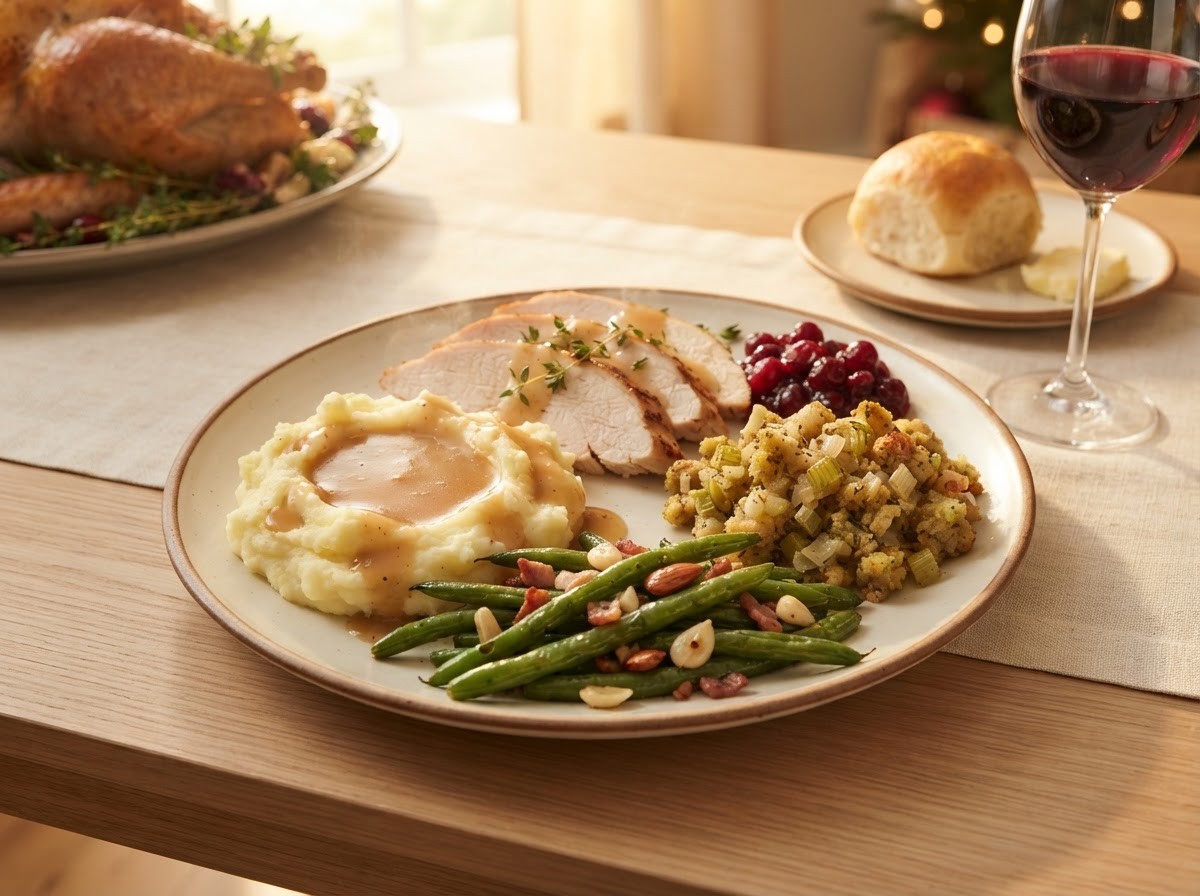
Here is a standard American holiday plate, each item at a realistic serving size, with figures from USDA FoodData Central. Sugars are total sugars as USDA reports them, which includes both added and naturally occurring.
| Dish | Serving | Calories | Sodium | Total sugars |
|---|---|---|---|---|
| Roast turkey breast, no skin | 3 oz (85 g) | 125 | 84 mg | 0 g |
| Mashed potatoes, milk and butter | 1 cup (210 g) | 237 | 666 mg | 3 g |
| Bread stuffing | ½ cup (100 g) | 195 | 479 mg | 2 g |
| Turkey gravy | ¼ cup (60 g) | 30 | 343 mg | 0 g |
| Cranberry sauce, canned | ¼ cup (69 g) | 110 | 3 mg | 22 g |
| Candied sweet potato | 1 piece (105 g) | 172 | 125 mg | 29 g |
| Dinner roll | 1 oz (28 g) | 87 | 131 mg | 2 g |
| Pumpkin pie | 1 slice (133 g) | 323 | 318 mg | 25 g |
| Plate total | ≈1,280 | ≈2,150 mg | ≈82 g |
Drinks sit on top of that: a 5 oz glass of red wine is 125 calories, a 12 oz beer 153, and a cup of eggnog 224 calories with 20 g of sugar. Swapping white turkey for dark meat with the skin adds 50 calories, which is the smallest decision on the table.
Against the FDA’s 2,000-calorie label basis, the plate alone is roughly two thirds of a day. That is a lot for one meal and completely unremarkable once a year. The 2025–2030 Dietary Guidelines are careful here too: “The calories you need depend on your age, sex, height, weight, and level of physical activity.” There is no single right number to measure this plate against.
Calories are not the interesting number. Sodium is
Add up the sodium column and the plate comes to about 2,150 mg. The Dietary Guidelines set the limit at “less than 2,300 mg per day of sodium” for everyone aged 14 and up, and the FDA uses the same 2,300 mg as the Daily Value. One holiday dinner is 93% of it — before the appetizers, before the cheese board, before anything anyone snacked on while cooking.
And it is not the turkey. The bird contributes 84 mg. The sodium is in the mashed potatoes (666 mg), the stuffing (479 mg), the gravy (343 mg) and the pie crust (318 mg) — the supporting cast nobody thinks of as salty. If you want one change that actually moves a number, it is making the potatoes and the stuffing with less salt, not eating less turkey. For the full picture, see daily sodium intake guidelines and sodium, potassium and blood pressure. For anyone on a sodium-restricted diet for blood pressure, this is the one line in the article that matters.
The sugar column tells a similar story: about 82 g of total sugars, and the three dishes responsible are cranberry sauce, candied sweet potato and pie. The Dietary Guidelines’ own per-meal wording is striking against that: “one meal should contain no more than 10 grams of added sugars.” USDA does not break out added sugars for these specific entries, so the honest statement is that most of the sugar in those three dishes is added rather than native to the food, and the plate is well past 10 g either way. Where it hides the rest of the year is in hidden sugars in healthy foods.
What actually helps
Skip the advice nobody follows. These are the recommendations that appear on sources willing to sign their name to them.
- Do not arrive hungry. The Academy of Nutrition and Dietetics: “Skipping meals before the event may lead some people to overeat later.” Mayo says the same — eat something with fruit or nuts beforehand.
- Vegetables first. The CDC: “Fill your plate with your favorite fruits and vegetables first, then add small portions of less healthy items.”
- Decide before you serve. Mayo’s version: “Decide ahead of time what you’re going to eat. Try to stick with that.” The Academy adds the practical one: “Move your socializing away from the buffet tables or appetizer trays.”
- Spend the calories on what you actually like. “Savor foods you truly enjoy and pass on those that don’t really interest you” — a better filter than any rule about which dish is “healthy.”
- Alternate drinks. Mayo suggests “alternating an alcoholic drink with some carbonated water with a little flavoring or something else with few calories.”
- Move, even briefly. The CDC notes that “even a few minutes of moderate-intensity physical activity can deliver some health benefits and count toward reaching the recommendations.” NIH’s version is more blunt: instead of a nap, do something that involves standing up.
And the thing worth saying out loud, from the Cleveland Clinic: after a big meal, “when you go back to your normal eating routine, you’ll go back to your usual weight.” One dinner does not need repairing. What needs attention is January, and the way back is the ordinary one — see how to start eating healthy and a meal-prep system you can keep.
What the guidelines now say about alcohol
This one changed, and most holiday articles have not caught up. The old formulation — up to two drinks a day for men, one for women — no longer appears in the Dietary Guidelines. The 2025–2030 edition says simply: “Consume less alcohol for better overall health.” The numeric definition of moderate drinking now survives on professional sources such as the Academy of Nutrition and Dietetics, which still defines it as “up to one drink per day for women and up to two drinks per day for men” — so if you see that figure attributed to the Dietary Guidelines this season, it is out of date.
The Guidelines are also specific about who should not drink at all, naming pregnant women and “people who are recovering from alcohol use disorder or are unable to control the amount they drink.” On the calorie side: three glasses of wine across an evening is about 375 calories that nobody counts. What alcohol does to training and recovery is covered in alcohol and athletic performance.
The turkey and the leftovers: the numbers that matter
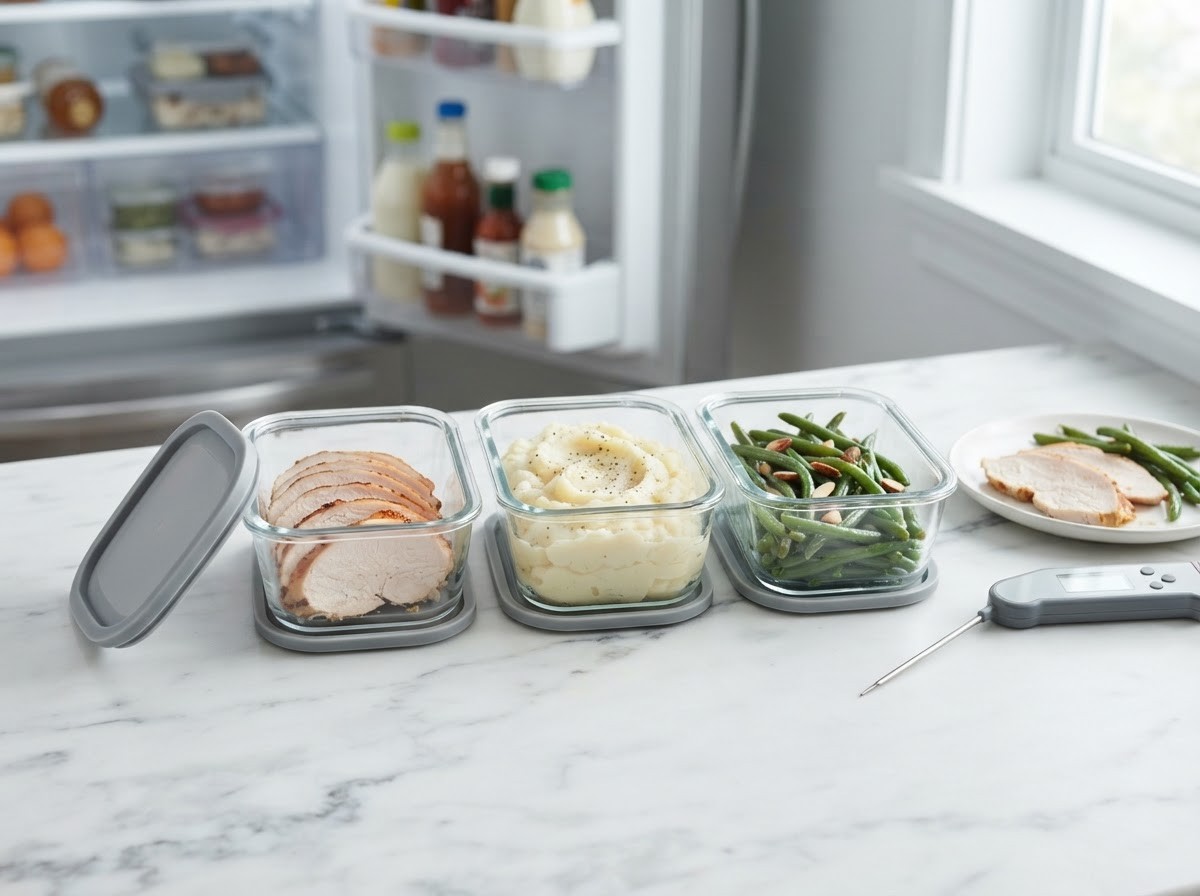
This is the part of holiday eating where getting it wrong has consequences the same week. All of it comes from USDA’s food-safety guidance.
| Step | The rule |
|---|---|
| Thawing | 24 hours for every five pounds in the refrigerator — a 16 lb bird needs 3 to 4 days. Cold water: 30 minutes per pound, changing the water every 30 minutes, cook immediately after. “The turkey should never be thawed on the counter or in hot water.” |
| Cooking | 165 °F, measured “in the thickest part of the breast, the innermost part of the thigh, and the innermost part of the wing.” |
| Stuffing in the bird | USDA does not forbid it but calls it riskier: the center of the stuffing must also reach 165 °F. |
| The table | Refrigerate within two hours — one hour if the room is above 90 °F. The clock runs from when the food leaves the oven or the warming tray. |
| Leftovers | Three to four days in the refrigerator, three to four months frozen. Reheat to 165 °F. |
Two of these trip people up every year. The first is thawing time — a large frozen bird bought on the Tuesday cannot be safely thawed by Thursday in the refrigerator, and the counter is not an option. The second is the two-hour rule, because a holiday table stays out for the whole afternoon by design. If dinner runs long, the food still needs to go back in the fridge on schedule. USDA staffs a Meat and Poultry Hotline for exactly these questions at 1-888-674-6854, weekdays 10 a.m. to 6 p.m. Eastern.
What we are not claiming
- That people gain five to ten pounds over the holidays. No federal or academic source supports it; the measured figure is about three quarters of a pound.
- An exact research figure of “one pound.” The studies most often quoted for it sit behind sources we do not cite from, so we use the Mayo Clinic’s number instead.
- That a 1,280-calorie dinner causes lasting weight gain. It does not; the Cleveland Clinic’s position is that normal eating returns you to your usual weight.
- An added-sugar total for the plate. USDA reports total sugars for these entries, and we have not separated added from naturally occurring.
- That the Dietary Guidelines permit one drink a day for women and two for men. The current edition says only to consume less alcohol; the numeric definition belongs to the Academy of Nutrition and Dietetics.
- Any “walk X miles to burn off the pie” equivalence. No source we use gives one, and the arithmetic behind those claims is not reliable.
FAQ
How much weight do people really gain over the holidays?
About three quarters of a pound on average between mid-November and mid-January, per the Mayo Clinic. The problem is not the amount but that it is often never lost, and it accumulates over years.
How many calories are in a Thanksgiving dinner?
A plate of turkey breast, mashed potatoes, stuffing, gravy, cranberry sauce, candied sweet potato, a roll and a slice of pumpkin pie comes to roughly 1,280 calories from USDA data — about two thirds of a 2,000-calorie day, before drinks and appetizers.
What is the unhealthiest part of a holiday plate?
By the numbers, the sodium in the sides. Mashed potatoes, stuffing, gravy and pie crust together supply about 1,800 mg, while the turkey contributes 84 mg. The whole plate reaches roughly 93% of the daily sodium limit.
How long can a turkey sit out after dinner?
Two hours, or one hour if the room is above 90 °F, counted from when it comes out of the oven. After that, perishable food should be refrigerated or discarded.
How long do Thanksgiving leftovers last?
Three to four days in the refrigerator or three to four months in the freezer, and they should be reheated to 165 °F.
Should I skip breakfast to save calories for the big meal?
No. The Academy of Nutrition and Dietetics warns that skipping meals beforehand tends to lead to overeating later; NIH suggests a normal breakfast for the same reason.
This content is for educational purposes only and is not medical advice. Always consult a qualified healthcare professional for personalised guidance.