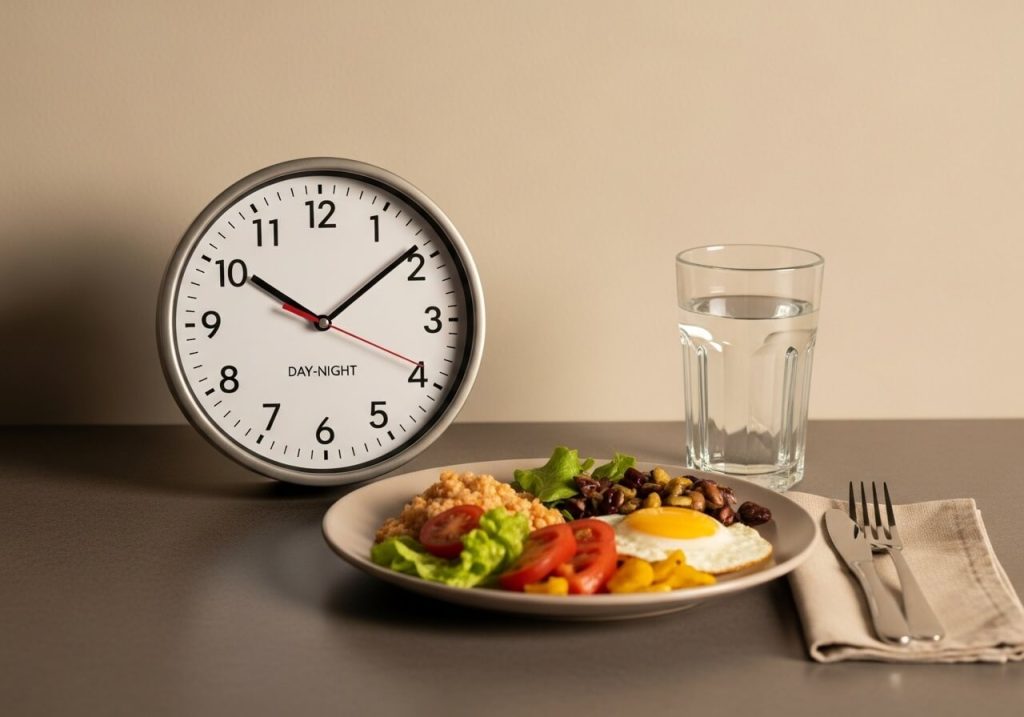
16/8 means a 16-hour fast paired with an eight-hour eating window, every day. It is the most popular fasting protocol in the world, and the trials on it are unusually clear about both what it does and why. The short answer: it works modestly, and it works by making you eat less. Everything else claimed for it is thinner than the marketing suggests.
The short version
- It reduces calorie intake without counting. In one trial the eating window cut intake by about 341 calories a day compared with controls.
- It is not better than counting calories. A 12-month trial found −4.61 kg with 16/8 against −5.42 kg with calorie restriction — no significant difference.
- Fasting glucose, insulin and HOMA-IR improve modestly in pooled trials. HbA1c, triglycerides and LDL do not.
- An earlier window looks better than a later one for insulin sensitivity — though not every trial agrees.
- Watch lean mass. One flagship trial found most of the weight lost was lean mass; pooled data is more reassuring. Both findings are below.
- Fasting longer than 16 to 18 hours a day is associated with a higher risk of gallstones.
What 16/8 actually means
Formally, it is “a fasting period of 16 hours coupled with a daily time-restricted eating (TRE) period of 8 hours.” There is no rule about what you eat inside the window, and no calorie target. That is the appeal — and, as the trials show, also the mechanism. Our intermittent fasting calculator sets out the hours of a 16/8 day and the calories that go with them.
In the largest randomised test of the protocol, participants were simply told to eat freely from noon until 8 pm and consume no calories from 8 pm until noon the next day. That is the whole intervention.
Does it work? Yes — by cutting calories
A pilot study of an 8-hour window from 10 am to 6 pm found participants lost 2.6% of body weight over 12 weeks, and measured why: energy intake fell by 341 ± 53 calories a day relative to controls. Nobody counted anything. The window did the counting.
The controlled trials that matched calories tell the other half of the story. A Johns Hopkins trial gave both groups identical calories and macronutrients, varying only the timing, and found both lost about the same weight with no significant differences in fasting glucose, waist circumference, blood pressure or lipids. The lead investigator’s summary was blunt: “It makes us think that people who benefit from time-restricted eating—meaning they lose weight—it’s probably from them eating fewer calories because their time window’s shorter and not something else.”

| Trial | Comparison | Result |
|---|---|---|
| TREAT, 12 weeks, n=116 | Noon–8 pm window vs three structured meals | −0.94 kg vs −0.68 kg; between-group difference not significant |
| 12-month trial, n=90 | 8-hour window vs calorie counting | −4.61 kg vs −5.42 kg; no significant difference |
| 12-month trial, n=139 | 8-hour window + calorie restriction vs calorie restriction alone | −8.0 kg vs −6.3 kg; net −1.8 kg, not significant |
| Meta-analysis, 20 trials | Time-restricted eating vs no restriction | −1.59 kg, significant |
Put together: against doing nothing, an eight-hour window is worth roughly one and a half kilograms. Against actually reducing calories, it is worth nothing extra. Its advantage is not physiological, it is practical — one rule instead of arithmetic at every meal.
The lean mass question, honestly
This deserves both sides, because a single striking finding has been repeated everywhere without its context.
The TREAT trial’s in-person cohort found that of the weight lost, “1.10 kg (approximately 65% of weight lost) was lean mass; only 0.51 kg of weight loss was fat mass” — against a normal expectation the authors state as “20% to 30% of total weight loss.” That is a real, published result, and it is alarming on its face.
But the pooled data does not replicate it. A meta-analysis of nine trials in adults with obesity found no significant lean-mass difference against controls (−0.25 kg, p=0.30). A 2025 review of 20 trials found lean mass fell by a similar amount whether time-restricted eating was used alone or combined with calorie restriction. The fair reading: TREAT’s 65% figure comes from a small subgroup of 50 people, and the wider evidence does not show that an eight-hour window is worse for muscle than any other way of losing weight. Resistance training and adequate protein remain the answer either way.
What happens to blood markers
A meta-analysis of 23 randomised trials covering 1,280 adults looked specifically at 16/8 rather than fasting in general. The results split cleanly into what moves and what does not:
| Marker | Effect vs control | Significant? |
|---|---|---|
| Fasting glucose | SMD −0.25 | Yes (P=.004) |
| Fasting insulin | SMD −0.22 | Yes (P=.04) |
| HOMA-IR (insulin resistance) | SMD −0.16 | Yes (P=.03) |
| HDL cholesterol | SMD +0.15 | Yes (P=.04) |
| HbA1c | SMD −0.12 | No (P=.27) |
| Triglycerides | SMD −0.12 | No (P=.10) |
| LDL cholesterol | SMD +0.04 | No (P=.56) |
These are small effects, and standardized mean differences of 0.15 to 0.25 are modest by any standard. But the direction is consistent for glucose handling, which is the most defensible claim anyone can make for this protocol beyond weight.
Does it matter when the window sits?
This is the most interesting open question in the field, and the evidence genuinely conflicts.
For an earlier window. A randomised trial compared an eating window of 6 am to 3 pm against 11 am to 8 pm in healthy adults. The early group improved insulin resistance markedly while the midday group did not, and the authors concluded that early time-restricted eating “showed greater benefits for insulin resistance and related metabolic parameters compared with mTRF.” A separate 14-week trial of a 7 am to 3 pm window plus calorie restriction found greater weight loss than a longer window — −2.3 kg — though notably no difference in body fat, and calculated that the effect was equivalent to cutting about 214 calories a day.
Against it mattering much. A controlled crossover study loaded calories either in the morning or the evening, with the same total energy, and reported “no differences in total daily energy expenditure or resting metabolic rate related to the timing of calorie distribution, and no difference in weight loss.” What did change was hunger: the morning-loaded diet left people significantly less hungry.
Hunger may be the real mechanism. Another controlled study found that eating late increased hunger, raised the ghrelin-to-leptin ratio and reduced waketime energy expenditure. An earlier window may not burn more; it may simply make eating less feel easier.
What you can drink during the fast

The protocols used in trials specify abstaining from caloric intake — the TREAT participants were told to “completely abstain from caloric intake” outside the window. Water, plain coffee and plain tea contain essentially none. Anything with sugar, milk or cream does, and ends the fast as the trials defined it.
Safety: the specific cautions
The Office of Dietary Supplements’ own guidance says fasting “can be dangerous for some people” and lists who should speak to a provider first: anyone under 25, pregnant or breastfeeding, taking insulin or other diabetes medication, prescribed medication that must be taken with food, with a seizure disorder, working night shifts, or operating heavy machinery.
Two items are specific to long daily windows:
- Gallstones. The same NIH source states that “people who regularly fast more than 16 or 18 hours a day have a higher risk of gallstones.” Sixteen hours is the threshold, not a comfortable distance from it.
- Diabetes medication. The ADA notes that hypoglycaemia risk is higher on insulin and secretagogues, that roughly half of hypoglycaemic events cluster in the final hours of a fast, and that avoiding intense exercise in those hours “seems to be a sensible approach.”
Anyone with a history of disordered eating should not use fasting protocols. And a twelve-hour window is a reasonable place to start: as one of the field’s own researchers puts it, “eating for 12 hours and then fasting for 12 hours is likely safe for most people.”
FAQ
Does 16 hours of fasting trigger autophagy?
There is no human evidence establishing a 16-hour threshold. Researchers writing on this in 2024 state that the optimal duration needed to trigger autophagy remains an open question, that human studies have relied on indirect markers, and that there is a notable lack of human data. The animal evidence is real; the specific number is not.
Is 16/8 better than counting calories?
No. At 12 months it produced −4.61 kg against −5.42 kg for calorie counting, with no significant difference. It is easier to follow, which is a genuine advantage — but not a metabolic one.
Will I lose muscle?
One trial found an unusually high proportion of lean mass lost; pooled analyses of many trials do not show that time-restricted eating is worse than other approaches. Eat enough protein and do resistance training, which is the answer regardless of how you time meals.
Should my window be early or late?
An earlier window has better evidence for insulin sensitivity, and controlled studies show late eating increases hunger. A study that matched calories exactly found no difference in energy expenditure or weight loss from timing alone, so the effect may work through appetite rather than metabolism.
Can I drink coffee during the fasting window?
Plain black coffee and plain tea contain effectively no calories, and the trials define the fast in terms of caloric intake. Adding sugar, milk or cream breaks it.
Where this fits
For the other protocols and how they compare against each other and against plain calorie restriction, see our guide to intermittent fasting: what it is and what the evidence shows. If your interest is what to put inside the window rather than when it opens, start with reading a nutrition label in 30 seconds.
Every figure here is linked to its source in the text: NIH News in Health, the American Diabetes Association Standards of Care, Johns Hopkins Medicine, and peer-reviewed trials and meta-analyses in Nutrition Reviews, JAMA Internal Medicine, Annals of Internal Medicine, Nature Communications, Cell Metabolism, Nutrition and Healthy Aging and the International Journal of Behavioral Nutrition and Physical Activity. Checked against those sources on 1 September 2026. Educational information, not medical advice — see our medical disclaimer.
This content is for educational purposes only and is not medical advice. Always consult a qualified healthcare professional for personalised guidance.