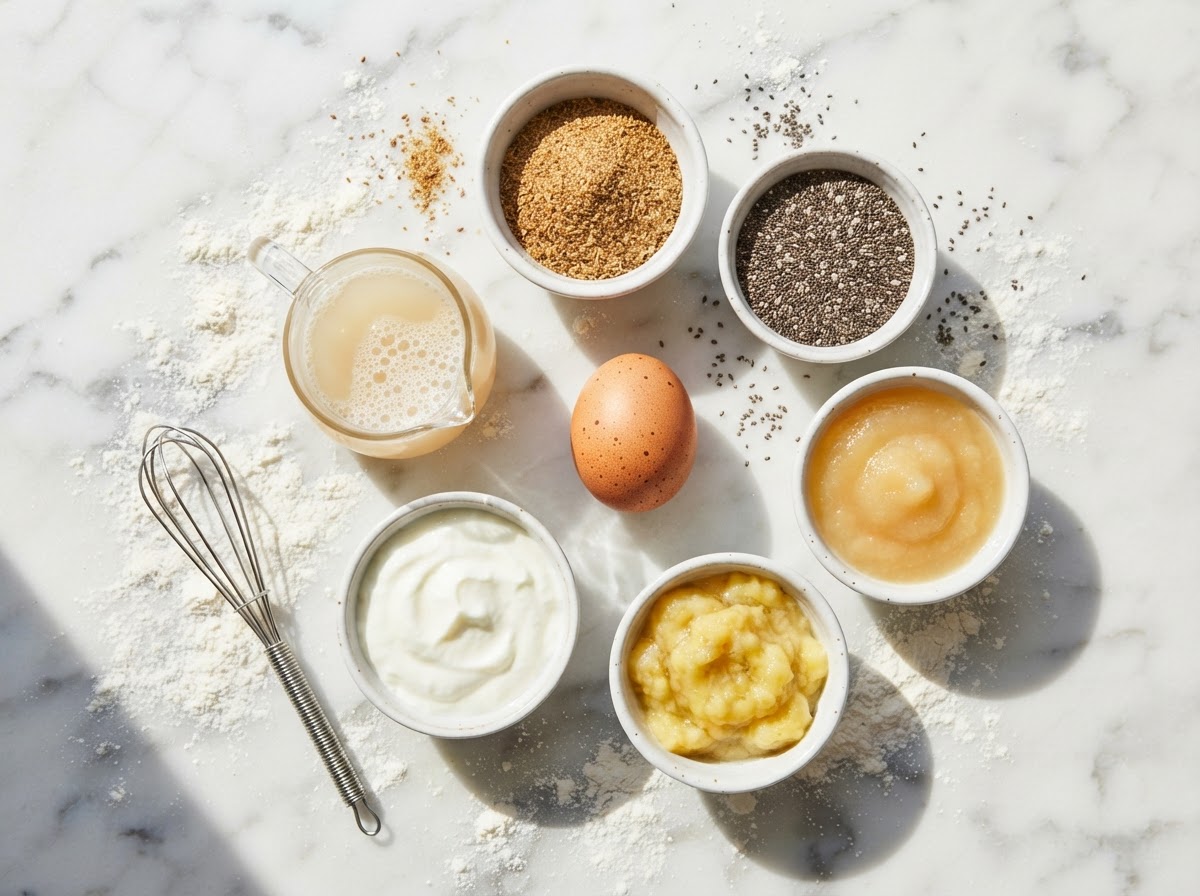
One large egg equals 1 tablespoon of ground flaxseed plus 3 tablespoons of water, or ¼ cup of applesauce, or 3 tablespoons of aquafaba — but which one you reach for depends entirely on what the egg was doing in that recipe. Binding, leavening and moisture are three different jobs, and no single swap covers all three. There is also a ceiling nobody mentions: US Cooperative Extension services say substitutes “generally do not work if a recipe calls for more than 3 eggs.” If the flour is changing too, our flour substitute calculator covers that swap.
Below: the ratio table, how to pick by function, what each swap costs you in protein and sugar, the four bakes where none of this works, and the product-label trap that catches people baking for an egg allergy.
Key takeaways. Flax and chia (1 Tbsp + 3 Tbsp water) bind. Aquafaba (3 Tbsp) and oil-water-baking-powder leaven. Applesauce, banana, yogurt and silken tofu (¼ cup) add moisture. Above three eggs, stop — Extension services say substitutes fail there. And check the label: liquid “egg substitute” in the refrigerated aisle contains egg whites; powdered “egg replacer” is the egg-free one. The amounts for other swaps are in our butter and oil substitute calculator, buttermilk substitute calculator and sugar substitute calculator.
If you would rather not do the arithmetic, the egg substitute calculator takes the number of eggs in your recipe and gives you the amount to mix, plus what that particular swap covers and what it leaves uncovered.
The ratio table
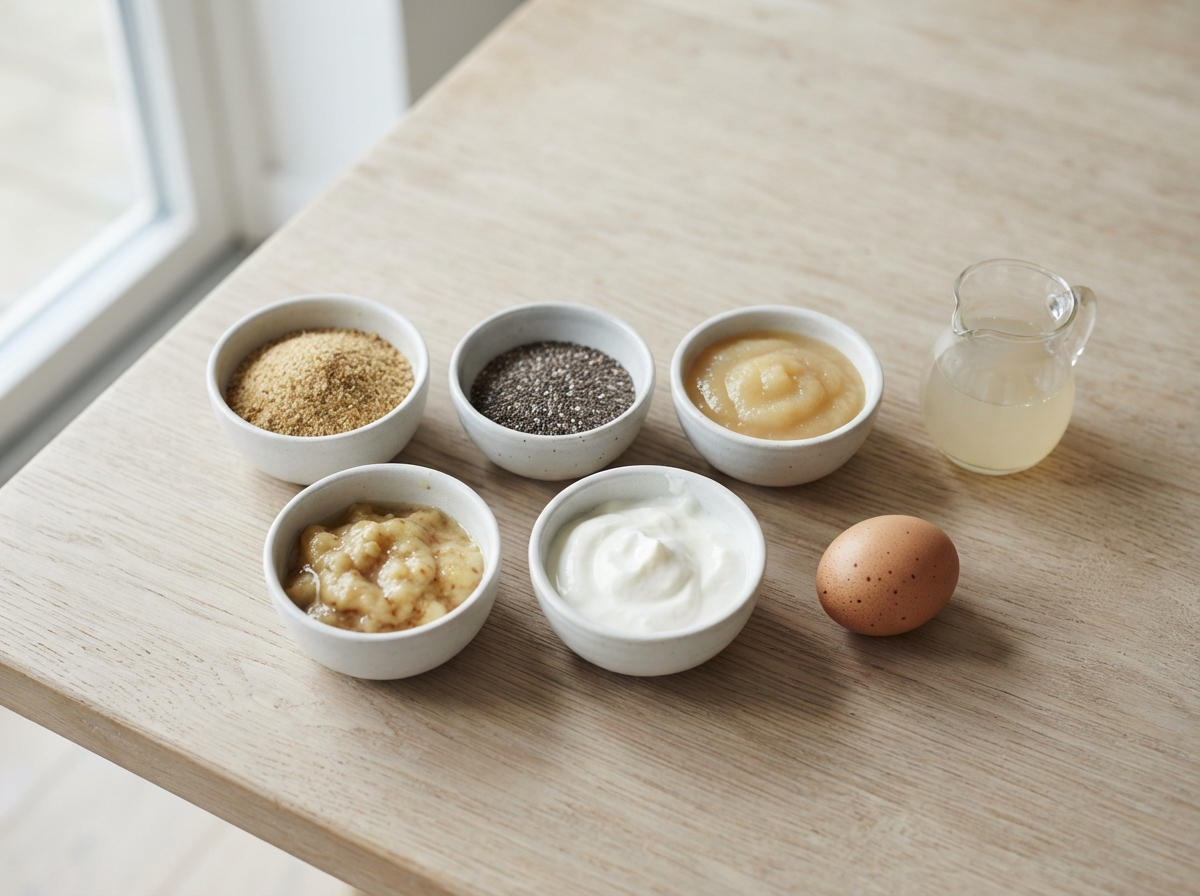
| Substitute for 1 large egg | Amount | Best for |
|---|---|---|
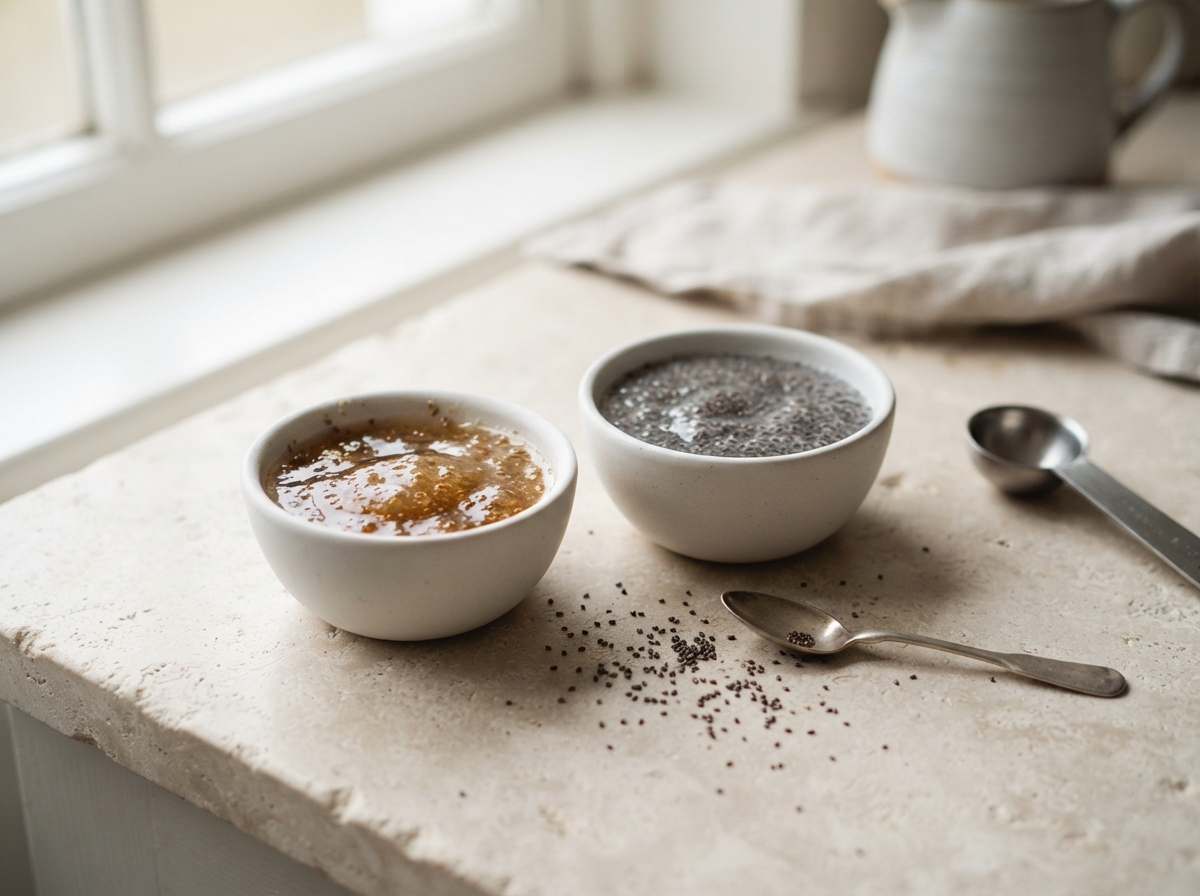
| Ground flaxseed + water | 1 Tbsp + 3 Tbsp water, rest 5 min | Binding |
| Chia seed + water | 1 Tbsp + 3 Tbsp water, rest 5 min | Binding |
| Unsweetened applesauce | ¼ cup | Moisture |
| Mashed ripe banana | ¼ cup | Moisture |
| Silken tofu, puréed | ¼ cup | Moisture |
| Plain yogurt | ¼–½ cup | Moisture |
| Aquafaba (chickpea liquid) | 3 Tbsp, whipped to a foam | Leavening |
| Oil + water + baking powder | 1½ Tbsp oil + 1½ Tbsp water + 1 tsp baking powder | Leavening |
| Vinegar + baking soda | 1 Tbsp vinegar + 1 tsp baking soda | Leavening |
| Powdered egg replacer | 1 Tbsp + 2 Tbsp water | General |
| Nut butter | 3 Tbsp | Binding |
| Unflavoured carbonated water | ¼ cup | Leavening |
The flax and chia ratio is the most solid figure on this page — six independent Extension sources give the same numbers. NC State: “1 tablespoon ground flax seeds + 3 tablespoons of water = 1 large egg.” Illinois Extension adds the resting step: “Combine and let sit for 5 minutes.” Kansas State gives the same for chia — “one tablespoon of chia seeds or ground flax seeds mixed with three tablespoons of water to replace one egg.”
For aquafaba, NC State is specific about the technique: “Three tablespoons of aquafaba equals one egg. Whip the aquafaba until it forms fluffy foam.”
First work out what the egg was doing
This is the step people skip, and it is why swaps fail. Iowa State Extension lists the full job description: eggs “can provide structure, leavening, tenderizing, moisture, flavor, color, nutrition, or thickening properties” and also “act as an emulsifier bridging waters and fats.”
NC State compresses that into the practical version: eggs “usually have three jobs: they act as a binder to hold the recipe together, provide moisture and/or act as a leavening agent to help the food rise.” Illinois Extension puts the consequence plainly: “Depending upon the recipe and the function of the egg, certain options are better suited than others.”
A rough rule that follows from the table:
- Cookies, brownies, veggie burgers, meatballs — the egg is binding. Use flax or chia.
- Quick breads, muffins, dense cakes — the egg is moisture. Use applesauce, banana, yogurt or silken tofu.
- Light cakes, waffles, anything that must rise — the egg is leavening. Use aquafaba, or the oil-water-baking-powder mix.
What each swap costs you nutritionally
This is the part no recipe site publishes, and it is worth knowing before you swap a whole batch. Using the USDA values on our own cards and standard baking weights, here is what one egg’s worth of each substitute actually delivers:
| One egg’s worth | Weight | Calories | Protein | Fat | Carbs | Fiber |
|---|---|---|---|---|---|---|
| 1 large egg | 50 g | 75 | 6.2 g | 5.2 g | 0.5 g | 0 g |
| 1 Tbsp ground flaxseed | 6 g | 34 | 1.1 g | 2.3 g | 2.1 g | 1.4 g |
| 1 Tbsp chia seeds | 9 g | 48 | 1.6 g | 3.0 g | 3.5 g | 3.2 g |
| ¼ cup applesauce | 64 g | 33 | 0.2 g | 0.1 g | 7.8 g | 0.7 g |
| ¼ cup mashed banana | 57 g | 55 | 0.4 g | 0.2 g | 13.1 g | 1.0 g |
| ¼ cup plain yogurt | 57 g | 44 | 2.2 g | 2.5 g | 3.2 g | 0 g |
Two things jump out. Every plant swap loses most of the protein. An egg brings 6.2 g; flax brings 1.1 g and applesauce brings 0.2 g. Across a three-egg cake that is roughly 18 g of protein gone. If protein matters to you, yogurt is the only substitute here that keeps a meaningful share of it — see how much protein you need for context, or run your own number through the protein calculator.
The fruit purées trade protein for sugar. Mashed banana brings 13.1 g of carbohydrate where the egg brought half a gram. That is not a reason to avoid it — it is a reason to expect a sweeter, denser result, which is exactly what NC State reports for applesauce: “results in a sweeter, chewer, denser product with a slight fruit flavor.”
The seeds go the other way and add fiber the egg never had: 3.2 g from a single tablespoon of chia. Full breakdowns on the chia and flaxseed cards.
The three-egg ceiling
Two separate NC State county extension pages carry the same sentence: “Egg substitutes generally do not work if a recipe calls for more than 3 eggs.” That is the clearest limit any authority states, and it makes sense: the more eggs a recipe calls for, the more of the structure they are carrying.
Cornstarch carries a tighter limit of its own — Colorado State Extension says “1 egg in every 3 can be replaced with 1 Tbsp cornstarch in baking.” And NC State warns against stacking changes: “Too many changes can throw off texture or rise—especially in delicate baked goods.” Swapping the eggs and the flour and the butter in one go is how you end up with something inedible and no idea which change did it.
Where none of this works
Four bakes are named explicitly by two independent NC State pages: “Pound cakes, sponge cakes, angel food cakes and churros do not turn out well with egg substitutes.”
The common thread is that in those recipes the egg is the structure — there is no gluten network or chemical leavener doing the job instead. Nothing you stir in replaces whipped egg white holding air.
Separately, if a recipe calls for raw egg white — royal icing, some frostings — a plant substitute is not the food-safety answer either. Iowa State Extension names the actual replacements: “Raw egg whites should be replaced with lightly cooked egg whites, meringue powder, dried egg whites, or pasteurized egg whites.” That is a different problem with a different solution.
The label trap — read this if you are baking for an egg allergy
This is the most common serious mistake on this topic, and it comes from two products sharing almost the same name.
Liquid “egg substitute” in the refrigerated or frozen aisle is the ¼-cup swap that Colorado State and Illinois Extension list. Clemson Extension spells out what is in it: “They consist of egg whites, artificial color and other non-egg additives.” It contains egg. It is a cholesterol swap, not an allergy swap.
Powdered “egg replacer” is the egg-free one — 1 tablespoon plus 2 tablespoons water per egg.
Two more items on the Extension substitution lists are also not egg-free, for the same reason: “2 egg whites” for one whole egg, and 2 tablespoons of mayonnaise. Both are legitimate swaps for other purposes; neither helps with an allergy. And gelatin, which Illinois and Colorado State both list as a binder, is not vegetarian.
Egg is one of the major allergens named in US law — the FDA lists “milk, eggs, fish… tree nuts… wheat, peanuts, and soybeans” as the group accounting for 90 percent of food allergies. StatPearls notes egg is “the second most common food allergy in the United States after milk allergy.” Mayo Clinic adds the practical warning: “Some people react to foods with only trace amounts of egg.” Reading the ingredient panel matters more than the product name — see how to read a nutrition label.
Where the sources disagree
Three ratios are not settled, and we would rather show you the disagreement than pick quietly:
- Mashed banana. Four Extension sources say ¼ cup. Cleveland Clinic says “1/2 large banana for one egg” — noticeably more. We lead with ¼ cup because the Extension services agree with each other.
- Vinegar and baking soda. Illinois Extension publishes two different formulas on two different pages: “1 Tablespoon vinegar + 1 teaspoon baking soda” and “½ teaspoon baking powder + 1 Tablespoon liquid + 1 Tablespoon vinegar.” Soda and powder are different leaveners; both formulas appear to work.
- Plain yogurt. ¼ cup per NC State Randolph and Cleveland Clinic; “¼ to ½ cup” per NC State Brunswick. Start at ¼ and add if the batter looks dry.
What we are not claiming
- That you can replace any number of eggs. Extension sources set the limit above three; a manufacturer’s page claims the flax formula scales indefinitely, and we are going with the Extension services.
- That substitutes match an egg nutritionally. The table above shows they do not — the protein is the main loss.
- That “2 tablespoons of aquafaba equals one egg white.” That figure circulates widely; we could not verify it on any source we are willing to cite. Only the whole-egg figure of 3 tablespoons is sourced.
- That egg substitution changes how long a bake keeps. No authoritative source we found addresses shelf life, so we will not guess.
- That custards or popovers fail with substitutes. Mechanically it looks likely, but the only named failures we could source are pound cake, sponge cake, angel food cake and churros.
- A US egg-allergy prevalence figure. The numbers commonly quoted are IgE sensitisation rates from lab testing, which the source itself distinguishes from diagnosed allergy.
- That aquafaba needs any particular storage handling. Nothing authoritative addresses it.
FAQ
What is the best egg substitute for baking?
There isn’t one — it depends on the job. Flax or chia for binding, aquafaba or the oil-water-baking-powder mix for rise, applesauce or yogurt for moisture. Match the swap to what the egg was doing.
How do I make a flax egg?
One tablespoon of ground flaxseed and three tablespoons of water, left to sit five minutes until it thickens into a gel. That gel is what binds. Whole flaxseed will not work — it has to be ground.
How many eggs can I replace in one recipe?
Up to three. Extension services say substitutes “generally do not work” above that, because at that point the eggs are carrying the structure.
Does applesauce really work instead of eggs?
For moisture, yes, at ¼ cup per egg. Expect a sweeter, denser, slightly fruity result. It will not make anything rise.
Is liquid egg substitute vegan?
No. Clemson Extension describes it as egg whites plus additives. The egg-free product is powdered egg replacer, used at 1 tablespoon per 2 tablespoons of water.
Do egg substitutes change the calories?
Yes, usually downward — applesauce is 33 calories against the egg’s 75 — but the protein drops much more sharply than the calories do.
What to do with this
Work out which job the egg is doing, pick the matching swap from the table, and change one thing at a time so you know what caused the result. Stay under three eggs. If you are baking for an allergy, read the ingredient panel rather than the front of the box — liquid “egg substitute” and powdered “egg replacer” are not the same product.
Related: high-protein vegetarian foods, how much protein you need, how to read a nutrition label.
Educational content, not medical advice. If you or your child has a diagnosed egg allergy, follow your clinician’s guidance on avoidance and label reading.
This content is for educational purposes only and is not medical advice. Always consult a qualified healthcare professional for personalised guidance.