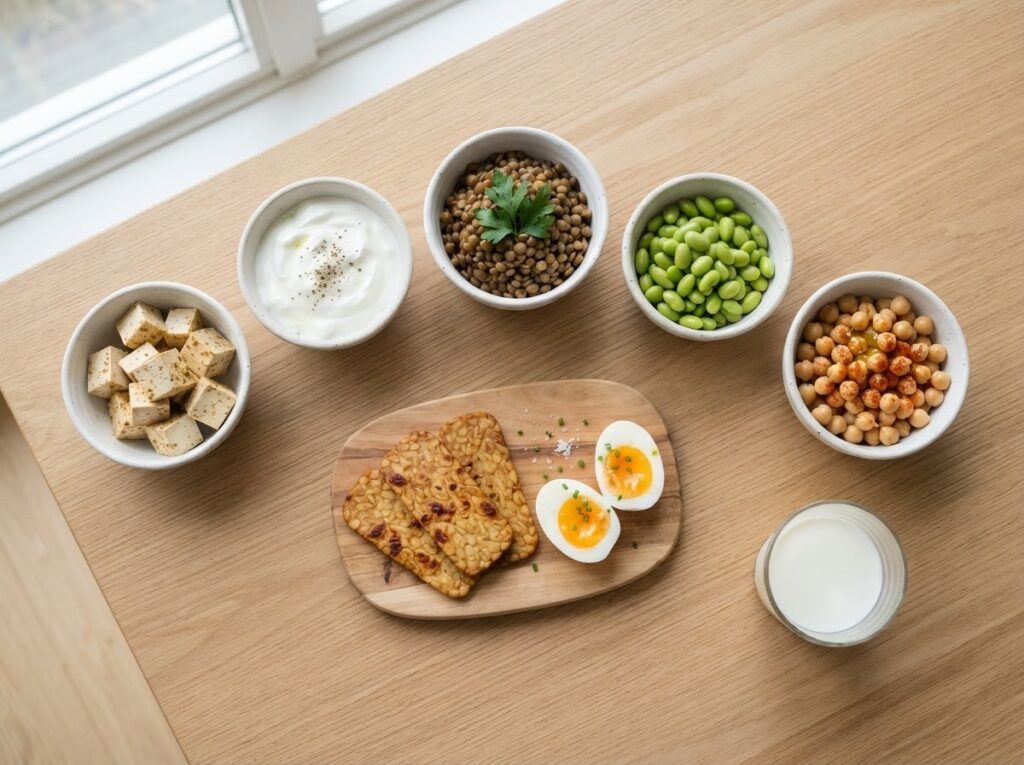
The highest-protein vegetarian foods are not the ones most lists lead with. Per serving, firm tofu, Greek yogurt, edamame, lentils and tempeh each deliver 17–22 g — as much as a small chicken breast — while the foods people reach for first, nuts and seeds, land at 5–9 g an ounce. Ranked by what a real serving delivers, the list looks different from ranked by grams per 100 g.
Below: 30 lacto-ovo vegetarian foods (dairy and eggs included) with protein per serving from USDA FoodData Central, grouped by type, plus what “complete protein” actually means, which nutrients to watch, and a sample day that reaches 100 g. We cover that term on its own in complete versus incomplete protein.
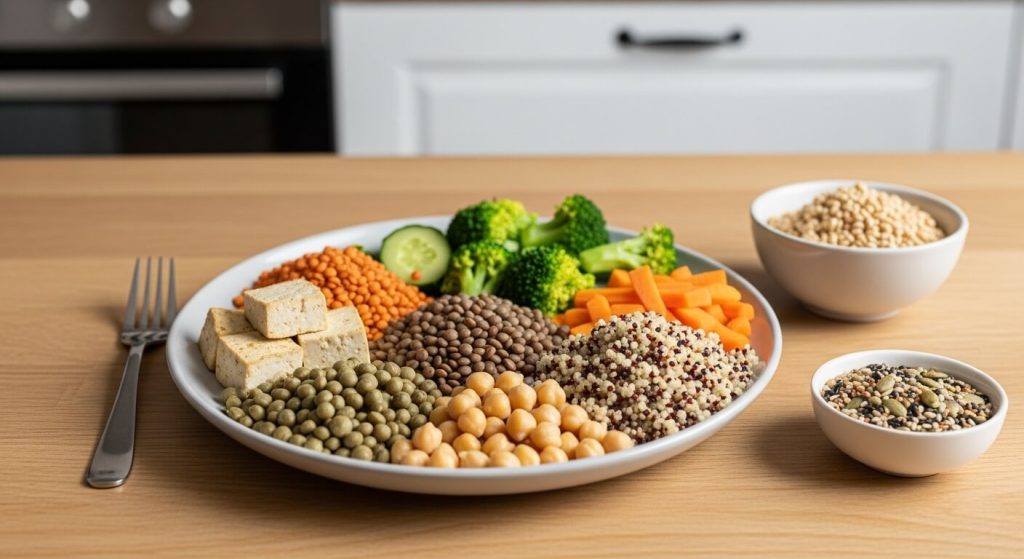
Key takeaways. Top five by serving: firm tofu (22 g per ½ cup), Greek yogurt (21 g per 7 oz), edamame (18 g per cup), lentils (18 g per cup), tempeh (17 g per 3 oz). You do not need to combine proteins at one meal — variety across the day covers the amino acids. Soy is a complete protein; most other plant proteins are short on one amino acid and pair naturally with grains or dairy. A vegetarian eating 1.2–1.6 g/kg is easy on paper and easy in practice if beans, soy and dairy each show up daily.
How much protein a vegetarian needs
The minimum is the same for everyone: 0.8 g per kilogram of body weight per day, per the National Academy of Medicine. The Dietary Guidelines for Americans 2025–2030 now set higher “serving goals: 1.2–1.6 grams of protein per kilogram of body weight per day” and explicitly list “beans, peas, lentils, legumes, nuts, seeds, and soy” as protein foods. For a 70 kg (154 lb) adult that is 84–112 g a day; for someone who lifts, the International Society of Sports Nutrition puts it at 1.4–2.0 g/kg, in doses of “0.25 g of a high-quality protein per kg of body weight, or an absolute dose of 20–40 g” per meal. Our protein calculator gives your number.
The Academy of Nutrition and Dietetics is direct on whether that is achievable: “adequate protein can easily be obtained without meat through a well-planned and varied diet,” and “a well-planned vegetarian or vegan diet can meet the nutrient needs of people during all stages of life.”
30 vegetarian protein foods, ranked by protein per serving
All values from USDA FoodData Central (Foundation and SR Legacy entries), cooked where applicable, no added salt. Serving sizes are standard household measures.
| # | Food | Serving | Protein | Per 100 g |
|---|---|---|---|---|
| 1 | Tofu, firm | ½ cup (126 g) | 22 g | 17.3 g |
| 2 | Greek yogurt, plain nonfat | 7 oz container (200 g) | 21 g | 10.3 g |
| 3 | Edamame, shelled | 1 cup (155 g) | 18 g | 11.9 g |
| 4 | Lentils | 1 cup (198 g) | 18 g | 9.0 g |
| 5 | Tempeh | 3 oz (85 g) | 17 g | 20.3 g |
| 6 | Split peas | 1 cup (196 g) | 16 g | 8.3 g |
| 7 | Kidney beans | 1 cup (177 g) | 15 g | 8.7 g |
| 8 | Black beans | 1 cup (172 g) | 15 g | 8.9 g |
| 9 | Chickpeas | 1 cup (164 g) | 15 g | 8.9 g |
| 10 | Ricotta, part-skim | ½ cup (124 g) | 14 g | 11.4 g |
| 11 | Cottage cheese, 1% | ½ cup (113 g) | 14 g | 12.4 g |
| 12 | Parmesan, hard | 1 oz (28 g) | 10 g | 35.8 g |
| 13 | Hemp seeds, hulled | 3 tbsp (30 g) | 9.5 g | 31.6 g |
| 14 | Kefir, low-fat | 1 cup (243 g) | 9 g | 3.8 g |
| 15 | Pumpkin seeds (pepitas) | 1 oz (28 g) | 8.6 g | 30.2 g |
| 16 | Skim milk | 1 cup (245 g) | 8.4 g | 3.4 g |
| 17 | Quinoa | 1 cup (185 g) | 8.1 g | 4.4 g |
| 18 | Peanut butter | 2 tbsp (32 g) | 7.7 g | 24.0 g |
| 19 | Egg whites | 2 large (66 g) | 7.1 g | 10.7 g |
| 20 | Soy milk, unsweetened | 1 cup (243 g) | 7.0 g | 2.9 g |
| 21 | Whole-wheat pasta | 1 cup (117 g) | 7.0 g | 6.0 g |
| 22 | Peanuts, dry-roasted | 1 oz (28 g) | 6.9 g | 24.4 g |
| 23 | Mozzarella, part-skim | 1 oz (28 g) | 6.9 g | 24.3 g |
| 24 | Cheddar | 1 oz (28 g) | 6.6 g | 23.3 g |
| 25 | Egg, whole | 1 large (50 g) | 6.3 g | 12.6 g |
| 26 | Almonds | 1 oz (28 g, 23 nuts) | 6.0 g | 21.2 g |
| 27 | Sunflower seeds | 1 oz (28 g) | 5.9 g | 20.8 g |
| 28 | Rolled oats, dry | ½ cup (40 g) | 5.3 g | 13.2 g |
| 29 | Chia seeds | 1 oz (28 g) | 4.7 g | 16.5 g |
| 30 | Vital wheat gluten (seitan base) | ¼ cup dry (30 g) | 23 g | 75.2 g |
Wheat gluten is listed last because USDA carries only the dry powder, not prepared seitan; made into seitan it is the densest vegetarian protein there is, but it is nearly pure protein with little else. Nutritional yeast and textured vegetable protein have no USDA generic entry — use the label.
Dairy and eggs: the easiest 20 g
For lacto-ovo vegetarians, dairy does what meat does for everyone else: dense, complete protein with no planning. A 7 oz Greek yogurt is 21 g; half a cup of cottage cheese or ricotta is 14 g; an ounce of hard parmesan is 10 g on top of whatever it is grated over. Milk and kefir add 8–9 g per cup — enough that a glass with breakfast changes the day’s total. Eggs are modest per unit (6 g) but scale: three eggs with an ounce of cheddar is 25 g.
The trade-off is sodium in aged and cultured cheeses. USDA lists hard parmesan at 1,180 mg per 100 g — about 335 mg per ounce — and cottage cheese at 300–400 mg per half cup. Yogurt, milk, ricotta and eggs are low. Our sodium guide has the daily ceilings.
Soy: the only complete plant protein you can eat by the cup
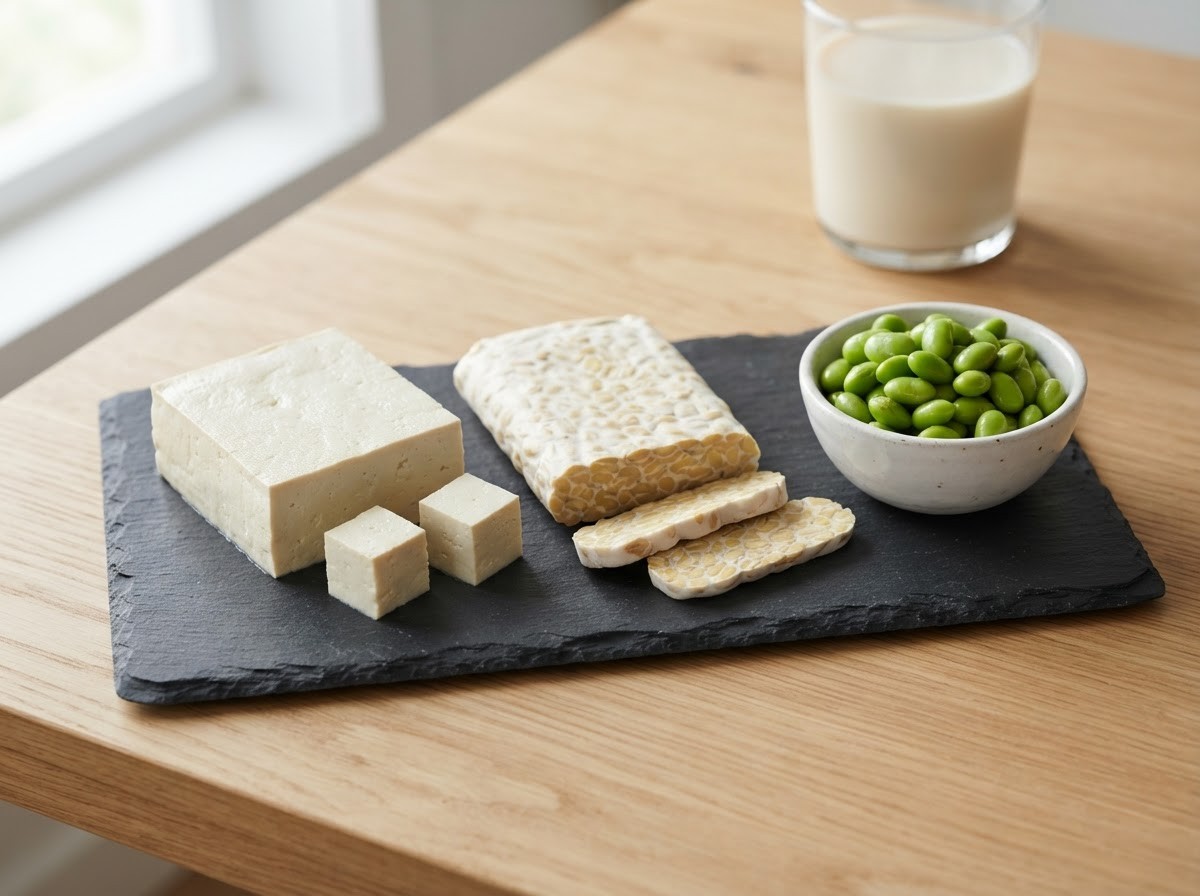
Harvard’s Nutrition Source: “Unlike some plant proteins, soy protein is considered a complete protein, containing all nine essential amino acids that the body cannot make.” That is why tofu, tempeh and edamame sit at the top of the ranked table — they combine soy’s amino acid profile with real serving sizes. Half a cup of firm tofu (22 g) beats a 7 oz yogurt; a cup of edamame (18 g) beats a cup of any bean. Tempeh is denser still per 100 g (20 g) and, per USDA, carries almost no sodium — 9 mg per 100 g plain — so the salt comes only from how you season it. Soy milk is the exception: 7 g per cup, on par with cow’s milk, but check that it is unsweetened.
Legumes: 15–18 g a cup, plus fiber
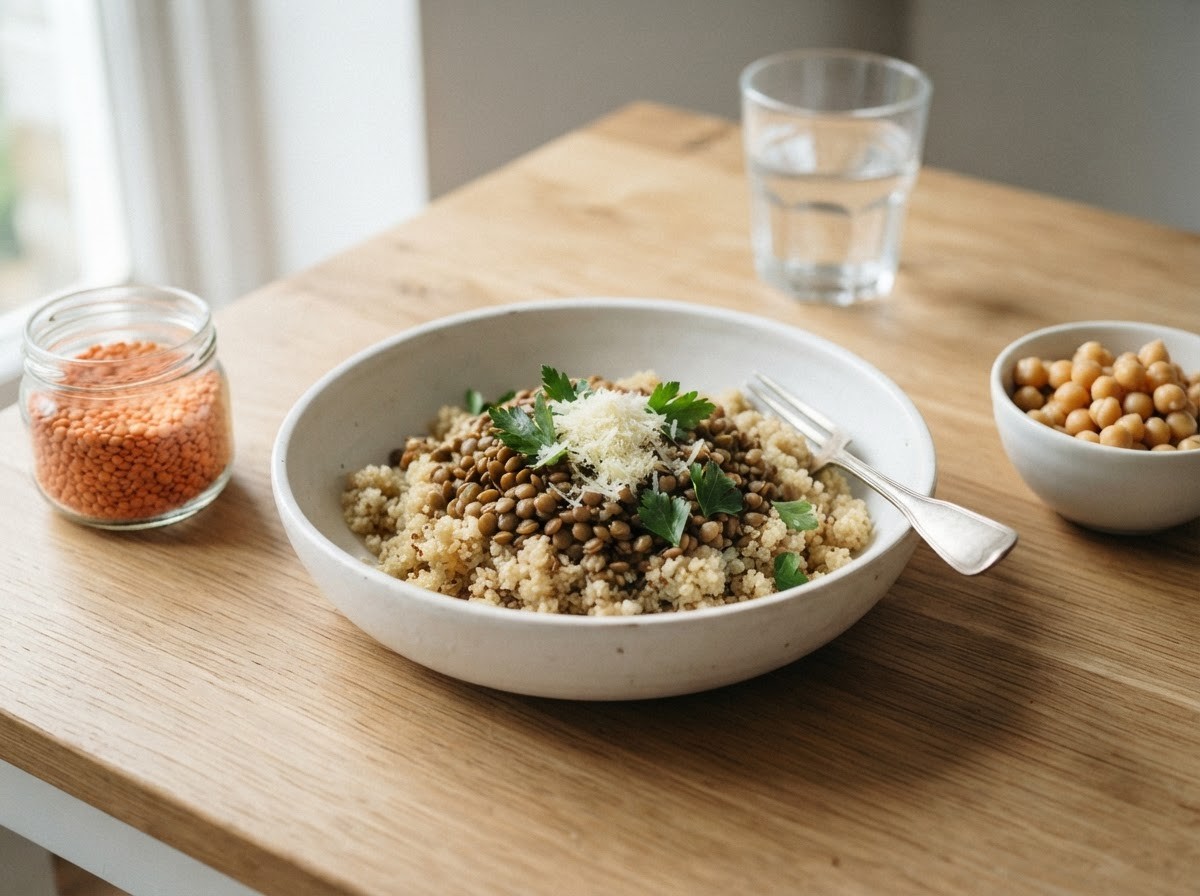
Lentils, split peas, kidney beans, black beans and chickpeas all land between 14.5 and 18 g per cooked cup, and they are the only protein foods that MyPlate also counts as vegetables: “Beans, peas, and lentils are also part of the Vegetable Group.” A cup of lentils brings roughly 15 g of fiber alongside its 18 g of protein — see our fiber table. MyPlate’s counting unit is “¼ cup of cooked beans, peas or lentils” = 1 ounce-equivalent of protein, so a cup counts as four. Between two of the cheapest, black beans and pinto beans come out close on protein and fiber alike.
Peanuts are legumes too: 7 g an ounce, or 7.7 g in two tablespoons of peanut butter. They are the calorie-dense end of the group, so they add protein to a meal rather than anchor it.
Grains, nuts and seeds: useful, but not the main course
Hemp seeds (9.5 g per 3 tbsp) and pumpkin seeds (8.6 g per oz) are the strongest here and both pour onto yogurt, oats or salad. Quinoa gives 8 g per cooked cup and whole-wheat pasta 7 g — real contributions when they are the base of a bowl. Almonds, sunflower seeds and chia fall at 5–6 g an ounce. Oats are 5 g per half cup dry, which is why oatmeal made with milk and topped with seeds reaches 15 g while oatmeal made with water stays at 5.
The pattern: nuts, seeds and grains add 5–10 g to a meal built on soy, legumes or dairy. On their own, reaching 30 g in a meal takes an unrealistic quantity.
Complete protein: what it means and why you can stop worrying
The Cleveland Clinic’s definition: “A food is considered a complete protein when it contains adequate amounts of the nine essential amino acids that our bodies can’t produce on their own.” Dairy, eggs and soy are complete; per the Academy of Nutrition and Dietetics, “most sources of plant-based protein are lacking in at least one of the nine essential amino acids. Soy and quinoa are two exceptions.” Beans are low in methionine, grains low in lysine — which is why beans-and-rice, hummus-and-pita, and peanut butter on whole-grain bread are traditional pairings.
The old rule that you had to combine them at the same meal is gone. MedlinePlus: “You do not need to combine these foods at the same meal to get enough protein.” The Cleveland Clinic agrees: “the goal should be to get a balance of those essential amino acids over the course of the day.” Eat a variety; the body sorts out the rest. For muscle specifically, the ISSN targets “700–3000 mg of leucine” per protein dose — soy, dairy and larger servings of legumes get there; a handful of nuts does not. Our plant vs animal protein for muscle guide goes deeper.
Nutrients to watch on a vegetarian diet
Protein is the easy part. MedlinePlus flags four nutrients: vitamin B12 (“you need this vitamin to help prevent anemia and have normal nerve function” — dairy and eggs supply some; the Academy notes “a supplement may be needed”), iron (“iron is not absorbed as well from plant-based sources” — pair beans and lentils with vitamin C), zinc (“important for the immune system and cell growth, especially in teens”), and omega-3s (“may be important for your heart and brain health” — hemp, chia and walnuts supply ALA). Our guide to protein absorption covers why plant iron and protein behave differently from animal sources.
A sample vegetarian day at ~100 g protein
| Meal | What | Protein |
|---|---|---|
| Breakfast | Oatmeal (½ cup oats) made with 1 cup skim milk, 3 tbsp hemp seeds | 23 g |
| Lunch | 1 cup lentils over 1 cup quinoa, 1 oz parmesan on top | 36 g |
| Snack | 7 oz Greek yogurt | 21 g |
| Dinner | ½ cup firm tofu stir-fried with vegetables, 1 cup edamame on the side | 40 g |
| Total | ~120 g |
Drop the edamame and the parmesan and it is ~92 g — still inside the DGA range for a 70 kg adult. Every meal clears the 20 g mark the ISSN sets for a useful dose. For cheaper versions of the same day, see affordable high-protein foods.
What we are not claiming
- That plant protein is “lower quality.” The ISSN’s language is about leucine content and dose, not quality; rice protein matched whey for muscle gains at 48 g a day in the trial it cites.
- That hemp or buckwheat are complete proteins. Allowed sources name soy and quinoa; the Cleveland Clinic lists only soy.
- That you must combine proteins at each meal. MedlinePlus and the Cleveland Clinic both say the day, not the meal, is what matters.
- Protein values for seitan, nutritional yeast or TVP. USDA has no generic entries; the figures above use vital wheat gluten powder and labels vary.
FAQ
What vegetarian food is highest in protein?
Per serving, firm tofu (22 g per ½ cup) and plain Greek yogurt (21 g per 7 oz). Per 100 g, hard parmesan (36 g) and hemp seeds (32 g) — but their servings are small. The same per-serving-versus-per-100-g gap runs through our comparison of snack foods.
How can vegetarians get 100 g of protein a day?
Put soy, legumes or dairy at every meal: Greek yogurt or milk-based oats at breakfast, a cup of beans or lentils at lunch, tofu or tempeh at dinner, yogurt or cottage cheese as a snack. The sample day above reaches 120 g.
Do vegetarians need to combine proteins?
Not at the same meal. MedlinePlus: “You do not need to combine these foods at the same meal to get enough protein.” Variety across the day is enough.
Is quinoa a complete protein?
The Academy of Nutrition and Dietetics and Harvard list it as one of the few complete plant proteins; the Cleveland Clinic does not. At 8 g per cup it is a helpful base either way, not a main source.
Are eggs or beans better for protein?
Per calorie they are close. One egg is 6 g; a cup of black beans is 15 g with 15 g of fiber. Beans win per serving, eggs win on completeness and speed. Our fiber intake calculator shows how far a day of beans gets you toward the daily fiber target.
Which vegetarian protein is best for building muscle?
Dairy and soy, because they are complete and reach the ISSN’s leucine target in a normal serving. Greek yogurt, cottage cheese, tofu and tempeh are the practical choices; whey or pea protein powder fills gaps.
This content is for educational purposes only and is not medical advice. Always consult a qualified healthcare professional for personalised guidance.