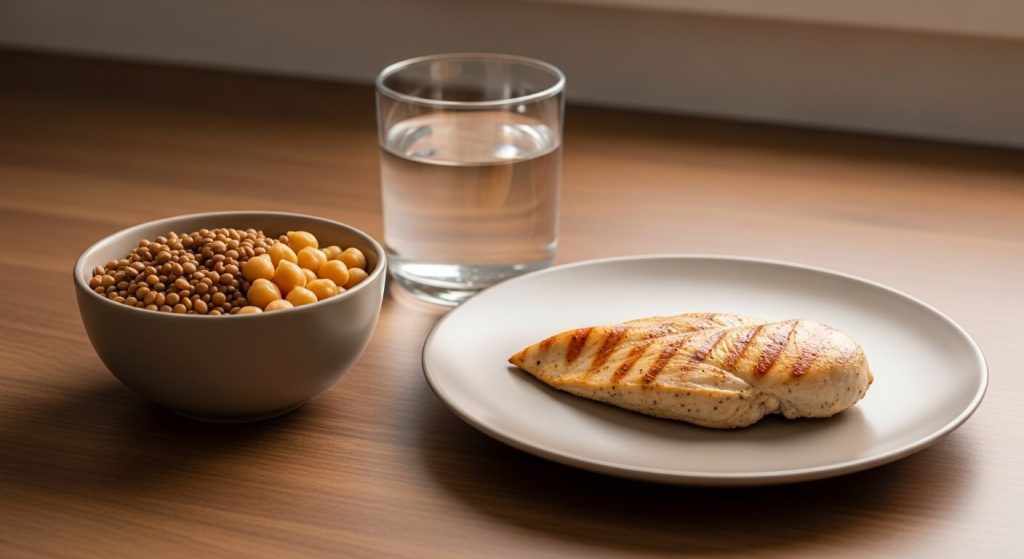
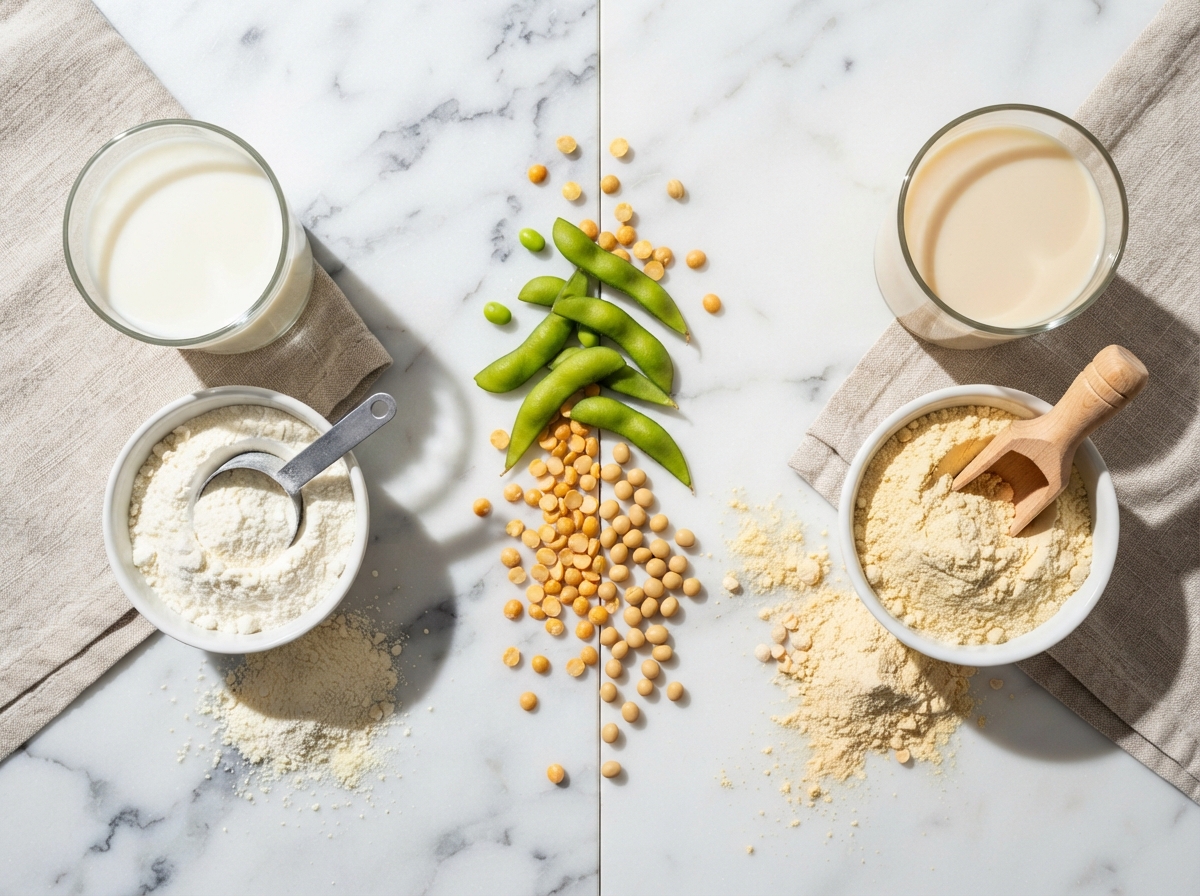
The short version of plant protein vs whey protein: whey has the stronger evidence and more leucine per gram, and plant protein closes most of that gap with a slightly larger serving and a sensible blend. That is the honest answer. The bigger lever is not which powder you buy — it is whether you hit 1.4–2.0 g of protein per kilogram of body weight a day, which the ISSN gives as the range that is “sufficient for most exercising individuals.” Get that right and the whey-versus-plant question is worth a few percent, not a training cycle.
Below: what actually differs between the two, which plant proteins are complete and which are not, the leucine question, what the research does and does not show for pea, rice, soy and hemp, and how to choose if you are buying today.
Key takeaways. Whey is a complete protein with more leucine than casein or soy, digests fast, and has the deepest research base. Soy is the one plant protein every authoritative source agrees is complete. Pea and rice are incomplete on their own but complement each other — grains run low in lysine, legumes in methionine. Practical fix for plant users: take a slightly larger scoop, prefer a blend, and check the protein-per-serving figure rather than the tub size.
What actually differs
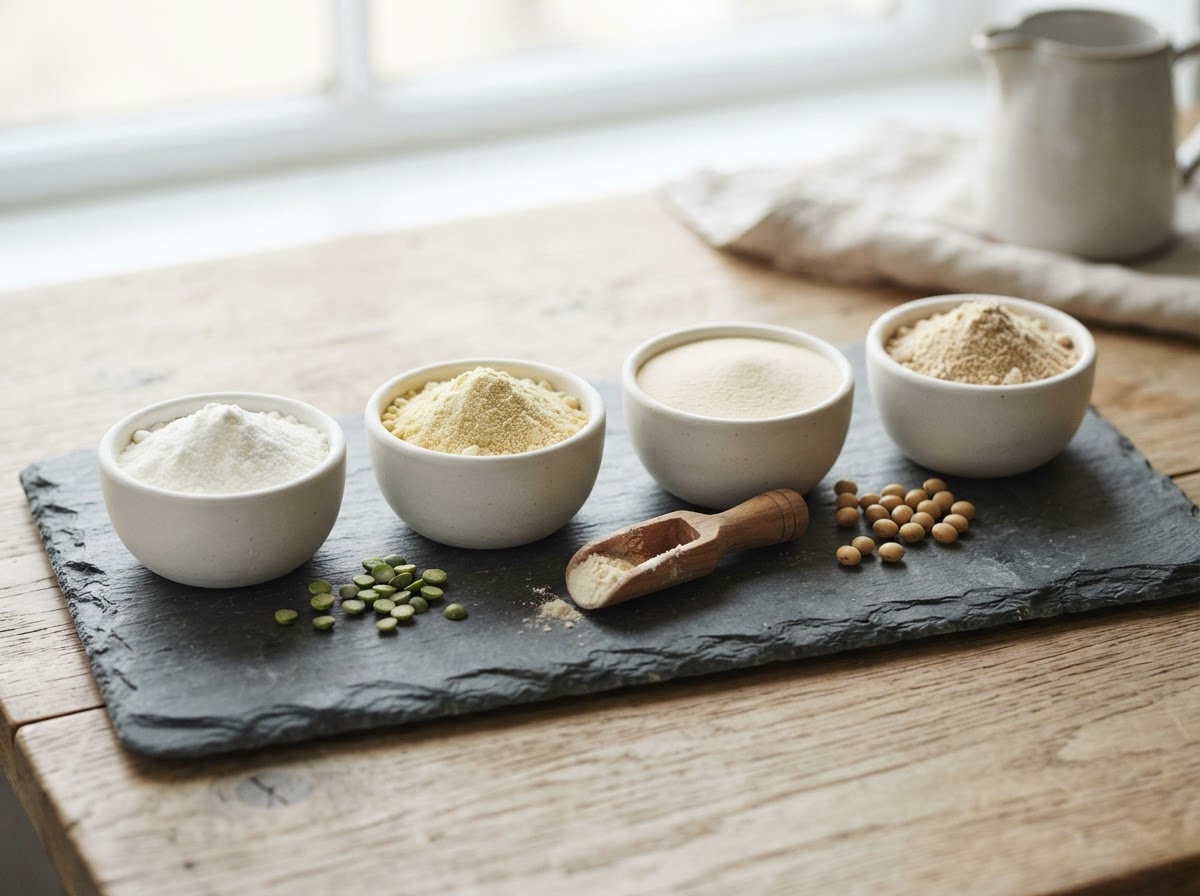
Three things separate them, and only the first two matter much.
Completeness. The FDA’s own consumer sheet on protein draws the line: “Animal foods (such as dairy products, eggs, meats, poultry, and seafood) and soy are complete protein sources,” while “Most plant foods (such as beans, grains, nuts, peas, seeds, and vegetables) are incomplete protein sources.” Incomplete does not mean useless — it means the food is short on at least one essential amino acid, and the sheet names which: “Grains are low in the amino acid lysine, while beans and nuts (legumes) are low in the amino acid methionine.”
That single sentence explains why pea-and-rice blends exist. Pea is a legume, rice is a grain, and each supplies what the other is short of.
Leucine. Leucine is the amino acid that switches on muscle protein synthesis, and this is where whey has a real edge. NIH’s Office of Dietary Supplements states it plainly, describing “whey, which has more leucine than either casein or soy”, and notes that branched-chain amino acids, “especially leucine, might also stimulate protein synthesis in exercised muscle”. The ISSN’s position stand puts a working range on a useful dose — “700–3000 mg of leucine” — and summarises the principle as “Rapidly digested proteins that contain high proportions of essential amino acids (EAAs) and adequate leucine, are most effective in stimulating MPS.”
Digestion speed. The ISSN describes whey as “water soluble, mixes easily, and is rapidly digested,” against casein, which “is water insoluble, coagulates in the gut and is digested more slowly.” Plant powders sit in between. In practice this matters least of the three, because the daily total dominates.
Protein per 100 g: the numbers
Two of these have reference entries in USDA FoodData Central, which is the only place worth taking a number from:
| Powder | Complete? | Protein per 100 g | Typical scoop |
|---|---|---|---|
| Whey | Yes | 78 g (USDA 173180) | 20–30 g protein |
| Soy isolate | Yes | 88.3 g (USDA 174276) | ~25 g protein per 28 g |
| Pea isolate | No — low in methionine | No USDA reference entry | 15–25 g, varies by brand |
| Rice | No — low in lysine | No USDA reference entry | 15–25 g, varies by brand |
| Hemp | Contested (see below) | No USDA reference entry | Lower — it carries fiber too |
On the whey side, OPSS — the US Department of Defense’s supplement-safety service — gives the practical serving figure: “Most whey protein products provide 20-30 grams of protein per serving or ‘scoop.'” Plant powders vary far more, which is why the protein-per-serving line on the panel matters more than the brand.
Whey, in one paragraph
Cleveland Clinic describes it as “a group of eight proteins found in milk” that “contains all of the essential amino acids and is easily digested.” OPSS adds that it is “rich in vitamins, minerals, enzymes, and essential amino acids (EAAs), especially leucine” and has “been shown to increase muscle protein synthesis (MPS) and enhance recovery and exercise performance.” Its limits are equally plain: it is a milk product, and “Some people experience constipation, diarrhea or nausea from taking whey protein, especially if they take large amounts.” OPSS puts the usual ceiling at “doses up to 40 grams per day.”
The three forms are not interchangeable on the lactose question. Concentrate products “vary widely in their protein, lactose and fat content”; isolate is “consistently high in protein and low in fat or lactose”; hydrolysate is “the easiest to digest.” Note the wording on isolate: low in lactose, not free of it.
The plant proteins, one at a time
Soy — the one that is complete
Harvard’s Nutrition Source is unambiguous: “Unlike some plant proteins, soy protein is considered a complete protein, containing all nine essential amino acids that the body cannot make which must be obtained from the diet.” If you want a single plant powder and no blending logic, soy isolate is the straightforward choice — and at 88.3 g of protein per 100 g it is the densest entry USDA holds for any of these.
Pea — incomplete, but easy on the gut
Cleveland Clinic calls pea protein “highly digestible, hypoallergenic and economical” and notes it is “digested well and, therefore, is easy on your stomach” as well as “both gluten- and lactose-free, making it a preferred option for people who have those particular allergies.” On density, “One scoop of pea protein isolate contains between 15 and 20 grams of protein for every 100 calories.” Compared with whey, the same source concludes it is “pretty similar in terms of proteins, fats and carbs” and that “It’s not that one is better than another. It just depends on what you’re looking for and what trade-offs you’re OK with.”
Rice — incomplete, but the closest plant match to whey in the literature
Cleveland Clinic states that “The protein in brown rice isn’t a complete protein because it doesn’t provide all the essential amino acids.” Against that, the ISSN’s position stand contains the most favourable line any plant protein gets in that document: “rice protein may be a suitable alternative to whey.” Both things are true — rice is short on lysine as an isolated source, and at a matched dose it has held up in the comparisons that exist.
Hemp — genuinely contested
We are flagging this one rather than settling it. Cleveland Clinic’s hemp page says “It contains all nine essential amino acids that we need in our diet,” but the same publication’s explainer on complete proteins lists hemp among the incomplete sources. What is not in dispute is the fiber: a serving carries “11 grams of fiber, about one-third of the daily recommended amount for adults,” which is why it “could cause some gas, bloating and a bit of digestive distress” and why the advice is to “start in small amounts and gradually build up.” Hemp is a fine food; it is a weak choice as your main protein powder.
Where the research is genuinely thin
This is the part most comparisons skip. The ISSN’s protein position stand says plant sources such as pea, rice and hemp “have garnered interest,” but that “research that examines the ability of these protein sources to modulate exercise performance and training adaptations is limited.” Limited is not the same as negative — it means the head-to-head trials that would settle the question mostly have not been run.
So the honest ranking is: whey has the most evidence, soy has a clear completeness advantage among plants, rice has one supportive line in the ISSN stand, and pea and hemp have the least training-outcome research of the group. None of that is a reason to avoid plant protein if you want it.
How to close the gap if you use plant protein
Four adjustments, in order of how much they matter:
- Hit the daily number first. NIH ODS gives the athlete range as “0.55 to 0.9 g/lb body weight [1.2 to 2.0 g/kg body weight]”. Our protein calculator turns that into grams, and the macro calculator shows what is left for carbohydrate and fat.
- Take a slightly larger serving. If a plant scoop gives 18 g and a whey scoop gives 25 g, that is the gap to close — not with a different brand, but with a bigger scoop.
- Use a blend, or soy. A pea-and-rice product pairs a legume with a grain, which is exactly the lysine-and-methionine complement the FDA sheet describes. Soy isolate sidesteps the question entirely.
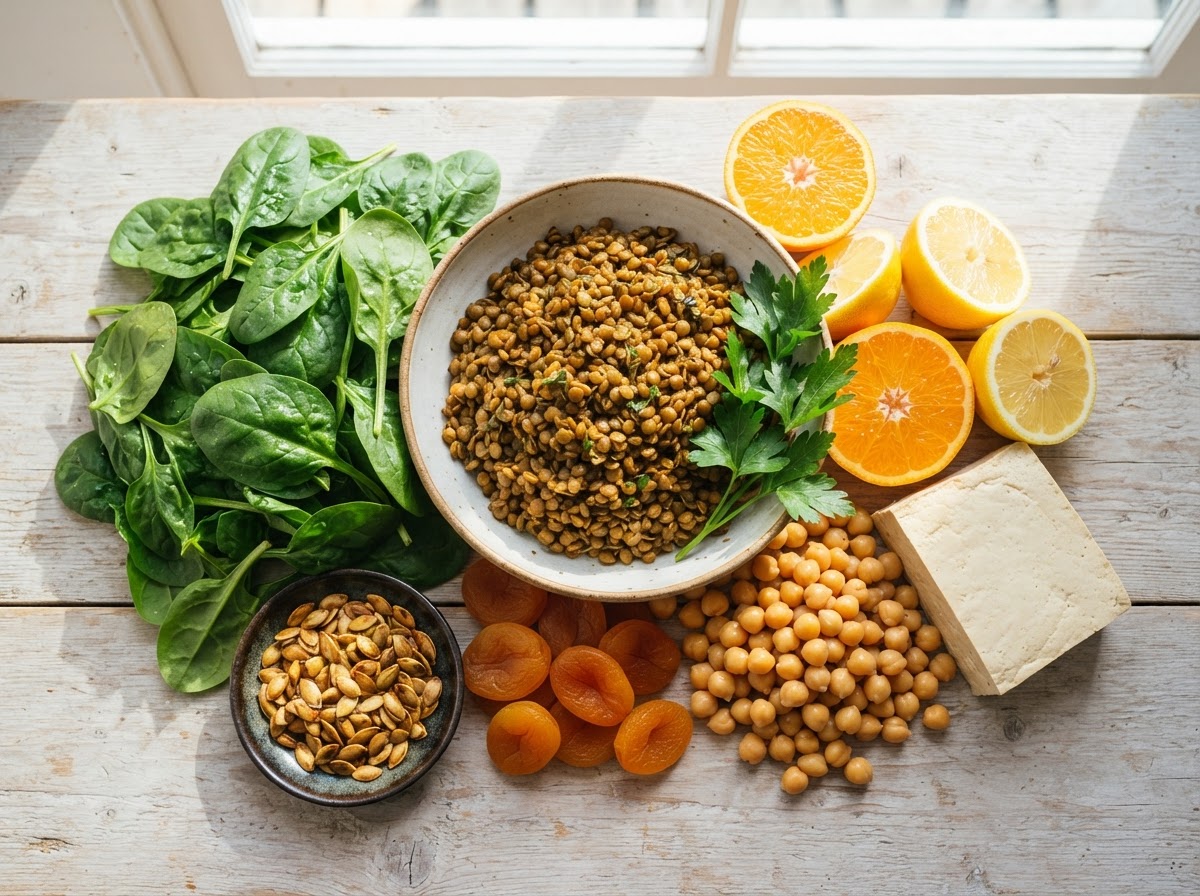
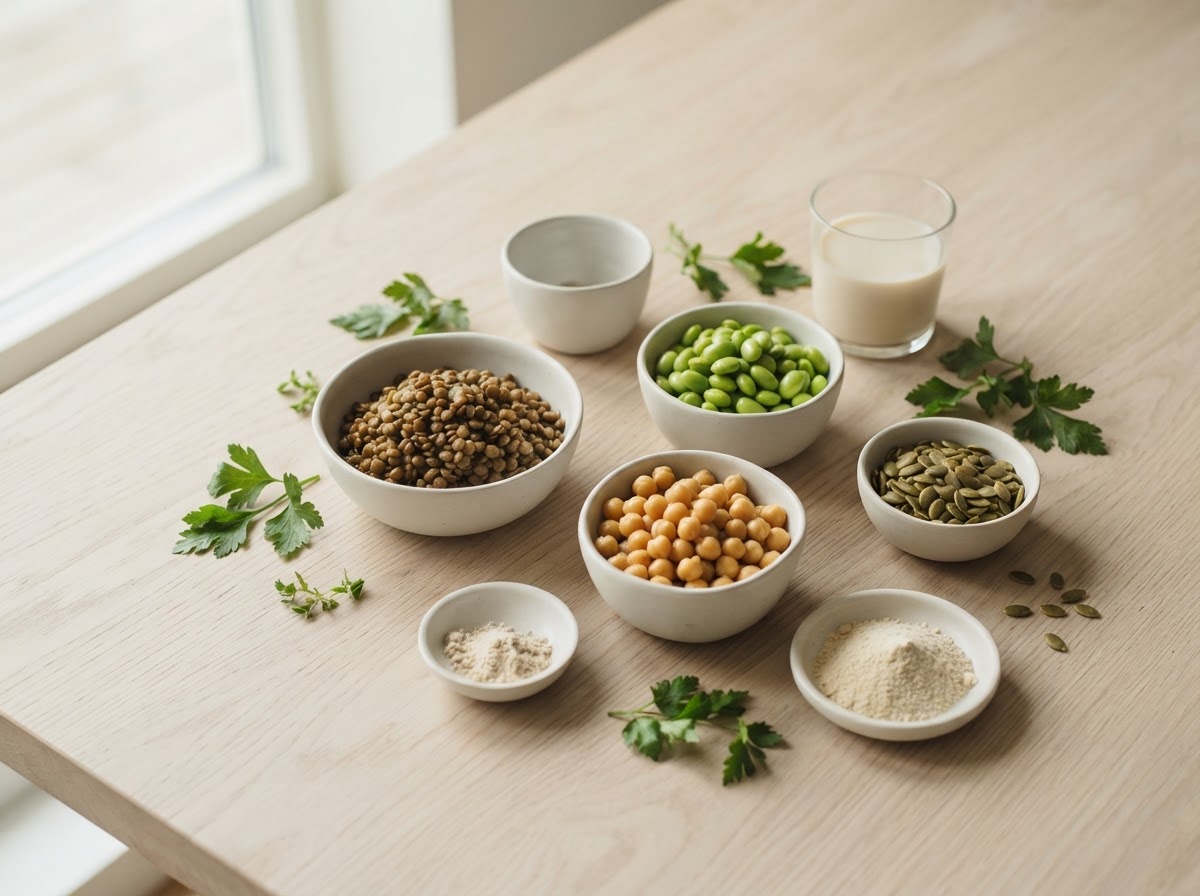
- Let food carry most of it. ODS notes that the requirement can be met from “animal foods containing complete proteins—or a combination of plant-based foods with complementary proteins that together provide all EAAs.” Full breakdowns for the plant staples that do this: edamame, lentils, chickpeas, black beans, pumpkin seeds, peanut butter, chia seeds and oats.
What to check on the label
Both categories are dietary supplements, and FDA is explicit about what that means: “FDA does not have the authority to approve dietary supplements before they are marketed,” and “Manufacturers and distributors have initial responsibility for ensuring that their dietary supplements meet the safety standards.”
- Grams of protein per serving, not per 100 g and not the tub size.
- Added sugar. Cleveland Clinic’s rule of thumb: “Don’t choose protein powders with sugar listed as one of the first three ingredients.” Harvard notes powders “can often contain non-protein ingredients” including added sugars and calories.
- Third-party certification. OPSS names “BSCG Certified Drug Free”, “Informed Sport”, “NSF Certified Sport” and “USP Verified”, and explains why it matters: “The only way to know the actual ingredients (or their amounts) in a dietary supplement product is through laboratory testing.”
- Lactose, if that is your issue. NIDDK reports that in the US “about 36 percent of people have lactose malabsorption,” while also noting that “Most people with lactose intolerance can consume some amount of lactose without having symptoms.” Isolate or a plant powder solves it either way.
What we are not claiming
- That plant protein cannot build muscle. It can; the evidence base is simply smaller.
- That people eating plant protein need a higher total daily intake. No authoritative source we could verify says that. The adjustment is per serving, not per day.
- A PDCAAS or DIAAS score for any of these powders. Those numbers circulate widely; we could not verify a single one on a source we are willing to cite.
- A leucine figure per scoop for any product. USDA does not list leucine for the whey entry, and no source gave per-serving figures for the plant powders.
- That pea-and-rice blends have been tested against whey in training trials. The complementary-amino-acid logic is sound and sourced; a head-to-head trial is not something we found.
- That hemp is a complete protein. One source says so, another from the same publisher implies otherwise.
- That whey isolate is lactose-free. Sources say low in lactose, which is not the same thing.
- Anything about heavy metals in plant versus whey powders. It is a real topic; we found no citable data.
FAQ
Is whey better than plant protein for building muscle?
Whey has more leucine per gram and the deeper research base, so on a like-for-like scoop it has the edge. Matched for total grams, soy is complete and rice has ISSN support as a possible alternative. The daily total matters more than the choice.
Which plant protein is complete?
Soy, per both the FDA’s protein sheet and Harvard. Pea and rice are not on their own — pea is a legume and runs low in methionine, rice is a grain and runs low in lysine. Together they cover each other.
Do I need more plant protein than whey to get the same effect?
Per serving, often yes, simply because plant scoops tend to deliver fewer grams. Over a whole day, no source we can cite says plant eaters need a higher total.
Is pea protein hard on digestion?
The opposite, per Cleveland Clinic — it is described as digested well and easy on the stomach, and it is gluten- and lactose-free. Hemp is the one more likely to cause bloating, because of its fiber content.
Can I mix whey and plant protein?
Yes, and nothing about that is problematic. Blending is how most plant products are built in the first place.
Does plant protein taste worse?
Not a question anyone has settled with evidence, and not one we will pretend to answer. Pea and rice products are commonly flavored for exactly this reason.
What to do with this
If you have no reason to avoid dairy, whey is the simpler default. If you do, buy soy isolate or a pea-and-rice blend, take a scoop that actually delivers 25–30 g of protein, and make sure the daily total lands in the 1.2–2.0 g/kg range. ODS reports “No safety concerns reported at daily recommended intakes for athletes of up to about 2.0 g/kg body weight” — for either kind.
Related: protein powder for muscle gain, how much protein you need, high-protein vegetarian foods, nutrient-dense foods for muscle growth.
Educational content, not medical advice. If you have kidney disease or a milk allergy, talk to a clinician before changing protein sources.
This content is for educational purposes only and is not medical advice. Always consult a qualified healthcare professional for personalised guidance.