“Low sodium” on an American package is not marketing language. It is a number, fixed in federal regulation: 140 milligrams or less per serving. “Very low sodium” is 35 mg. “Sodium free” is under 5 mg. Once you know the three numbers, the label does most of the work for you.
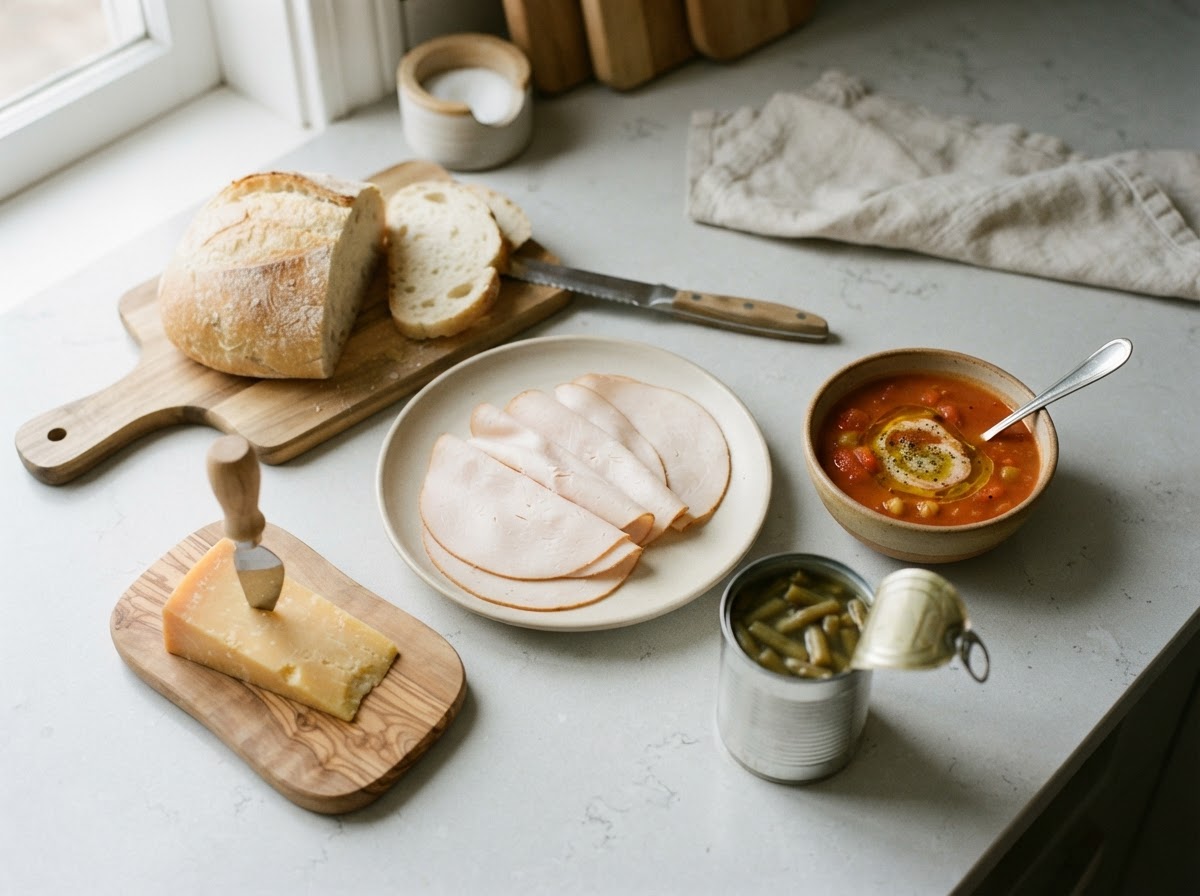
What the label will not tell you is where your sodium is actually coming from, and the federal answer to that is not the salt shaker. It is bread, poultry, cheese and canned vegetables — foods most people would put on a low-sodium list. This article covers both halves: which foods are genuinely low in sodium, which are quietly high, and how to read a package so you never have to guess.
Key takeaways. Over 70% of dietary sodium comes from packaged and prepared food, not from the shaker. “Low sodium” legally means 140 mg or less per serving; “very low sodium” 35 mg; “sodium free” under 5 mg. “Unsalted” means only that no salt was added — and the regulation makes such packages print “not a sodium free food”. A hidden rule requires any product making a nutrition claim to warn you once it passes 480 mg of sodium per serving. Bread, poultry, cheese and canned vegetables all sit on the federal top-ten list. And no US federal health source addresses the sea salt or pink salt claims at all.
Where the sodium actually is
The FDA states it plainly: “most dietary sodium (over 70%) comes from eating packaged and prepared foods—not from table salt added to food when cooking or eating.” So the shaker is a minor player. (No federal source we found puts a number on the shaker’s share, so we are not going to give you one.)
Both the FDA and the CDC publish a list of the top sources — and interestingly, the two lists do not match. We are going to show you both rather than average them, because the disagreement is informative.
The FDA’s list, which the agency itself attributes to CDC, has nine items accounting for “about 40%” of Americans’ sodium, in this order: deli meat sandwiches, pizza, burritos and tacos, soups, savory snacks, poultry, pasta mixed dishes, burgers, and egg dishes and omelets.
CDC’s own current list has ten items, split by age, and includes things the FDA list does not:
| # | Adults, ages 18+ | Children, ages 1–17 |
|---|---|---|
| 1 | Deli meat sandwiches | Savory snacks |
| 2 | Soups | Pizza |
| 3 | Pizza | Deli meat sandwiches |
| 4 | Poultry (excluding nuggets and tenders) | Chicken nuggets and tenders |
| 5 | Savory snacks | Soups |
| 6 | Pasta mixed dishes | Pasta mixed dishes |
| 7 | Breads, rolls, buns | Breads, rolls, buns |
| 8 | Cheese (including cottage and ricotta) | Cheese (including cottage and ricotta) |
| 9 | Meat mixed dishes | Poultry (excluding nuggets and tenders) |
| 10 | Vegetables (excluding white potatoes) | Cookies, brownies, cakes |
One more shape of the same claim, from NHLBI: “More than 40% of the sodium we eat daily comes from 10 main sources of foods, according to the Centers for Disease Control and Prevention.” So: three federal hosts, nine items and “about 40%”, ten items and no percentage, and ten items and “more than 40%”. We record the divergence rather than pick a winner.
The quiet ones: bread, poultry, cheese, vegetables
Four entries on CDC’s list are the ones worth staring at, because nobody thinks of them as salty.
Bread, rolls and buns rank seventh for both adults and children. No single slice is dramatic; the ranking comes from how much of it people eat.
Cheese ranks eighth in both columns, and CDC specifies “including cottage and ricotta” — the two most people assume are the mild ones.
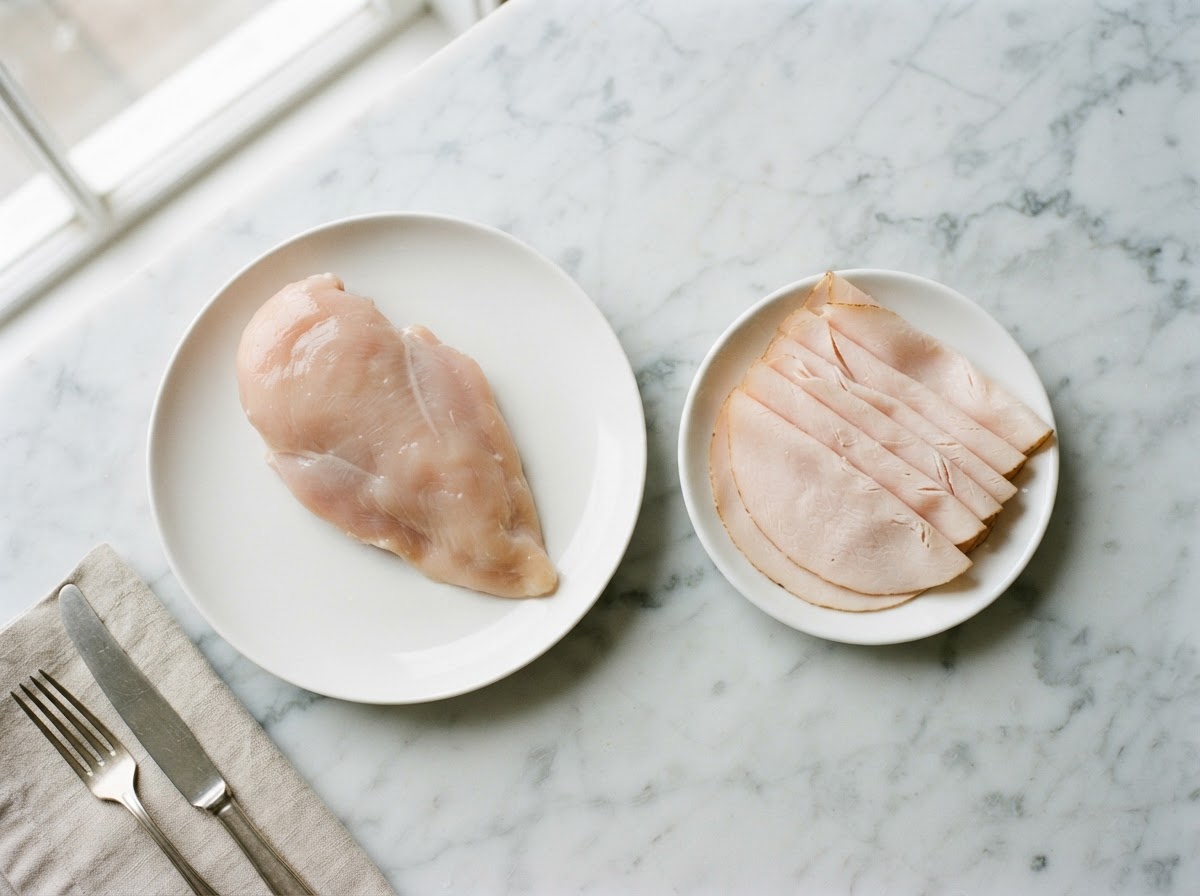
Poultry and vegetables are the genuinely surprising entries, and CDC explains them in a single footnote that carries the whole argument: “*Packaged or processed soups, vegetables, and poultry often contain sodium.” It is not the chicken or the green beans. It is what was done to them before they reached you.
CDC follows this with a piece of practical advice almost nobody publishes: “When possible, purchase fresh poultry, fish, pork, and meat, rather than cured, salted, smoked, and other processed meats” — and then, crucially, “For fresh items, check to see whether saline or salt solution has been added.” Raw chicken in a supermarket tray can be brined. “Fresh” is not the same as unsalted, and the label is where you find out.
One correction while we are here: both federal lists say deli meat sandwiches, not cold cuts. The unit they measured is the sandwich, bread included. It would be wrong to report it as “cold cuts are the number one source”.
What each label claim legally means
This is the part that makes the rest easy. 21 CFR 101.61 defines every sodium claim a US package may carry. The thresholds are per reference amount customarily consumed — the FDA’s defined serving, not whatever the manufacturer feels like calling one.
| What the package says | What the regulation requires |
|---|---|
| Sodium free, salt free, no sodium, zero sodium | less than 5 mg of sodium per serving |
| Very low sodium | 35 mg or less |
| Low sodium, low in sodium, little sodium, low source of sodium | 140 mg or less |
| Reduced sodium, less sodium, lower in sodium | at least 25% less than an appropriate reference food |
| Light in sodium | reduced by 50% or more in sodium compared with the reference food |
| Lightly salted | 50% less sodium than is normally added to the reference food |
| Unsalted, without added salt, no salt added | no salt added during processing — see below, this one is a trap |
Note that “salt free” is not a softer version of “sodium free”: the regulation permits it only if the food already meets the sodium-free definition. And “reduced sodium” is relative, not absolute — 25% less than something that was very salty can still be very salty. Our guide to what food label claims mean covers the same logic for fat, fiber and the rest.
“Unsalted” is the one that catches people
Read the regulation’s conditions carefully. “Unsalted”, “without added salt” and “no salt added” may be used only if no salt is added during processing, and if the food it substitutes for is normally processed with salt. Then comes the condition that gives the game away:
“If the food is not sodium free, the statement, ‘not a sodium free food’ or ‘not for control of sodium in the diet’ appears adjacent to the nutrition label of the food bearing the claim.”
In other words: the law anticipated that shoppers would read “no salt added” as “low in sodium”, and it requires the package to say otherwise in small type. An unsalted product can be naturally high in sodium and still carry the claim. If you see “no salt added”, look for that disclaimer — and then look at the number.
The “light” claims have their own quirk: they are not in the sodium regulation at all, but in 21 CFR 101.56, the one about “light” and “lite”. And the two are measured differently — “light in sodium” against the reference food’s sodium content, “lightly salted” against the sodium normally added. A “lightly salted” product that is still not low in sodium must print “not a low sodium food”.
The 480 mg rule almost nobody writes about
Here is a genuinely useful thing buried in 21 CFR 101.13. If a food makes any nutrient content claim — “low fat”, “high fiber”, “good source of calcium”, anything — and it contains more than 480 mg of sodium per serving, it must print a disclosure: “See nutrition information for ____ content”, with the nutrient named in the blank.
The same rule sets 960 mg for meal products and 720 mg for main dish products, and applies parallel thresholds for fat, saturated fat and cholesterol.
What that means in a supermarket: a package shouting about one virtue is legally obliged to point you at its sodium once it crosses that line. If you see “See nutrition information for sodium content” on a box, the box is telling you it has more than 480 mg per serving — roughly a fifth of a day’s limit, in one serving, on a product that is advertising how healthy it is.
What is genuinely low in sodium
Federal sources are confident about categories and unhelpfully quiet about numbers — we could not find per-serving figures for low-sodium foods on any of the FDA, CDC, NHLBI or MedlinePlus pages we read. What they do give is a consistent list.
NIDDK’s tip sheet names: fresh or frozen fruits and vegetables; rice and noodles; cooked cereal without added salt; fresh meat, poultry and seafood; low-sodium cheese; unsalted nuts; low- and reduced-sodium frozen dinners, peanut butter and salad dressings; and air-popped popcorn. (That sheet dates from 2011, so treat it as colour rather than current guidance.)
NHLBI’s DASH tips put it as instructions: “Choose plain fresh, frozen, or canned (low-sodium or no-salt-added) vegetables”; “Choose fresh or frozen skinless poultry, fish, and lean cuts of meat”; “Cook rice, pasta, and hot cereals without salt.” And CDC adds: “Buy fresh, frozen, or canned vegetables with no salt or sauce added.”
The pattern across all three is the same, and it is more useful than a list of individual foods: plain versions of ordinary foods are low in sodium; the sodium arrives with processing, sauce, cure or brine. That is why “fresh, frozen, or canned with nothing added” keeps recurring — frozen and canned are not the problem, the additions are.
A practical rule of thumb, from MedlinePlus’s medical encyclopedia — which is produced by A.D.A.M. and hosted by the National Library of Medicine, so not an agency position: “A healthy level of sodium is 140 mg or less per serving.” Which is, neatly, the same number the regulation uses.
If you want the daily limits rather than the shopping list, our guide to daily sodium intake has them; the short version is under 2,300 mg a day for anyone 14 and over.
Rinsing canned food: the real number is smaller than you have read
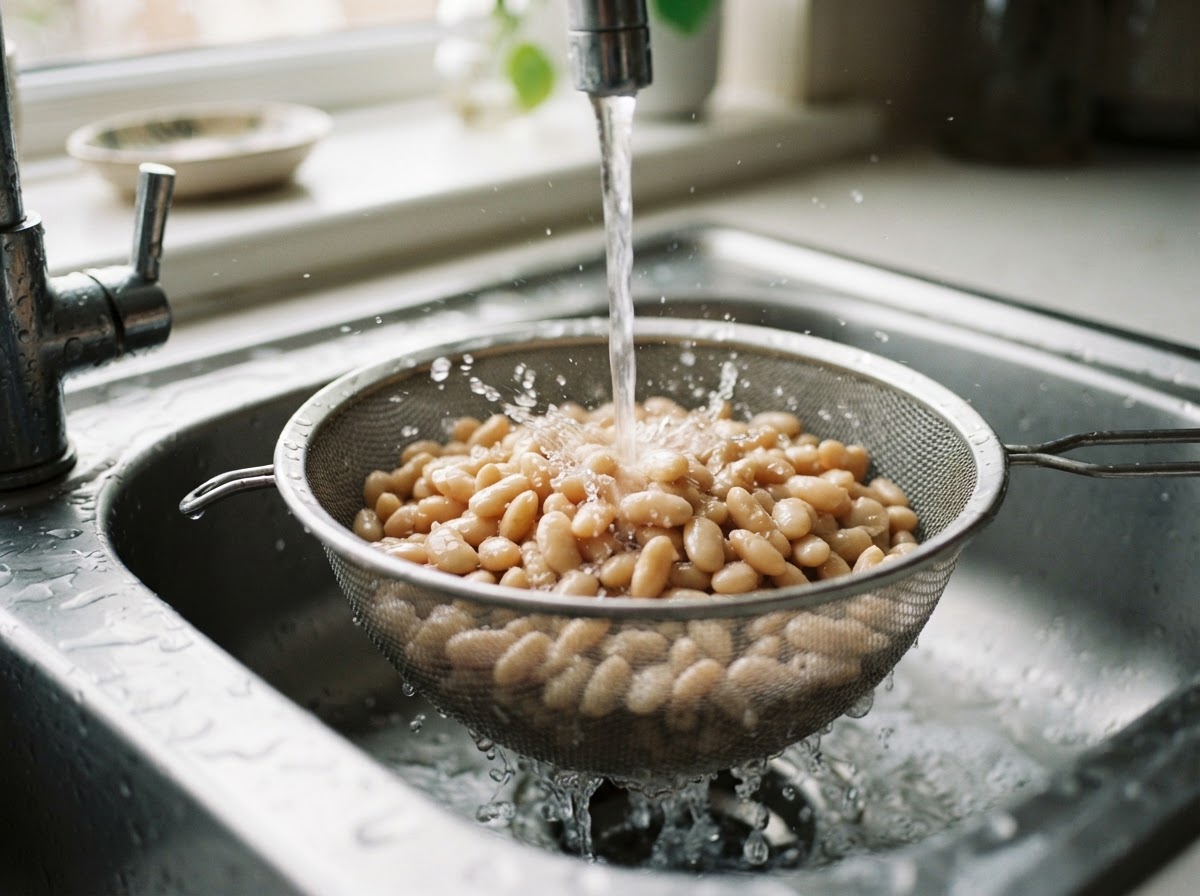
You will see “rinsing canned beans removes 40% of the sodium” repeated everywhere. We could not source that figure to any US federal host.
What does exist is a USDA Agricultural Research Service conference abstract by D.B. Haytowitz of the Nutrient Data Laboratory, which reports: “Draining and rinsing of canned vegetables can reduce the sodium content from 9-23%.” Two things must travel with that number. It is for canned vegetables, not beans. And it is a conference abstract by a named scientist, not a USDA position.
The same document carries a cost that nobody quotes: “Of all the nutrients tested, vitamin C decreased from 5-28% with draining and rinsing.” Its own conclusion keeps both halves: draining and rinsing “can be effective in reducing sodium in canned vegetables; however, varying amounts of some water-soluble nutrients may also be lost.”
Rinsing is still worth doing. It is just worth about a tenth to a quarter of the sodium, not half.
Salt substitutes: genuinely useful, genuinely risky for some people
Potassium chloride substitutes do reduce sodium, and for most people that is fine. For some it is not, and the NIH Office of Dietary Supplements says so in its own voice:
“Some people, such as those with kidney disease or who are taking certain medications, should consult their health care provider before taking salt substitutes because of the risk of hyperkalemia posed by the high levels of potassium in these products.”
The medications in question are named on the same page: ACE inhibitors and ARBs, which “reduce urinary potassium excretion, which can lead to hyperkalemia”, and potassium-sparing diuretics such as amiloride and spironolactone, which “reduce the excretion of potassium in the urine and can cause hyperkalemia”. ODS’s monitoring advice is attributed to “Experts”, not to itself — so we will not upgrade it either.
If you take blood pressure medication or have any kidney problem, this is a conversation with your doctor rather than a supermarket decision. Our article on foods high in potassium covers the other side of that balance.
Sea salt and pink Himalayan salt: nobody official has an opinion
We checked nine documents across five federal hosts — the FDA’s two sodium pages, CDC’s two, NHLBI’s two, NIDDK’s tip sheet and two MedlinePlus pages. Not one of them mentions sea salt, Himalayan salt, pink salt or kosher salt. The only sea salt documents on the FDA’s site are regulatory ones about colour additives, which have nothing to do with sodium content.
So we are not going to tell you the government has debunked the claim, because it has not addressed it. What we can tell you is that the question is answerable without them: whatever salt you buy, the Nutrition Facts panel on the package gives the sodium per serving, and the FDA’s rule of thumb is that 5% of the Daily Value or less is low and 20% or more is high. The colour of the crystals does not change the arithmetic.
FAQ
What does “low sodium” actually mean on a label?
140 mg of sodium or less per serving, under 21 CFR 101.61. “Very low sodium” is 35 mg or less, and “sodium free” is under 5 mg.
Does “no salt added” mean low sodium?
No, and the regulation knows it. A product can say “no salt added” and still be high in sodium naturally — in which case it must print “not a sodium free food” or “not for control of sodium in the diet” near the nutrition label.
What are the biggest sources of sodium?
Packaged and prepared foods, over 70% of the total per the FDA. On CDC’s list for adults, the top five are deli meat sandwiches, soups, pizza, poultry and savory snacks — with bread, cheese and canned vegetables also in the top ten.
Why is chicken on a list of high-sodium foods?
Because of processing. CDC’s own footnote says packaged or processed soups, vegetables and poultry often contain sodium, and CDC advises checking whether a saline or salt solution has been added even to fresh items.
Does rinsing canned beans remove the sodium?
Some of it. The only federal figure is 9–23%, and it is for canned vegetables, from a USDA Agricultural Research Service conference abstract. The widely quoted 40% has no federal source. Rinsing also costs 5–28% of the vitamin C.
Is sea salt lower in sodium than table salt?
No US federal health source addresses the question at all — we checked nine documents on five hosts. Use the Nutrition Facts panel instead: 5% DV or less is low, 20% or more is high.
Are salt substitutes safe?
For most people, but not for everyone. NIH’s Office of Dietary Supplements says people with kidney disease or taking certain medications should consult a health care provider first, because of hyperkalemia risk from the potassium.
What to do with this
Three numbers do most of the work. 140 mg or less per serving is what “low sodium” legally means. 5% of the Daily Value or less is low and 20% or more is high, on any panel. And 480 mg is the point at which a product making any health-sounding claim has to admit, in small print, that you should go and look at its sodium.
Beyond the label: buy plain versions of ordinary foods, because the sodium arrives with the sauce, the cure and the brine rather than with the food. Check whether “fresh” poultry has been brined. Rinse canned vegetables, expecting about a tenth to a quarter of the sodium to go. And treat bread, cheese and canned vegetables as sodium sources, because the federal data says they are, however innocent they look.
Related: daily sodium intake guidelines, foods high in potassium, what food label claims mean, the DASH eating plan and other named diets.
This content is for educational purposes only and is not medical advice. Always consult a qualified healthcare professional for personalised guidance.