You do not get the nutrition that is printed on the package. You get what your gut manages to break apart and move across a wall — and for several nutrients that fraction swings widely depending on what else was on the plate. The National Institute of Diabetes and Digestive and Kidney Diseases describes the job simply: your digestive system “breaks nutrients into parts small enough for your body to absorb and use for energy, growth, and cell repair.” This is how that actually happens, and which parts of it you can influence.
The short version
- The small intestine does almost all of it. It absorbs most nutrients and 7 to 8 of the roughly 9 liters of fluid that pass through daily.
- Iron is the nutrient most affected by the rest of your meal. Vitamin C and meat raise absorption of plant iron; phytate, some polyphenols and calcium lower it.
- Fat-soluble vitamins need fat in the same meal. Dressing on the salad is not optional.
- Calcium absorbs best in doses of 500 mg or less, and needs vitamin D to be actively transported at all.
- B12 needs stomach acid and intrinsic factor. Age, atrophic gastritis, metformin and acid-reducing drugs all interfere.
- Persistent symptoms are not a “sluggish gut” to fix with supplements — celiac disease and lactose malabsorption are common and diagnosable.
The route a meal takes
Digestion is a sequence of chemical steps carried out by different organs, each contributing a specific juice. The NIDDK lays it out plainly:
| Organ | What it makes | What that breaks down |
|---|---|---|
| Mouth | Saliva | Starches |
| Stomach | Stomach acid and enzymes | Proteins |
| Pancreas | Pancreatic juice | Carbohydrates, fats and proteins |
| Liver (stored in the gallbladder) | Bile | Fats |
| Small intestine | Intestinal digestive juice | Starches, proteins and carbohydrates |
The end products are the forms your body can actually take up: “Proteins break into amino acids. Fats break into fatty acids and glycerol. Carbohydrates break into simple sugars.”
Why the small intestine does the work
It is about 22 feet long, and a single meal takes up to five hours to pass through it. Its lining is folded and covered in projections — “the surface area [is] 100 times greater than the skin”, and each absorptive cell carries roughly 3,000 microvilli. Around 9 liters of fluid reach the gastrointestinal tract each day, and the small intestine absorbs 7 to 8 of them.
The transport itself is specific rather than passive. Glucose and galactose are pulled in by a sodium-coupled transporter; fructose crosses by facilitated diffusion through a different one. Peptides and amino acids have their own carriers. Fats are a separate system entirely: they form micelles, are reassembled inside the cell into triglycerides, packaged into chylomicrons and enter the lacteals — the lymphatic system, not the bloodstream. The far end of the small intestine, the ileum, is where bile salts and vitamin B12 are reclaimed.
What genuinely changes how much you absorb
This is the part with practical consequences. Five nutrients account for most of it.
Iron — the one your whole meal votes on
Iron comes in two forms, and they behave differently. Heme iron, from meat and seafood, “has higher bioavailability than nonheme iron” and makes up only about 10–15% of intake in Western diets. The rest is non-heme, and how much of it you get depends on context. The NIH Office of Dietary Supplements puts dietary absorption at approximately 14–18% from mixed diets that include meat, seafood and vitamin C, against 5–12% from vegetarian diets.
| Raises non-heme iron absorption | Lowers it |
|---|---|
| Ascorbic acid (vitamin C) in the same meal | Phytate, present in grains and beans |
| Meat, poultry and seafood eaten alongside | Certain polyphenols in cereals and legumes |
| Normal gastric acid | Calcium, which reduces both non-heme and heme iron |
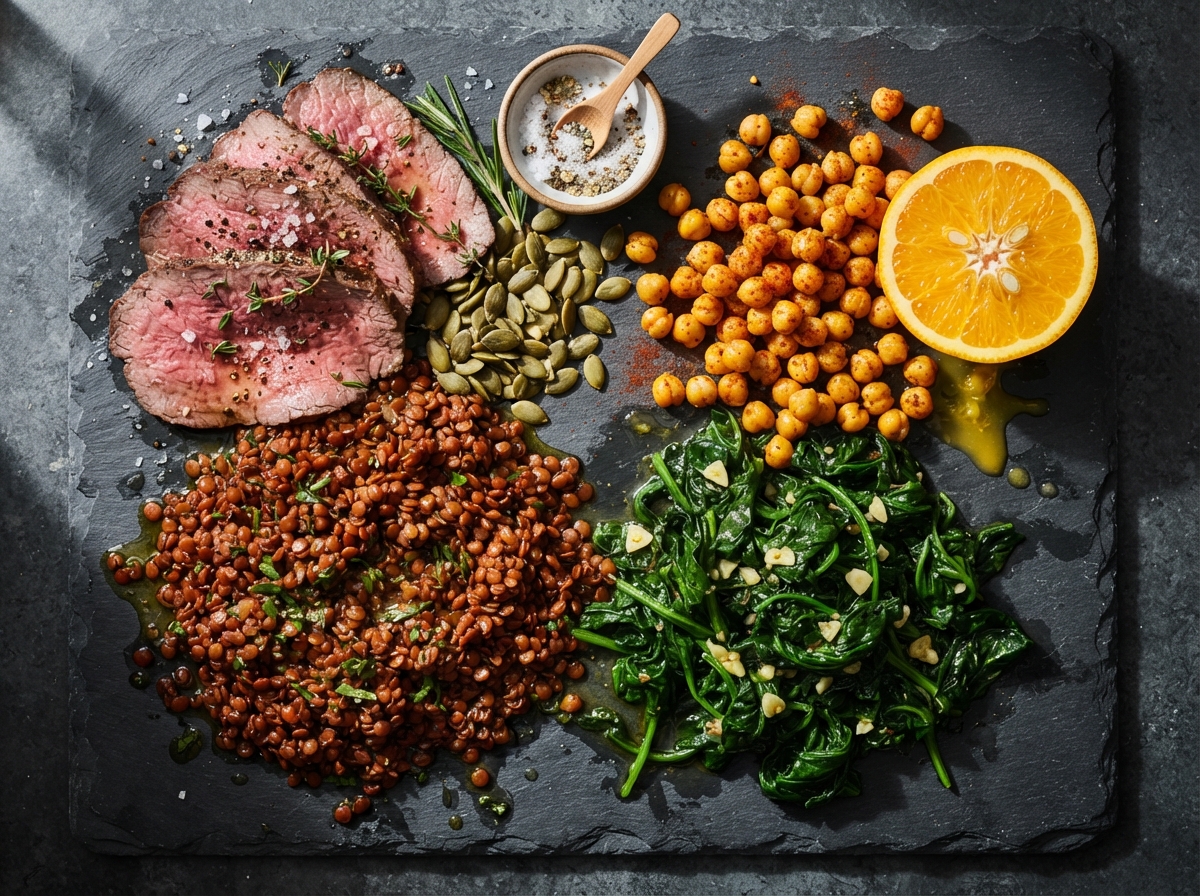
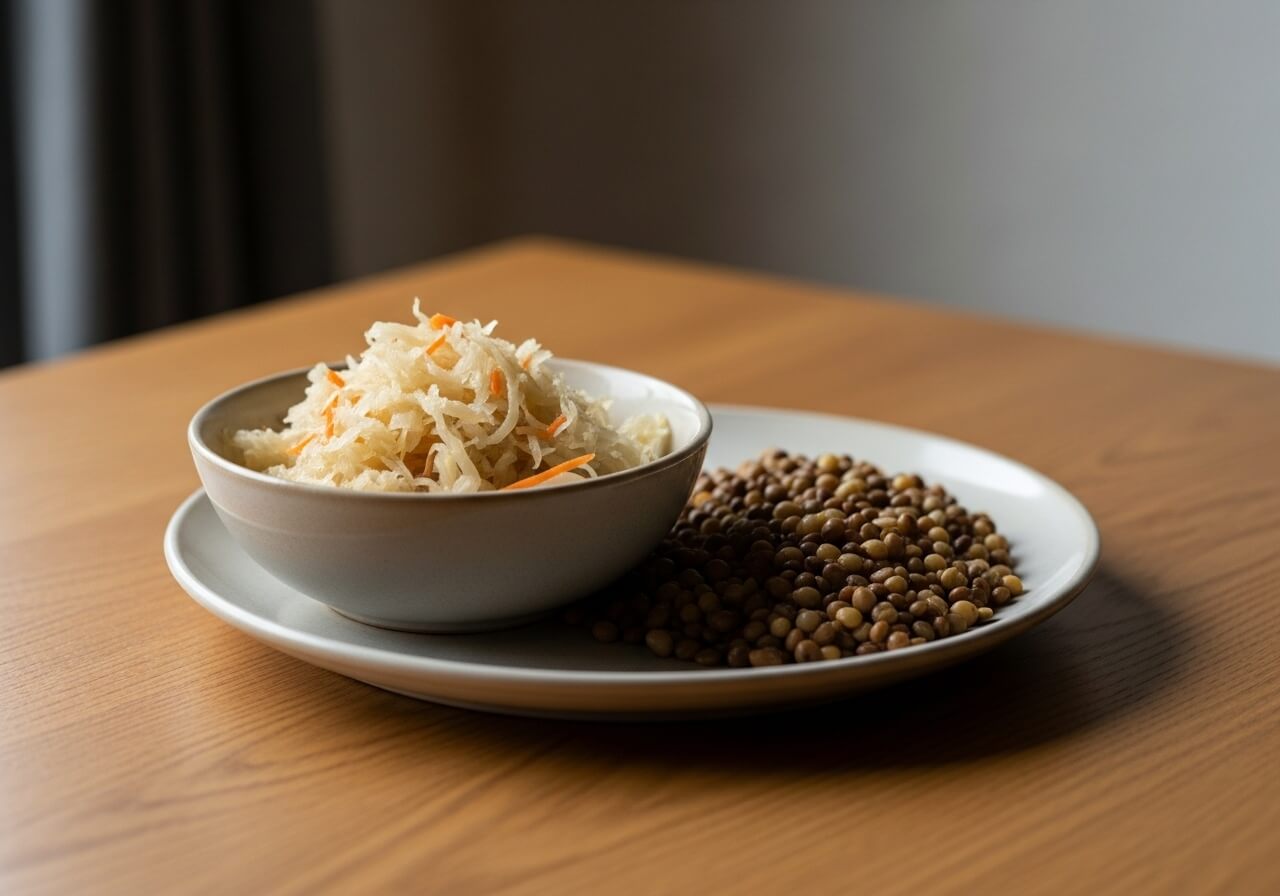
The consequence is not subtle: the NIH states that “the requirement for iron is 1.8 times higher for people who follow vegetarian diets.” Lentils with tomato or peppers, not lentils with tea, is the practical version.
Calcium — dose size matters more than total
Adults absorb about 25% of the calcium they eat, and that share “continues to decline with age.” Two things move it. Vitamin D is required for the active transport route at all. And the size of a single dose matters: absorption “is highest with doses of 500 mg or less” — roughly 36% at 300 mg, falling to about 28% at 1,000 mg. Splitting a supplement across the day beats taking it in one go.
Plant compounds matter here too. Oxalic and phytic acid form indigestible salts with calcium, which is why roughly 5% of the calcium in spinach is absorbed against about 27% from milk. Spinach is a good food; it is not a calcium source.
Fat-soluble vitamins — they need fat
Vitamin D absorption “depends on the gut’s ability to absorb dietary fat”, and fat in the meal enhances it. Vitamin K is the same story with a striking number attached: the body absorbs only 4% to 17% as much phylloquinone from spinach as from a tablet, and “consuming vegetables at the same time as some fat improves phylloquinone absorption.”
Vitamin B12 — the most fragile chain
B12 has the longest route of any nutrient. It is bound to protein in food, freed by hydrochloric acid and gastric protease, handed to one carrier, freed again in the duodenum, combined with intrinsic factor made by the stomach, and only then absorbed in the distal ileum. Any broken link in that chain reduces absorption.
- Age. Atrophic gastritis affects “2% of the general population but 8% to 9% of adults age 65 and older,” reducing both acid and intrinsic factor.
- Medication. Metformin “might reduce the absorption of vitamin B12”; proton pump inhibitors interfere by slowing gastric acid release.
- Dose. Absorption is about 50% at doses under 1–2 mcg, but only 1.3% at 1,000 mcg — which is why high-dose supplements are not 500 times better.
Vitamin C — its own ceiling
Around 70% to 90% of vitamin C is absorbed at moderate intakes of 30 to 180 mg per day. Above 1 g a day, absorption falls below 50%. Very large doses are largely paid for and excreted.
What the large intestine adds
By the time material reaches the colon, most absorption is done. What remains is water — “more water moves from your GI tract into your bloodstream” — and fermentation: “bacteria in your large intestine help break down remaining nutrients and make vitamin K.”
How much vitamin K, honestly. The NIH is careful here: substantial quantities of bacterial vitamin K are present in the large bowel, but “the amount of vitamin K that the body obtains in this manner is unclear”, and experts believe it covers “at least some” of the requirement. Not all of it — some. Anyone telling you gut bacteria supply your vitamin K is overstating a real but unquantified contribution.
When absorption is genuinely impaired
Malabsorption is a medical finding, not a wellness category. The nutrients most often affected are vitamin B12, calcium, iron, folate, vitamin D, magnesium, thiamine, copper and selenium. Two causes are common enough to be worth knowing by name. Selenium is the one on that list where the per-food amounts are unusually lopsided: a single Brazil nut can pass the daily requirement.
Celiac disease is “a chronic digestive and immune disorder that damages the small intestine”, affecting about 2 million people in the United States and around 1% of people worldwide. The damage is to the absorptive surface itself — blunted villi and flattened mucosa — and it can impair iron absorption and cause anemia even without obvious digestive symptoms.
Lactose malabsorption is far more common and often misunderstood. The NIDDK draws a line between the two terms: malabsorption is the inability to break down all the lactose consumed, while intolerance is having symptoms as a result — and “not everyone with lactose malabsorption has digestive symptoms.” About 68% of the world’s population and about 36% of people in the United States have lactose malabsorption. Undigested lactose reaches the colon, where bacteria break it down and “create fluid and gas.”
Where self-management stops. Ongoing diarrhea, unexplained weight loss, or anemia that does not respond to more dietary iron are reasons to see a clinician rather than to buy digestive enzymes. Both celiac disease and lactose malabsorption are testable, and celiac disease must be tested before removing gluten, not after.
FAQ
Does drinking water with meals dilute my digestion?
No. Around 9 liters of fluid pass through the gastrointestinal tract daily as a matter of normal function, most of it secreted by your own organs, and the small intestine reabsorbs 7 to 8 liters of it.
Do I need digestive enzyme supplements?
Enzyme deficiency is a specific clinical condition — exocrine pancreatic insufficiency — with a specific diagnosis and prescription treatment. In a person without it, the pancreas already produces enzymes for carbohydrate, fat and protein.
Is it true that coffee or tea blocks iron?
The verified statement is narrower: certain polyphenols in some plant foods reduce non-heme iron absorption, as does calcium and as does phytate. If iron is a concern, the practical move is vitamin C with plant-iron meals and keeping supplements separate from calcium.
Should I take my calcium and iron together?
No. Calcium reduces the absorption of both non-heme and heme iron, and calcium itself absorbs best in doses of 500 mg or less. Separate them.
Can I improve absorption by “healing my gut”?
In a healthy person there is nothing to heal, and no product has been shown to raise nutrient absorption generally. What demonstrably works is meal composition — vitamin C with plant iron, fat with fat-soluble vitamins, split calcium doses.
Where this fits
The wider picture — fiber, fermented food, prebiotics and probiotics, and what packages may legally claim — is in our guide to gut health and nutrition. If your interest is stomach trouble during hard training, that is a different mechanism, covered in the gut and athletic performance. To check the iron, calcium or fiber in a specific food, use the Nutrition Facts database.
Every figure here is linked to its source in the text: the National Institute of Diabetes and Digestive and Kidney Diseases, the NIH Office of Dietary Supplements, and StatPearls physiology reviews hosted by the National Center for Biotechnology Information. Checked against those sources on 1 September 2026. Educational information, not medical advice — see our medical disclaimer.
This content is for educational purposes only and is not medical advice. Always consult a qualified healthcare professional for personalised guidance.