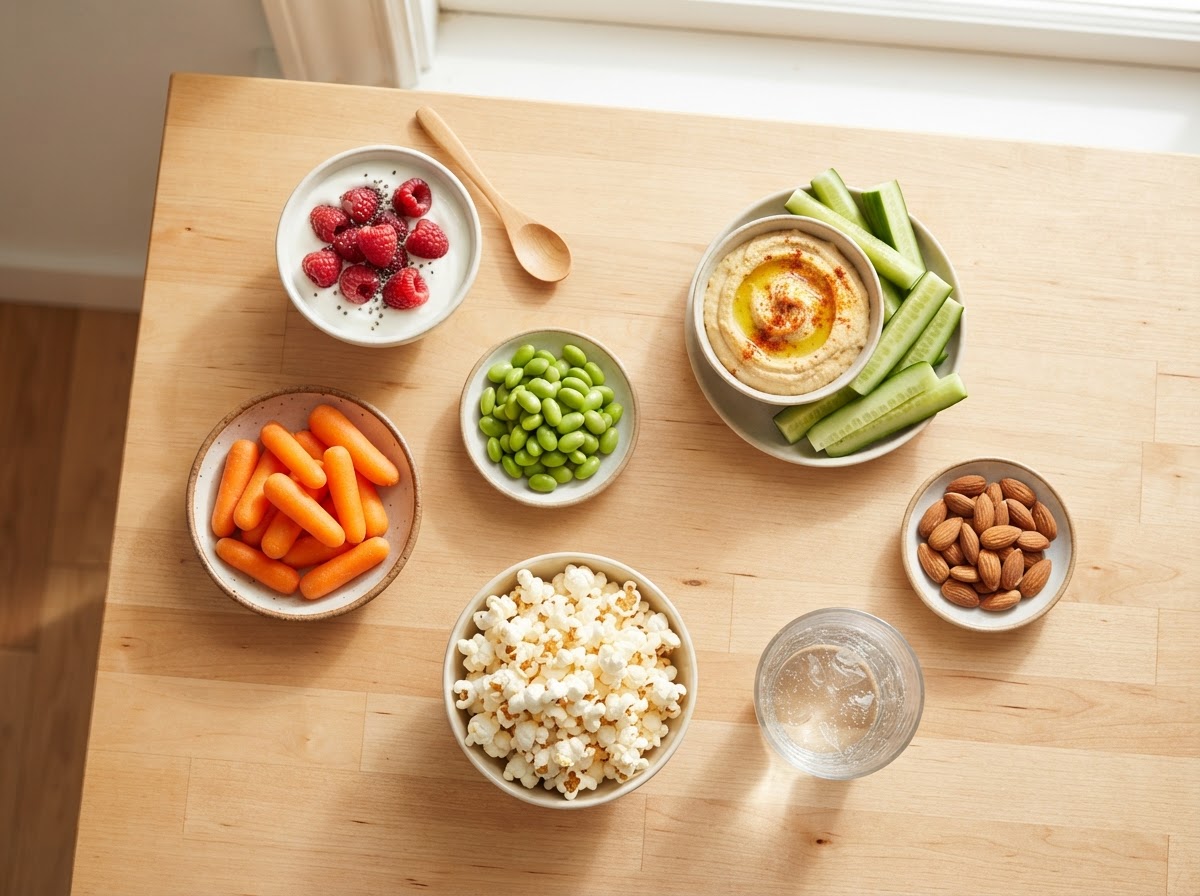
Most advice about snacking for weight loss starts from the assumption that snacking is the problem. The federal evidence review does not support that assumption, and once you drop it the useful question changes: not whether to snack, but what the bag in your hand actually contains and how much of it you are going to eat.
Below: what the 2025 Dietary Guidelines Advisory Committee actually concluded about snacking and body weight, the one place snack portions reliably go wrong, what a federal snack budget looks like in real food, and the popular claim about snacks that we could not find on a single government page.
Key takeaways. The Advisory Committee’s graded conclusion is that overall snacking in adults “may not be associated” with body composition or obesity risk — with evening snacking flagged as the possible exception, on limited evidence. FDA is explicit that a serving size “is not a recommendation of how much you should eat or drink”, and that is where most snack calories escape. The USDA handout budgets 300 calories a day for snacks. And there is no federal statement anywhere that protein keeps you full.
What the evidence review actually concluded
The 2025 Dietary Guidelines Advisory Committee reviewed snacking as its own question and graded its answer. The conclusion, in full, because the hedges are the content:
“Overall snacking in adults may not be associated with outcomes related to body composition and risk of obesity. However, after dinner/evening snacking in adults may be associated with less favorable outcomes related to body composition and risk of obesity. This conclusion statement is based on evidence graded as limited. (Grade: Limited)”
Three things are worth pulling out of that. Snacking as a behavior is not officially implicated in weight. Evening snacking specifically might be. And the whole finding sits on evidence the committee itself graded limited — so anyone telling you confidently that snacking wrecks weight loss, or that it is essential to it, is going further than the evidence does.
The same chapter found that snacking frequency in childhood “may not be associated with outcomes related to growth, body composition, and/or risk of obesity” (also Grade: Limited), and that for older adults “a conclusion statement cannot be drawn… because there is not enough evidence available.”
One definitional point makes all of this easier to read. In the federal intake data, a snack is whatever the person eating it called a snack — the analysis defines snacks as eating occasions “designated by the participant as ‘snack,’ ‘drink,’ ‘extended consumption’” and equivalent terms. A snack is not a nutritional category. The same yogurt is a snack or a meal depending on what you call it, which is exactly why “stop snacking” is such weak advice.
A note on sourcing: these conclusions come from the Advisory Committee’s scientific report to USDA and HHS. That is a federal evidence review, not the Dietary Guidelines themselves, and we are attributing it as such rather than upgrading it.
Where snack calories actually escape: the label
This is the part that is fully, unhedgedly documented, and it is mechanical rather than moral.
FDA states it directly: “The serving size reflects the amount that people typically eat or drink. It is not a recommendation of how much you should eat or drink.” The number on the panel describes behavior; it does not authorise it. FDA’s companion instruction is to “pay attention to the serving size, especially how many servings there are in the food package.”
NHLBI adds the reason this matters more for snacks than for meals: “some foods that most people consume in one portion actually contain multiple servings (e.g., a 20-ounce soda or 3-ounce bag of chips).” A bag is a portion to the person holding it and two or three servings to the label. NIDDK draws the same distinction formally — “a portion is how much food you choose to eat at one time,” while “a serving, or serving size, is the amount of food listed on a product’s Nutrition Facts label.”
NIDDK’s operational fix is the most concrete official snack advice we found anywhere:
“Buy snacks, such as fruit or single-serving prepackaged foods that are lower in calories. If you buy bigger bags or boxes of snacks, divide the items into single-serving packages right away so you aren’t tempted to overeat.” And: “Take one serving according to the food label and eat it off a plate instead of straight out of the box or bag.”
One caveat on all of this, in fairness: the Advisory Committee could not actually grade portion size. Its conclusion was that one “cannot be drawn… because of inconsistency in the interventions, comparators, and outcomes” in the trials. The label advice above stands on its own logic rather than on a graded finding — but the logic is hard to argue with.
NIDDK also suggests keeping the relevant foods out of reach entirely: “try to keep snack foods and higher calorie options out of your home or stored in a cabinet or pantry—not out on the counter.”
What a federal snack budget looks like in real food
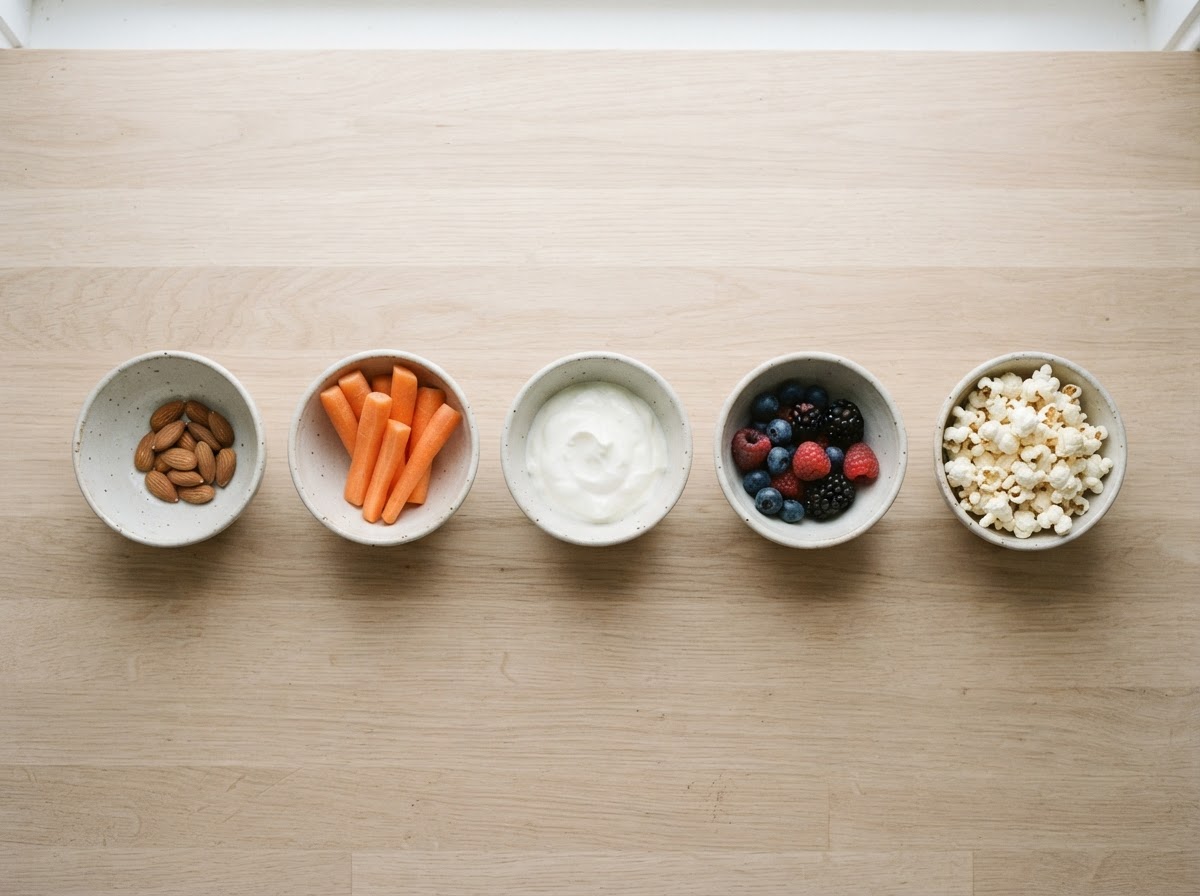
USDA and HHS publish a one-day nutrient-density handout that treats snacks as an ordinary, budgeted eating occasion rather than a lapse. Its snack line reads: “SNACKS / Total calories: 300,” with examples of air-popped popcorn at 60 calories for two cups, and yogurt with peaches at 240 — a cup of plain low-fat Greek yogurt with half a cup of peaches canned in 100% juice.
That is the whole framework: roughly 300 calories a day, spent on food that carries something. The Dietary Guidelines’ definition of what “carries something” means is worth having verbatim, because it is a definition about what a food lacks as much as what it has: “Nutrient-dense foods provide vitamins, minerals, and other health-promoting components and have no or little added sugars, saturated fat, and sodium.”
CDC frames snacks around a similar figure, introducing its own list with “if you are aiming for snacks with about 100 calories, consider:”. Two or three of those, or one larger one, and the day’s snack budget is spent.
| Snack | Why it works inside a 300-calorie budget |
|---|---|
| Plain Greek yogurt with fruit | The USDA handout’s own worked example, at 240 calories |
| Baby carrots | Named by MedlinePlus as an after-dinner option if you are hungry |
| Raspberries or blueberries | Whole fruit, which CDC specifies over juice for the fiber |
| Edamame or hummus with vegetables | Volume and fiber rather than concentrated calories |
| Almonds or pistachios | Fine — but calorie-dense, so this is the one to portion out first |
The two things that genuinely make a snack more filling
MedlinePlus states the fiber case without a hedge: “dietary fiber adds bulk to your diet and makes you feel full faster, helping you control your weight.” It also notes that “most Americans don’t eat enough dietary fiber,” with the practical warning to “add it to your diet slowly” because increasing fiber too quickly “can lead to gas, bloating, and cramps.” FDA puts the Daily Value for fiber at 28 g, and its rule of thumb — 5% DV or less is low, 20% DV or more is high — turns the back of a snack package into a usable test.
The second is volume. CDC: “vegetables and fruits can reduce the total calories in your meal without reducing the amount of food you eat,” and they “help you feel full and can reduce your hunger.” On fruit specifically: “it is better to eat whole fruits because they contain fiber that helps you feel full.” Our guide to high-volume, low-calorie foods is built on the same principle.
And the sentence that keeps this honest, also CDC’s: “the total number of calories you eat counts, even if a good proportion of them come from vegetables and fruits.” A healthy snack is not a free snack.
Notice which word has not appeared: protein. It is the load-bearing claim in almost every snack article, and we went looking for it on MedlinePlus, CDC, NIDDK, NHLBI and the Dietary Guidelines material without finding a single statement that protein increases fullness or reduces later intake. NIDDK’s weight-management page mentions protein only as a food group. It may well be true; it is not something we can source, so it is not a reason we are going to give you.
Timing, metabolism and eating at night
The idea that eating every few hours stokes your metabolism has a direct federal answer, and it is no. MedlinePlus: “unfortunately, there is little scientific evidence that eating small, frequent meals boosts metabolism.”
The same page offers the reason frequent eating can still help some people, and the mechanism is behavioural rather than metabolic: “spreading your meals throughout the day might keep you from getting too hungry and overeating.” That is a real benefit. It is just not the one usually advertised.
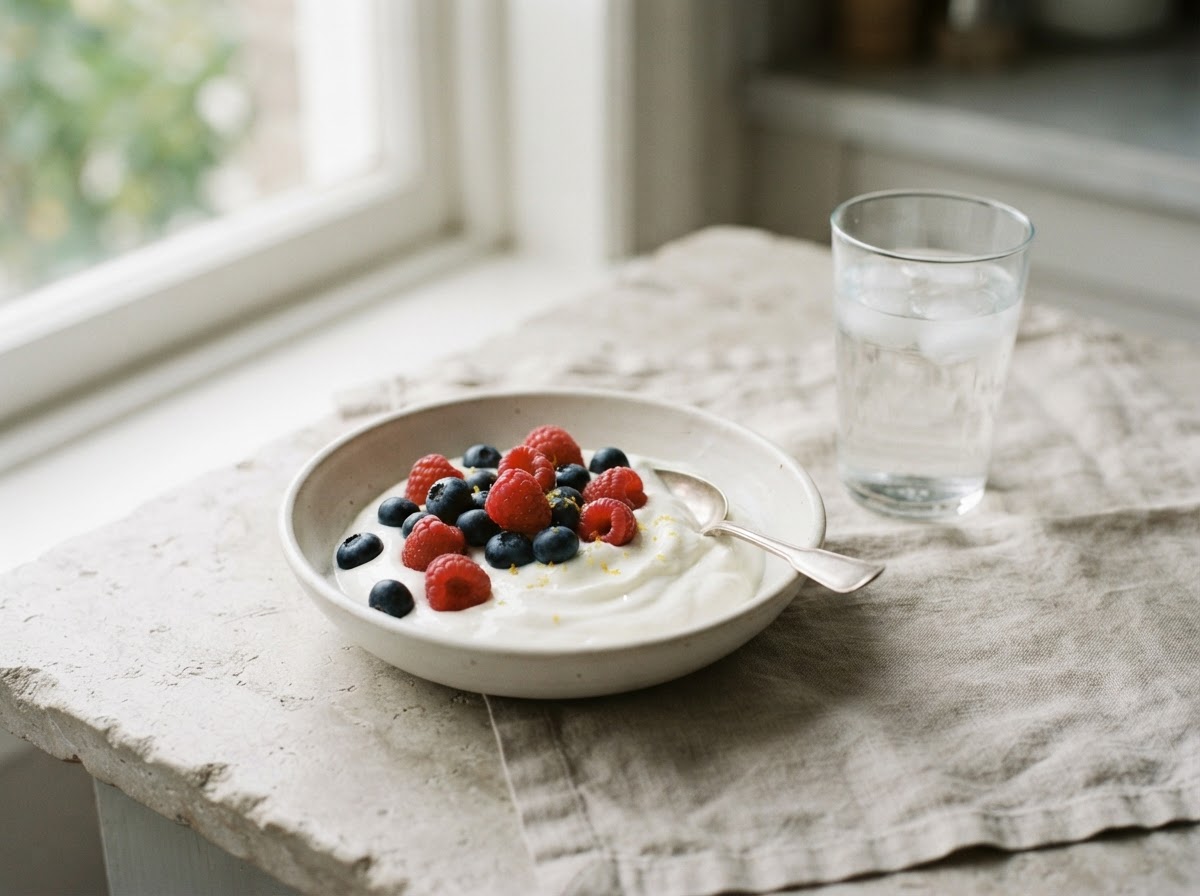
Night eating gets the same careful treatment. MedlinePlus files “eating at night will make you gain weight” under myths, then answers with a distinction: “people who eat late at night do tend to put on extra weight. One possible reason is that late-night eaters tend to choose high-calorie treats.” The clock is not doing the work — the choice is. Their suggestion if you are hungry after dinner: “limit yourself to healthy snacks such as low-fat yogurt or baby carrots.”
That fits alongside the Advisory Committee’s evening-snacking caveat rather than contradicting it. If there is one snacking habit worth examining, it is the one that happens after dinner, in front of a screen, out of a bag.
For the rate to expect, CDC is specific: “people who lose weight at a gradual, steady pace—about 1 to 2 pounds a week—are more likely to keep the weight off than people who lose weight quicker.”
FAQ
Should I stop snacking to lose weight?
Nothing official supports that as a rule. The Advisory Committee’s graded conclusion is that overall snacking in adults may not be associated with body composition or obesity risk. What is worth changing is the after-dinner snack, which is the one the same conclusion singles out, and the portion, which is where the calories actually accumulate.
How many calories should a snack be?
The USDA and HHS one-day handout budgets 300 calories for snacks across the day. CDC frames individual snacks at about 100 calories. Neither is a rule, but together they give a workable shape: two or three small snacks, or one substantial one.
Does eating late at night make you gain weight?
MedlinePlus lists this as a myth with a real kernel: late-night eaters do tend to put on extra weight, and “one possible reason is that late-night eaters tend to choose high-calorie treats.” Change what the evening snack is before changing whether you have one.
Do small frequent meals speed up your metabolism?
No. MedlinePlus says there is little scientific evidence for it. Spreading meals out may still stop you getting too hungry and overeating, which is a different and more modest claim.
What is the single most useful change?
Dividing multi-serving packages into single servings as soon as you get home, and eating a snack off a plate rather than out of the bag. Both come straight from NIDDK, and both work by removing the decision rather than by requiring willpower at the moment it is weakest.
What to do with this
Stop treating snacking as the thing to fix. Spend roughly 300 calories a day on snacks that bring fiber and volume — whole fruit, vegetables, plain yogurt — portion them out of their packaging before you are hungry, and if you are going to look hard at one habit, make it the one after dinner. That is the entire evidence-supported version, and it is shorter than most of what gets written about it.
Related: nutrient-dense snack ideas by category for what to actually put on the plate; high-fiber foods and why fiber intake matters for the mechanism behind fullness; sustainable weight-loss strategies for the wider picture; and healthy snacks for kids if you are feeding a household rather than yourself.
Educational content, not medical advice.
This content is for educational purposes only and is not medical advice. Always consult a qualified healthcare professional for personalised guidance.