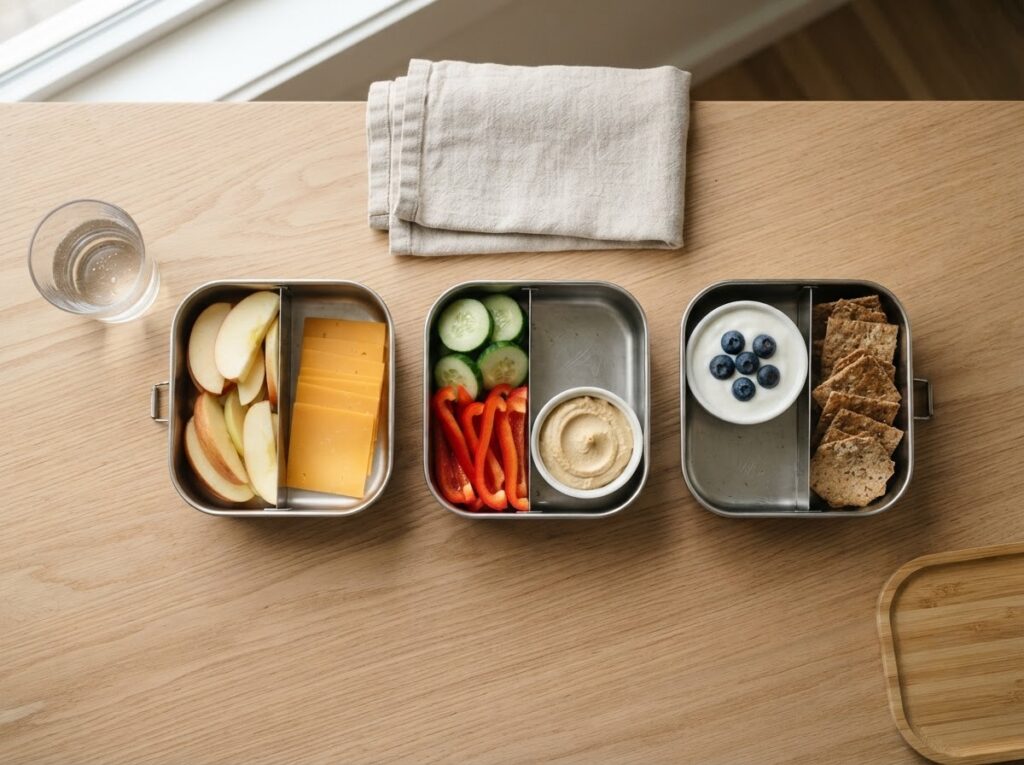
The best snack for a child depends on age more than on any “superfood” list. A 2-year-old and a 12-year-old both need a snack between lunch and dinner, but one of them cannot safely eat a whole grape and the other can eat three times as much sodium in a day. Almost every “healthy snacks for kids” list ignores that.
This guide is built by age band: how many snacks a day pediatric sources recommend, what is off-limits before age 4, how much juice and sugar is too much, and 30 snack ideas grouped so you can prep them in minutes. Every number is quoted from the American Academy of Pediatrics, the Dietary Guidelines for Americans, the CDC or the Academy of Nutrition and Dietetics. The adult version of the same question is snacking and weight loss.
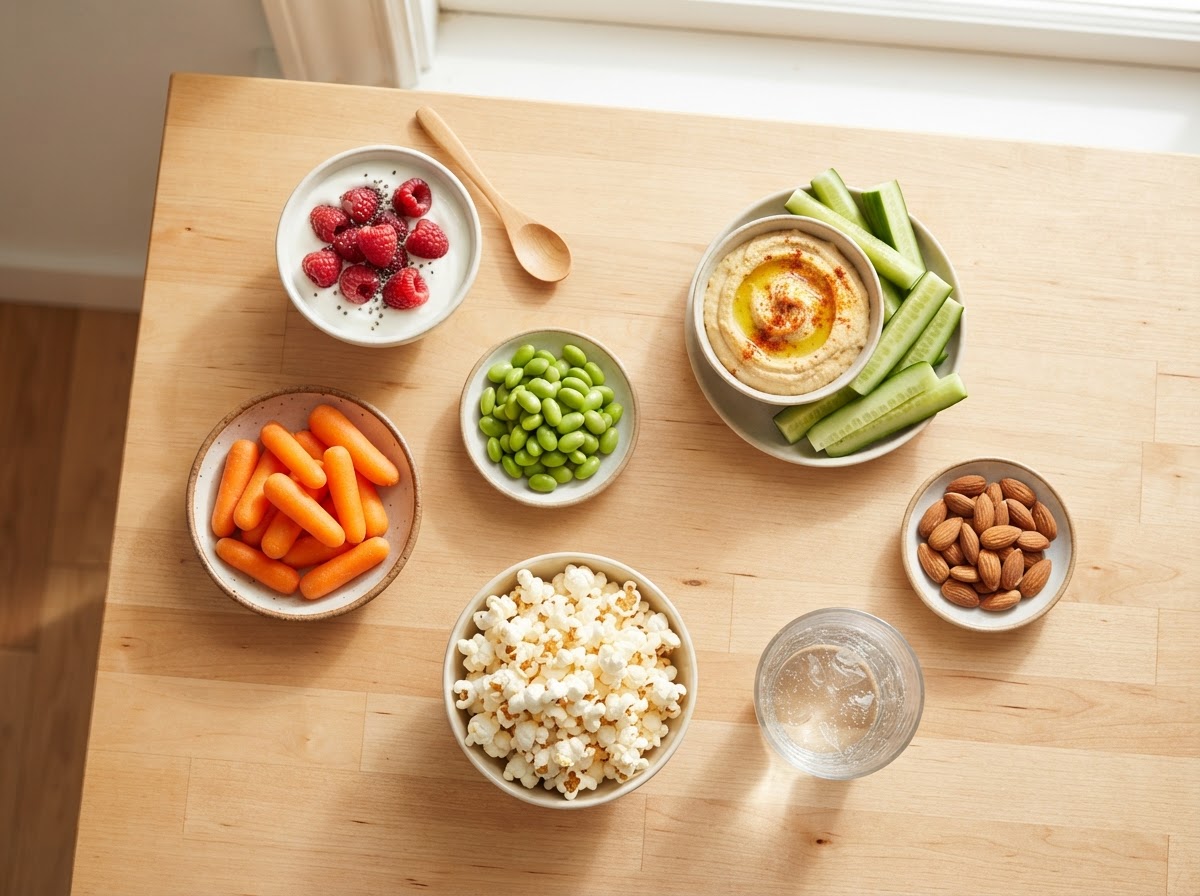
Key takeaways. Younger kids need about two snacks a day, older kids about one, served at set times rather than grazed. Before age 4, cut grapes, skip whole nuts and popcorn. Water and plain milk are the drinks; juice is capped at 4–8 oz a day by age. A filling snack pairs protein with fiber — cheese and apple, yogurt and berries, hummus and pepper strips.
How many snacks a day, by age
The Academy of Nutrition and Dietetics puts it simply: “Younger kids need three meals and about two snacks a day” while “older kids need to eat three meals and about one snack a day.” The AAP says the same for preschoolers — “a growing preschooler needs 1 to 2 healthy snacks every day” — and adds that many toddlers need an afternoon snack and some a morning one too.
Timing matters as much as the count. The Academy’s rule of thumb is to offer a snack “a few hours after one meal ends and about one to two hours before the next meal begins.” For toddlers, that usually means two to three hours between eating occasions. The reason is appetite: the AAP notes that children who are “grazing” throughout the day “may not be hungry at mealtimes, when healthier foods tend to be available.”
| Age | Snacks per day | Choking-risk foods | Juice limit | Sodium limit |
|---|---|---|---|---|
| 1–3 years | About 2 (afternoon; often morning) | Avoid the high-risk list until age 4 | Up to 4 oz/day; none under 1 year | Under 1,200 mg/day |
| 4–8 years | 1–2 | Introduce with supervision from age 4 | 4–6 oz/day (ages 4–6); up to 8 oz (7+) | Under 1,500 mg/day |
| 9–13 years | About 1 | — | Up to 8 oz/day | Under 1,800 mg/day |
| 14–18 years | About 1 | — | Up to 8 oz/day | Under 2,300 mg/day |
Snack counts: Academy of Nutrition and Dietetics and AAP. Choking cutoff: AAP. Juice: AAP 2017 policy. Sodium: Dietary Guidelines for Americans 2025–2030.
What makes a snack filling instead of a sugar hit
Protein plus fiber. The Academy of Nutrition and Dietetics: “Offer your kids a snack containing protein and fiber, so the snacks are filling, sustaining and add to the quality of their intake.” The AAP’s toddler guidance describes a balanced snack as a protein food (dairy counts), a fruit or vegetable, and a grain or starchy vegetable — while noting that “not every snack needs to be a mini-meal.”
The fiber side is where most kids fall short. The AAP’s quick rule: add 5 to your child’s age — “a 5-year-old needs about 10 grams of fiber per day.” A medium apple with the skin, a cup of raspberries, or half a cup of chickpeas each contribute several grams toward that. Our fiber-content table lists the numbers per serving.
The gap is real. In a 2023 CDC report on children aged 1–5, “approximately one in three (32.1%) children did not eat a daily fruit” and “nearly one half (49.1%) did not eat a daily vegetable” in the preceding week. Snack time is the easiest place to close that gap, because a child who refuses broccoli at dinner will often eat pepper strips with hummus at 3 p.m.
30 snack ideas, grouped by prep time
Each pairs protein with fiber or fruit. Portion to age: a toddler’s snack is roughly a quarter of an adult’s.
No prep (open and serve)
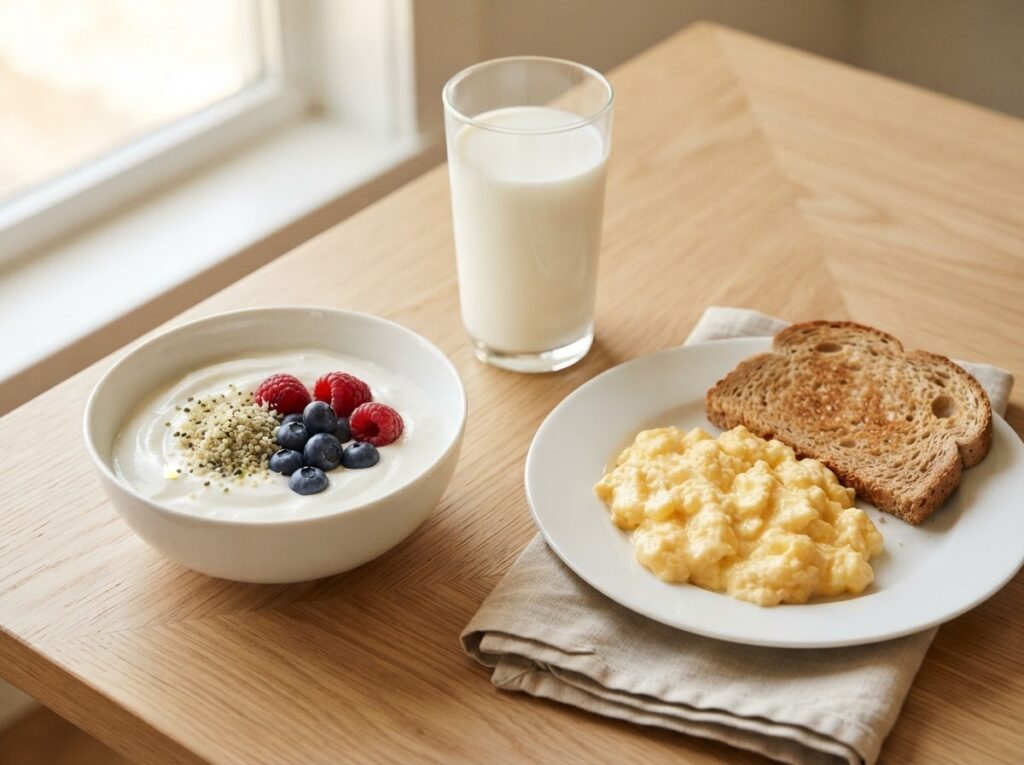
- Plain yogurt with a spoon of fruit — skip flavored cups, which are where the added sugar hides
- String cheese and a clementine
- Whole-grain crackers with a cheese slice
- A banana and a handful of whole-grain cereal (low-sugar)
- Cottage cheese with pineapple
- Unsweetened applesauce pouch and a cheese stick
- Edamame in the pod (ages 4+)
- Roasted chickpeas (ages 4+)
- Hard-boiled egg, quartered
- Milk and a small whole-grain muffin
Two minutes (cut and plate)
- Apple slices with thin-spread nut or seed butter
- Cucumber rounds with hummus
- Bell pepper strips with hummus or a yogurt dip
- Baby carrots with cottage cheese (cut lengthwise under 4)
- Pear slices and cheddar cubes
- Halved grapes and cheese (grapes always quartered under 4)
- Whole-grain toast with mashed avocado
- Rice cake with cream cheese and sliced strawberries
- Cherry tomatoes (halved) with mozzarella pearls
- Kiwi halves with a spoon, plus a cheese stick
Prep once, serve all week
- Fruit skewers on a blunt stick (older kids) or in a cup (younger)
- Mini muffins made with oats, banana and egg — freeze and thaw one at a time
- Homemade trail mix: whole-grain cereal, dried fruit, seeds or nuts for ages 4+
- Yogurt bark: plain yogurt spread thin with berries, frozen and broken up
- Overnight oats in small jars with grated apple
- Veggie muffins (zucchini, carrot) with cheese
- Bean quesadilla wedges — reheat or serve cold
- Turkey and cheese roll-ups, sliced into pinwheels
- Smoothie made with milk or plain yogurt, frozen fruit and a handful of spinach, poured into freezer pops
- Whole-grain pita triangles with a batch of homemade hummus
Before age 4: the choking list
The AAP is specific: “Keep high-risk foods from children until 4 years of age or older, depending on each child’s development and maturity level.” Its list includes hot dogs, nuts and seeds, whole grapes, raw vegetables such as carrot sticks, raw fruit chunks such as apple pieces, popcorn, thick chunks of peanut butter or other nut butters, marshmallows, chunks of cheese or string cheese, hard or sticky candy, chewing gum, meat sticks and chunks of meat.
That does not mean skipping these foods — it means changing the shape. The CDC’s guidance is that “cutting food into smaller pieces and mashing foods can help prevent choking.” In practice for toddlers:
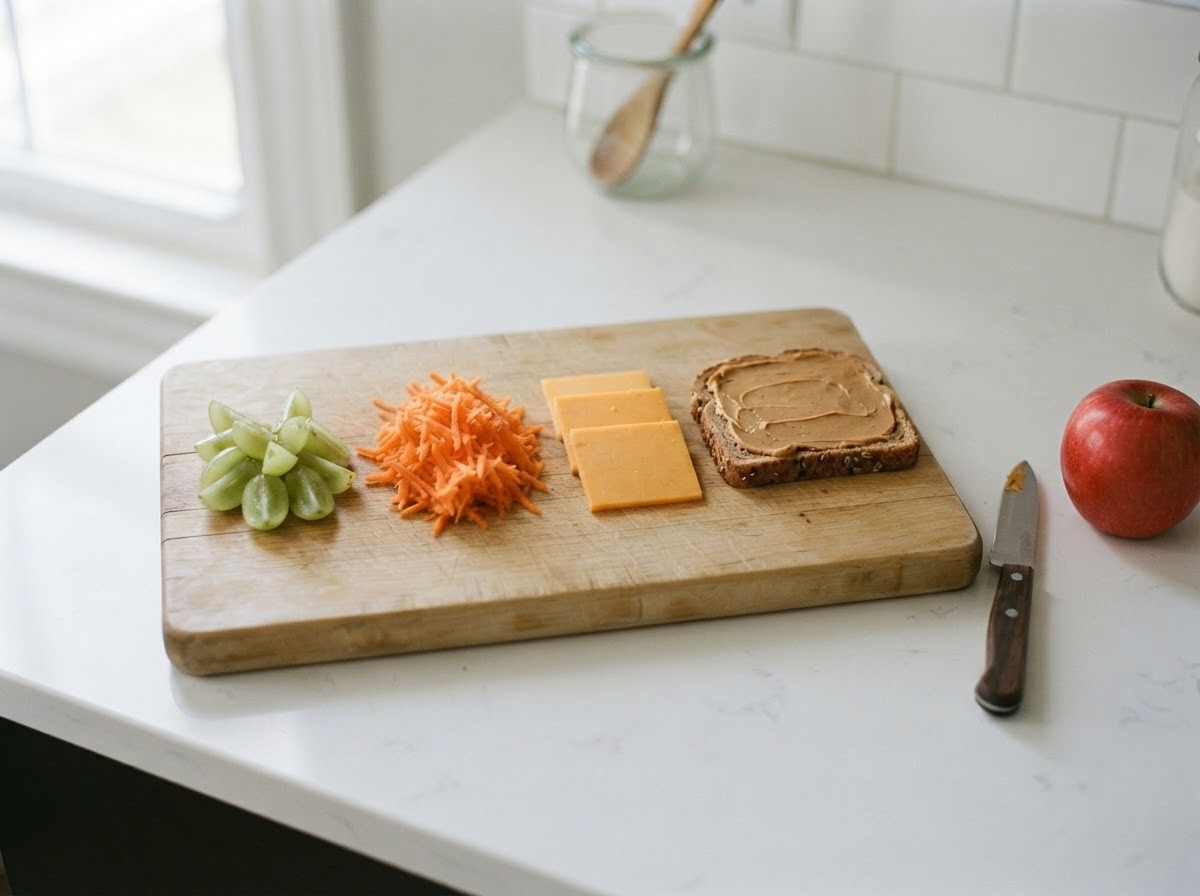
- Grapes, cherry tomatoes and berries larger than a pea: quartered lengthwise.
- Carrots and apples: grated, or cooked until soft. Cucumber: thin rounds, not chunks.
- Nut butter: spread thin on bread or crackers, never off the spoon.
- Cheese: thin slices or shreds, not cubes or whole sticks.
- Hot dogs and sausages: skip, or quarter lengthwise and slice.
- Popcorn, whole nuts, marshmallows, hard candy: wait until 4.
School snacks: nut-free and allergy-aware
The CDC estimates that “1 in 13 children (8%), or 2 students per classroom, are affected with food allergies,” which is why many schools ask for nut-free snacks. The FDA recognizes nine major allergens: milk, eggs, fish, crustacean shellfish, tree nuts, peanuts, wheat, soybeans and sesame — sesame was added in January 2023, so check labels on hummus, crackers and granola bars if your school lists it.
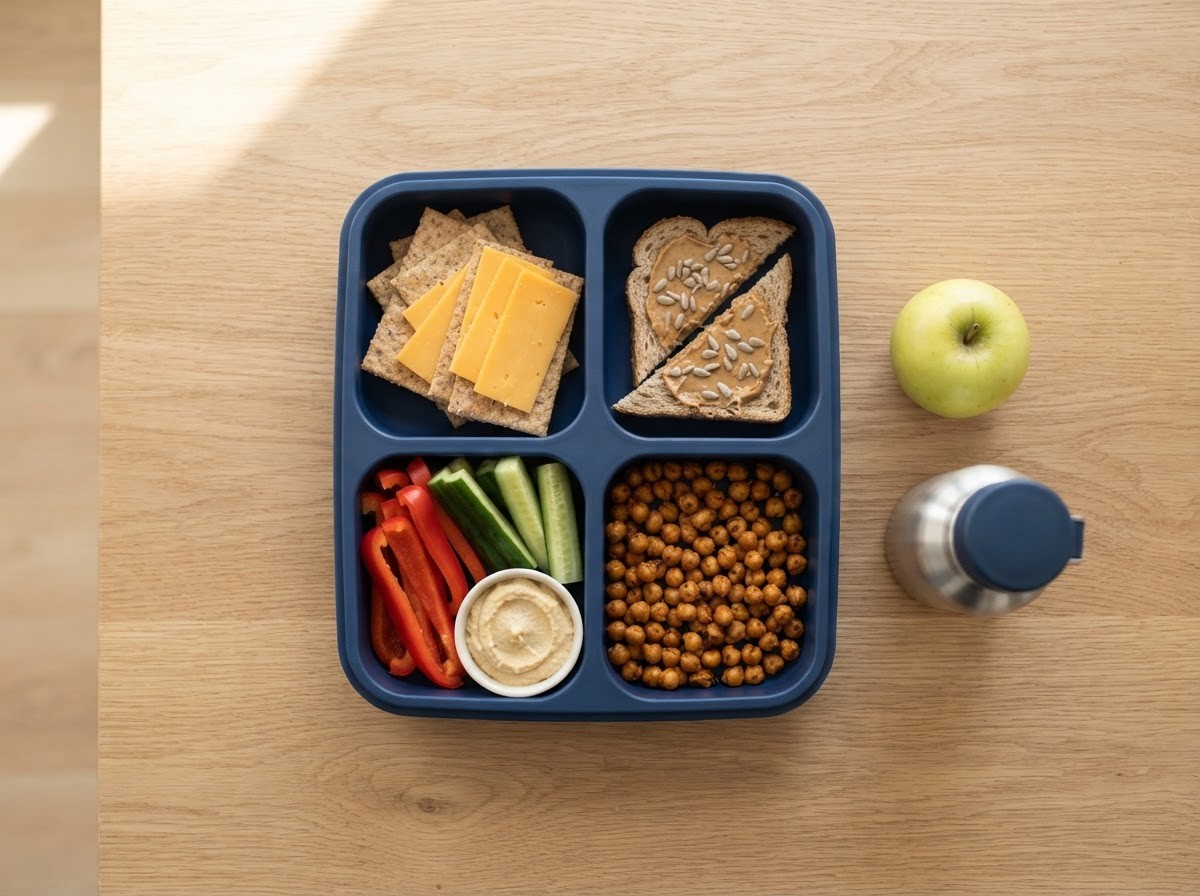
Nut-free swaps that hold up in a lunch box: sunflower-seed butter instead of peanut butter, roasted chickpeas instead of trail mix, cheese and fruit, hummus with vegetable strips, hard-boiled egg, yogurt tubes frozen the night before so they stay cold. If your child has a diagnosed allergy, our guide to food allergy vs sensitivity explains the difference and what a label can and cannot tell you.
Sugar and drinks: where most “kid snacks” fail
Packaged snacks marketed to children — fruit gummies, flavored yogurts, granola bars, juice boxes — are where added sugar concentrates. The Dietary Guidelines 2020–2025 set the ceiling at “less than 10 percent of calories per day starting at age 2” and none before age 2. The 2025–2030 edition is stricter in tone: no amount of added sugar is “recommended or considered part of a healthy or nutritious diet,” a meal should carry no more than 10 grams, and grain snacks such as crackers “should not exceed 5 grams of added sugar per ¾ ounce.” The American Heart Association’s limit for ages 2–18 is 25 grams a day — a flavored yogurt cup and a juice box can use most of it.
Reading the Added Sugars line on the label is the fastest filter; our guide on hidden sugars in “healthy” foods lists the products that surprise most parents.
Drinks follow the same logic. The AAP’s guidance, drawn from the Healthy Eating Research expert panel, is water and plain milk for young children. Juice is capped by age: none under 1 year, at most 4 oz a day for ages 1–3, 4–6 oz for ages 4–6, and 8 oz for ages 7–18 — and whole fruit is preferred over juice at any age. The AHA adds that sugar-sweetened drinks should be limited to at most one 8-oz serving a week for children. If a snack comes with a drink, the drink is water.
Sodium is the other packaged-snack problem. Crackers, pretzels, cheese puffs and deli meat add up fast against a toddler’s 1,200 mg daily ceiling — check the Sodium line the same way you check Added Sugars. Our sodium guide has the limits and the label cues.
What we are not claiming
- That pairing protein with carbs “prevents blood sugar crashes” in children. No pediatric source we checked makes that claim; the sourced language is “filling and sustaining.”
- That every child needs exactly two snacks. The AAP says one to two for preschoolers and that every toddler is different — appetite, activity and meal timing all shift it.
- That “no snacks” is better. Structured snacks at set times are the recommendation; unstructured grazing is what pediatric sources caution against.
- Fiber targets are given two ways in the literature — the AAP’s “age plus 5” rule and the higher Institute of Medicine adequate intakes (19 g at ages 1–3, 25 g at 4–8). We quote the simpler AAP rule; either way, most children eat less than both.
FAQ
How many snacks should a toddler have a day?
Usually two — an afternoon snack and often a morning one — spaced two to three hours from meals. Some toddlers need only one; the AAP notes that every toddler is different.
What are healthy snacks for school?
Nut-free and no refrigeration needed: whole-grain crackers with cheese, fruit, roasted chickpeas, sunflower-seed butter on whole-grain bread, a frozen yogurt tube that thaws by snack time, cucumber or pepper strips with hummus.
What snacks should a 2-year-old avoid?
Whole grapes, whole nuts, popcorn, hot dogs, spoonfuls of nut butter, cheese chunks, raw carrot sticks and apple chunks, marshmallows and hard candy — the AAP’s high-risk list until age 4. Most can be served grated, quartered or spread thin instead.
Is juice a healthy snack for kids?
Whole fruit is better. If you serve juice, the AAP caps it at 4 oz a day for ages 1–3, 4–6 oz for ages 4–6 and 8 oz for older children, and none before age 1.
How much sugar can a child have a day?
The AHA limit for ages 2–18 is 25 grams of added sugar a day; the Dietary Guidelines say none before age 2 and less than 10% of calories after. The newest edition suggests no more than 10 grams per meal.
Are granola bars a healthy snack for kids?
Depends on the label. Many exceed the 5-gram-per-serving added-sugar ceiling the 2025–2030 Dietary Guidelines suggest for grain snacks. Choose ones with under 5 g added sugar and some fiber, or make oat-and-banana mini muffins instead.
This content is for educational purposes only and is not medical advice. Always consult a qualified healthcare professional for personalised guidance.