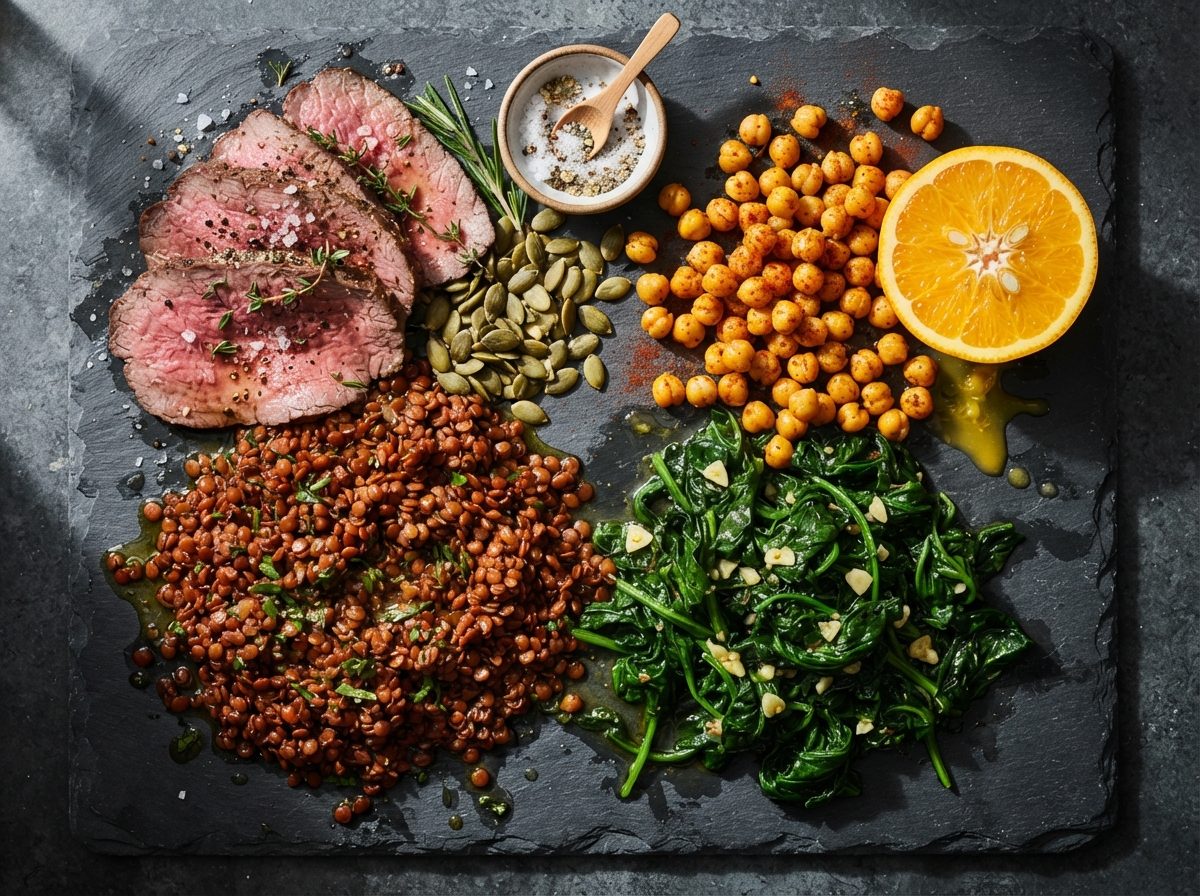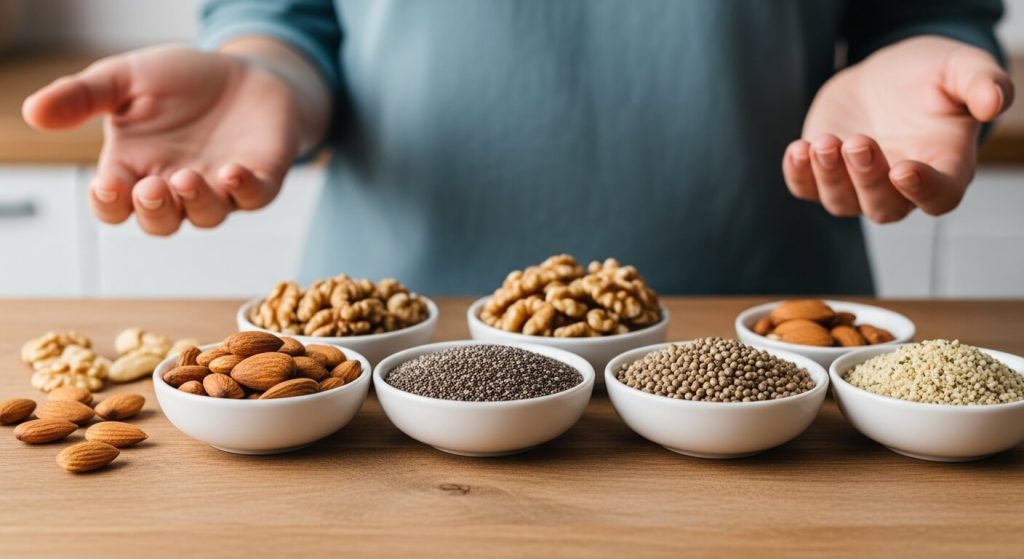
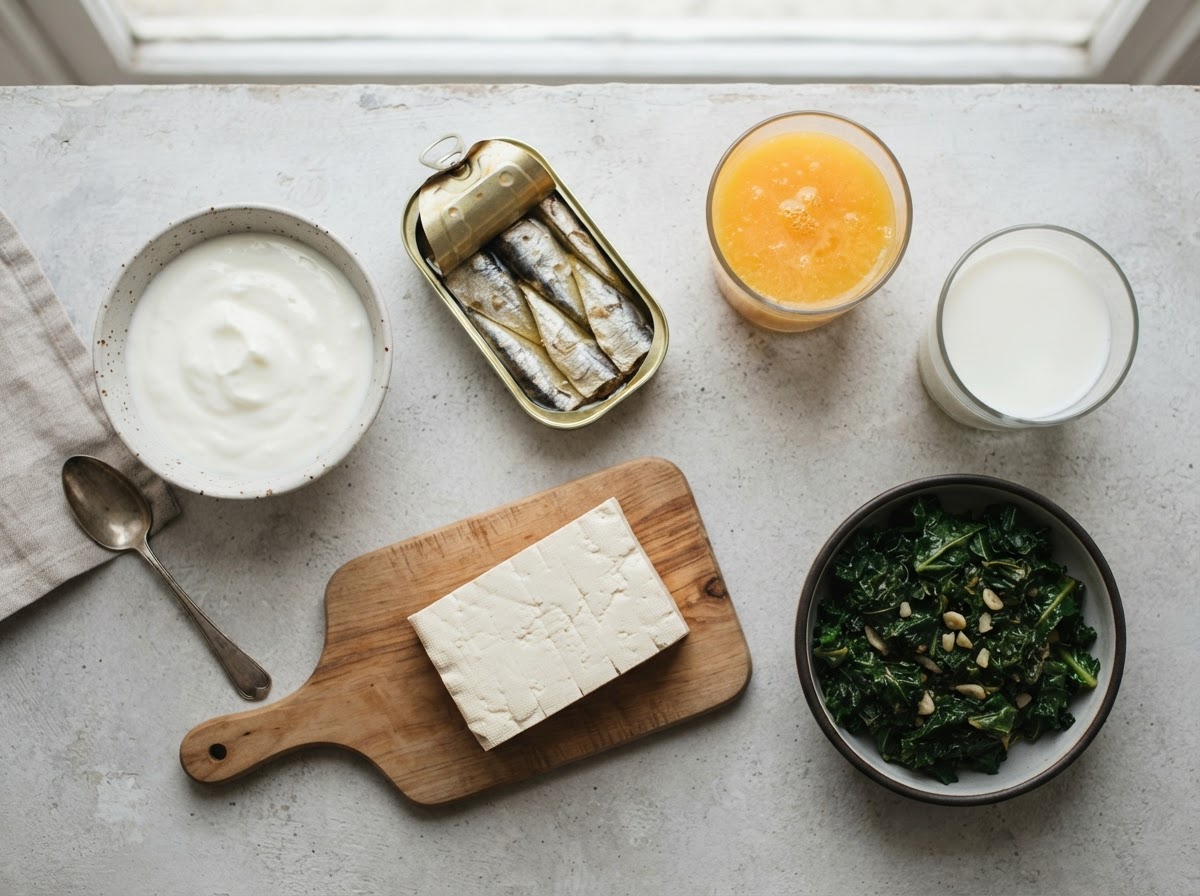
Spinach has more calcium per serving than cooked kale. Your body absorbs about 5% of it. From milk it absorbs about 27%. That single comparison, published by the NIH Office of Dietary Supplements, is the reason most lists of foods high in calcium are misleading: they rank by milligrams on the label, and milligrams are not what reaches your bones.
This article uses the federal numbers for both halves of the problem — how much calcium a food contains, and how much of it you can actually use. It also covers the part almost nobody mentions: which greens escape the spinach problem entirely, why tofu is sometimes a calcium food and sometimes not, and exactly what a package is legally allowed to claim.
Key takeaways. Absorption is 5% for spinach and 27% for milk, per ODS. But broccoli, kale and cabbage are absorbed about as well as milk — they simply contain far less per serving. Fish canned with bones beats every green: sardines 325 mg a serving. Fortified orange juice (349 mg) and fortified soy milk (299 mg) sit level with dairy. Tofu only counts if it was set with a calcium salt. Supplements absorb best at 500 mg or less at a time, and calcium carbonate must be kept four hours away from levothyroxine. The current Dietary Guidelines give a dairy serving goal but no milligram figure for calcium at all.
How much you need, and the ceiling
These are the recommended intakes from the ODS calcium fact sheet. The same figures appear independently on MedlinePlus and on the bone-health page of the National Institute of Arthritis and Musculoskeletal and Skin Diseases, which makes this the best-corroborated table in the article. Infant rows are Adequate Intakes rather than RDAs.
| Age | Male | Female | Upper limit |
|---|---|---|---|
| 0–6 months | 200 mg | 200 mg | 1,000 mg |
| 7–12 months | 260 mg | 260 mg | 1,500 mg |
| 1–3 years | 700 mg | 700 mg | 2,500 mg |
| 4–8 years | 1,000 mg | 1,000 mg | 2,500 mg |
| 9–13 years | 1,300 mg | 1,300 mg | 3,000 mg |
| 14–18 years | 1,300 mg | 1,300 mg | 3,000 mg |
| 19–50 years | 1,000 mg | 1,000 mg | 2,500 mg |
| 51–70 years | 1,000 mg | 1,200 mg | 2,000 mg |
| Over 70 | 1,200 mg | 1,200 mg | 2,000 mg |
Two things about the upper limits. They were set by the Food and Nutrition Board, which ODS reports rather than sets, and they are based on observational evidence linking supplemental calcium to kidney stones — more on that below. Note also that the ceiling comes down after 50 while the requirement goes up: the window between what you need and what is too much is narrowest in exactly the group most likely to be taking supplements.
The federal food table, in full
ODS publishes 27 foods with their calcium content and percentage of the Daily Value. The Daily Value for calcium is 1,300 mg for adults and children aged 4 and over. Here is the whole list, in the order the source prints it.
| Food | mg per serving | % DV |
|---|---|---|
| Yogurt, plain, low fat, 8 ounces (about 227 g) | 415 | 32 |
| Orange juice, calcium fortified, 1 cup | 349 | 27 |
| Yogurt, fruit, low fat, 8 ounces | 344 | 27 |
| Mozzarella, part skim, 1.5 ounces (about 43 g) | 333 | 26 |
| Sardines, canned in oil, with bones, 3 ounces (about 85 g) | 325 | 25 |
| Milk, nonfat, 1 cup | 299 | 23 |
| Soymilk, calcium fortified, 1 cup | 299 | 23 |
| Milk, whole (3.25% milk fat), 1 cup | 276 | 21 |
| Tofu, firm, made with calcium sulfate, ½ cup | 253 | 19 |
| Salmon, pink, canned, solids with bones, 3 ounces | 181 | 14 |
| Cottage cheese, 1% milk fat, 1 cup | 138 | 11 |
| Tofu, soft, made with calcium sulfate, ½ cup | 138 | 11 |
| Soybeans, cooked, ½ cup | 131 | 10 |
| Breakfast cereals, fortified with 10% of the DV, 1 serving | 130 | 10 |
| Spinach, boiled, drained, ½ cup | 123 | 9 |
| Frozen yogurt, vanilla, soft serve, ½ cup | 103 | 8 |
| Turnip greens, fresh, boiled, ½ cup | 99 | 8 |
| Kale, fresh, cooked, 1 cup | 94 | 7 |
| Chia seeds, 1 tablespoon | 76 | 6 |
| Chinese cabbage (bok choy), raw, shredded, 1 cup | 74 | 6 |
| Beans, pinto, canned, drained, ½ cup | 54 | 4 |
| Tortilla, corn, one, 6″ diameter | 46 | 4 |
| Sour cream, reduced fat, 2 tablespoons | 31 | 2 |
| Bread, whole wheat, 1 slice | 30 | 2 |
| Kale, raw, chopped, 1 cup | 24 | 2 |
| Broccoli, raw, ½ cup | 21 | 2 |
| Apple, golden delicious, with skin, 1 medium | 10 | 0 |
Two rows need reading carefully. The fortified breakfast cereal row says 130 mg because the row is defined as cereal fortified with 10% of the Daily Value — it is a specification, not a measurement of any particular box. And both tofu rows specify calcium sulfate, which matters more than anything else in the table; see below.
Why the milligrams mislead
ODS explains the mechanism in one sentence: “Certain compounds in plants (e.g., oxalic acid, phytic acid) can decrease calcium absorption by forming indigestible salts with calcium.” Then it gives the consequence, and this is the number to remember: “As a result, absorption of calcium is only 5% for spinach, whereas it is much higher, at 27%, for milk.”
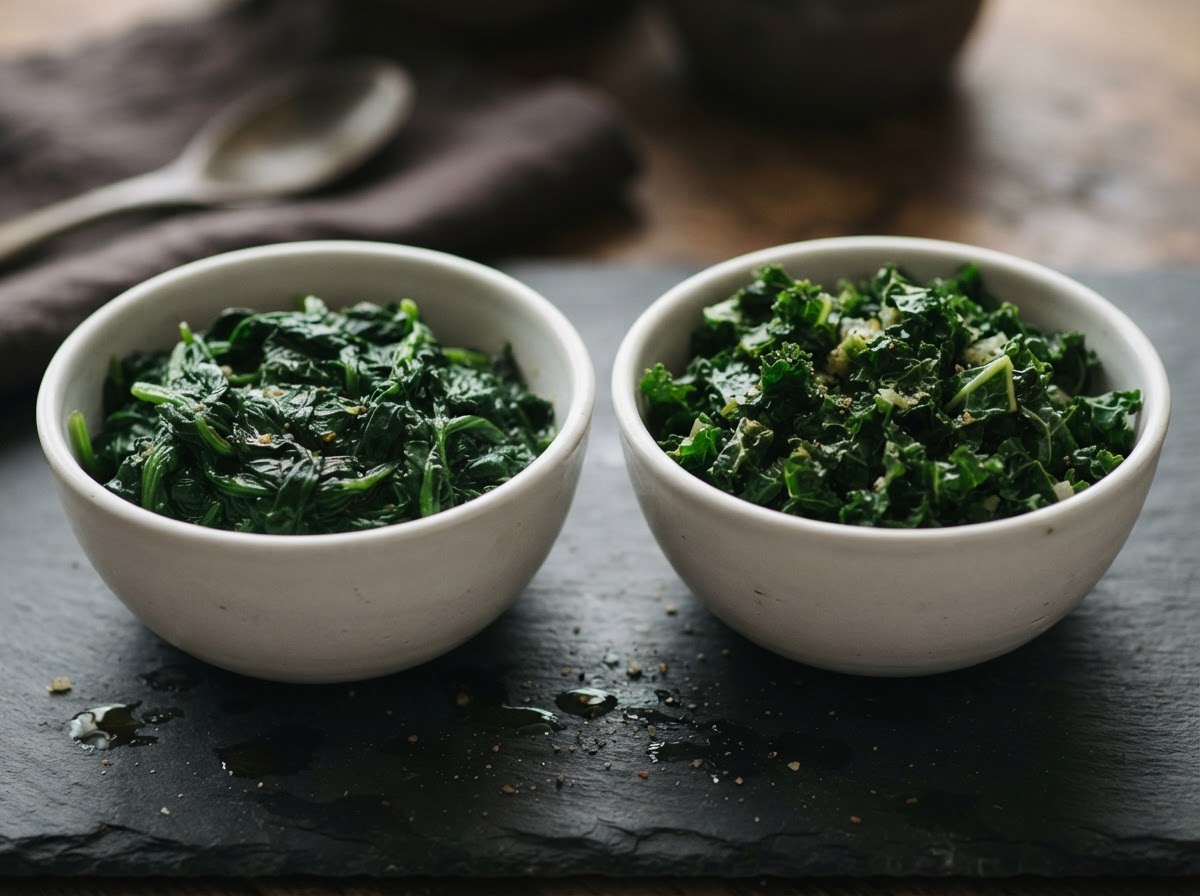
Now the part that most articles cut off halfway. ODS does not extend the spinach problem to greens as a class. It says: “The bioavailability of calcium from other plants that do not contain these compounds—including broccoli, kale, and cabbage—is similar to that of milk, although the amount of calcium per serving is much lower.”
Both halves matter. Kale, broccoli and bok choy are absorbed about as well as milk — and a cup of cooked kale still only carries 94 mg against a cup of milk’s 299 mg. Well absorbed and small are not a contradiction.
There is a genuine disagreement between two federal sources here, and it is worth seeing rather than smoothing. MedlinePlus states flatly that “leafy greens are not considered an adequate source of calcium by themselves, because your body is unable to utilize much of the calcium they contain.” That generalizes the oxalate problem to leafy greens as a category. ODS restricts it to spinach and rhubarb and explicitly exempts kale, broccoli and cabbage. ODS is the more precise of the two, and if you only read the MedlinePlus version you would write off the greens that actually work.
MedlinePlus is useful on the food list though: as well as spinach and rhubarb it names wheat bran as a binder, and adds calcium sources no other federal page lists — “Almonds, Brazil nuts, sunflower seeds, tahini, and dried beans” and blackstrap molasses.
One illustration, clearly labeled as ours and not the government’s: half a cup of boiled spinach holds 123 mg, more than a cup of cooked kale’s 94 mg. Apply ODS’s 5% to the spinach and you get roughly 6 mg absorbed. ODS publishes no absorption figure for kale specifically, so no equivalent number can be calculated honestly — but “similar to that of milk” is 27% to 30%, which would put the kale far ahead. That arithmetic is ours, built from two ODS numbers. ODS does not perform it.
Non-dairy calcium that actually works
Fish canned with bones beats every vegetable on the list. Sardines canned in oil with bones give 325 mg a serving — 25% of the Daily Value — and canned pink salmon with bones gives 181 mg. Both rows in the federal table specify “with bones”, because the bones are the calcium.

Fortified foods sit level with dairy. Calcium-fortified orange juice is the second-highest item in the entire table at 349 mg, above nonfat milk. Fortified soy milk matches nonfat milk exactly at 299 mg. ODS also notes that “calcium citrate malate is a well-absorbed form of calcium used in some fortified juices” — the fortificant in juice is a good one.
Tofu counts only if it was set with a calcium salt. This is the single most actionable line in the source, and it is a footnote under the table: “Calcium content is for tofu processed with a calcium salt. Tofu processed with other salts does not provide significant amounts of calcium.” Both tofu rows in the table say “made with calcium sulfate”. Check the ingredients for calcium sulfate; without it, tofu is not a calcium food.
Plant milks are not interchangeable with dairy. The FDA puts it plainly: “many of them don’t have the same amount of calcium and vitamin D or other nutrients as milk.” Writing in 2023, with reference to the Dietary Guidelines then in force, the agency added that fortified soy beverages were the only plant alternative with a nutrient content close enough to milk to be placed in the dairy group. That was the 2020–2025 edition; the current edition does not discuss plant milks or dairy-group membership at all. The practical instruction has not changed: read the Nutrition Facts label rather than assuming a carton is fortified.
And the National Institute on Aging names which plant milks fall short. On its food groups page for older adults (content reviewed February 2022), NIA says fortified soy milk and yogurt “which have calcium, vitamin A, and vitamin D added — are included as part of the dairy group and have nutritional content similar to dairy.” Then the caveat, with the list spelled out: “Other plant-based milks (for example, almond, rice, coconut, oat, and hemp milks) may contain calcium, but are not always fortified with the vitamins and minerals present in dairy.” NIA also gives the dairy serving equivalents, which are useful if you are counting: 1 cup of yogurt, 1½ ounces (about 43 g) of hard cheese, ⅓ cup shredded cheese, 1 cup of milk or calcium-fortified soy beverage, 2 cups of cottage cheese, or 1 cup of pudding made with milk. And on why it matters for this age group: “Consuming dairy helps older adults maintain strong bones and provides several vital nutrients, including calcium, potassium, and vitamin D.”
Chia seeds are in the federal table at 76 mg a tablespoon, which most competing lists miss. See our guide to chia seeds for the rest of what is in them.
Who is actually short
ODS gives a figure here that we could not find for potassium: a real percentage of the population below the requirement. “An analysis of 2007–2010 data from the National Health and Nutrition Examination Survey (NHANES) found that 49% of children age 4 to 18 years and 39% of all individuals age 4 and older consume less than the EAR for calcium from foods and supplements.”
A second cut, from a different survey cycle: “According to 2009–2012 NHANES data, rates of calcium inadequacy (intakes below the EAR) are higher among non-Hispanic Blacks and non-Hispanic Asians (47%–48%) than among Hispanics (30%) and non-Hispanic Whites (24%).” Those two figures come from different NHANES cycles and different denominators, so they do not add up into one statement — and both data sets are over a decade old, which the article you read last week probably did not tell you.
Average intakes: “1,083 mg for men age 20 and older and 842 mg for women.” Against a requirement of 1,000 mg for adults up to 50 and 1,200 mg for women over 50, the gap is a women’s gap.
ODS names the groups at higher risk directly: “People with lactose intolerance, those with an allergy to milk, and those who avoid eating dairy products (including vegans) have a higher risk of inadequate calcium intakes because dairy products are rich sources of calcium.” Postmenopausal women are also named among the groups most likely to fall short.
One absence worth recording: CDC’s nutrition data pages contain no calcium figures at all. Every intake number above is ODS’s. Nobody should write “CDC says” about calcium intake.
What a label is allowed to claim
Two different rules are worth knowing, and they are not the same rule.
Content claims. Under 21 CFR 101.54, “high”, “rich in” and “excellent source of” require 20 percent or more of the reference intake per reference amount customarily consumed. “Good source”, “contains” and “provides” require 10 to 19 percent — a band, not a floor. Confusingly, the FDA’s own consumer page on the Daily Value uses a different scale entirely: 5% DV or less is low, 20% or more is high, and it gives no “good source” threshold at all. Two systems, one agency. Our guide to food label claims covers the rest.
Health claims. An authorized claim for calcium and osteoporosis exists, in 21 CFR 101.72, and the regulation prints the exact sentences a package may use. There are four, and every one of them hedges:
- “Adequate calcium throughout life, as part of a well-balanced diet, may reduce the risk of osteoporosis.”
- “Adequate calcium as part of a healthful diet, along with physical activity, may reduce the risk of osteoporosis in later life.”
- “Adequate calcium and vitamin D throughout life, as part of a well-balanced diet, may reduce the risk of osteoporosis.”
- “Adequate calcium and vitamin D as part of a healthful diet, along with physical activity, may reduce the risk of osteoporosis in later life.”
May reduce the risk — never “reduces”. And two of the four require physical activity in the same breath as the calcium. The regulation goes further and forbids overclaiming outright: a label “does not attribute any degree of reduction in risk of osteoporosis” to adequate calcium intake. No percentages beside a bone claim, by law.
The conditions on the food are quotable too: it must meet the requirements for a “high” level of calcium, the calcium must be “assimilable”, and the product must not contain more phosphorus than calcium by weight.
Supplements: form, dose and timing
Dose. ODS: “Absorption from supplements is highest with doses of 500 mg or less,” and gives the arithmetic — “the body absorbs about 36% of a 300 mg calcium dose and 28% of a 1,000 mg dose.” Its consumer sheet turns that into an instruction: “If you take 1,000 mg/day of calcium from supplements, for example, it is better to take a smaller dose twice a day than to take it all at once.”
Form. ODS is careful: in people with low stomach acid, calcium carbonate’s solubility “could reduce the absorption… unless they are taken with a meal,” while “calcium citrate is less dependent on stomach acid for absorption than calcium carbonate, so it can be taken without food.” Its general rule covers both: “absorption of calcium supplements is greater when they are taken with food, regardless of whether the user’s gastric acid is low.” MedlinePlus states the practical version flatly — carbonate is cheaper and absorbed better with food; citrate costs more and works on a full or empty stomach.
Timing, and the one number to act on. Calcium carbonate interferes with levothyroxine, and the gap is specified: the FDA-approved label for the medication instructs patients taking calcium carbonate “to avoid taking levothyroxine within 4 hours of taking the supplement.” ODS names three other interactions on the same page — dolutegravir, lithium, and quinolone antibiotics such as ciprofloxacin.
Iron is a real interaction, but it lives on a different page and it is heavily hedged. The ODS calcium fact sheet never mentions iron. The ODS iron fact sheet does: calcium “might reduce the bioavailability of both nonheme and heme iron” and “might interfere with the absorption of iron, although this effect has not been definitively established.” Its advice is what “experts suggest” — taking calcium and iron supplements at different times of day. Four hedges in three sentences; keep all of them.
What the current guidelines say
The Dietary Guidelines for Americans, 2025–2030, published in January 2026, give calcium no milligram figure anywhere. What they give is a food-group goal — “Dairy serving goals: 3 servings per day as part of a 2,000-calorie dietary pattern, adjusting as needed based on your individual caloric requirements” — plus an instruction that is new in emphasis: “When consuming dairy, include full-fat dairy with no added sugars.” That last one is about fat, not calcium.
The calcium sentence itself sits inside the adolescence section, and the context is better than the sentence alone: “While the most significant increases in bone density occur during adolescence, optimizing bone health to achieve peak bone mass and peak bone strength is essential. Adequate calcium and vitamin D are vital for peak bone mass. Adolescents should eat nutrient-dense foods such as dairy, leafy greens, and iron-rich animal foods.”
Dairy and leafy greens, named together, in the current edition. Calcium also appears for older adults — “Some older adults need fewer calories but still require equal or greater amounts of key nutrients such as protein, vitamin B12, vitamin D, and calcium” — and in the vegetarian and vegan section, where readers are told to “monitor nutrient status periodically, especially for iron, vitamin B12, vitamin D, calcium, and iodine.”
On vitamin D, ODS is blunt about why it keeps appearing next to calcium: “Vitamin D is required for calcium to be absorbed in the gut by active transport and to maintain adequate calcium levels in the blood.”
The claims with no federal source
“Shake the carton or you miss the calcium.” We checked five federal pages — both ODS calcium sheets, two FDA pages on plant beverages, and MedlinePlus. Not one says anything about fortificant settling out of plant milk. It may well be true; there is nothing to cite, so this article does not say it.
“Dairy causes inflammation.” The word “inflammation” does not appear on the ODS calcium fact sheet at all. No federal source we consulted addresses it in either direction, which means it cannot honestly be asserted or debunked here.
“Dairy leaches calcium from your bones.” No federal source supports it. The current Dietary Guidelines state the opposite direction outright, in the peak bone mass sentence above.
“Calcium blocks zinc.” The ODS zinc fact sheet, updated January 2026, does not contain the word calcium. There is no federal source for this interaction. See our article on foods high in zinc for what does affect zinc absorption.
Kidney stones are more complicated than either camp admits. Three federal-host positions, and they do not agree. ODS: the upper limits rest on observational evidence linking supplemental calcium at 1,000 mg a day for seven years to greater stone risk — but two later systematic reviews “found no such association”. ODS discusses only supplemental calcium; asked directly, its page says nothing about dietary calcium and stones. A StatPearls review on NIH’s NCBI Bookshelf, by Taylor M. Drake and Muhammad Zubair, goes the other way: “However, study findings indicate that dietary calcium intake reduces the risk of kidney stone formation, largely through effects on intestinal oxalate absorption.” MedlinePlus makes no distinction at all, saying only that higher amounts over a long period raise the risk “in some people”.
Calcium supplements and the heart. ODS reports a meta-analysis in which supplements raised cardiovascular risk by 15%, and a long-term Women’s Health Initiative analysis finding 6% higher CVD death. It then reports a reassuring conclusion — but read who reached it: “An expert panel convened by the National Osteoporosis Foundation and American Society for Preventive Cardiology determined, on the basis of moderate-quality evidence, that calcium intakes with or without vitamin D from foods or supplements neither increase nor decrease the risk of CVD or CVD mortality.” That is a professional panel’s conclusion, reported by ODS. It is not the Office of Dietary Supplements’ own finding, and it should not be quoted as one.
FAQ
What are the best foods high in calcium?
By the federal table: plain low-fat yogurt (415 mg), fortified orange juice (349 mg), part-skim mozzarella (333 mg), sardines with bones (325 mg), and nonfat milk and fortified soy milk (299 mg each). By absorption, dairy and fortified foods run about 27–30%, and kale, broccoli and bok choy are similar — they just carry less per serving.
Is spinach a good source of calcium?
No, despite the milligrams. ODS gives spinach an absorption rate of 5%, against 27% for milk, because of its oxalic acid. Rhubarb has the same problem. Kale, broccoli and cabbage do not.
Can I get enough calcium without dairy?
Yes, but not from greens alone. Fish canned with bones, calcium-set tofu, fortified juice and fortified soy milk all deliver dairy-level amounts. ODS names people who avoid dairy, including vegans, as a group at higher risk of falling short — so it takes deliberate choices rather than incidental ones.
How much calcium can I absorb at once?
ODS says absorption is highest at doses of 500 mg or less, and that the body takes up about 36% of a 300 mg dose but 28% of a 1,000 mg dose. Its consumer guidance is to split 1,000 mg into two smaller doses.
Does tofu contain calcium?
Only if it was made with a calcium salt. The federal table’s own footnote says tofu processed with other salts “does not provide significant amounts of calcium”. Look for calcium sulfate in the ingredients.
Do calcium supplements cause kidney stones?
The upper limits were set partly on evidence that they might, but ODS reports two later systematic reviews that found no such association. Dietary calcium appears to work in the opposite direction, although that finding comes from a StatPearls review on NCBI Bookshelf rather than from an agency. This is a question for your clinician, not an article.
What to do with this
Stop ranking foods by the milligrams on the label. The short version of the federal evidence is that dairy, fortified juice, fortified soy milk and fish canned with bones do the heavy lifting; calcium-set tofu joins them; kale, broccoli and bok choy are genuinely well absorbed but small; and spinach, despite its reputation and its milligram count, contributes almost nothing.
If you are supplementing, the two numbers that matter are 500 mg per dose and four hours away from levothyroxine. If you are not, the target is 1,000 mg a day up to 50, and 1,200 mg for women after that — which three servings of dairy, or their fortified equivalents, will cover on their own.
Related: foods high in magnesium, foods high in zinc, foods high in potassium, chia seeds benefits.
This content is for educational purposes only and is not medical advice. Always consult a qualified healthcare professional for personalised guidance.