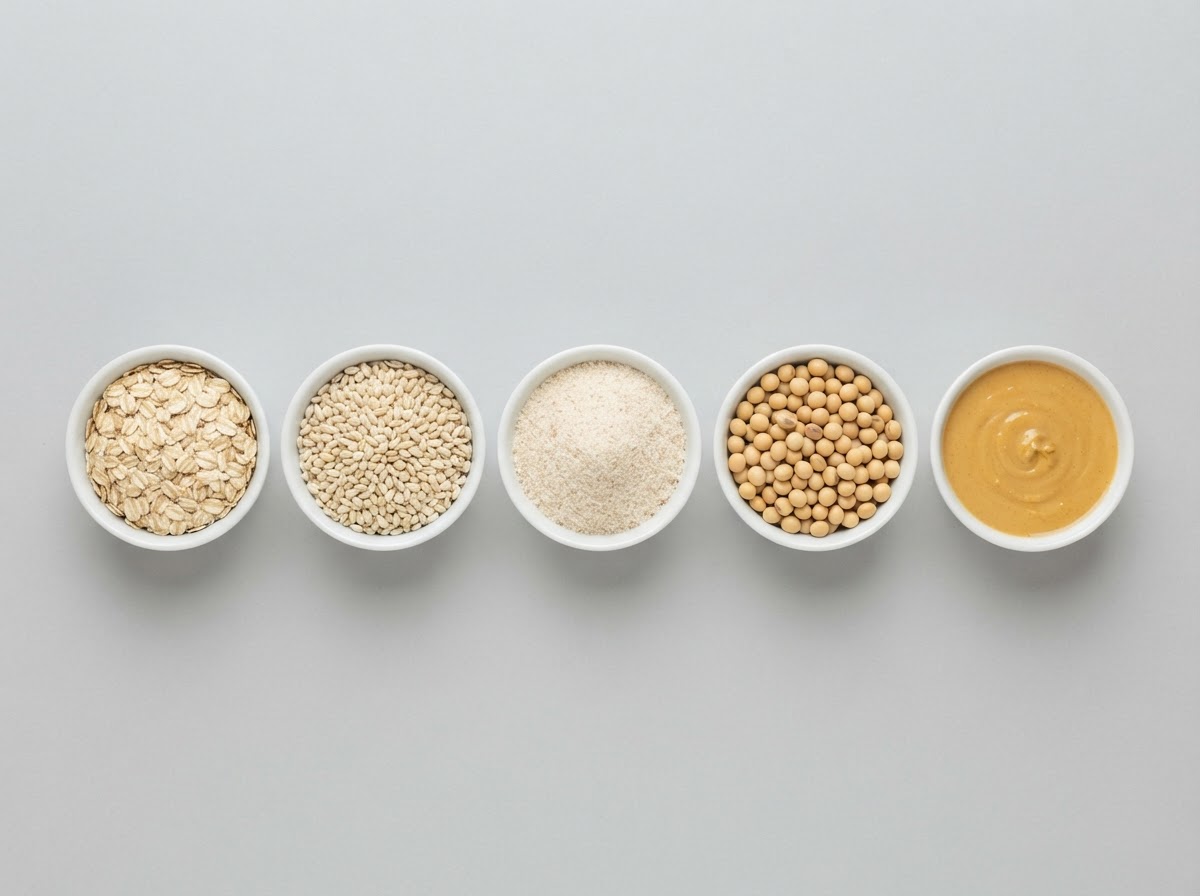
There is a short list of foods the United States government has put an actual number on. Not “studies suggest” — a number, written into federal regulation, with a required daily amount and rules about what the product must contain. The list has four things on it: oats and barley, psyllium, plant sterols and stanols, and soy protein.
Almost every article about foods that lower cholesterol names a dozen of them and sources none of them. This one works the other way round: it starts from what the Food and Drug Administration has authorized, explains the two-tier system the agency uses, and then says plainly which popular claims sit one tier down and which have no federal source at all. Two of the most-recommended foods on the internet — avocado and apple cider vinegar — are in the second category.
Key takeaways. Four substances carry an authorized FDA health claim for heart disease, each with an exact daily amount: 3 g of beta-glucan from oats or barley, 7 g of soluble fiber from psyllium, 1.3 g of plant sterol esters or 3.4 g of stanol esters, and 25 g of soy protein. Nuts, olive oil and omega-3 have only qualified claims, which by law must state that the evidence is limited. On the National Heart, Lung, and Blood Institute’s own figures, plant sterols do more for LDL than cutting saturated fat, and soluble fiber does the least. There is no federal statement that fish oil lowers cholesterol. Apple cider vinegar has no federal source of any kind.
Two tiers, and the FDA says which is which
This distinction is the whole article, and the agency explains it better than any paraphrase. An authorized health claim is one the FDA has written into a regulation after deciding the relationship is well established. The agency reviews the literature “using the significant scientific agreement standard to determine whether the substance/disease relationship is well established,” and says of that standard: “The SSA standard is intended to be a strong standard that provides a high level of confidence in the validity of the substance/disease relationship.”
A qualified health claim is something else entirely. The FDA’s own explanation is that when evidence exists “but the evidence is not well enough established to meet the significant scientific agreement standard,” a company can ask the agency to exercise enforcement discretion instead. In other words the claim is not approved — the FDA simply declines to act against it. And it comes with a condition: “Qualifying language is included as part of the claim to indicate that the evidence supporting the claim is limited.” That is why nut and oil packages say “Supportive but not conclusive research shows” — the hedge is legally required.
Exactly five authorized claims touch cholesterol or coronary heart disease, and the FDA lists them with their regulation numbers: dietary saturated fat and cholesterol (21 CFR 101.75), fiber-containing fruits, vegetables and grain products (101.77), soluble fiber from certain foods (101.81), soy protein (101.82), and stanols and sterols (101.83). There is no authorized claim for fish, omega-3, nuts, olive oil, avocado, garlic, green tea, eggs or coconut. If you want to know which claims on a package mean something, our guide to what food label claims actually mean covers the rest of the vocabulary.
The four with a number attached
Here are the authorized amounts, as printed in the regulations. Note that the units are not interchangeable and the article you read last week probably collapsed them.
| Substance | Required daily amount | Minimum per serving |
|---|---|---|
| Beta-glucan from whole oats or barley | 3 g or more | 0.75 g soluble fiber |
| Soluble fiber from psyllium seed husk | 7 g or more | 1.7 g soluble fiber |
| Plant sterol esters | 1.3 g or more | 0.65 g |
| Plant stanol esters | 3.4 g or more | 1.7 g |
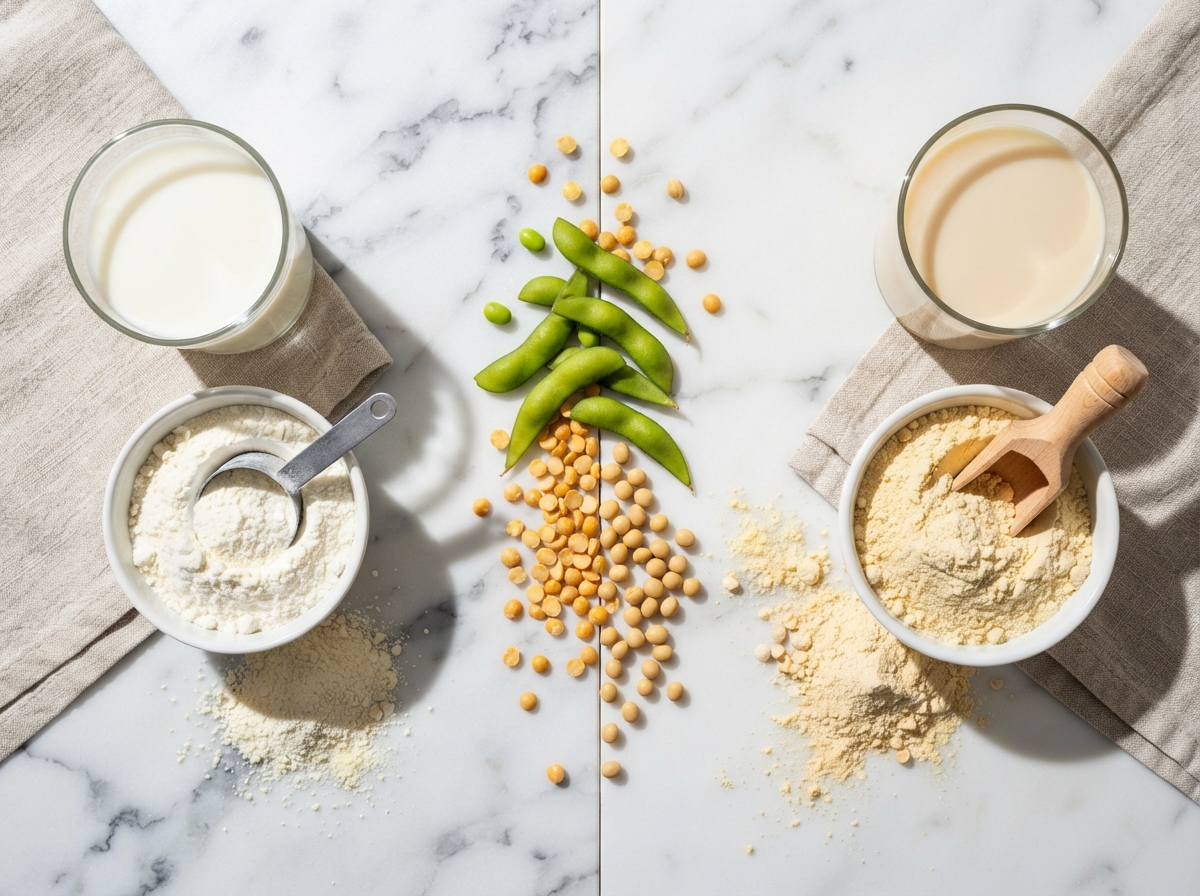
| Soy protein | 25 g or more | 6.25 g |
For oats and barley the requirement is 3 g of beta-glucan specifically — a named fiber, not fiber in general. For psyllium it is 7 g of soluble fiber. Printing “3 g of fiber” for oatmeal gets it wrong. The soy numbers are worth a second look too: 6.25 g per serving against 25 g a day is the regulation’s own arithmetic for four servings.
“Minimum per serving” here means per reference amount customarily consumed — the FDA’s defined serving size, not a household spoonful.
And there are purity rules nobody quotes
This is the part that surprised me. The government does not say “eat oats.” 21 CFR 101.81 specifies what an ingredient must contain before a product can carry the claim:
| Source | Required beta-glucan or purity |
|---|---|
| Oat bran | at least 5.5% (dry weight basis) |
| Rolled oats | at least 4% (dry weight basis) |
| Whole oat flour | at least 4% (dry weight basis) |
| Whole grain and dry milled barley | at least 4% (dry weight basis) |
| Barley betafiber | at least 70% |
| Psyllium husk (Plantago ovata) | purity no less than 95% |
One caveat, and it matters: these percentages govern what a manufacturer may print on a label. They are not a test you can run on the box in your cupboard, and nothing federal says supermarket oatmeal does or does not qualify.
The claim is also conditional on the whole food, not just the fiber: the product must meet the requirements for a “low saturated fat” and “low cholesterol” food — unless, in a nicely specific exception, it exceeds that because of fat from the oats themselves.
And the statutory verb is always the same. Every model claim in these regulations says the food “may reduce the risk of heart disease.” Not reduces. The hedge is in the law.
What each change is actually worth, and the ranking is upside down
The only federal document that quantifies a complete cholesterol-lowering diet is the National Heart, Lung, and Blood Institute’s Therapeutic Lifestyle Changes guide. A caveat first: the publication carries no printed date, it belongs to the older National Cholesterol Education Program era, and NHLBI’s current TLC page has had all the numbers stripped out of it. So these are NHLBI’s figures from its TLC publication, not 2026 guidance. They are also the only ones that exist.
| Change | LDL reduction |
|---|---|
| Plant sterols or stanols, add 2 g/day | 5%–15% |
| Saturated fat, decrease to less than 7% of calories | 8%–10% |
| Lose 10 pounds (4.5 kg) if overweight | 5%–8% |
| Soluble fiber, add 5–10 g/day | 3%–5% |
| Dietary cholesterol, decrease to less than 200 mg/day | 3%–5% |
| All of it together | 20%–30% |
Read the order. Plant sterols beat cutting saturated fat. Soluble fiber comes last, tied with cutting dietary cholesterol. The food the internet obsesses over does the least, and the one nobody has heard of does the most. The whole diet together is 20% to 30%, which is a figure worth holding on to, because it tells you what diet can and cannot do on its own.
One inconsistency inside that same document, which I am not going to smooth over: the TLC diet asks for 10 to 25 g of soluble fiber a day in total, while the reduction table credits adding 5 to 10 g a day. A total and an increase are different quantities. The 10–25 g target is the one repeated on MedlinePlus as well, so that is the number to work with. Our explainer on soluble versus insoluble fiber covers which is which.
Psyllium: most fiber per spoon, and a warning required by law
On NHLBI’s own food table, one tablespoon of ground psyllium seeds carries 5 g of soluble fiber. Half a cup of cooked oatmeal carries 1 g. Barley, oat bran, broccoli, carrots, an apple, a banana — all 1 g. Brussels sprouts and a pear manage 3 g and 2 g.
Set that against a target of 10 to 25 g a day and the arithmetic is blunt: oatmeal is a contributor, not a solution, and psyllium can nearly get you there by itself. It is also the only food in this article with its own authorized health claim and a mandatory safety warning. Under 21 CFR 101.17, a psyllium product that carries the heart claim must also carry this: “NOTICE: This food should be eaten with at least a full glass of liquid. Eating this product without enough liquid may cause choking. Do not eat this product if you have difficulty in swallowing.”
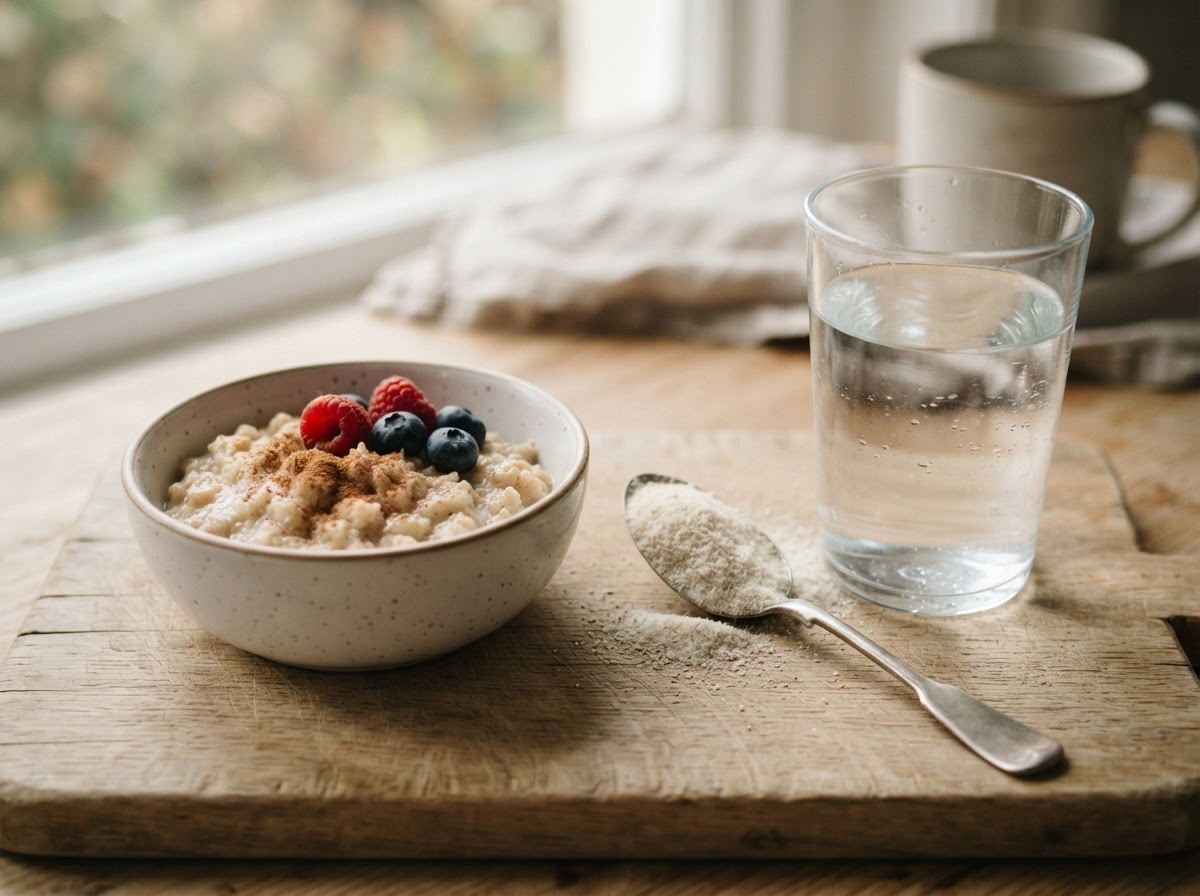
The benefit and the warning are joined by the same regulation. The variable is water — the same lesson that applies to flaxseed and chia.
I should be honest about one gap: NHLBI’s fiber table appears to have no rows for beans or lentils, but I could not establish whether they are genuinely absent or were lost in reading the document, so I am not printing that table as complete and there is no federal gram figure for legumes here. MedlinePlus does name them — “Legumes such as kidney beans, lentils, chickpeas, black-eyed peas, and lima beans” — without numbers.
Plant sterols: best supported, least discussed
Four separate federal documents converge on plant sterols and stanols, which is more than anything else in this article manages. 21 CFR 101.83 carries the authorized claim. NHLBI’s table gives them the largest single effect. A StatPearls review on NIH’s NCBI Bookshelf, by Sharon F. Daley and Jennifer Goldin, describes the mechanism: “Plant sterols competitively inhibit intestinal cholesterol absorption, reducing uptake by about 10%.” And the National Center for Complementary and Integrative Health calls them, in unusually plain language, “an option in conventional treatment for high cholesterol levels” — the only place in this whole subject where a federal agency describes a supplement as part of conventional care rather than complementary to it.
The regulation also prescribes something regulations rarely do — a dosing pattern: “The daily dietary intake of plant sterol or stanol esters should be consumed in two servings eaten at different times of the day with other foods.” NCCIH independently says “taken with meals” on two of its pages.
Three federal documents give three different daily amounts, in three different units, and I am not going to average them for you: 1.3 g of sterol esters or 3.4 g of stanol esters (21 CFR 101.83), 800 mg of free phytosterol equivalent (an FDA enforcement-discretion letter that widened the claim beyond the foods the regulation names), and about 2 g (NHLBI). Esters weigh more than the free sterol they carry, so these are not contradictory — but no federal source performs the conversion, so neither will we.
Where to find them, per MedlinePlus: “They can be found in whole grains, nuts, legumes, and oils, such as olive oil and avocado oil. They are also added to some foods, such as certain types of orange juice, margarine, and bread.”
The most honest sentence in any of this is inside a health claim
The FDA authorizes a claim for fiber-containing fruits, vegetables and grain products. In the same regulation, 21 CFR 101.77, it writes this: “Currently, there is not scientific agreement as to whether a particular type of soluble fiber is beneficial, or whether the observed protective effects of fruits, vegetables, and grain products against heart disease are due to other components, or a combination of components, in these diets.”
The agency permitted the claim and stated, in the text of the permission, that it does not know whether the fiber is the active ingredient. For an article about which foods lower cholesterol, that is the paragraph worth trusting.
It also sits oddly beside the mechanism the rest of the federal record offers, which is itself two different mechanisms. The StatPearls review says viscous fibers “bind bile acids, increasing fecal bile acid excretion and stimulating hepatic conversion of cholesterol to bile acids” — the liver pulls cholesterol out of circulation to replace them. MedlinePlus says something simpler and different: “Soluble fiber helps prevent your digestive tract from absorbing cholesterol.” Three federal hosts, three positions, ranging from a specific biochemical pathway to an explicit “we don’t know.”
One tier down: nuts and oils
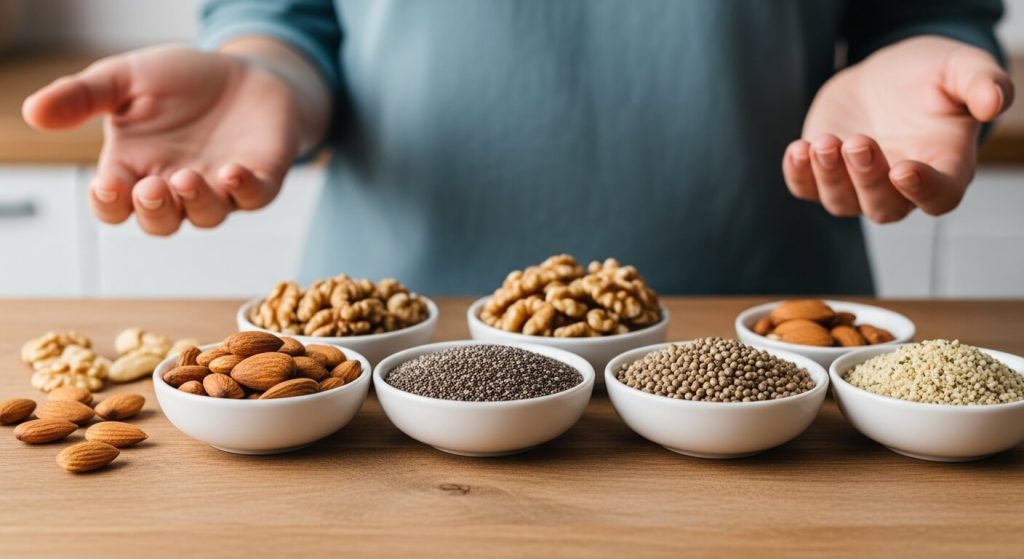
These have qualified claims, and the required hedge is part of the sentence. For macadamia nuts the FDA’s wording, confirmed identically in an agency update and in the underlying letter, is: “Supportive but not conclusive research shows that eating 1.5 ounces per day of macadamia nuts, as part of a diet low in saturated fat and cholesterol and not resulting in increased intake of saturated fat or calories may reduce the risk of coronary heart disease.” That is about 43 g.
For high-oleic oils: “Supportive but not conclusive scientific evidence suggests that daily consumption of about 1½ tablespoons (20 grams) of oils containing high levels of oleic acid, when replaced for fats and oils higher in saturated fat, may reduce the risk of coronary heart disease.”
Notice the mechanism written into both: replacement. “Not resulting in increased intake of saturated fat or calories.” “When replaced for fats and oils higher in saturated fat.” The federal claim is not “olive oil is good for you” — it is “this instead of something worse, without eating more.” That is a meaningfully different instruction.
Two older qualified claims do exist for nuts in general (2003) and for olive oil specifically (2004) — the FDA lists both by title and date. Their actual wording lives only in the agency’s web archive, which refused repeatedly, so this article does not quote them. If you have seen a confident “1.5 ounces of most nuts” sentence attributed to the FDA, it may well be accurate; we just could not verify it, so we are not printing it.
Soy: the claim the FDA tried to kill and never did
The FDA proposed revoking the soy protein heart claim on 31 October 2017 and extended the comment period in January 2018. Nine years later the proposal is still a proposal: 21 CFR 101.82 is still in force, still says 25 g a day, and the FDA’s own list of authorized claims still carries it — with a link to the unfinalized revocation sitting beside it.
What the agency concluded about the evidence, we cannot tell you: the FDA page that explained the reasoning returns a 404, and the constituent update that is still reachable does not discuss the science. NCCIH, separately, says “Some soy products can have a small cholesterol-lowering effect” and that the effect “is much smaller than that of cholesterol-lowering drugs” — and, interestingly, that “soy foods are more beneficial than soy protein or isoflavone supplements.” The FDA regulates the protein in grams; NCCIH prefers the bean.
Fish oil does not lower cholesterol, and the FDA wrote five sentences proving it
This is the cleanest negative in the whole subject. When the FDA announced qualified claims for EPA and DHA in 2019, it set out five permitted wordings. Every one of them runs through blood pressure:
- “Consuming EPA and DHA combined may help lower blood pressure in the general population and reduce the risk of hypertension.”
- “Consuming EPA and DHA combined may reduce the risk of CHD (coronary heart disease) by lowering blood pressure.”
Not one of the five mentions cholesterol. The NIH Office of Dietary Supplements has no sentence stating that omega-3s lower, raise or affect blood cholesterol — LDL and HDL appear on its omega-3 fact sheet only as baseline characteristics of trial participants, not as outcomes attributed to omega-3s. And NCCIH’s page on natural products for high cholesterol does not mention fish oil at all. Neither does it mention niacin.
What is there is triglycerides, and the distinction matters more than any other in this article. ODS reports that “the AHA concludes that 4 g/day prescription omega-3s (containing EPA plus DHA or EPA only) lower triglyceride levels.” Read that twice: it is the American Heart Association’s conclusion, not a federal one; the AHA is a professional society; and the dose is 4 g a day of prescription omega-3, not a supermarket capsule. Triglycerides are not cholesterol.
Fish itself is federally supported — for heart health, framed as a substitution. The FDA says “Strong evidence shows that eating fish, as part of a healthy eating pattern, may have heart health benefits,” and FDA and EPA advise at least 8 ounces (about 225 g) of seafood a week. ODS adds “especially when the seafood is consumed in place of less healthy foods.” None of that is a cholesterol claim.
Red yeast rice works, which is exactly why it is not legal
NCCIH: “Red yeast rice that contains monacolin K may lower blood cholesterol levels, but it can also cause the same types of side effects and drug interactions as lovastatin.” And: “Monacolin K is chemically identical to the cholesterol-lowering drug lovastatin.”
Then the turn: “The FDA has determined that red yeast rice that contains more than trace amounts of a substance called monacolin K is an unapproved new drug and cannot be sold legally as a dietary supplement.”
So the version that works is the version that cannot legally be sold as a supplement in the United States. And you cannot tell which one you have bought — NCCIH states flatly that “It’s impossible for consumers to know the amount of monacolin K in red yeast rice products,” because those levels “are not usually included on product labels.” Some products also contain citrinin, a contaminant NCCIH says “is toxic and can damage the kidneys.”
Garlic and green tea survive, and they mirror each other
Garlic survives with four conditions attached, and dropping any one of them misrepresents it. NCCIH: “A recent review of the research on garlic supplements concluded that they can lower cholesterol if taken for more than 2 months, but their effect is modest in comparison with the effects of cholesterol-lowering drugs.” Elsewhere: garlic supplements “may reduce levels of total cholesterol and low-density lipoprotein (LDL) cholesterol to a small extent in people who have high blood cholesterol levels.” So: supplements, not garlic in cooking; more than two months; modest against drugs; in people who already have high cholesterol. Also “Taking garlic supplements may increase the risk of bleeding.”
Green tea survives more weakly, and with a negative attached. NCCIH reports “some limited evidence that suggests green tea may have a modest cholesterol-lowering effect,” and more specifically that it “reduced total cholesterol and low-density lipoprotein (LDL) cholesterol to a small extent, but it did not affect high-density lipoprotein (HDL) cholesterol or triglycerides.” Its overall verdict: “definite conclusions cannot yet be reached.”
The mirror is the interesting part. For garlic, only the supplement has evidence behind it. For green tea, only the beverage is free of safety concerns — NCCIH reports no safety concerns for green tea as a drink, while noting that “liver injury has been reported in some people who used green tea products, primarily green tea extracts in tablet or capsule form.”
Dietary cholesterol: the limit was not lifted, it moved
You have probably read that the 300 mg-a-day cholesterol limit was abolished. What actually happened is narrower and stranger: it was removed from one document and left standing in four others.
| Where | What it says now |
|---|---|
| Dietary Guidelines for Americans 2025–2030 | the word “cholesterol” does not appear in the document at all |
| FDA Nutrition Facts label | Daily Value still 300 mg |
| 21 CFR 101.75, in force | “Recommended daily cholesterol intakes are 300 mg or less per day.” |
| CDC | “Experts recommend that people eat as little dietary cholesterol as possible.” |
| NHLBI’s TLC guide and MedlinePlus | “less than 200 mg a day” for someone already lowering their cholesterol |
Two of those deserve a closer look. The Dietary Guidelines for Americans, 2025–2030, published in January 2026, replaced the 2020–2025 edition — and we checked: the word “cholesterol” is not in it. Nor is any seafood amount in ounces. It does say “In general, saturated fat consumption should not exceed 10% of total daily calories,” which keeps the old ceiling while dropping the “starting at age 2” qualifier the previous edition used.
Meanwhile 21 CFR 101.75 — a currently effective FDA regulation — still recites both 300 mg of cholesterol and “an average of 30 percent or less of total calories from all fat,” a total-fat cap the Dietary Guidelines abandoned years ago. The regulation dates from 1993 and that paragraph was never rewritten. It also contains a typo the agency has never fixed, describing blood cholesterol of 240 “milligrams/decaliter (mg/dL)”.
Note the exact wording on the CDC page too: “Experts recommend,” not “CDC recommends.” The agency is reporting a consensus, not issuing an instruction.
What about eggs, and about your target numbers
On eggs, the honest answer is that the US government has largely stopped answering. CDC, NHLBI and MedlinePlus all name eggs or egg yolks as a source of dietary cholesterol — composition statements, not warnings. The current Dietary Guidelines mention eggs as a protein food, a choline source and an infant allergen, never in a cholesterol context. The one substantive statement on any federal host is the StatPearls review’s: foods “traditionally characterized as high in cholesterol, such as eggs, may have variable effects on LDL-C that depend on the overall dietary pattern and the accompanying intake of saturated fats and refined carbohydrates.”
The only numbers come from an NHLBI-funded observational study its newsroom publicized in 2019, which reported that “300 mg of dietary cholesterol per day is linked to 17 percent higher risk of cardiovascular disease.” That page carries no stated limitation, which is reason enough to handle it as one study rather than a conclusion. And no federal source we could find gives a number of eggs per day or per week, so we are not going to invent one.
On target numbers, CDC publishes a list: total cholesterol “About 150 mg/dL”, LDL “About 100 mg/dL”, HDL at least 40 mg/dL in men and 50 in women, triglycerides less than 150 mg/dL. Keep the word “About” — and keep the attribution, because CDC footnotes those figures to the 2018 AHA/ACC cholesterol guideline. They are a professional society’s numbers that CDC cites, not federal targets. NHLBI’s own treatment page gives no target numbers at all.
The claims with no federal source
This is the section most articles skip, and it is the one that saves you money.
Apple cider vinegar. Nothing. We searched seven federal hosts and found no statement of any kind about apple cider vinegar and cholesterol — including NCCIH, the agency whose entire job is evaluating exactly this kind of product. Every result was in databases this site does not treat as a source. That is the strongest “no” available.
Avocado. No federal source says avocado lowers cholesterol. It is named as a source of monounsaturated fat, and avocado oil as one carrier of plant sterols. Both true; neither is a cholesterol claim. Nearly every competing article leads with avocado.
Coconut oil. Here we have to be careful in both directions. No federal page has assessed coconut oil as a topic — there is no review of its evidence, nothing about medium-chain triglycerides, no statement that it raises or lowers LDL. The only mention on an allowed host is placement: the StatPearls review lists it among “the main sources of dietary saturated fat,” which is the nutrient NHLBI says “raises ‘bad’ LDL cholesterol levels” and the Dietary Guidelines cap at 10% of calories. That chain is fair to draw. Saying US agencies have examined coconut oil and found it harmful would not be — they have not examined it.
Niacin and fish oil are both absent from NCCIH’s cholesterol page entirely, while flaxseed, bergamot and red clover are on it. On flaxseed, NCCIH’s findings are mixed, apply to the whole seed and its lignans rather than the oil, and include the detail that the lignans lowered HDL as well.
FAQ
What is the single most effective food change for cholesterol?
On NHLBI’s own figures, adding about 2 g a day of plant sterols or stanols: 5% to 15% off LDL, the largest single line in its table. Cutting saturated fat to under 7% of calories comes second at 8% to 10%.
How much oatmeal do I need to eat?
The FDA’s authorized claim requires 3 g a day of beta-glucan from oats or barley. Separately, NHLBI’s food table puts half a cup of cooked oatmeal at 1 g of soluble fiber against a daily target of 10 to 25 g. Both numbers are real and they answer slightly different questions — one is about what a label may claim, the other about what a bowl contributes.
Does fish oil lower cholesterol?
There is no federal statement that it does. All five of the FDA’s permitted omega-3 claim wordings go through blood pressure, and ODS has no sentence attributing any change in LDL or HDL to omega-3s. The lipid effect that is documented is on triglycerides, at 4 g a day of prescription omega-3, and it is the American Heart Association’s conclusion rather than a federal one.
Is the 300 mg cholesterol limit still a thing?
Depends which document you mean. It is gone from the Dietary Guidelines — the current edition does not mention cholesterol at all — but 300 mg is still the Daily Value on every Nutrition Facts label in the US and is still printed in a live FDA regulation. CDC’s position is to eat as little as possible. NHLBI tells someone actively lowering their cholesterol to stay under 200 mg.
Should I take a red yeast rice supplement?
That is a question for a clinician, not an article, but the federal facts are unusually clear: the version that lowers cholesterol contains monacolin K, which is chemically identical to lovastatin, and the FDA considers a product containing more than trace amounts of it an unapproved new drug that cannot legally be sold as a supplement. NCCIH also says consumers cannot tell how much is in a given product.
Does garlic lower cholesterol?
Garlic supplements may, to a small extent, in people who already have high cholesterol, if taken for more than two months — and the effect is modest compared with medication. NCCIH’s sentences all say “supplements”; nothing federal supports garlic in cooking as a cholesterol treatment.
What to do with this
Four things have a federal number: 3 g of beta-glucan from oats or barley, 7 g of soluble fiber from psyllium, 1.3 g of sterol esters or 3.4 g of stanol esters, 25 g of soy protein. Two of those — sterols and psyllium — are the ones almost nobody recommends, and they are the ones with the best numbers behind them.
Beyond that: soluble fiber to 10–25 g a day, saturated fat under 10% of your calories, and the replacement framing the FDA writes into its oil claims — better fat instead of worse fat, not in addition to it. The whole diet, done properly, is worth 20% to 30% off LDL on NHLBI’s figures. That is a real number, and it is also a ceiling worth knowing before you spend money on vinegar.
Related: soluble and insoluble fiber, high-fiber foods, daily sodium intake guidelines, what food label claims mean, flaxseed benefits.
This content is for educational purposes only and is not medical advice. Always consult a qualified healthcare professional for personalised guidance.