The federal agency responsible for flaxseed is the National Center for Complementary and Integrative Health, part of the NIH. Its page on flaxseed opens by saying these products “are promoted for the heart, brain, and immune system.” Then it moves to a section headed “What Have We Learned?” — and reviews weight loss and diabetes. Not the heart. Not the brain. Not immunity.
One page names the three things flaxseed is sold for and examines none of them. That is a useful place to start, because flaxseed does have a real federal evidence file — it is just not the file the marketing implies.
Below: the one preparation tip that turns out to be genuinely official, what a tablespoon actually contains, the single claim flaxseed earns, the two that federal reviews tested and rejected, and the safety point that almost no article mentions.
Key takeaways. Grinding is real advice: two federal sources say whole seeds are likely to pass through undigested. A tablespoon carries about 2.8 g of fiber — 10% of the Daily Value — and 2.35 g of ALA, more than the daily adequate intake for either sex, though MedlinePlus notes this form of omega-3 is “less usable” than the kind in fish. Cholesterol is the one benefit with federal support, and only for the seed and its lignans, not the oil. Hot flashes were tested and flaxseed came out no better than placebo. And NCCIH warns that without enough water, flaxseed can worsen constipation rather than relieve it.
Grind it — the one tip everyone repeats that is actually official
Of all the flaxseed advice circulating, “you have to grind it” is the one that sounds most like folklore. It is not. Two federal sources say it independently, in almost the same words.
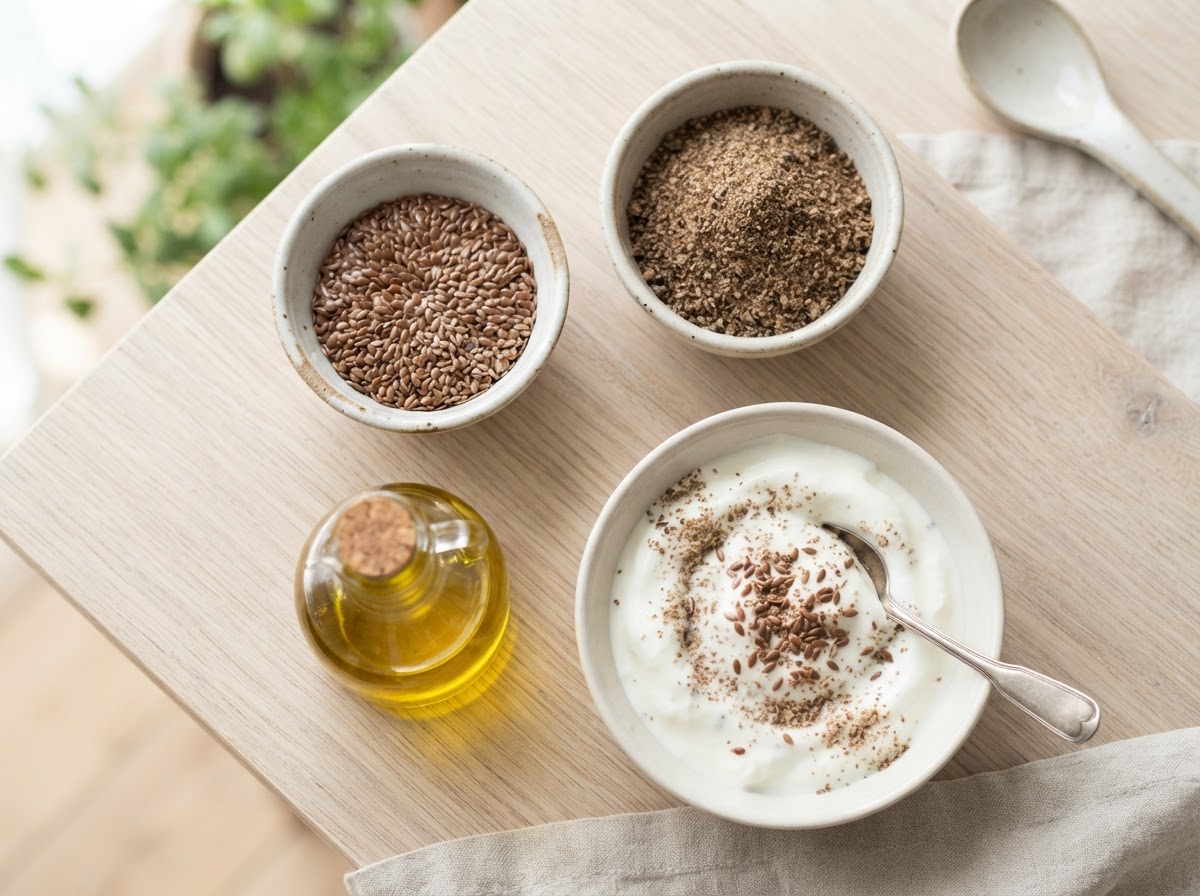
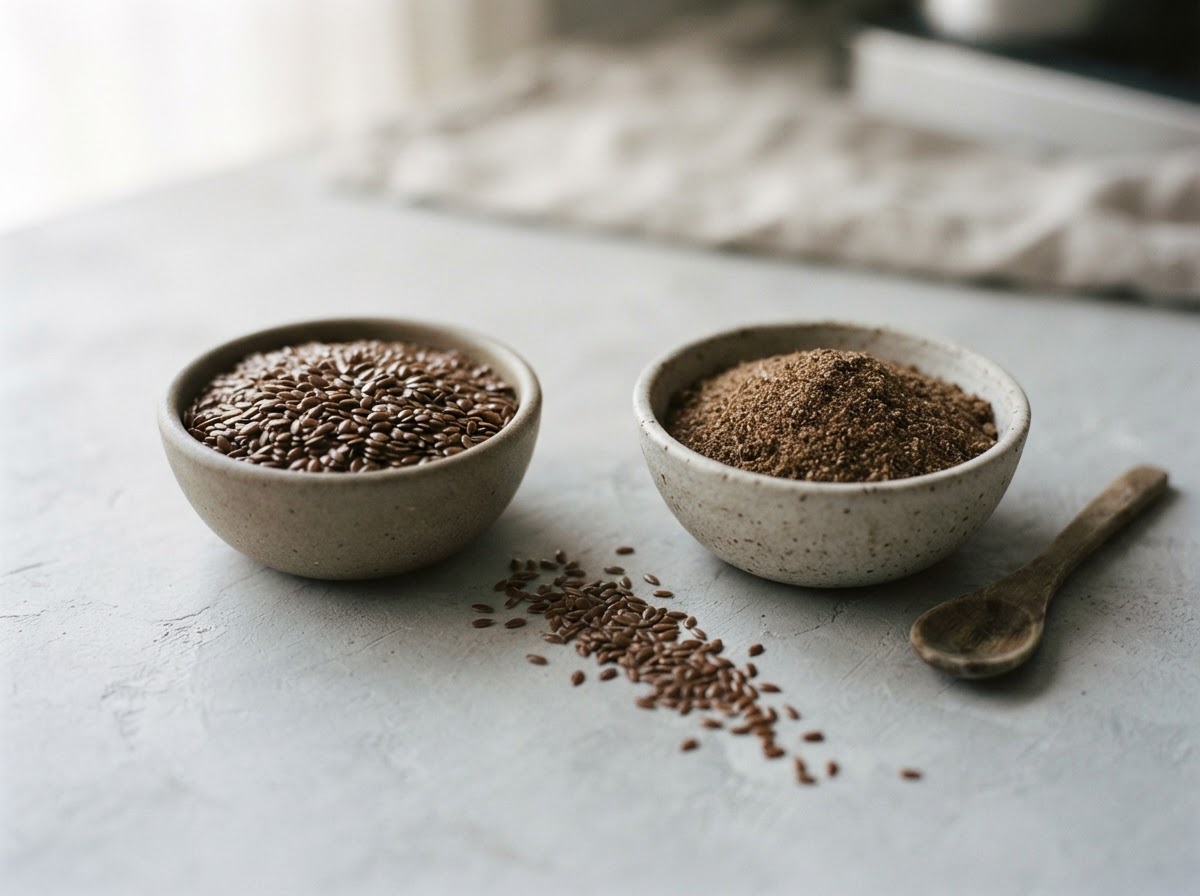
MedlinePlus, the National Library of Medicine’s consumer encyclopedia: ground flaxseeds are easiest to digest and may provide more nutrients than whole seeds, which can pass through your digestive system undigested. And a USDA Agricultural Research Service article by Lin Yan of its Grand Forks Human Nutrition Research Center: flaxseed eaten whole is more likely to pass through the body undigested, so the body does not get all of the nutrients.
Note the hedges — “may provide more”, “can pass through”, “is more likely to”. Neither says whole seed always passes through. But the direction is agreed, from two agencies.
Here is the part nobody writes. The federal nutrient figures for flaxseed are published for the whole seed. The NIH omega-3 table lists “Flaxseed, whole, 1 tbsp.” The Dietary Guidelines fiber list says simply “Flax seeds”. The only figure specified as ground comes from that same ARS article, and it is a different number. So the government tells you to grind it and then reports its headline numbers for the form it told you not to eat.
Practically: buy it whole, grind what you need, and keep the ground seed in the freezer — ARS says that is what stops it oxidizing and losing potency. That storage advice, incidentally, is about ground seed. There is no federal statement anywhere about how to store flaxseed oil.
What a tablespoon actually contains
Two numbers are solidly sourced, and they are worth knowing precisely because they are less impressive than the marketing and more useful.
Fiber: 2.8 g per tablespoon, from the Food Sources of Fiber list published with the 2020–2025 Dietary Guidelines — the 2025–2030 edition that replaced them in January 2026 carries no food-by-food fiber list, and does not mention flax at all. Against a Daily Value of 28 g, that is exactly 10% — which means a tablespoon of flax does not reach the 20% threshold the FDA uses to call a food a high source of anything. It is a contribution, not a solution.
And on the same list, at the same portion, chia seeds carry 4.1 g. Chia beats flax on fiber, per tablespoon, on the government’s own document — the reverse of how the two are usually ranked. We went through chia separately in what chia seeds actually do.
Omega-3: 2.35 g of ALA per tablespoon of whole seed, from the NIH Office of Dietary Supplements. The adequate intake for adults is 1.6 g a day for men and 1.1 g for women — so one tablespoon exceeds it for both, by half again for men and more than double for women. Both figures come from the same fact sheet, so that comparison is clean.
Then the qualifier that has to travel with it. MedlinePlus puts it plainly: the main type of omega-3 found in flaxseeds is less usable than the types found in seafood. The technical version, from ODS, is that conversion of ALA into the forms the body mostly uses is “very limited, with reported rates of less than 15%” — a statement about ALA as a nutrient, not about flax specifically. Flaxseed is a good source of an omega-3 your body converts poorly. Both halves are true.
Beyond that, the honest answer is that we cannot give you a full nutrition panel. MedlinePlus names flaxseed as a good source of vitamin B1, copper, phosphorus, magnesium and manganese, but publishes no amounts, and we could not open a USDA composition record. So we are not printing numbers we do not have.
Cholesterol: the one benefit flaxseed earns
NCCIH keeps a review for clinicians called High Cholesterol and Natural Products: What the Science Says, and flaxseed has a section in it. The conclusion is careful and, read closely, quite specific.
Studies, it says, “suggest possible beneficial effects for some types of flaxseed supplements, including whole flaxseed and flaxseed lignans but not flaxseed oil.” Three hedges and one exclusion in a single sentence. The same page notes that studies of flaxseed for cholesterol have had mixed results.
The detail underneath matters more than the headline. A 2022 systematic review, as NCCIH summarizes it, found that in postmenopausal women whole flaxseed significantly reduced total cholesterol; lignan supplementation reduced total cholesterol, LDL-C and HDL-C; and flaxseed oil supplements had no lowering effect on lipids at all.
HDL-C is the cholesterol you want more of, not less. That clause sits in the middle of the finding, and it is exactly the part a promotional summary would drop. It is also worth noting that the studies behind this are in particular groups — postmenopausal women in one, people with peripheral artery disease in another — not in the general population.
So: yes, flaxseed has federal support for cholesterol. For the seed, not the oil. With mixed results on the record. And with a caveat about HDL that comes from the same sentence as the benefit.
Hot flashes: tested, and it failed
This one is unusual, because the claim was not ignored — it was examined and came back negative, which is far more useful than silence.
NCCIH’s page on menopausal symptoms states that studies of flaxseed products found them to be no more effective than a placebo in reducing hot flashes. Its clinician review lists three results: a 2018 meta-analysis finding no significant effect on sexual function in menopausal women, and two randomized trials from 2012 — one in 188 women finding no significant difference in hot flashes against placebo, and one in 90 women that is worth describing properly.
In that second trial, flaxseed looked effective when researchers compared the women to themselves, before treatment and after. When the analysis compared flaxseed against placebo, no significant difference was found.
That is, in one federally published sentence, how a supplement acquires a reputation. People do feel better over six months. The question a trial exists to answer is whether they feel better because of the thing — and here, they did not.
NCCIH does call flaxseed a phytoestrogen source. That is a statement about what is in it, not about what it does.
Blood pressure: an absence you can check
Plenty of pages claim flaxseed lowers blood pressure. Here is a way to test that claim that does not require trusting anyone.
NCCIH publishes a dedicated review of complementary approaches for hypertension. Flaxseed does not appear in it. Not as a positive finding, not as a negative one — it is absent, while the same agency’s cholesterol review does have a flaxseed section. An agency that had something to say put it where it belonged and did not put flaxseed in the blood pressure file.
MedlinePlus frames it as open: researchers are looking at whether the essential fatty acids in flaxseeds will improve blood pressure, blood sugar and heart health. That is a description of ongoing work, not a finding.
There is one sentence people sometimes cite, from that USDA ARS article, saying diets rich in omega-3 fatty acids may lower blood pressure in people with hypertension. Read what it is about: omega-3-rich diets, in people who already have hypertension, hedged with “may”. It is not a claim about flaxseed, and it is not about healthy readers.
Weight loss: the supported form is not the one on sale
NCCIH’s flaxseed page covers weight loss, and the shape of the finding is the interesting part.
One clinical trial, it says, suggests that flaxseed mucilage powder mixed with water might support weight loss in adults with overweight or obesity. One trial, “suggests”, “might” — three hedges stacked on one sentence.
And immediately afterwards: flaxseed lignan extract and flaxseed oil supplements don’t seem to help with weight loss.
So the form with a signal is essentially a soluble fiber drink, the least marketed version of flax there is. The two forms actually sold for weight loss are the two NCCIH says do not appear to work.
Cancer and hormones: what is not there
Cancer. NCCIH’s flaxseed page says nothing about it. The only mention on any federal source we could use is that ARS article, which says emerging evidence suggests lignans may help protect the body from cancer — and, in the very next sentence, that more clinical studies are needed to understand how flaxseed and lignans may affect cancer in humans. Those two sentences belong together, and neither supports the claim as it is usually made.
Hormone balance. No federal source says flaxseed normalizes or balances hormones. The only statement that flaxseed has any hormonal effect appears inside a warning: NCCIH’s cholesterol review says flaxseed and flaxseed oil should be avoided during pregnancy as they may have mild hormonal effects. The popular claim takes a caution and sells it as a benefit — and the one hormonal endpoint anyone actually tested, hot flashes, came back no better than placebo.
Seed or oil?
On omega-3 alone, the oil wins easily: 7.26 g of ALA per tablespoon against 2.35 g for the whole seed, both from the same the Office of Dietary Supplements table. Roughly three times as much.
And yet the oil is the form NCCIH singles out as the one that does not lower cholesterol — “no lowering effect on lipids” — and one of the two forms it says do not seem to help with weight loss. The oil is pressed from the seed, so what it does not carry is the fiber and the lignans, the parts most of the actual findings are about.
More omega-3, less of everything else, and the form the evidence does not support. That is close to the opposite of how flax oil is sold.

The safety points worth knowing
Water, and this is the one most articles miss. MedlinePlus says flaxseed’s soluble and insoluble fiber helps keep bowel movements regular and prevents constipation. NCCIH says flaxseed, like any fiber supplement, should be taken with plenty of water, as it could worsen constipation or, in rare cases, cause an intestinal blockage. Both are federal and both are true; the variable between them is water. It also notes that both the seed and the oil can cause diarrhea.
Don’t eat it raw or unripe. NCCIH says so on three separate pages: raw or unripe flaxseeds may contain potentially toxic compounds. Worth noting what the agency does not do — it never names the compound. The chemical explanation you will find everywhere online is not something we could source to any US federal page, so we are not repeating it.
Blood thinners — a theoretical concern, stated as one. NCCIH’s wording is unusually careful: there are theoretical reasons to suspect that flaxseed or flaxseed oil might interact with drugs such as anticoagulants or antiplatelets. That is not a documented interaction, and writing it as one would misrepresent the source. MedlinePlus adds, vaguely, that regular flaxseed may affect how certain medicines work, without naming any.
Pregnancy. Two NCCIH pages differ in strength here, and the stronger one is worth following. The consumer page says some studies suggest use during pregnancy is possibly unsafe, but the evidence is not conclusive. The clinician review is direct: flaxseed and flaxseed oil should be avoided during pregnancy.
How much, and for how long. NCCIH gives no amount in grams at all — it says limited amounts may be safe short-term, up to six months, and that higher doses may cause bloating, fullness and diarrhea. The only quantity on any federal page is in the ARS article, which suggests one to two tablespoons of ground flaxseed a day. That is a staff researcher’s article rather than agency guidance, and it is worth saying so.
FAQ
Do you have to grind flaxseed?
To get the most from it, yes. MedlinePlus and USDA’s Agricultural Research Service both say whole seed is likely to pass through undigested. Grind what you need and keep the ground seed in the freezer.
How much flaxseed a day?
NCCIH does not give a number. The only federal figure is a suggestion of one to two tablespoons of ground flaxseed daily, in a USDA ARS article. NCCIH’s safety statement covers limited amounts for up to six months.
Does flaxseed lower cholesterol?
This is the claim with the best support, with conditions. NCCIH says studies suggest possible benefit for whole flaxseed and flaxseed lignans, but not flaxseed oil, and that results have been mixed. One review found lignan supplements lowered HDL-C as well as LDL-C.
Does flaxseed help with hot flashes?
No, on the evidence NCCIH reviewed — it reports that flaxseed products were no more effective than a placebo, and describes three studies that found no significant benefit.
Flaxseed or chia?
On fiber per tablespoon, chia: 4.1 g against 2.8 g on the same government list. Chia also needs no grinding. Flaxseed, on the other hand, has an actual federal evidence file — NCCIH has reviewed it for several conditions, and has no dedicated chia page at all.
Is flaxseed oil as good as the seed?
It carries about three times the ALA per tablespoon, and it is the form NCCIH says did not lower lipids and does not seem to help with weight loss. It also has none of the fiber.
What to do with this
If you like flaxseed, keep eating it — ground, with enough water, a tablespoon or so a day. It is a genuine source of fiber and of an omega-3 your body converts inefficiently, and it may do something useful for cholesterol.
What it is not is a heart, brain or immunity supplement, however it is marketed. The agency that reviews it has not examined any of those three. It is not a treatment for hot flashes, because that was tested and it failed. And it is not a blood pressure intervention, because the relevant federal review does not include it.
If fiber is the reason you are here, our guides to high-fiber foods and the two kinds of fiber cover more ground than one seed can.
Related: chia seeds, fiber content in foods and what genuinely changes nutrient absorption.
Educational content, not medical advice. If you are pregnant, take an anticoagulant, or take any regular medication, discuss flaxseed with your clinician before making it a habit.
This content is for educational purposes only and is not medical advice. Always consult a qualified healthcare professional for personalised guidance.