
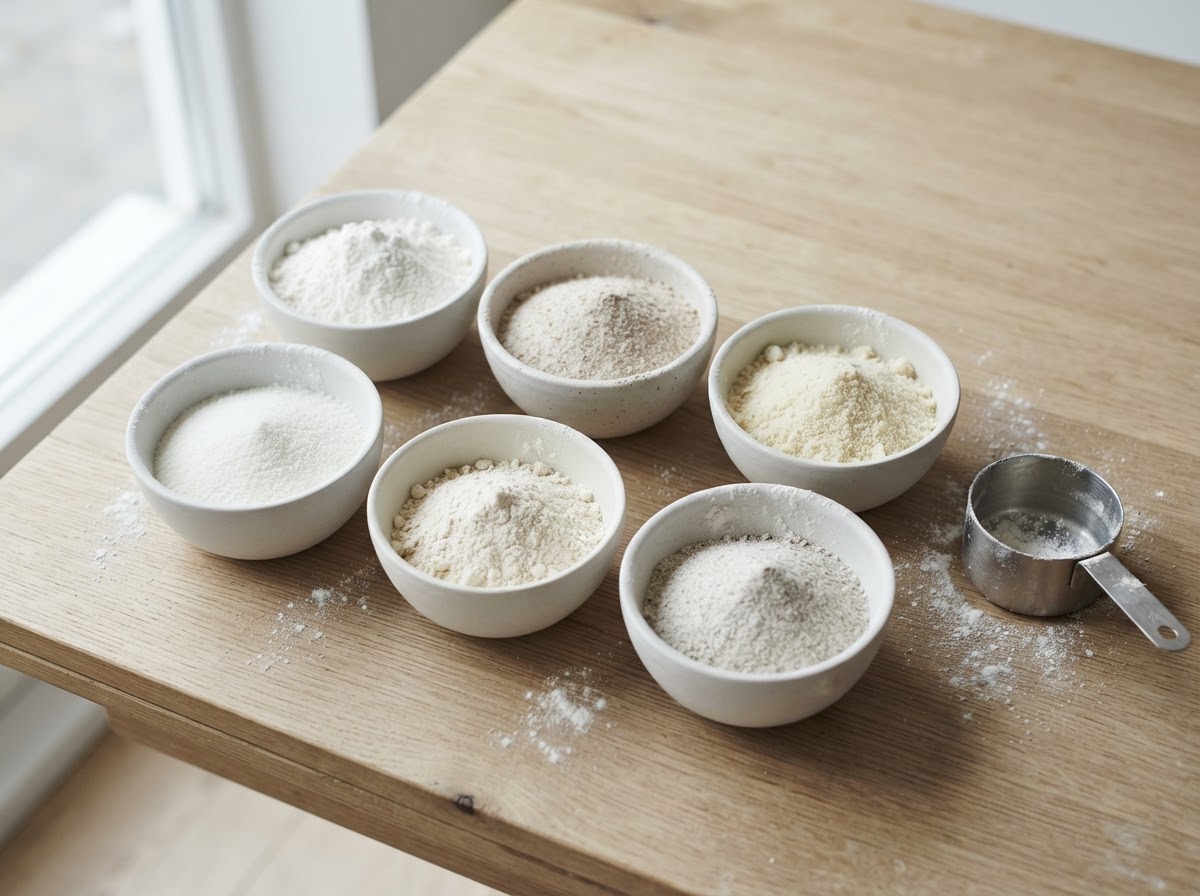
Almond, oat and coconut flour do not replace wheat flour one cup for one cup, and the tables that say they do will cost you a batch. The real limit is not a conversion factor — it is what share of the wheat flour you can replace at all. Almond tops out around 25%, coconut around 20%, whole wheat around 50%. Only a commercial 1-to-1 gluten-free blend goes all the way, because it has gum added to do the job the gluten was doing.
Below: the maximum-share table, why each flour fails past its limit, the fixes coconut flour needs, what the swap does to the calories and fiber of your batch, and the one case where 1:1 genuinely works.
Key takeaways. Think in shares, not ratios. Whole wheat 50%, brown rice 30%, almond 25%, buckwheat 20–25%, oat 20–50% depending on the recipe, coconut 20%. Coconut also needs extra liquid and an egg per ¼ cup. And the swap most people assume is the “light” one — almond — actually adds calories and multiplies the fat. For the rest of a baking swap we have calculators too: cups to grams for weighing flour, plus butter and oil, buttermilk and egg substitute amounts.
If you would rather not work the percentages out by hand, the flour substitute calculator takes the amount your recipe calls for and returns how much of it you can replace, in cups, with the adjustments that swap needs.
How much you can actually replace
| Flour | Max share of the wheat flour | How to measure the replaced part |
|---|---|---|
| Whole wheat | 50% (start at 25% in yeast dough) | 1:1 by volume |
| Brown or white rice | 30% | ⅞ cup per cup of wheat |
| Almond | 25% | Not 1:1 — needs a starch binder |
| Buckwheat | 20–25% | 1:1 by volume |
| Oat | 20%, up to 50% in non-yeast baking | 1⅓ cups per cup of wheat |
| Coconut | 20% | ¼ cup per cup + equal extra liquid + 1 egg per ¼ cup |
| Chickpea | 20% | ⅞ cup per cup |
| Commercial 1-to-1 gluten-free blend | 100% | 1:1 — the only full replacement |
The oat range is a genuine disagreement between two reputable sources rather than a mistake: the conservative figure is 20%, while King Arthur allows up to half in recipes that are not yeast-raised. Start low and work up.
Why it fails past the limit
Wheat flour in a dough is not a powder, it is a frame. Its gluten proteins link into a network when you mix, and that network traps the gas that makes things rise and keeps them from collapsing. Swap the flour and you are removing the scaffolding, not an ingredient. Four things go wrong, and our own USDA-based cards show why.
1. No gluten. Almond, coconut, rice, buckwheat and chickpea flours have none. Nothing holds the structure, so the crumb turns dense or sinks.
2. Fat. Almond flour carries 50.2 g of fat per 100 g against 1.5 g in all-purpose wheat — thirty-four times as much. Past about a quarter of the flour, batter spreads instead of holding its shape.
3. Fiber and water. Coconut flour is 34.2 g of fiber per 100 g where wheat is 2.7 g. That fiber drinks the liquid in the recipe, which is the whole reason coconut flour needs extra water and an egg rather than a straight swap.
4. Density. A cup of wheat flour weighs about 120 g; a cup of almond flour about 96 g, a cup of oat flour about 92 g, a cup of coconut flour about 128 g. Equal volume is not equal weight, which is why the good instructions are given in shares and cups-per-cup rather than a single multiplier.
Coconut flour is its own category

Every other flour on the list is a partial swap with a share limit. Coconut flour needs a recipe change. The working rule from university extension guidance: ¼ cup of coconut flour per cup of wheat flour, plus the same volume of extra liquid, plus one egg per ¼ cup.
That is not fussiness — it follows directly from the fiber number above. Skip the liquid and you get something dry and crumbly; skip the egg and there is nothing binding it, because coconut flour brings no gluten and the fiber is holding all the moisture.
If you are already replacing eggs in the same recipe, be careful: stacking a coconut-flour swap on top of an egg swap changes two structural things at once. Our guide to egg substitutes in baking covers that side of it.
What the swap does to your numbers
This is the part the recipe blogs leave out, and it is where the assumptions usually break. Per cup, from our cards:
| Flour | g per cup | Calories | Protein | Fat | Carbs | Fiber |
|---|---|---|---|---|---|---|
| All-purpose wheat | 120 | 439 | 13.1 g | 1.8 g | 92.8 g | 3.2 g |
| Whole wheat | 113 | 418 | 17.1 g | 3.1 g | 80.5 g | 12.0 g |
| Almond | 96 | 597 | 25.2 g | 48.2 g | 15.6 g | 8.9 g |
| Oat | 92 | 358 | 12.1 g | 5.8 g | 64.3 g | 9.7 g |
| Coconut | 128 | 560 | 20.7 g | 19.6 g | 75.4 g | 43.8 g |
| Brown rice | 142 | 519 | 10.2 g | 5.5 g | 107.2 g | 6.5 g |
| Buckwheat | 120 | 430 | 10.7 g | 3.0 g | 90.0 g | 12.4 g |
Now put that into a real batch. Take a recipe with 2 cups of all-purpose flour and swap each flour in at its maximum allowed share:
| 2 cups of flour, as | Calories | Protein | Fat | Carbs | Fiber |
|---|---|---|---|---|---|
| All all-purpose (unchanged) | 878 | 26.2 g | 3.6 g | 185.5 g | 6.5 g |
| 25% almond | 957 | 32.2 g | 26.8 g | 146.9 g | 9.3 g |
| 20% oat | 846 | 25.8 g | 5.2 g | 174.1 g | 9.0 g |
| 50% whole wheat | 857 | 30.1 g | 4.9 g | 173.2 g | 15.2 g |
Two results worth sitting with.
Almond flour is not the light option. Swapping in the maximum allowed quarter raises the calories of the batch from 878 to 957 and takes the fat from 3.6 g to 26.8 g — more than seven times. It does cut the carbohydrate substantially, which is why it belongs in low-carbohydrate baking, but nobody should reach for it expecting fewer calories.
The best nutritional swap is also the least fashionable. Half whole wheat leaves calories almost unchanged, adds 4 g of protein and takes the fiber from 6.5 g to 15.2 g — and it has the highest allowed share of any flour here. If the goal is a more nutritious bake rather than a gluten-free one, that is the swap. See how much fiber you actually need and where else to get it.
The one case where 1:1 works
Commercial “1-to-1” or “measure for measure” gluten-free blends are the only full replacement, and the reason is in the ingredient list: they contain xanthan gum or a similar hydrocolloid, added specifically to imitate what gluten was doing. That is why a blend behaves and a single alternative flour does not.
Even then the substitution is not universal — blends struggle in yeast-raised dough, where the gluten network has to stretch and hold over a long rise. Check the ingredient panel rather than the claim on the front; our guide to reading a nutrition label covers what the panel has to tell you.
Practical order of operations
- Work out how much flour the recipe uses in total. Everything below is a share of that number.
- Pick the flour and look up its ceiling in the first table. Two cups of wheat flour means at most ½ cup of almond, or ⅖ cup of coconut, or 1 cup of whole wheat.
- Leave the rest as wheat flour. This is the step people skip, and it is the difference between a denser cake and a failed one.
- Apply the fixes — extra liquid and an egg for coconut, a starch binder for almond.
- Change one thing at a time. Swapping the flour, the eggs and the fat in one go leaves you with no idea which change caused the result.
What we are not claiming
- That these shares are exact for every recipe. They are ceilings drawn from university extension guidance and milling-company testing; a sturdy muffin tolerates more than a delicate cake.
- A reliable ceiling for cassava flour. The sources we checked contradict each other, so we are not publishing a number.
- Weights from mixed sources. All the gram-per-cup figures here come from one weight chart, because they differ enough between publishers that mixing them would throw a cup measurement off by a quarter.
- That any of these flours is healthier in the abstract. The table above shows the trade is real in both directions — fiber up, or fat up.
- That a gluten-free blend makes a recipe suitable for coeliac disease on its own. Cross-contact in a shared kitchen is a separate question and a medical one.
FAQ
Can I substitute almond flour for all-purpose flour 1:1?
No. Almond flour has no gluten and roughly thirty-four times the fat of wheat flour, so at full replacement the batter spreads and the crumb collapses. Around a quarter of the total flour is the working limit, and it needs a starch binder alongside.
How much coconut flour replaces one cup of wheat flour?
About ¼ cup — plus the same volume of extra liquid and one egg per ¼ cup used. Coconut flour is 34 g of fiber per 100 g and absorbs far more liquid than wheat.
Is oat flour a good substitute?
It is one of the easier ones. Use 1⅓ cups of oat flour per cup of wheat flour, and keep it to about 20% of the total in yeast baking, though up to half can work in quick breads and cookies.
Which flour substitute is healthiest?
For fiber and protein with no calorie penalty, half whole wheat. Almond adds protein and fiber but also fat and calories. “Healthiest” depends on what you are optimising.
What about gluten-free baking?
A commercial 1-to-1 blend is the only swap that works at full replacement, because it includes a gum that mimics gluten. Single alternative flours all need a share limit.
Why does my gluten-free bake turn out gritty or dry?
Usually too high a share of a high-fiber flour without the extra liquid it needs — coconut and, to a lesser extent, rice flour are the common culprits.
What to do with this
Decide the share before you decide the flour. Work out the total flour in the recipe, take the ceiling from the table, leave the balance as wheat, and add the fixes the flour needs. If what you actually want is a more nutritious bake rather than a gluten-free one, half whole wheat gets you there with the least disruption and the best numbers.
Related: egg substitutes in baking, high-fiber foods, is quinoa healthy.
Educational content, not medical advice. If you have coeliac disease, talk to your clinician about cross-contact as well as ingredients.
This content is for educational purposes only and is not medical advice. Always consult a qualified healthcare professional for personalised guidance.