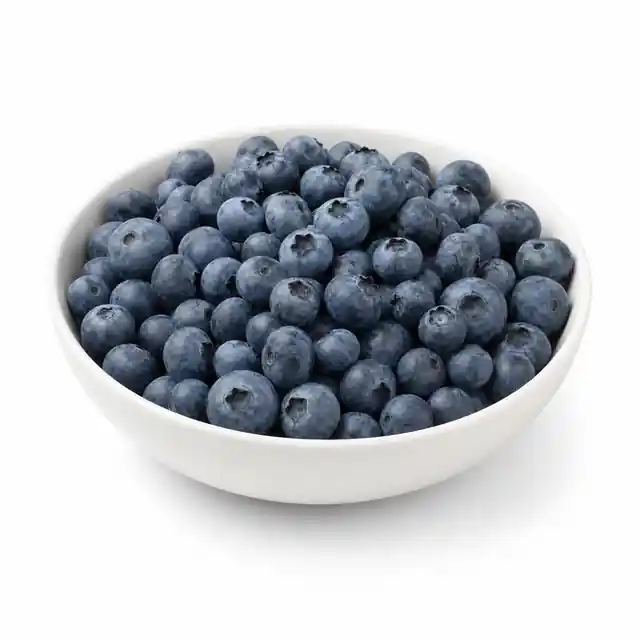
Blueberries are a water-rich fruit that provides carbohydrate, vitamin C, manganese, and anthocyanin polyphenols. Anthocyanin-rich foods are being studied for effects on vascular function and exercise recovery, but blueberries should not be called the universal antioxidant 'leader,' and recovery findings remain mixed. Choose dry, firm berries without mold; refrigerate promptly and do not wash until just before eating, because added surface moisture encourages spoilage.
Calories64
Protein0.7g
Carbs14.6g
Fat0.3g
ProteinCarbsFat
Nutrition for 100 g
Calories
64 kcal
Protein
0.7 g
Total Fat
0.31 g
Carbohydrates
14.57 g
Fiber
2.4 g
Total Sugars
9.36 g
Sodium
0 mg
Nutrients
Full nutrient profile
Proximates
Water84.19 g
Energy (Atwater General Factors)63.86 kcal
Energy (Atwater Specific Factors)57.38 kcal
Nitrogen0.11 g
Protein0.7 g
Total lipid (fat)0.31 g
Ash0.23 g
Energy240 kj
Energy57 kcal
Carbohydrates
Carbohydrate, by difference14.57 g
Sugars, Total9.36 g
Sucrose0 g
Glucose4.42 g
Fructose4.94 g
Lactose0 g
Maltose0 g
Galactose0 g
Sugars, Total9.96 g
Fiber, total dietary2.4 g
Starch0.03 g
Lipids
Fatty acids, total trans0 g
Cholesterol0 mg
PUFA 18:20.09 g
PUFA 18:30.06 g
PUFA 20:40 g
PUFA 18:40 g
MUFA 20:10 g
MUFA 22:10 g
Fatty acids, total monounsaturated0.05 g
Fatty acids, total polyunsaturated0.15 g
SFA 4:00 g
SFA 6:00 g
SFA 10:00 g
SFA 16:00.02 g
SFA 18:00.005 g
MUFA 18:10.05 g
Fatty acids, total saturated0.03 g
SFA 8:00 g
SFA 12:00 g
SFA 14:00 g
PUFA 22:6 n-3 (DHA)0 g
MUFA 16:10.002 g
PUFA 20:5 n-3 (EPA)0 g
PUFA 22:5 n-3 (DPA)0 g
Amino acids
Isoleucine0.02 g
Leucine0.04 g
Lysine0.01 g
Cystine0.008 g
Valine0.03 g
Arginine0.04 g
Histidine0.01 g
Aspartic acid0.06 g
Serine0.02 g
Tryptophan0.003 g
Threonine0.02 g
Methionine0.01 g
Phenylalanine0.03 g
Tyrosine0.009 g
Alanine0.03 g
Glutamic acid0.09 g
Glycine0.03 g
Proline0.03 g
Minerals
Calcium, Ca11.69 mg
Iron, Fe0.34 mg
Magnesium, Mg6.18 mg
Phosphorus, P12.96 mg
Potassium, K85.64 mg
Sodium, Na0 mg
Zinc, Zn0.09 mg
Copper, Cu0.05 mg
Manganese, Mn0.42 mg
Selenium, Se0.1 ug
Vitamins and other components
Vitamin C, total ascorbic acid8.06 mg
Biotin0.3 ug
Folic acid0 ug
Vitamin D (D2 + D3), International Units0 iu
Choline, total6 mg
Betaine0.2 mg
Retinol0 ug
Folate, food6 ug
Folate, DFE6 ug
Vitamin B-120 ug
Vitamin E (alpha-tocopherol)0.57 mg
Lutein + zeaxanthin80 ug
Tocopherol, beta0.01 mg
Tocopherol, gamma0.36 mg
Tocotrienol, alpha0 mg
Tocotrienol, beta0 mg
Niacin0.42 mg
Pantothenic acid0.12 mg
Vitamin B-60.05 mg
Vitamin K (Dihydrophylloquinone)0 ug
Vitamin K (phylloquinone)19.3 ug
Thiamin0.04 mg
Riboflavin0.04 mg
Folate, total6 ug
Vitamin A, IU54 iu
Vitamin A, RAE3 ug
Carotene, beta32 ug
Carotene, alpha0 ug
Cryptoxanthin, beta0 ug
Lycopene0 ug
Tocopherol, delta0.03 mg
Tocotrienol, gamma0.07 mg
Tocotrienol, delta0 mg
Vitamin B-12, added0 ug
Vitamin E, added0 mg
Vitamin D (D2 + D3)0 ug
Other nutrients
Alcohol, ethyl0 g
Caffeine0 mg
Theobromine0 mg
Interesting fact
Anthocyanins are pigments, not a force field
Anthocyanins give blueberries their blue-purple color. After eating, they and their metabolites interact with biological signaling pathways; they do not simply circulate as direct scavengers that erase all exercise-generated free radicals. Cold storage and freezing preserve berries well, while prolonged warm storage and processing can reduce anthocyanin content.
Recipes featuring this food will appear here when the recipe library is connected.
These nutrition values are provided for educational purposes only and are not medical advice. Values may vary depending on brand, preparation method, and serving size.