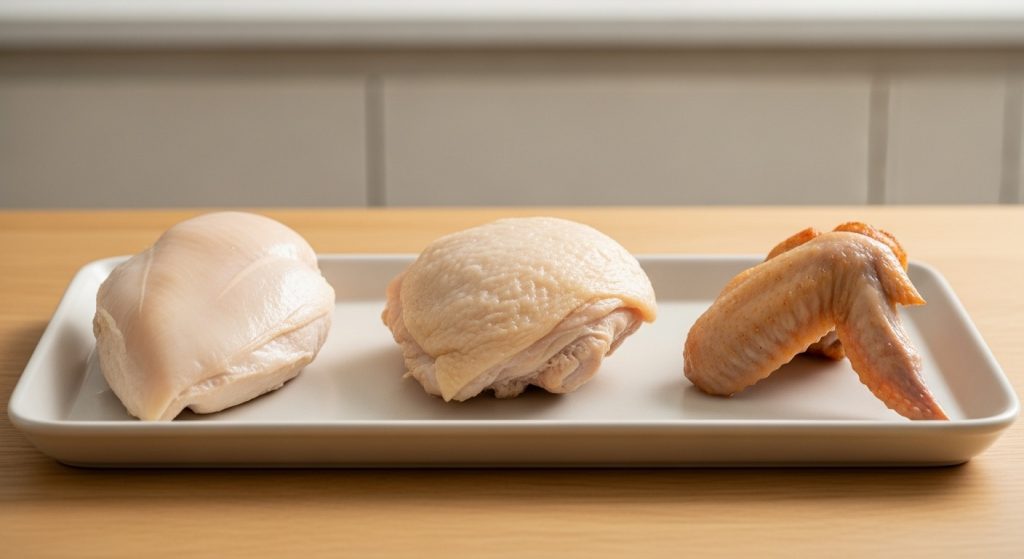
The gap between the leanest and the fattiest skinless chicken cut is smaller than the gap between roasting a breast and battering it. That is the finding that reorganises this whole subject, and it comes straight out of USDA’s own records.
So this is not a ranking of cuts from good to bad. It is what each part of the bird actually is, what it costs you in calories and gives you in protein and minerals, and where the differences are big enough to change what you buy.
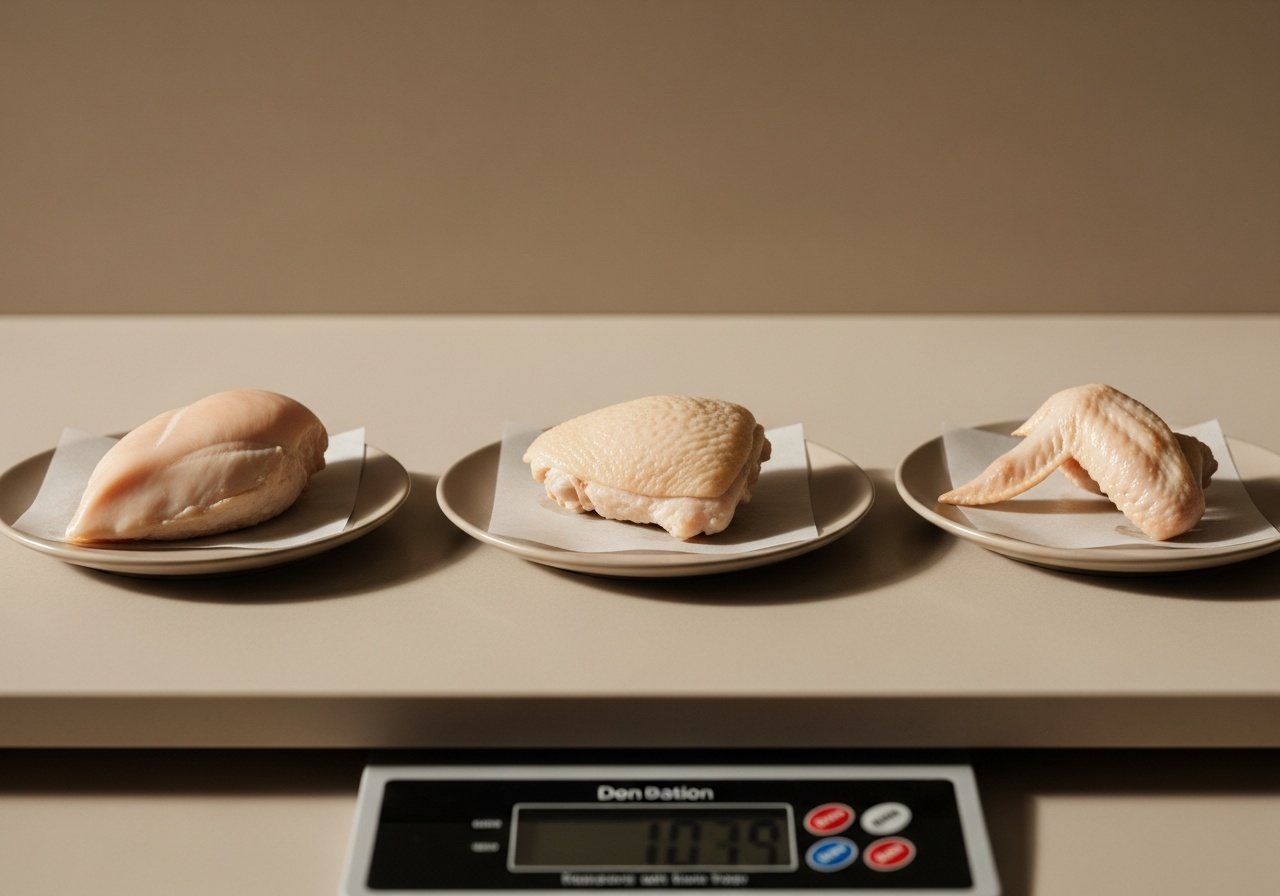
Every cut, roasted and skinless
All of these are USDA Standard Reference records for chicken broilers or fryers, meat only, cooked by roasting — the same bird, the same method, so the numbers are comparable.
| Cut (meat only, roasted) | Calories | Protein | Fat | Saturated fat |
|---|---|---|---|---|
| Drumstick | 155 | 24.2 g | 5.70 g | 1.50 g |
| Breast | 165 | 31.0 g | 3.57 g | 1.01 g |
| Light meat | 173 | 30.9 g | 4.51 g | 1.27 g |
| Leg (drumstick + thigh) | 174 | 24.2 g | 7.80 g | 2.11 g |
| Thigh | 179 | 24.8 g | 8.15 g | 2.31 g |
| Wing | 203 | 30.5 g | 8.13 g | 2.26 g |
| Dark meat | 205 | 27.4 g | 9.73 g | 2.66 g |
| Back | 239 | 28.2 g | 13.2 g | 3.60 g |
Per 100 g of cooked, skinless meat. USDA FoodData Central, SR Legacy.
Three things in that table are not what the usual advice implies.
The drumstick is the lowest-calorie cut on the list — lower than breast. It carries more fat, but less of everything else, so per 100 g it lands at 155 against the breast’s 165.
Wing meat matches breast on protein. 30.5 g per 100 g against 31.0 g — a rounding error apart. Wings have a reputation built entirely on how they are usually served, not on the meat inside them.
The spread is 84 calories. From the leanest cut to the fattiest, across the entire bird, skin off. Hold that number: a single change of cooking method, further down this page, costs almost twice that.
Light meat and dark meat trade — neither wins
This is the comparison people actually mean when they ask which part is healthier, and the honest answer is that each side wins something.
| Per 100 g, meat only, roasted | Light meat | Dark meat |
|---|---|---|
| Calories | 173 | 205 |
| Protein | 30.9 g | 27.4 g |
| Fat | 4.51 g | 9.73 g |
| Niacin | 12.4 mg | 6.55 mg |
| Selenium | 24.4 µg | 18.0 µg |
| Zinc | 1.23 mg | 2.80 mg |
| Iron | 1.06 mg | 1.33 mg |
Light meat carries more protein per calorie and nearly double the niacin. Dark meat carries more than twice the zinc and more iron. There is no federal source that ranks one above the other, and the differences run in both directions — which is the whole reason we are not going to hand you a winner.
Per-nutrient detail for the two cuts most people actually buy is on our boneless chicken breast and boneless chicken thigh pages.
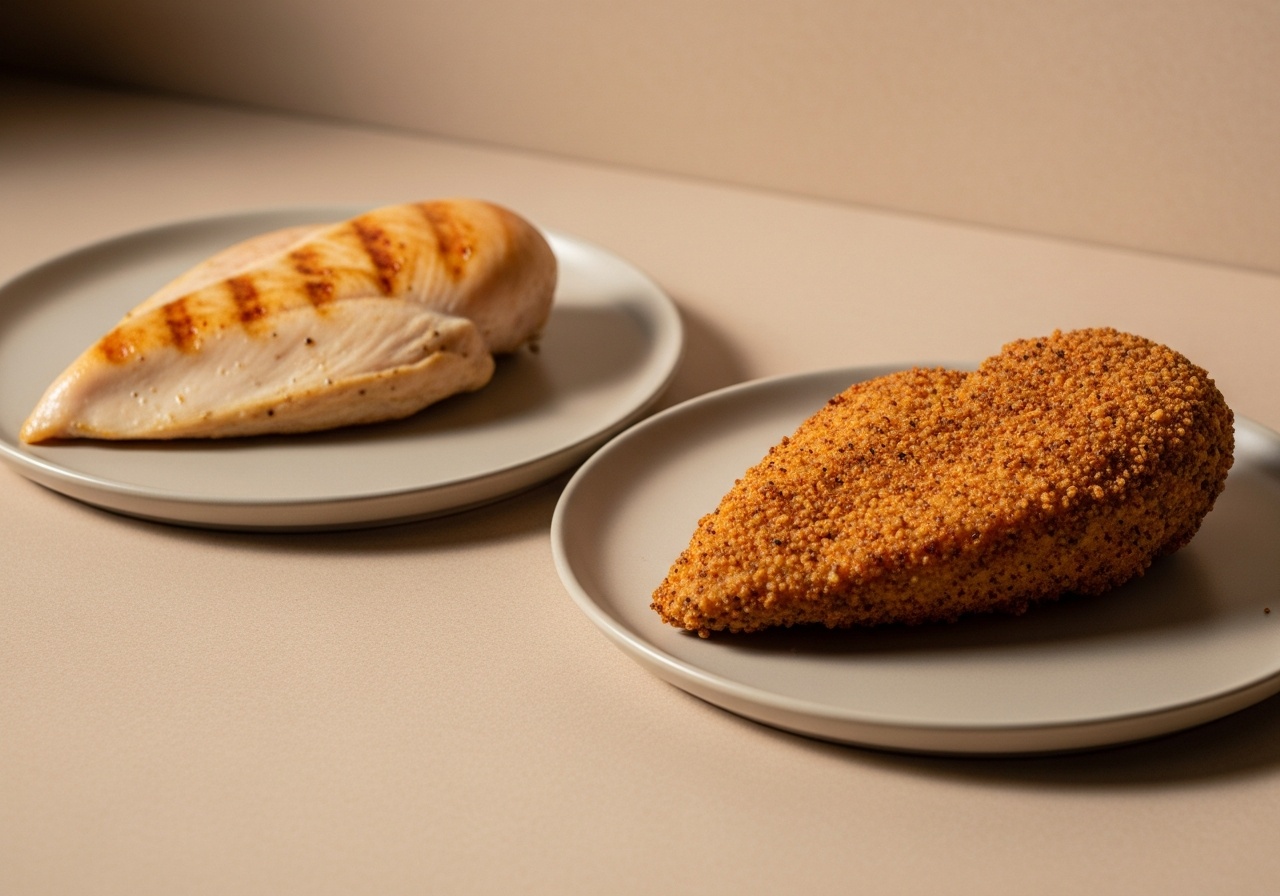
What the skin actually adds
Less than its reputation suggests, and you can see it precisely because USDA holds both versions of the same cut, roasted the same way.
| Roasted, per 100 g | Meat only | Meat and skin | Difference |
|---|---|---|---|
| Thigh — calories | 179 | 232 | +53 |
| Thigh — fat | 8.15 g | 14.7 g | +6.6 g |
| Dark meat — calories | 205 | 253 | +48 |
| Dark meat — fat | 9.73 g | 15.8 g | +6.1 g |
Roughly fifty calories per 100 g, and the fat roughly doubles. Real, and worth knowing if you eat chicken every day — but it is one cut’s worth of difference, not a category error. USDA’s MyPlate guidance does count protein foods in the skinless form: “1 ounce cooked (without skin) chicken, ostrich, or turkey” is one ounce-equivalent.
Cooking method beats cut, and it is not close
Same breast, four treatments, all from USDA:
| Chicken breast, per 100 g | Calories | Protein | Fat |
|---|---|---|---|
| Meat only, stewed | 151 | 29.0 g | 3.03 g |
| Meat only, roasted | 165 | 31.0 g | 3.57 g |
| Meat and skin, fried in flour | 222 | 31.8 g | 8.87 g |
| Meat and skin, fried in batter | 260 | 24.8 g | 13.2 g |
From roasted to battered and fried is 95 calories per 100 g. The entire range across every skinless cut of the bird was 84. So if you are choosing between breast and thigh for calorie reasons and then frying either one in batter, you have optimised the smaller decision.
Look at the protein column in that last row. Battering drops it from 31.0 g to 24.8 g per 100 g — not because the chicken changed, but because a fifth of what you are now weighing is batter. This is why “grams per 100 g” and “grams per piece” answer different questions.
A piece of chicken is not 100 grams
USDA publishes what one piece actually weighs, and the pieces are nothing like each other.
| One piece, cooked | Without skin | With skin |
|---|---|---|
| Half a breast, bone removed | 86 g | — |
| Thigh | 116 g | 137 g |
| Drumstick | 96 g | 105 g |
| Wing, bone and skin removed | 21 g | — |
| Whole leg (drumstick + thigh + back meat) | 199 g | — |
A wing is twenty-one grams of meat. Ten wings is roughly one thigh. That is the number that explains why wings never fill anyone up, and why the per-100 g figure above — which makes wing meat look almost identical to breast — describes a portion nobody eats in one piece.
MyPlate counts an ounce of cooked skinless chicken as one ounce-equivalent, and puts adults at “5 to 6½ oz-equiv” a day for women aged 19–30 and “6½ to 7 oz-equiv” for men. One skinless thigh is about four of those.
Ground chicken and deli chicken are separate products
Neither is a cut, and both behave differently from the parts above. Ground chicken is not a lean-breast product by default — the USDA record for raw ground chicken gives 143 calories and 8.10 g of fat per 100 g, against 172 calories and 9.25 g for raw breast with skin, because ground chicken is made from a mixture that can include skin. What is in the pack depends on the pack.
We hold cards for both: ground chicken and chicken breast lunchmeat. If you are weighing ground chicken against ground turkey, that comparison is on its own page: ground turkey vs ground chicken, and chicken breast vs ground chicken.
Chicken liver is not in the same conversation
It gets left out of cut comparisons because it is not a cut. But the numbers are worth seeing once.
| Per 100 g, cooked | Liver, simmered | Breast, roasted |
|---|---|---|
| Iron | 11.6 mg | 1.04 mg |
| Vitamin B-12 | 16.8 µg | 0.34 µg |
| Vitamin A (RAE) | 3,980 µg | — |
| Folate | 578 µg | — |
| Cholesterol | 563 mg | 85 mg |
| Calories | 167 | 165 |
Eleven times the iron and roughly fifty times the B-12, at the same calorie cost. And 563 mg of cholesterol, which is why it is a food you eat occasionally rather than a weekly staple. We are not going to tell you how often — no federal source sets a frequency.
What the label on the pack is telling you
Four terms do most of the work in the poultry aisle, and FSIS defines them rather than the marketing department.
| Term | What it means |
|---|---|
| No hormones added | Legally meaningless as a difference. Hormones “are not allowed in raising hogs or poultry,” so the claim can only appear alongside a statement that “Federal regulations prohibit the use of hormones.” Every chicken qualifies. |
| Natural | “A product containing no artificial ingredient or added color and is only minimally processed.” It says nothing about how the bird was raised. |
| Fresh | “‘Fresh’ means whole poultry and cuts have never been below 26 °F” — a temperature rule, not a time-since-slaughter rule. |
| Basted or self basted | Injected or marinated with a solution. FSIS: products “injected or marinated with a solution containing butter or other edible fat, broth, stock or water plus spices, flavor enhancers” must be labeled this way. |
| No antibiotics added | Allowed “if sufficient documentation is provided by the producer to the Agency demonstrating that the animals were raised without antibiotics.” |
The basted line has a number behind it. USDA holds a separate record for drumstick with added solution: 190 mg of sodium per 100 g, against 128 mg for the plain roasted drumstick. Not alarming, but it is the one label term on that list that changes the nutrition rather than the paperwork.
Handling it, which matters more than which cut you chose
All of this is FSIS guidance, quoted.
- Temperature. “Cook all poultry to 165°F” — measured with a food thermometer, and the same figure for whole birds, parts and ground chicken. Color is not a doneness test.
- Do not wash it. “Washing raw poultry before cooking is not recommended because bacteria in raw meat and poultry juices can be spread to other foods, utensils, and surfaces.” And: “Rinsing or soaking chicken does not destroy bacteria. Only cooking will destroy any bacteria.”
- Raw, in the fridge: 1 to 2 days. Cooked: 3 to 4 days.
- Frozen: a whole chicken keeps a year, parts 9 months, cooked chicken 4 months.
The one to actually change your habits over is washing. It feels careful and it is the opposite — the splash radius of a rinsed chicken is wider than the sink.
So which cut should you buy?
- For protein per calorie, breast or wing meat. Both land around 31 g per 100 g. Breast is simply the practical way to eat that much of it.
- For flavor at almost no calorie cost, the drumstick. It is the lowest-calorie cut in the table and it is dark meat, which is the combination most people assume does not exist.
- For zinc and iron, thigh or any dark meat. More than double the zinc of light meat.
- Skin on or off is your call. About fifty calories per 100 g. Decide it once and stop relitigating it.
- Then stop optimising the cut and look at the pan. Batter and deep-frying costs more than every cut decision on this page combined.
What we are not going to tell you
| Claim you will read elsewhere | Why not |
|---|---|
| “Chicken breast is the healthiest cut” | USDA holds no ranking. Breast leads on protein per calorie; dark meat leads on zinc and iron. Those are different questions. |
| “Dark meat is bad for you” | The roasted skinless spread across the whole bird is 84 calories per 100 g. No federal source describes any cut as one to avoid. |
| “Organic or free-range chicken is more nutritious” | We found no USDA nutrient data comparing them, so we make no claim in either direction. |
| “Chicken has added hormones” | FSIS: hormones “are not allowed in raising hogs or poultry.” The claim on the pack describes the law, not the brand. |
| “Wash your chicken before cooking” | FSIS explicitly recommends against it. |
| “Chicken is done when the juices run clear” | FSIS gives one test: 165°F on a food thermometer. |
FAQ
Which cut of chicken has the fewest calories?
Skinless and roasted, the drumstick at 155 calories per 100 g, just under the breast’s 165. The whole skinless range, drumstick to back, is 155 to 239.
How much protein is in each cut?
Per 100 g of roasted skinless meat: breast 31.0 g, wing 30.5 g, back 28.2 g, thigh 24.8 g, drumstick 24.2 g. Wing meat is essentially as protein-dense as breast — there is just very little of it per wing.
Is thigh meat unhealthy compared with breast?
No source says so. A roasted skinless thigh carries 179 calories per 100 g against 165 for breast, with more zinc and iron and less protein and niacin. The differences run both ways.
How many calories does the skin add?
About 50 per 100 g. A roasted thigh goes from 179 to 232 calories, and its fat from 8.15 g to 14.7 g.
How much meat is actually on a chicken wing?
USDA puts one wing, bone and skin removed, at 21 g. Ten of them is roughly one thigh’s worth of meat.
Does frying really matter that much?
Yes. A breast goes from 165 calories per 100 g roasted to 260 battered and fried, and its protein falls from 31.0 g to 24.8 g because part of what you are weighing is now batter.
What temperature should chicken be cooked to?
165°F for every form of poultry, per FSIS, measured with a food thermometer. Not by color and not by clear juices.
Should I rinse chicken before cooking it?
No. FSIS advises against it: rinsing spreads bacteria to surfaces and utensils, and “only cooking will destroy any bacteria.”
Does “no hormones added” mean anything?
Not as a difference between brands. Hormones are not permitted in raising poultry at all, so the claim has to be printed alongside a note saying federal regulations prohibit them.
How much chicken counts toward my daily protein?
MyPlate counts 1 ounce of cooked skinless chicken as one ounce-equivalent, with adults needing roughly 5 to 7 ounce-equivalents a day depending on age and sex. One skinless thigh is about four.
This content is for educational purposes only and is not medical advice. Always consult a qualified healthcare professional for personalised guidance.