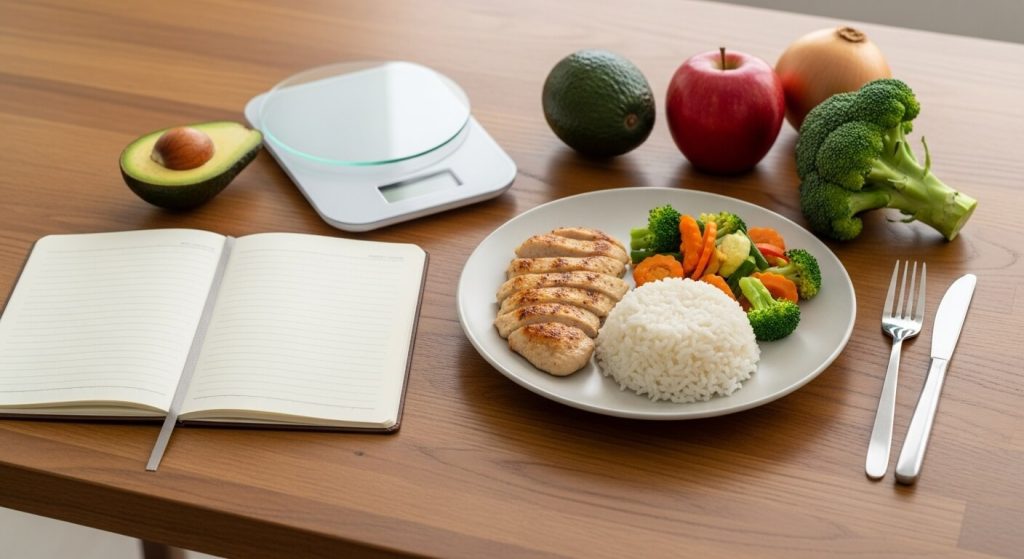
The useful question is not which food has the most protein — it is how much protein you get per calorie, because that decides how much room the rest of your diet has left. Below are both numbers for the highest-density foods in our database, each traced to a named USDA record on its own card. The best of them deliver about 24 g of protein per 100 calories.
The short version
- Target: 1.2–2.0 g of protein per kg of body weight per day, split into servings of roughly 20–40 g.
- Highest protein per calorie in our database: white fish, shellfish, egg white, chicken breast — 20–24 g per 100 kcal.
- Best plant-side density: nonfat Greek yogurt and defatted soy flour; dry beans land around 7–8 g per 100 kcal.
- Whole food is not inferior to powder — powders are described as no more effective, only more convenient.
- Values are per 100 g in the state named on each card. Dry beans are dry; cooking adds water.
Why protein per calorie is the number to use
Two foods can both be “high protein” and behave completely differently in a day’s eating. What you actually spend is calories. The right-hand column below — grams of protein per 100 calories — tells you which foods let you hit your protein target without crowding out everything else. Our body recomposition calculator sets the calorie and protein targets for building muscle without adding fat.
The target itself, from NIH’s Office of Dietary Supplements: 1.2 to 2.0 g/kg body weight per day for athletes, with no safety concerns reported up to 2.0. Per serving, a physique-nutrition review found a 20 g dose of egg protein stimulated MPS to a greater degree than smaller doses of 5 g or 10 g, plateauing near 40 g.
Animal sources, ranked by protein per calorie
| Food (per 100 g) | Protein, g | Calories | Protein per 100 kcal |
|---|---|---|---|
| Cod, Atlantic | 16.1 | 66 | 24.4 |
| Mahi mahi | 19.8 | 84 | 23.6 |
| Crab | 18.7 | 81 | 23.1 |
| Snapper | 20.7 | 90 | 23.0 |
| Alaska pollock | 17.3 | 78 | 22.2 |
| Shrimp | 15.6 | 71 | 22.0 |
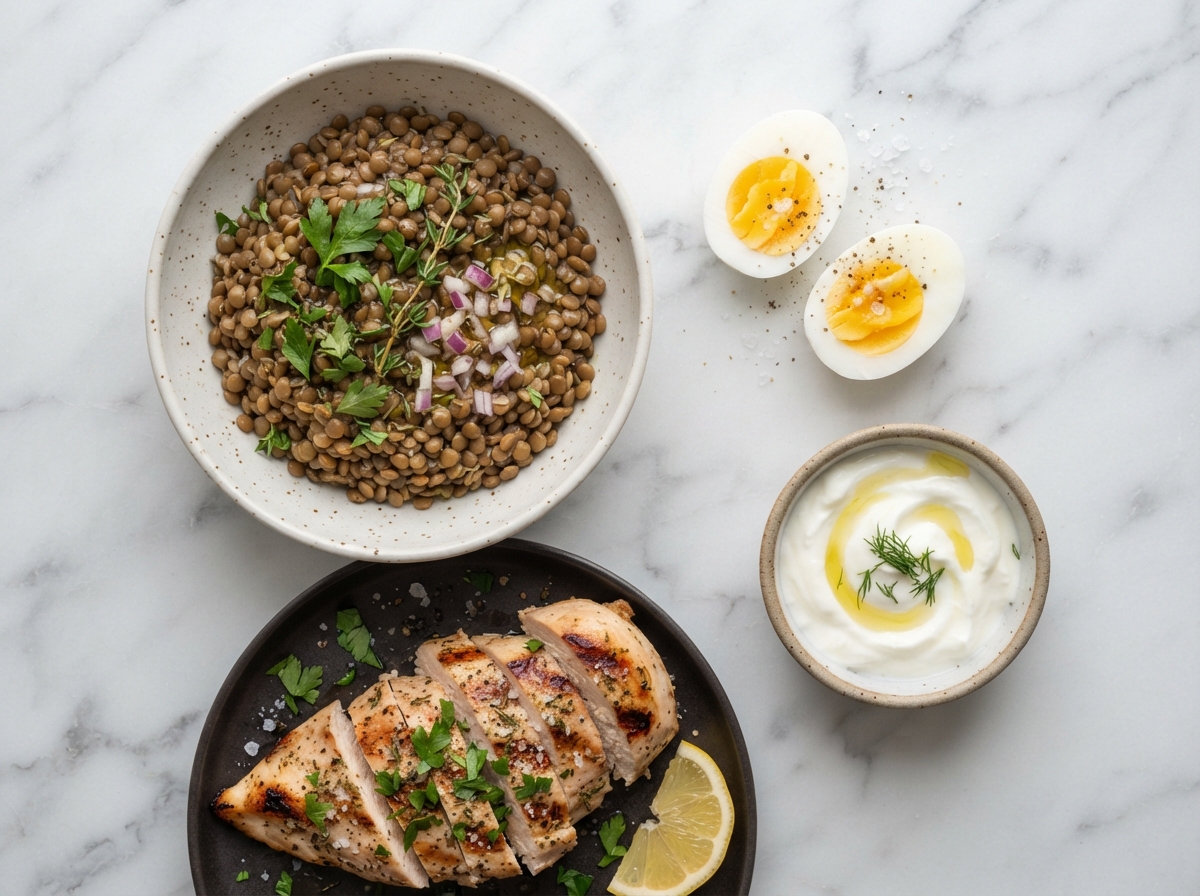
| Chicken breast | 22.5 | 106 | 21.2 |
| Tuna, canned in water | 19.0 | 90 | 21.1 |
| Egg white | 10.1 | 48 | 21.0 |
| Scallops, bay | 16.4 | 78 | 21.0 |
| Tilapia | 19.0 | 95 | 20.0 |
| Beef, top round | 23.7 | 123 | 19.3 |
| Whole egg | 10.7 | 55 | 19.5 |
The pattern is worth noticing: white fish and shellfish beat chicken breast on this measure, and they belong to the food group USDA says Americans actually under-eat — see the documented shortfalls.
Plant and dairy sources
| Food (per 100 g) | Protein, g | Calories | Protein per 100 kcal |
|---|---|---|---|
| Greek yogurt, nonfat | 10.3 | 61 | 16.9 |
| Soy flour, defatted | 51.1 | 366 | 14.0 |
| Cottage cheese, low-fat | 11.0 | 84 | 13.1 |
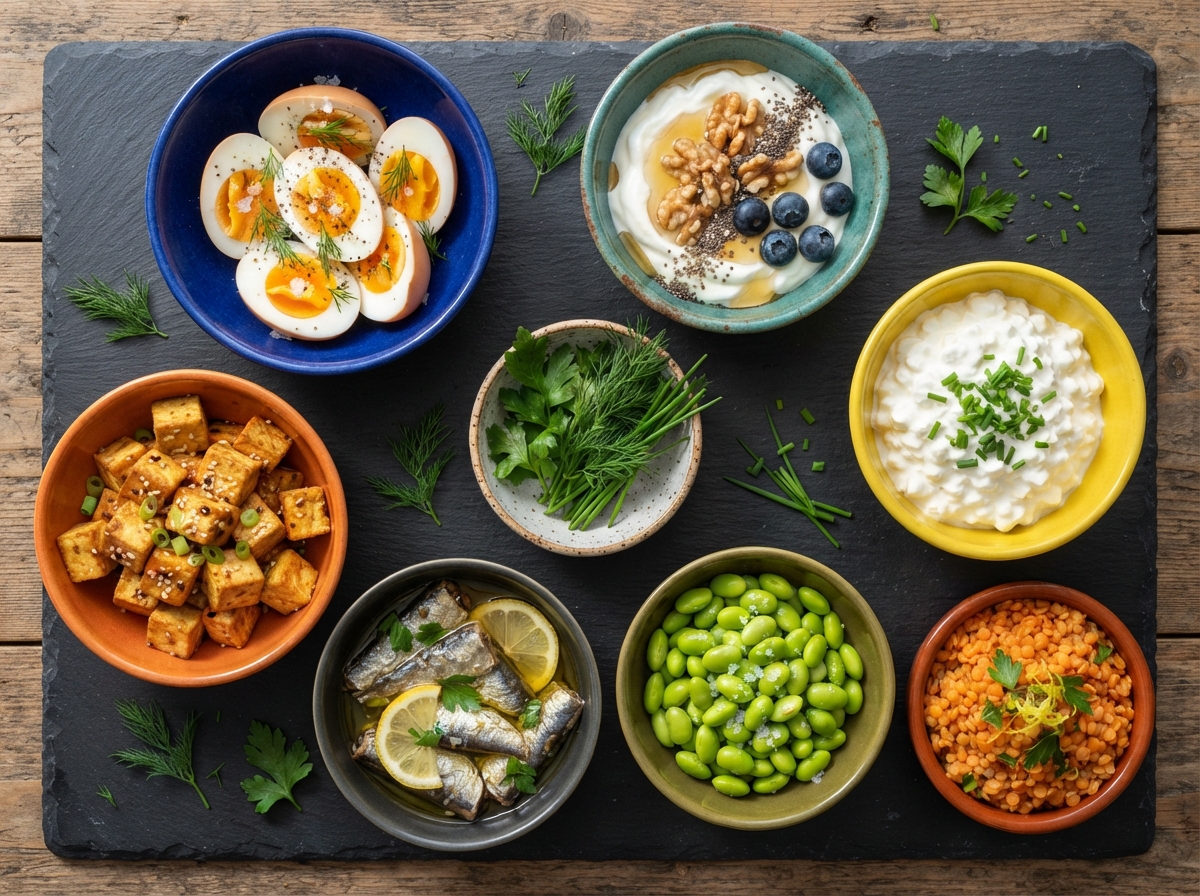
| Edamame | 11.9 | 121 | 9.8 |
| Greek yogurt, whole milk | 8.8 | 94 | 9.4 |
| Kidney beans, dry | 25.9 | 337 | 7.7 |
| Lentils, dry | 23.6 | 360 | 6.6 |
| Chickpeas, dry | 21.3 | 383 | 5.6 |
Read the state of the food. The beans and lentils here are weighed dry — 100 g of dry lentils is not a portion, it is several. Their calories come attached to fiber the fish does not have, which is a feature, not a flaw. See the fiber tables for that side of the ledger.
What about powder
Convenient, not superior. A physique-nutrition review states that protein powders are not inherently more efficacious than any other high-quality protein source and are generally viewed as a convenient means. MedlinePlus goes further on the wider aisle: amino acid supplements and eating a lot of protein are not recommended, and athletes, even body builders, need only a little bit of extra protein to support muscle growth.
The reason to keep a tub is that it makes a 25 g serving cost thirty seconds. That is a real reason. It is not a physiological one.
What we are not claiming
- That these foods build muscle by themselves. They supply protein. Training builds muscle.
- A protein quality ranking. Digestibility scores exist, but we could not source them from our approved list, so the tables rank by density only.
- That plant protein is inferior. No source we could reach makes that comparison in these terms; the tables show density, not quality.
- Leucine thresholds per serving. Frequently quoted, not verifiable from the sources we could reach.
- That you need more than 2.0 g/kg. Higher figures come from physique-competition contexts and are justified partly by appetite control while dieting.
FAQ
Which food has the most protein per calorie? In our database, Atlantic cod at about 24 g per 100 calories, followed by mahi mahi and crab.
How much protein do I need to build muscle? 1.2–2.0 g per kg of body weight per day, in servings of roughly 20–40 g.
Is chicken breast the best protein source? It is excellent, but several white fish and shellfish beat it on protein per calorie.
Can I build muscle on plant protein? Nothing we could verify says otherwise. Watch the calories that come with it: dry beans carry roughly three times the calories per gram of protein that white fish does.
Do I need a protein shake? No. Powders are described as no more effective than other high-quality protein sources — just faster.
What to do with this
Pick two or three foods from the top of the first table and one from the second, and build your standard meals around them. That gets you to a 1.6 g/kg intake without thinking about it, and leaves calorie room for the carbohydrate that actually fuels your training.
Set the target first: the protein calculator gives a daily figure, and the macro calculator shows what is left for carbohydrate and fat.
Related: nutrition for strength, protein per meal.
Educational content, not medical advice. All values are per 100 g and sourced on each food’s Nutrition Facts card.
This content is for educational purposes only and is not medical advice. Always consult a qualified healthcare professional for personalised guidance.