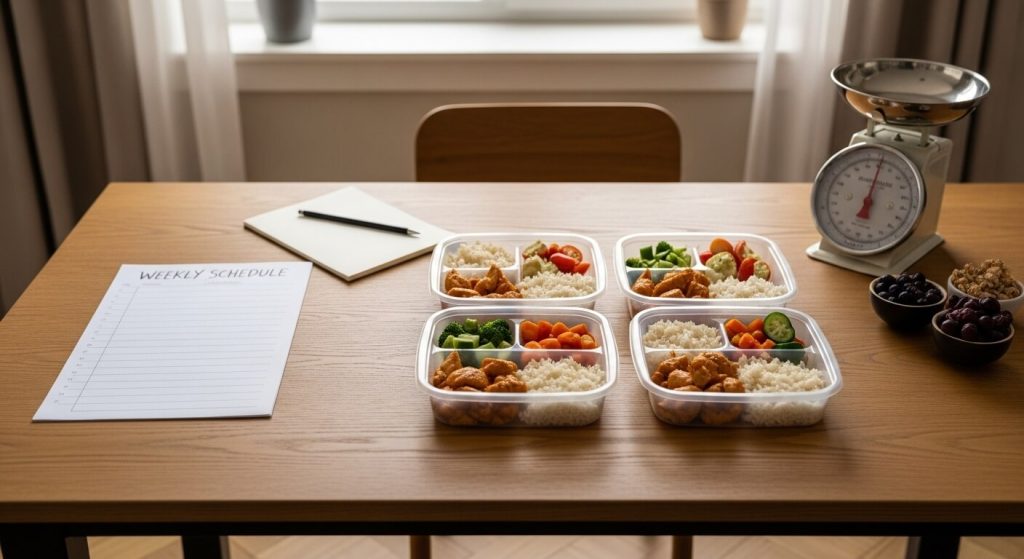
A meal plan is not a menu. A menu tells you what to eat on Tuesday; a plan tells you what any Tuesday has to contain. Once you can build the second, you stop needing to find the first. Our meal calorie calculator splits a daily calorie target across the meals such a plan has to contain.
This is the method — the four numbers that define a plan, where to get each from a real source, and what changes between losing weight and building muscle.
Number 1: protein, and why it comes first
Protein is the only target that stays roughly the same whichever direction you are going, so it anchors everything else.
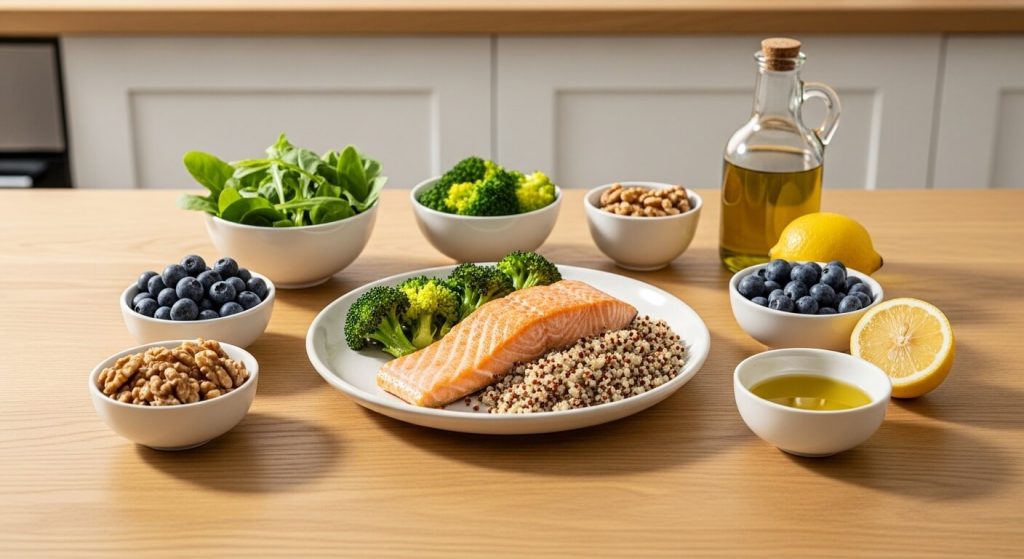
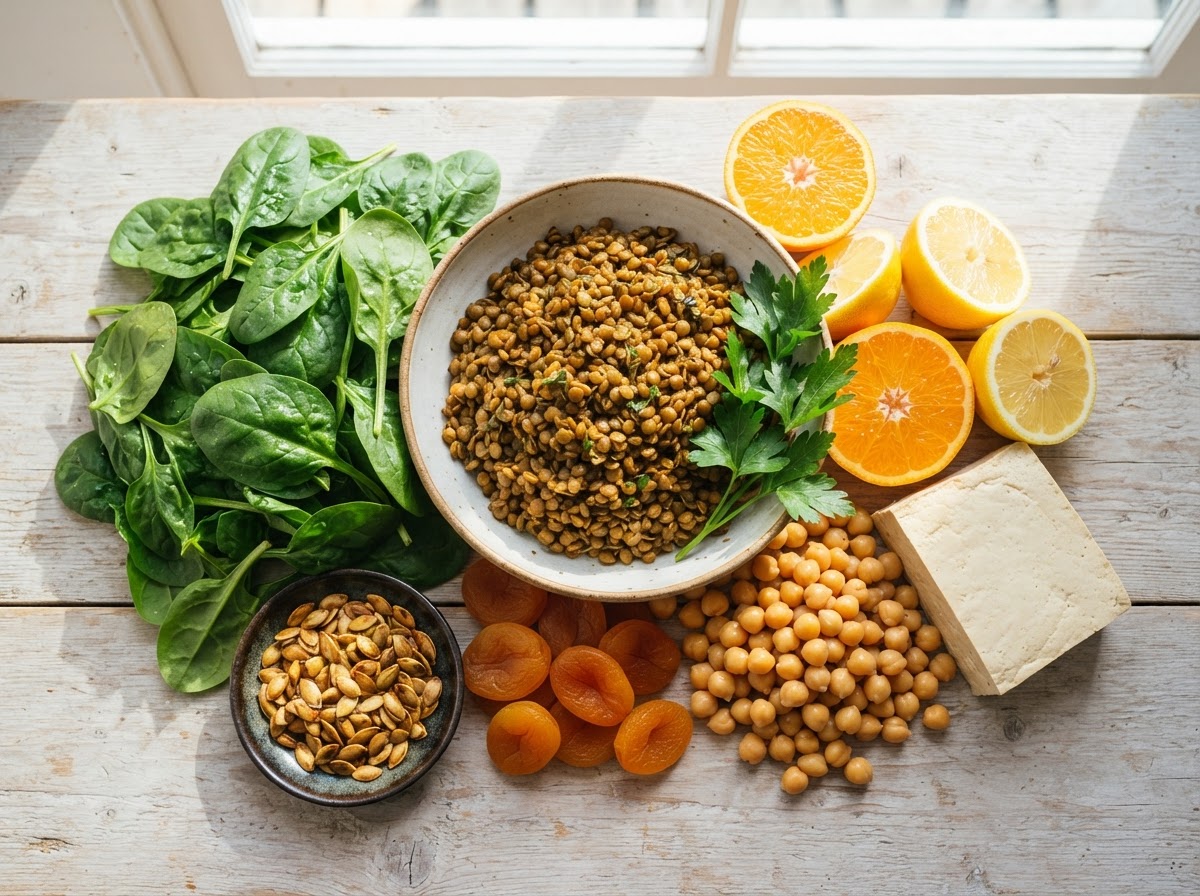
Protein staples with full nutrition breakdowns: chicken breast, salmon, eggs, Greek yogurt, lentils and chickpeas. The protein calculator turns your body weight into a target.
The current Dietary Guidelines set it by bodyweight: “1.2–1.6 grams of protein per kilogram of body weight per day.” For a 70 kg adult that is 84–112 g.
If you are training, the sports nutrition position stands go higher — the ISSN puts it at “1.4–2.0 g protein/kg body weight/day” for most exercising people, and notes that “higher protein intakes (2.3–3.1 g/kg/d) may be needed to maximize the retention of lean body mass” while in a calorie deficit. Our recipe collection gives meals to drop into those slots, starting with the chicken burrito bowl.
Two reasons it goes first. It is the macronutrient most likely to fall short when calories drop. And processing it costs 20–30% of its own calories, against 0–3% for fat — the only diet-composition effect on energy expenditure with solid numbers behind it.
Per-meal distribution is in how much protein per meal.
Number 2: your calorie level
No article can set this responsibly — it depends on your size, composition and activity. Two legitimate starting points:
Two tools cover this number: the TDEE calculator for maintenance and the calorie deficit calculator if you are aiming below it.
- USDA’s MyPlate Plan, which generates food-group targets from your age, sex, height, weight and activity level
- NIH’s Body Weight Planner, built on the model that replaced the old 3,500-calorie rule
Why the second one matters. The familiar rule — 3,500 calories per pound, so 500 a day is a pound a week forever — is wrong in a specific, quantified way. A paper hosted on CDC’s server states it “ignores dynamic physiological adaptations to altered body weight” and overpredicts a year’s weight loss by “about 100%.” Any plan built on it will stop working, and you will think you failed. Build in recalculation from the start.
Number 3: how fast, and how much
| Goal | The sourced figure |
|---|---|
| Rate of weight loss | CDC: “about 1 to 2 pounds a week” — and people at that pace “are more likely to keep the weight off” |
| Six-month target | NIDDK: “an initial weight-loss goal of 5% to 10% of your starting weight” |
| Activity while losing | NIDDK: “at least 150 minutes a week” moderate aerobic, plus strength work “on two or more days a week” |
| Activity to maintain | NIDDK: “at least 300 minutes a week” |
For muscle gain there is no equivalent federal number — the guidance simply does not address it. What the evidence does support is the protein range above plus resistance training; anyone quoting you a precise weekly rate of muscle gain is going beyond what has been established.
Number 4: the food-group shape
This is what stops a plan from being a spreadsheet of macros. The current Dietary Guidelines give daily serving goals — vegetables 3, fruit 2, dairy 3, whole grains 2–4 — but no serving definitions of their own. NHLBI’s DASH guide supplies those:
Fill the shape from cards with real numbers: broccoli, spinach, sweet potatoes, oats, whole-wheat bread and nonfat milk.
| Grains | 1 slice bread; 1 oz dry cereal; ½ cup cooked rice or pasta |
| Vegetables | 1 cup raw leafy; ½ cup cooked |
| Fruit | 1 medium fruit; ¼ cup dried; ½ cup fresh or frozen |
| Dairy | 1 cup milk or yogurt; 1.5 oz cheese |
| Meat, poultry, fish | 1 oz cooked; 1 egg |
| Nuts, seeds, legumes | ⅓ cup nuts; 2 Tbsp nut butter; ½ cup cooked legumes |
Three limits sit on top, from the current Guidelines: added sugars “no more than 10 grams” in one meal, saturated fat “should not exceed 10% of total daily calories,” sodium “less than 2,300 mg per day.”
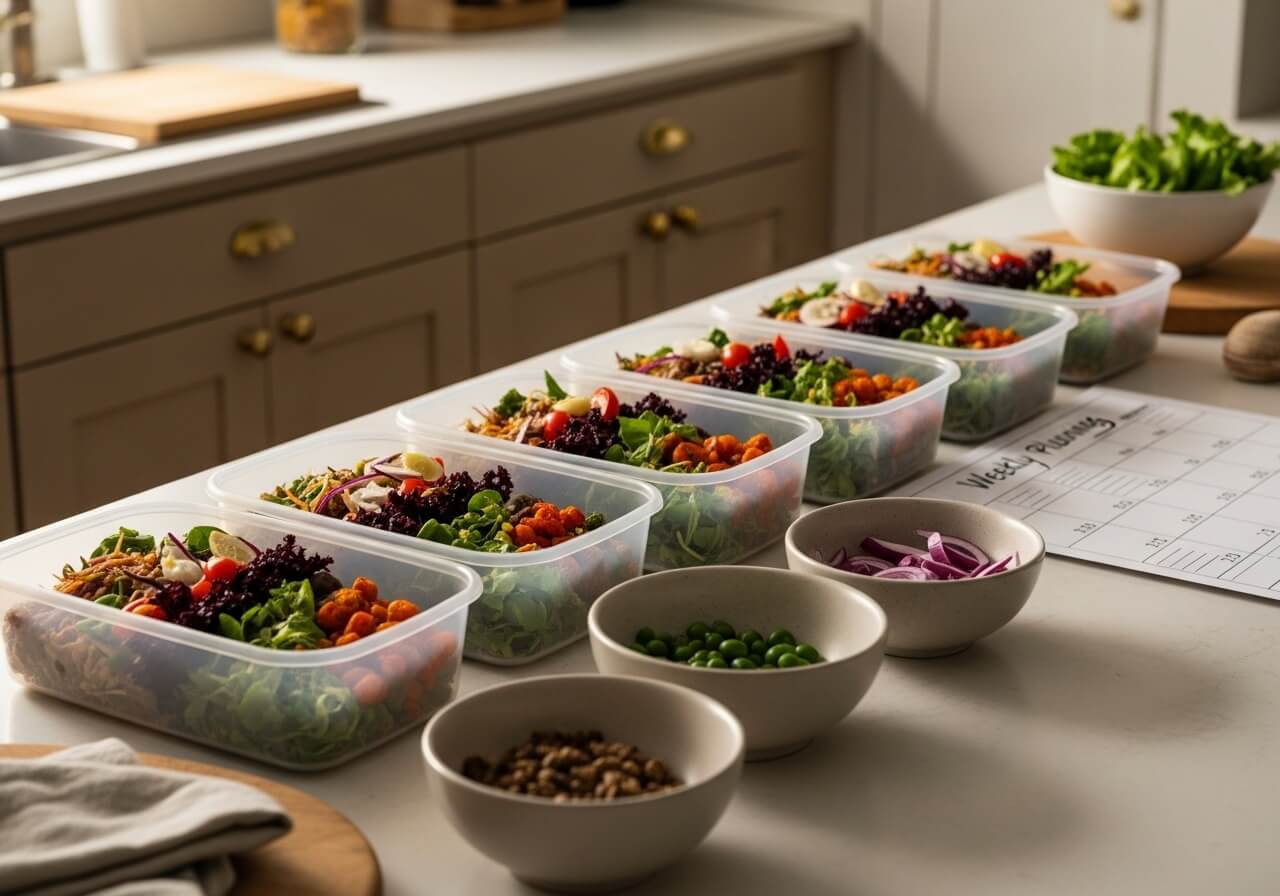
Building the week from those four numbers
The method, in order:
- Set protein per meal. Divide your daily target across four or five eating occasions. This fixes the anchor of every meal before anything else is decided.
- Choose four or five dinners, not seven. Cooked leftovers keep “3 to 4 days in the refrigerator,” so each dinner can cover a lunch. Seven distinct dinners is the single most common reason plans collapse by Thursday.
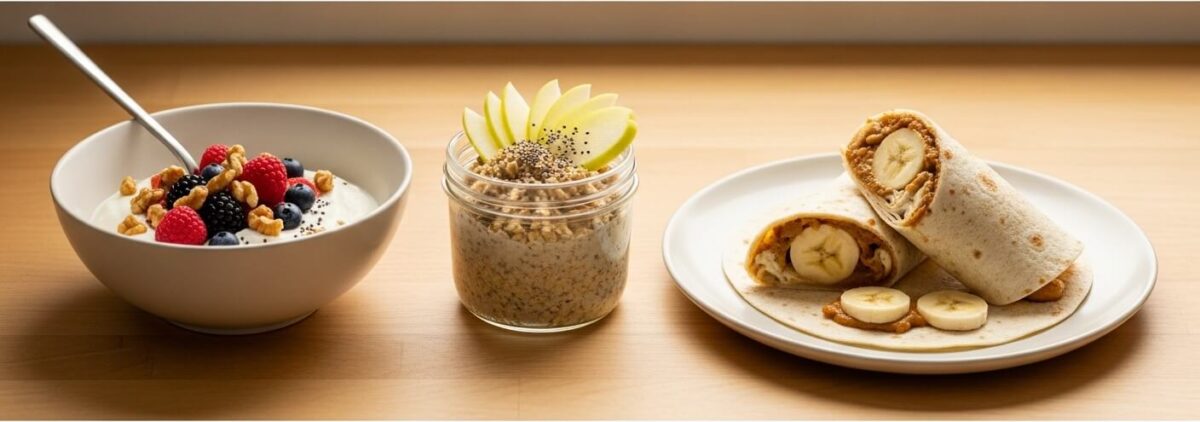
- Fix breakfast. Rotating it costs decision-making for no benefit, and it is where protein most often goes missing.
- Fill the food-group shape around those anchors — vegetables at each main meal, fruit twice, dairy, whole grains at half your grain servings.
- Leave two slots blank for eating out or a bad day. A plan with no slack is a plan that gets abandoned rather than adjusted.
What changes between losing and gaining
| Losing weight | Building muscle | |
|---|---|---|
| Protein | Toward the top of the range — it protects lean mass in a deficit | 1.4–2.0 g/kg per ISSN |
| Calories | Deficit, recalculated as you lose | Surplus, modest |
| Food-group shape | Same | Same |
| Training | 150 min/week plus strength twice | Resistance training is the stimulus; food is permission |
Notice how little changes. The plan structure is identical; the calorie level and the emphasis move. That is why building the method once is worth more than collecting menus.
Where plans actually break
| Failure | Fix |
|---|---|
| Seven separate dinners | Four or five, each covering a lunch. Leftovers keep 3–4 days |
| Breakfast has no protein | Eggs, yogurt, cottage cheese or beans. One egg is one ounce-equivalent |
| The calorie target never changes | Recalculate as your weight changes — the 3,500 rule overpredicts by roughly double over a year |
| No slack | Two unplanned slots a week, built in deliberately |
| Shopping without a list | USDA: “make a shopping list based on the money you have to spend” — and “have something to eat before you go shopping” |
| Food spoils before it is eaten | USDA: “buy only the amount of food you can use before it spoils”; frozen and canned last longer |
On the last two: cooked food must be refrigerated “within 2 hours of cooking,” in shallow containers, and reheated to 165°F. The batch-cooking system itself is in building a sustainable meal prep system.
A worked week, if you want one
Rather than repeat it here, there is a full seven days built on these numbers in the 7-day weight-loss meal plan. NHLBI also publishes a free week of DASH menus with the serving sizes above.
What a plan cannot do
NIDDK lists the promises that mark a program as bogus: “lose weight without diet or exercise!”, “lose weight while eating as much as you want of all your favorite foods!”, “lose 30 pounds in 30 days!”, “lose weight in a specific part of your body!”
That last one applies to meal plans directly: no arrangement of food targets fat loss by body region.
FAQ
Where do I start when building a meal plan?
With protein. The Dietary Guidelines give 1.2–1.6 g per kilogram of bodyweight daily; sports position stands give 1.4–2.0 g/kg for people who train. Divide it across four or five eating occasions, then build meals around those anchors.
How do I set my calorie target?
Use USDA’s MyPlate Plan or NIH’s Body Weight Planner, both of which take your own details. Avoid the flat 3,500-calorie rule — it overpredicts a year’s weight loss by about 100%.
How many different meals do I need?
Four or five dinners, each covering a lunch. Cooked leftovers keep three to four days refrigerated, which is exactly what makes that work.
Is the plan different for muscle gain?
Barely. Protein sits toward the upper range either way, the food-group shape is identical, and the calorie level moves from deficit to modest surplus. There is no federal guidance on rate of muscle gain.
How much added sugar, salt and saturated fat?
Current Guidelines: no more than 10 grams of added sugars in one meal, saturated fat under 10% of daily calories, sodium under 2,300 mg a day.
Why does my plan keep failing by Thursday?
Usually too many distinct meals and no slack. Cut to four or five dinners that cover lunches, and leave two slots a week deliberately unplanned.
Can I plan to lose fat from one area?
No. NIDDK lists that promise among the markers of a bogus weight-loss program.
This content is for educational purposes only and is not medical advice. Always consult a qualified healthcare professional for personalised guidance.