
Meal timing is one of the most heavily marketed ideas in nutrition and one of the least supported. Almost every documented effect of “when you eat” turns out, on inspection, to be an effect of how much you ate or how much protein you got. This page separates the part that holds up from the part that does not.
The short version
- Total intake decides most outcomes. The ISSN’s nutrient timing position stand concludes that “when recommended levels of protein are consumed, the effect of timing appears to be, at best, minimal”.
- Protein spacing is the one timing habit worth keeping. Roughly “a 20–40 g protein dose (0.25–0.40 g/kg body mass/dose) of a high-quality source every three to 4 h”.
- Eating windows work by cutting calories, not by changing metabolism. See our page on what intermittent fasting actually does.
- No US agency recommends a timing-based diet. The National Institute on Aging states that “There’s insufficient evidence to recommend any type of calorie-restriction or fasting diet”.
The anabolic window is much wider than advertised
The claim that a post-workout meal must land within 30 or 60 minutes does not survive its own source literature. The ISSN timing stand reports that muscle “remain[s] sensitized to protein ingestion for at least 24 h following a resistance training bout”. The protein position stand puts the hierarchy plainly: “total protein intake was the strongest predictor of muscular hypertrophy and that protein timing likely influences hypertrophy to a lesser degree”, and adds that pre- or post-workout is “likely a matter of individual tolerance.”
What the stand does ask you to prioritize is unglamorous: “Meeting the total daily intake of protein, preferably with evenly spaced protein feedings (approximately every 3 h during the day), should be viewed as a primary area of emphasis”.
The timing habit that does pay off: protein at every meal
This is the practical core of the topic. The 2025–2030 Dietary Guidelines put it in three words — “Prioritize Protein Foods at Every Meal” — alongside a daily goal of “1.2–1.6 grams of protein per kilogram of body weight per day.”
In practice that means most people need to fix breakfast, which is usually where the protein is missing. Foods that make a 20–40 g dose easy, with full nutrition breakdowns: eggs, Greek yogurt, cottage cheese, chicken breast, salmon and lentils. Set your own daily figure with the protein calculator.
One genuine before-bed finding
Among all the timing claims, this one has direct support: “Consuming casein protein (~ 30–40 g) prior to sleep can acutely increase MPS and metabolic rate throughout the night without influencing lipolysis.” Note the last clause — it raises overnight muscle protein synthesis; it does not burn fat.
Eating windows: the calories move, the metabolism does not
Time-restricted eating is meal timing taken to its logical end, and it has been tested directly against ordinary calorie restriction. A 2025 network meta-analysis in the BMJ covering 99 randomised trials found that, measured against standard calorie restriction rather than against free eating, time-restricted eating did not come out ahead. When calories are matched, the timing advantage disappears.
We cover the detail — protocols, adherence, side effects and who should avoid them — in intermittent fasting: what the evidence shows and the 16/8 window specifically.
What about training days?
Around exercise, timing matters more for fuel and comfort than for adaptation. The ISSN notes that “Post-exercise ingestion (immediately to 2-h post) of high-quality protein sources stimulates robust increases in MPS” — a two-hour span, not a thirty-minute one. Practical pre- and post-session choices are in what to eat before a workout.
What we are not claiming
- That eating late causes weight gain. No source we could verify supports that as an independent effect of the clock.
- That skipping breakfast slows metabolism. The trials that test eating windows do not find metabolic-rate differences when calories are matched.
- That six small meals beat three larger ones. Meal frequency has no verified independent effect on body weight in the sources we use.
- That there is a 30-minute post-workout window. ISSN describes at least 24 hours of sensitivity and an “immediately to 2-h post” ingestion span.
- That a fasting or time-restricted schedule is recommended. NIA says the evidence is insufficient to recommend one — and equally does not discourage it.
- That meal timing affects blood sugar in a way we can quantify for a general reader. Glycaemic responses are individual and clinical; this is a question for a clinician if you have diabetes.
FAQ
Does meal timing matter for weight loss? Less than total calories. Eating windows help some people eat less without counting — that is a behavior effect, not a timing effect. Your daily level comes from the calorie calculator. If you want to try one, our intermittent fasting calculator lays out the hours and the calories that go with a given window.
How long after training should I eat? Anywhere in the two hours after is well supported, and the wider window is at least 24 hours. Eat when it is convenient.
Is it bad to eat after 8pm? Not on the evidence we can cite. What usually happens late at night is extra calories, not a metabolic penalty.
How many meals a day is best? Enough to hit your protein target in 20–40 g portions — for most people that is three or four.
Should I eat before a morning workout? Individual tolerance. ISSN says benefits come from either pre- or post-workout ingestion.
What to do with this
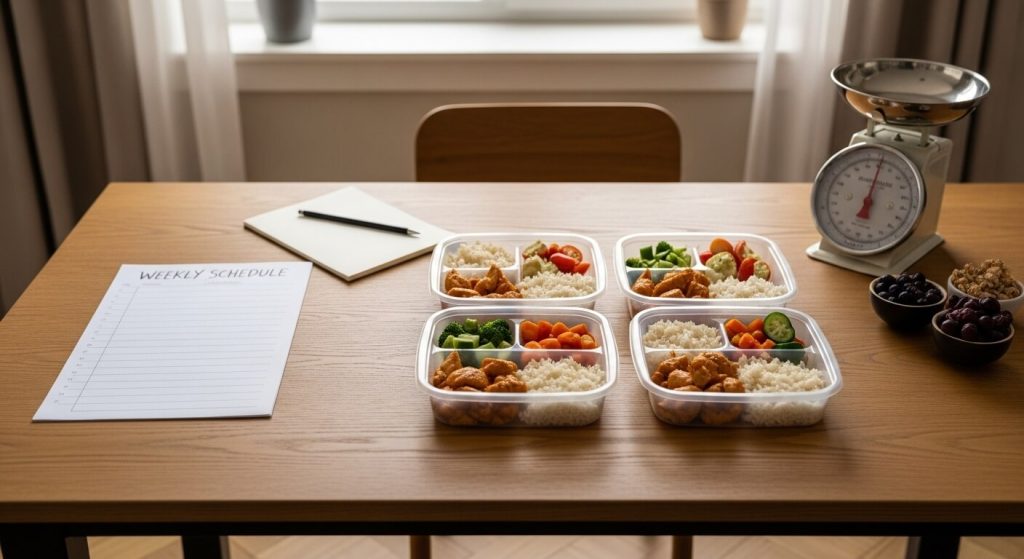
Set your daily calorie and protein numbers first, then spread the protein across three or four meals roughly three to four hours apart. That is the entire evidence-based content of meal timing. Everything else on the topic is either an eating-window strategy for controlling intake — a legitimate tool, covered separately — or marketing.
Related: how much protein you need, building a meal plan, intermittent fasting.
Educational content, not medical advice. If you have diabetes or take medication with food, talk to your clinician before changing your eating schedule.
This content is for educational purposes only and is not medical advice. Always consult a qualified healthcare professional for personalised guidance.