
Endurance fuelling comes down to three numbers: carbohydrate per hour, fluid per hour, and the point at which drinking more becomes dangerous rather than helpful. The last one is the least discussed and the only one that lands people in the hospital. This page gives all three with their sources, plus what actually restores glycogen afterwards.
The short version
- Carbohydrate during long efforts: about 1 g per minute, taken every 15–30 minutes.
- Start fuelling before you tire — at the latest 30 minutes before you expect to fade.
- Afterwards: over 1.0 g/kg of carbohydrate keeps glycogen replacing at its top rate for two hours, and up to six with repeat feeds.
- Fluid: drink to thirst on efforts over two hours. Forced hydration in large volumes is explicitly discouraged.
- Salt tablets have not been shown to prevent exercise-associated hyponatremia.
Carbohydrate during the effort
An Institute of Medicine review gives the rate directly: a carbohydrate intake of about 1 g/min, consumed at 15- to 30-min intervals. That is roughly 60 g an hour, split into four to six feeds rather than taken in one go.
The threshold for bothering at all: glucose feedings may be of benefit during prolonged exercise lasting longer than 90 min, with a committee summary putting the practical line at endurance events that last at least 60 minutes and involve vigorous exercise.
And the timing rule that most people get wrong: people should not wait until they are fatigued before they ingest carbohydrate — feeding should begin, at the latest, 30 min prior to the anticipated fatigue. In a cycling trial in that chapter, carbohydrate taken this way delayed fatigue by 21% against placebo.
Refuelling afterwards
There is a real window here, and unlike the protein one it has a mechanism and a number. Glycogen storage runs at 5 and 8 µmol/g (wet weight) per hour for the two hours after exercise — provided that a glucose supplement in excess of 1.0 g per kilogram of body weight is ingested.
Better still, it does not have to stop there: this rate of storage can be maintained up to 6 h after exercise if the blood glucose and insulin concentrations are sustained by providing supplements at 2-h intervals. For a 70 kg athlete that means roughly 70 g of carbohydrate soon after finishing, repeated.
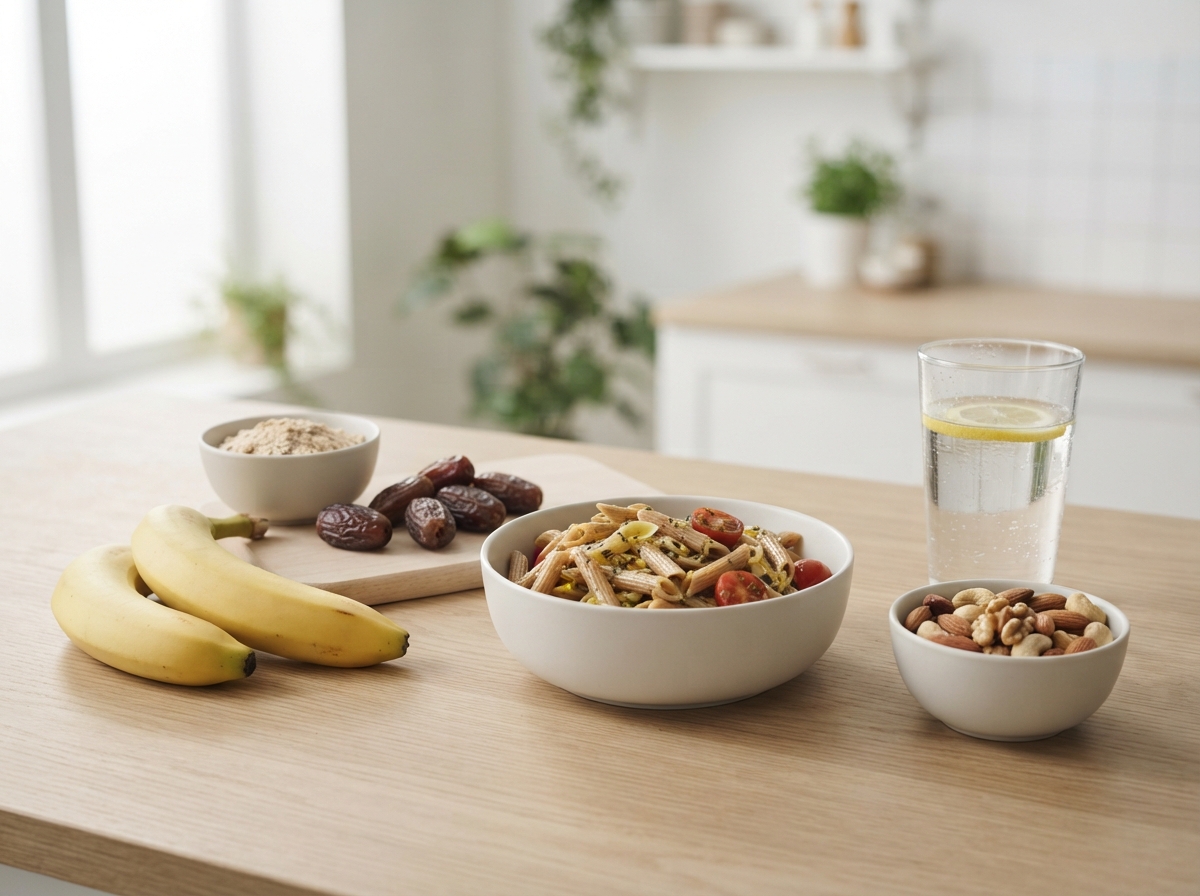
Across the day, ODS puts athlete carbohydrate at 3 to 10 g/kg body weight. Options with numbers on our cards: white rice, banana, oats, whole wheat bread.
Fluid — and the number that goes the other way
Dehydration costs are steep: small (2%) to moderate (4%) water deficits reduce maximal aerobic power (10%-27%) and physical work capacity (22%-48%), and effects begin at as little water loss as 1 percent of body weight.
But over-drinking is its own emergency. Exercise-associated hyponatremia concentrates in exactly the events this page is about: ultramarathon and marathon running, triathlon, shorter distance running, military training operations, team ball sports, recreational hiking, and yoga. The risk factors are excessive hypotonic fluid consumption beyond the capacity for normal renal free water excretion, high ambient temperature, and longer exercise time, usually exceeding 2 hours.
The prevention strategy is stated plainly: the safest strategy for fluid repletion is a thirst-driven replacement to avoid overhydration. Forced hydration, particularly at large volumes, should be discouraged. CDC sets a hard ceiling for work in heat: do not drink more than 48 oz (1½ quarts) per hour.
Note the apparent contradiction and how to resolve it. CDC tells heat-exposed workers to drink before feeling thirsty; the hyponatremia literature says drink to thirst. Both are right in their context: short shifts in heat with high sweat rates versus multi-hour endurance events where the danger flips from too little to too much. Past two hours, follow thirst.
Sodium: what it does and does not do
Electrolyte replacement has a documented composition — a committee recommends solutions providing approximately 20 to 30 meq of sodium per liter, 2 to 5 meq of potassium per liter — and it matters most for people with heavy sweat losses in hot conditions.
What it does not do is prevent hyponatremia by itself: supplementing the serum sodium with salt tablets or packets at any particular rate or total dose during activity has not been shown to decrease rates of EAH. If you take salt tablets believing they let you drink freely, that belief is not supported.
More on the two minerals in sodium and potassium.
Supplements that touch endurance
Beets / nitrate. ODS reports that beet juice has generally improved performance and endurance to different extents compared with placebo among runners, swimmers, rowers, and cyclists in time trials and time-to-exhaustion tests, but not in all studies. Studies used about 500 ml/day (about 2 cups) of beet juice, with no safety concerns identified at that intake for several weeks.
Caffeine. 2–6 mg/kg, 15 to 60 minutes before exercise.
Creatine — not for you. ODS is explicit that it is of little value for endurance sports, such as distance running or swimming.
What we are not claiming
- Carbohydrate targets broken down by athlete level or event type. The position stands publishing those tables were unreachable; we quote the ranges we could verify.
- That sports drinks are necessary. They are evidenced for efforts past about an hour and heavy sweat conditions, not as a default.
- That salt prevents hyponatremia. Explicitly not shown.
- A sweat-rate formula. No source we could reach gives one; weigh yourself before and after to learn your own.
- That beets work for everyone. ODS says generally, but not in all studies — we quote that hedge rather than dropping it.
FAQ
How many carbs per hour when running or cycling? About 1 g per minute — roughly 60 g an hour — taken every 15–30 minutes.
When should I start fuelling? Before you feel tired. At the latest, 30 minutes before you expect to fade.
How much should I drink in a marathon? To thirst. Past two hours the risk shifts from dehydration to hyponatremia, and forced large volumes are discouraged.
Do salt tablets stop cramping or hyponatremia? They have not been shown to reduce hyponatremia rates. Cramping was not addressed by any source we could verify.
How fast should I eat after a long session? Over 1.0 g/kg of carbohydrate keeps glycogen storage at its highest rate for two hours, extendable to six with feeds every two hours.
What to do with this
Rehearse fuelling in training, not on race day: 60 g an hour is more than most people are used to swallowing while moving, and the gut needs practice. Weigh yourself before and after one long session to learn your own sweat rate. And on anything past two hours, drink to thirst rather than to a schedule.
Related: the four numbers that matter, what to eat before training.
Educational content, not medical advice. Confusion, nausea or swelling during a long event can indicate hyponatremia — that is a medical emergency, not a reason to drink more.
This content is for educational purposes only and is not medical advice. Always consult a qualified healthcare professional for personalised guidance.