In January 2026 the US federal dietary advice changed — and changed more than usual. The Dietary Guidelines for Americans, 2025–2030 describe themselves as “the most significant reset of federal nutrition policy in our nation’s history,” with a summary you can hold in your head: “eat real food.”
That matters practically, because a lot of what circulates online — including some of USDA’s own consumer pages — still reflects the previous edition. This guide sets out what the current edition actually says, in its own words, and flags the two places where federal sources now disagree with each other.
The twelve things the current guidelines actually tell you
The document is short and organized around twelve instructions. Here they are with the key sentence from each.
| Section | What it says |
|---|---|
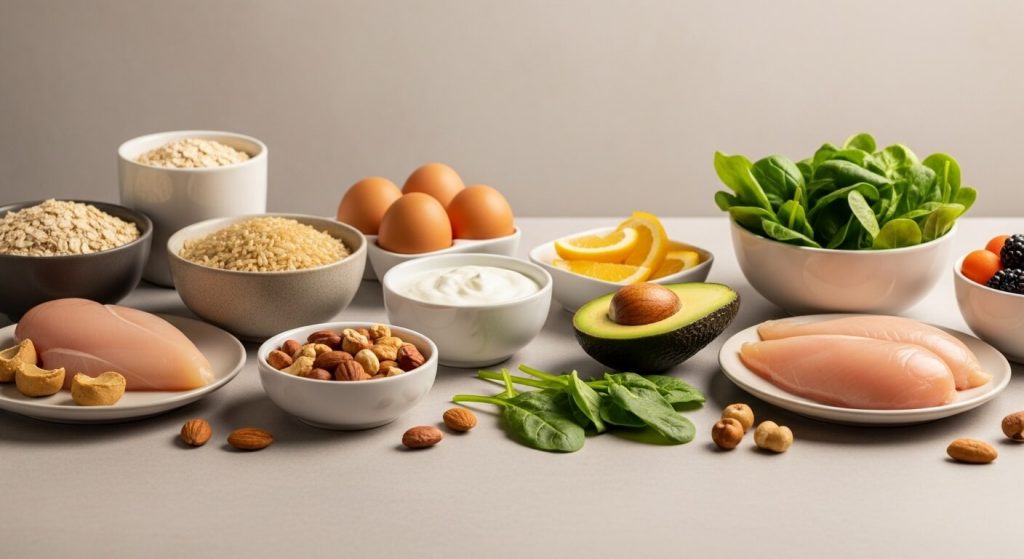
| Protein at every meal | “Prioritize high-quality, nutrient-dense protein foods as part of a healthy dietary pattern.” Target: “1.2–1.6 grams of protein per kilogram of body weight per day” |
| Dairy | “When consuming dairy, include full-fat dairy with no added sugars.” Three servings a day at 2,000 calories |
| Eat the right amount for you | “The calories you need depend on your age, sex, height, weight, and level of physical activity.” And: “Pay attention to portion sizes, particularly for foods and beverages higher in calories.” |
| Gut health | “A healthy diet supports a well-balanced microbiome and healthy digestion.” |
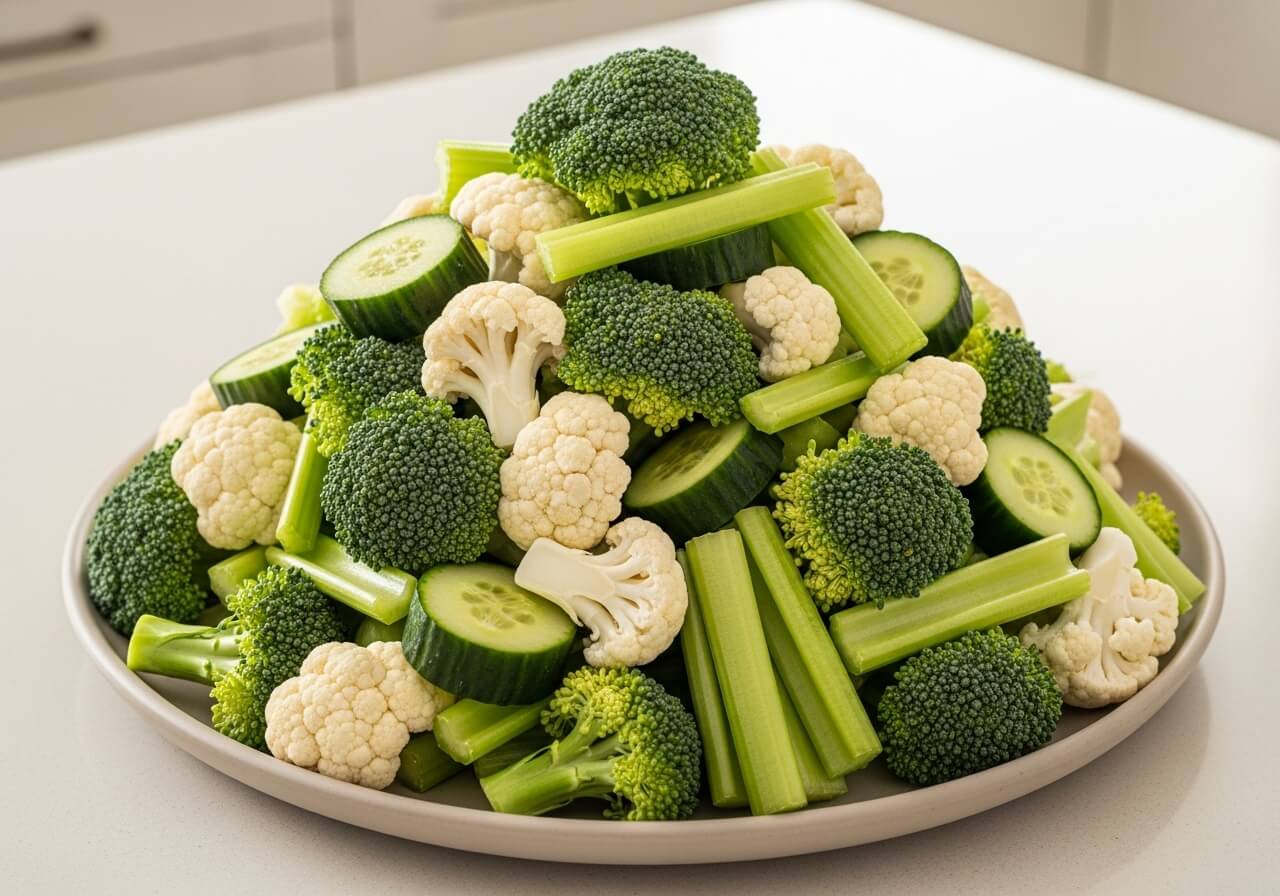
| Vegetables and fruits | “Eat a variety of colorful, nutrient-dense vegetables and fruits” and “eat whole vegetables and fruits in their original form.” Three servings of vegetables, two of fruit, daily |
| Healthy fats | Found in “meats, poultry, eggs, omega-3–rich seafood, nuts, seeds, full-fat dairy, olives, and avocados.” Saturated fat “should not exceed 10% of total daily calories” |
| Whole grains | “Prioritize fiber-rich whole grains.” Two to four servings a day |
| Limit highly processed foods | “Avoid highly processed packaged, prepared, ready-to-eat, or other foods that are salty or sweet.” |
| Added sugars | “One meal should contain no more than 10 grams of added sugars.” |
| Sodium | “The general population, ages 14 and above, should consume less than 2,300 mg per day.” |
| Alcohol | “Consume less alcohol for better overall health.” |
| Hydration | “Choose water (still or sparkling) and unsweetened beverages.” |
Note the added sugars figure carefully. It is stated per meal, in grams — not as a percentage of daily calories. If you have seen “under 10% of calories,” that was the previous edition. Ten grams is about two and a half teaspoons, which is less than most flavored yogurts.
Two places federal sources now contradict each other
We would rather show you this than quietly pick a side.
Dairy fat. The current Dietary Guidelines say to “include full-fat dairy with no added sugars.” USDA’s own MyPlate pages still advise “fat-free or low-fat dairy products,” and so does NIDDK’s older-adult guidance. MyPlate has not been updated to the 2026 edition. Where they conflict, the Dietary Guidelines are the governing document — but whichever you choose, the saturated fat ceiling of 10% of calories still applies.
Protein units. The Guidelines set protein by bodyweight: 1.2–1.6 g/kg per day. MyPlate still uses ounce-equivalents — 5 to 6½ for women aged 19–30, 6½ to 7 for men. For a 70 kg adult the Guidelines’ figure is 84–112 g of protein daily, which is a meaningfully higher target than the MyPlate framing implies.
What the food groups look like in portions
The Dietary Guidelines give serving goals but no serving definitions. For those, MyPlate remains useful — its daily amounts for adults:
| Group | Women 19–50 | Men 19–50 | Over 50 |
|---|---|---|---|
| Vegetables | 2½ cups | 3 cups | 2 cups (W), 2½ cups (M) |
| Fruit | 1½–2 cups | 2 cups | 1½ cups (W), 2 cups (M) |
| Grains | 5–8 oz-equiv, half whole | 7–10 oz-equiv, half whole | 5–7 (W), 6–9 (M) |
| Protein foods | 5–6½ oz-equiv | 6–7 oz-equiv | 5–6 (W), 5½–6½ (M) |
| Dairy | 3 cups | 3 cups | 3 cups |
MyPlate’s grains principle is the one worth memorising: “at least half of the grains you eat should be whole grains.” And on fruit form, it settles a common worry: “fruits may be fresh, canned, frozen, or dried, and may be whole, cut-up, or pureed.”
What counts as one serving
NHLBI’s DASH guide defines these, which makes the numbers above usable:
| Grains | 1 slice bread; 1 oz dry cereal; ½ cup cooked rice or pasta |
| Vegetables | 1 cup raw leafy; ½ cup cooked; ½ cup juice |
| Fruit | 1 medium fruit; ¼ cup dried; ½ cup fresh, frozen or canned |
| Dairy | 1 cup milk or yogurt; 1.5 oz cheese |
| Meat, poultry, fish | 1 oz cooked; 1 egg |
| Nuts, seeds, legumes | ⅓ cup nuts; 2 Tbsp nut butter; ½ cup cooked legumes |
Serving size is not a recommendation
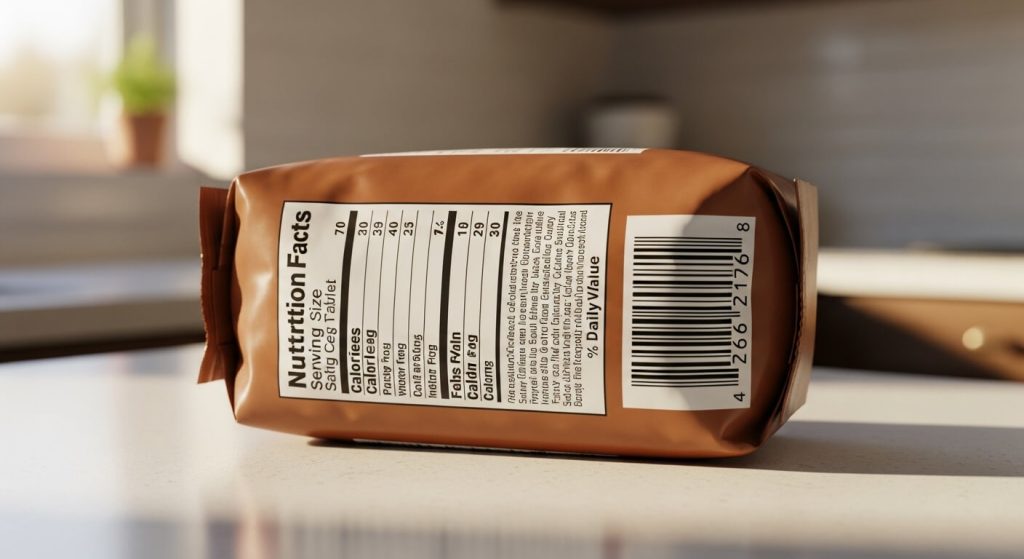
This trips up almost everyone reading a label. FDA is explicit: “the serving size is not a recommendation of how much to eat or drink.” Label serving sizes “must be based on the amount of food people typically consume, rather than how much they should consume.”
So a serving size on a package describes behavior, not advice. What you should eat comes from the food-group amounts above; what is on the label tells you what the numbers beside it refer to. We go through the whole panel in how to read nutrition labels, and the %DV column specifically in what percent Daily Value really means.
Portions outside the home have also drifted: NHLBI notes that “in many cases, the amount of food that appears on your plate when eating out has nearly doubled over the past 20 years.”
Protein, in practice
The Guidelines want variety on both sides: “consume a variety of protein foods from animal sources, including eggs, poultry, seafood, and red meat, as well as a variety of plant-sourced protein foods, including beans, peas, lentils, legumes, nuts, seeds, and soy.”
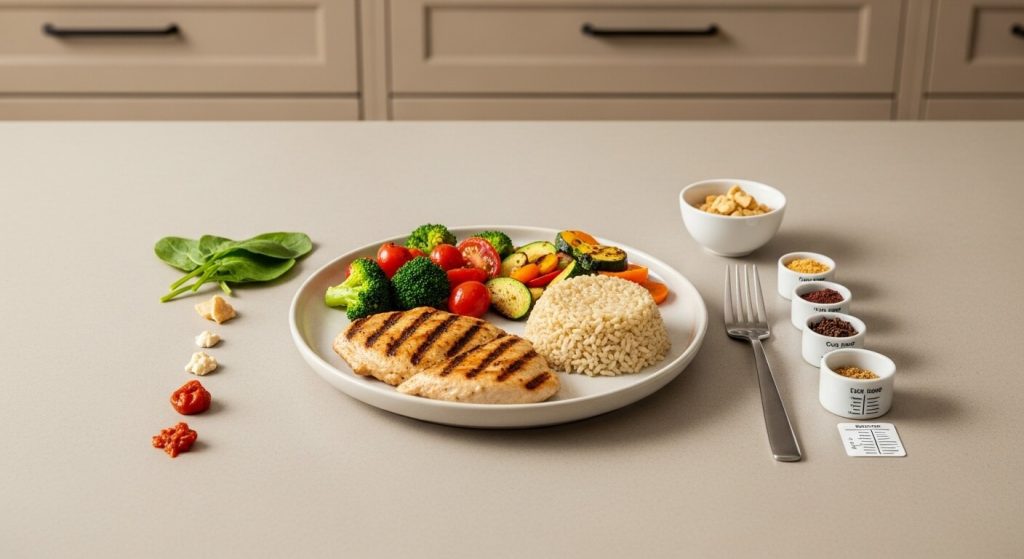
Two smaller instructions in the same section are easy to miss and easy to act on: “swap deep-fried cooking methods with baked, broiled, roasted, stir-fried, or grilled cooking methods,” and “consume meat with no or limited added sugars, refined carbohydrates or starches, or chemical additives.”
Beans occupy an unusual position — MyPlate counts them twice: “the nutrition found in beans, peas, and lentils are similar to foods in both the Vegetable Food Group and the Protein Foods Group.” They are “excellent sources of fiber, folate, and potassium” and “excellent sources of plant protein, also providing iron and zinc.”
How much to eat at a sitting is covered in how much protein per meal.
Where to start if this feels like a lot
NIDDK’s guidance on changing habits is the antidote to overhauling everything at once: “start with small changes,” because “small changes can lead to healthy habits worth keeping.” USDA’s own beginner framing is the same — “meet healthy eating goals one at a time.”
It also treats setbacks as normal rather than as failure: “a setback does not mean you have failed. All of us experience setbacks. The key is to get back on track as soon as you can.”
And you do not need new recipes: “try making your old favorite recipes in healthier new ways. For example, you can trim fat from meats and reduce the amount of butter, sugar, and salt you cook with.”
CDC offers concrete single swaps: “cut back on the amount of cereal in your bowl to make room for bananas, peaches, strawberries, or blueberries”; “replace 1 cup of rice or pasta in your favorite dish with 1 cup of vegetables.” A full beginner sequence is in how to start eating healthy.
Four claims we are not going to make
| Common claim | Why not |
|---|---|
| “Breakfast is the most important meal” | The current Dietary Guidelines contain no meal-timing or breakfast requirement anywhere in their twelve sections |
| “Small frequent meals boost metabolism” | No federal source supports it. The Guidelines are silent on meal frequency entirely |
| “Fresh is always more nutritious than frozen” | CDC: “frozen or canned vegetables and fruits can be just as nutritious as the fresh varieties” — choosing those without added salt, sugar or syrup |
| “Eating healthy costs more” | USDA publishes the Thrifty Food Plan precisely as a costed nutritious diet. See eating well on a budget |
One more worth stating plainly: the current Dietary Guidelines use the phrase “nutrient-dense” repeatedly but never define it, and contain no list of “nutrients of public health concern.” Both are widely attributed to them and neither is in the document. What the term can usefully mean is unpacked in nutrient density: what it officially means.
FAQ
What are the current US dietary guidelines?
The Dietary Guidelines for Americans, 2025–2030, 10th edition, published January 2026. They replace the 2020–2025 edition, which should no longer be cited.
How much protein should I eat a day?
The current edition gives 1.2–1.6 grams per kilogram of bodyweight — roughly 84–112 g for a 70 kg adult. MyPlate’s older ounce-equivalent figures have not been updated to match.
Should dairy be full-fat or low-fat?
The current Guidelines say full-fat with no added sugars. MyPlate still says fat-free or low-fat. Where they conflict the Guidelines govern, but saturated fat should stay under 10% of daily calories either way.
How much added sugar is allowed?
No more than 10 grams in one meal — about two and a half teaspoons. This is a per-meal figure, not a percentage of daily calories.
Is frozen or canned produce a real substitute?
CDC says frozen and canned can be just as nutritious as fresh, provided you choose versions without added salt, sugar or syrup. MedlinePlus adds that produce eaten straight from the farm is the ceiling.
Do I have to change everything at once?
No, and federal guidance advises against it. NIDDK recommends starting with small changes and treats setbacks as part of the process; USDA’s framing is one goal at a time.
What does “serving size” on a label mean?
It describes what people typically eat, not what you should eat. FDA states directly that the serving size is not a recommendation.
This content is for educational purposes only and is not medical advice. Always consult a qualified healthcare professional for personalised guidance.