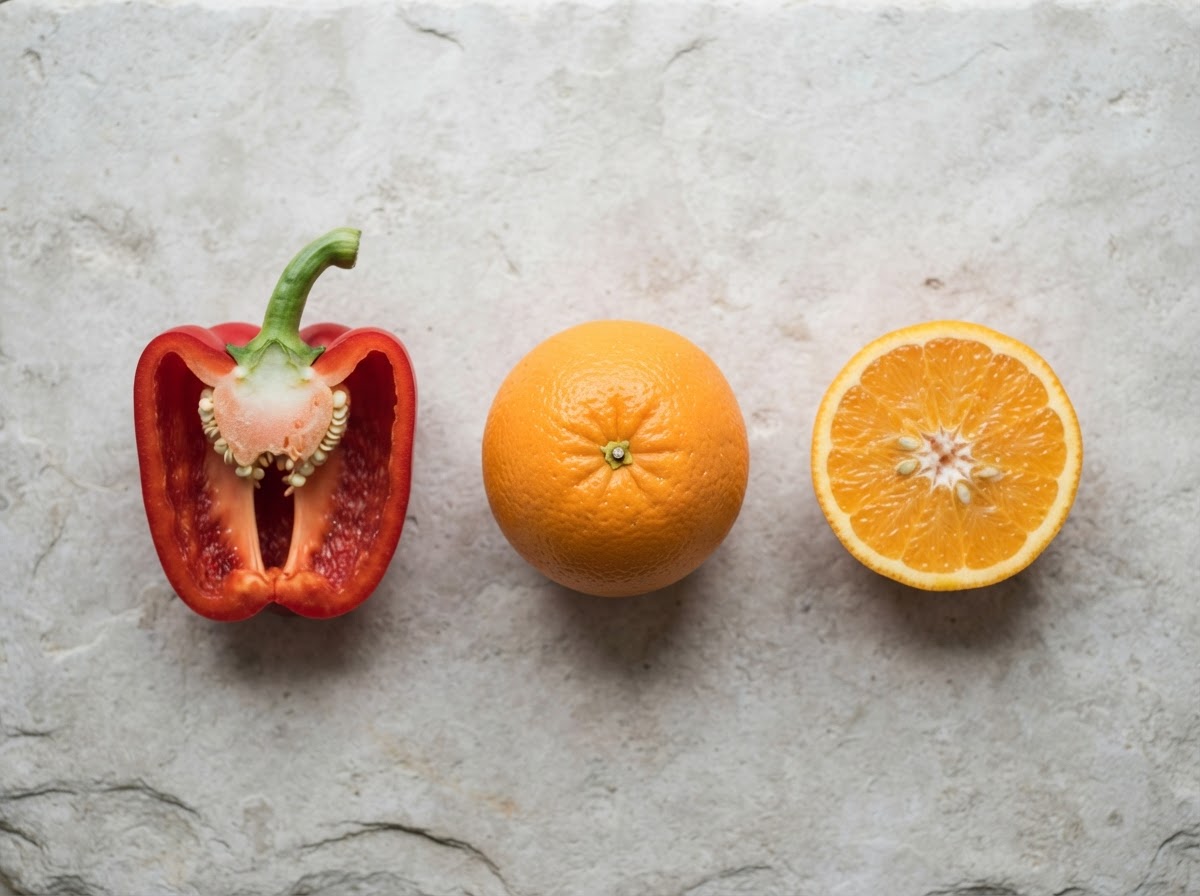
Half a cup of raw red bell pepper contains 95 mg of vitamin C. A medium orange contains 70 mg. That is the federal government’s own table, and it is the single most useful thing in this article: the food most associated with vitamin C is not the best source of it, and it is not close.
The second most useful thing concerns the reason you are probably reading this in November. Vitamin C does not prevent colds in ordinary people — and taking it once you feel one starting does nothing at all. Both of those are stated plainly by two separate US federal sources, and both are worth knowing before you buy anything.
Key takeaways. Raw red pepper (95 mg per half cup) beats orange juice (93 mg) and a whole orange (70 mg); kiwifruit beats the orange too. On the cold question, a 2007 Cochrane Review reported by the Office of Dietary Supplements found that taking vitamin C regularly does not reduce the risk of catching a cold in the general population, shortens colds by 8% in adults and 14% in children, and cuts colds in half only in marathon runners, skiers and soldiers under extreme physical stress. Starting it after symptoms begin does not affect duration or severity. Above 1 g a day, absorption falls below 50% and the rest is excreted. And the most practical use of vitamin C has nothing to do with colds: it is iron absorption.
The federal food table, all 19 rows
The NIH Office of Dietary Supplements publishes this list. The Daily Value for vitamin C is 90 mg, so anything over 90 mg is a full day in one serving.
| Food | mg per serving | % DV |
|---|---|---|
| Red pepper, sweet, raw, ½ cup | 95 | 106 |
| Orange juice, ¾ cup | 93 | 103 |
| Orange, 1 medium | 70 | 78 |
| Grapefruit juice, ¾ cup | 70 | 78 |
| Kiwifruit, 1 medium | 64 | 71 |
| Green pepper, sweet, raw, ½ cup | 60 | 67 |
| Broccoli, cooked, ½ cup | 51 | 57 |
| Strawberries, fresh, sliced, ½ cup | 49 | 54 |
| Brussels sprouts, cooked, ½ cup | 48 | 53 |
| Grapefruit, ½ medium | 39 | 43 |
| Broccoli, raw, ½ cup | 39 | 43 |
| Tomato juice, ¾ cup | 33 | 37 |
| Cantaloupe, ½ cup | 29 | 32 |
| Cabbage, cooked, ½ cup | 28 | 31 |
| Cauliflower, raw, ½ cup | 26 | 29 |
| Potato, baked, 1 medium | 17 | 19 |
| Tomato, raw, 1 medium | 17 | 19 |
| Spinach, cooked, ½ cup | 9 | 10 |
| Green peas, frozen, cooked, ½ cup | 8 | 9 |
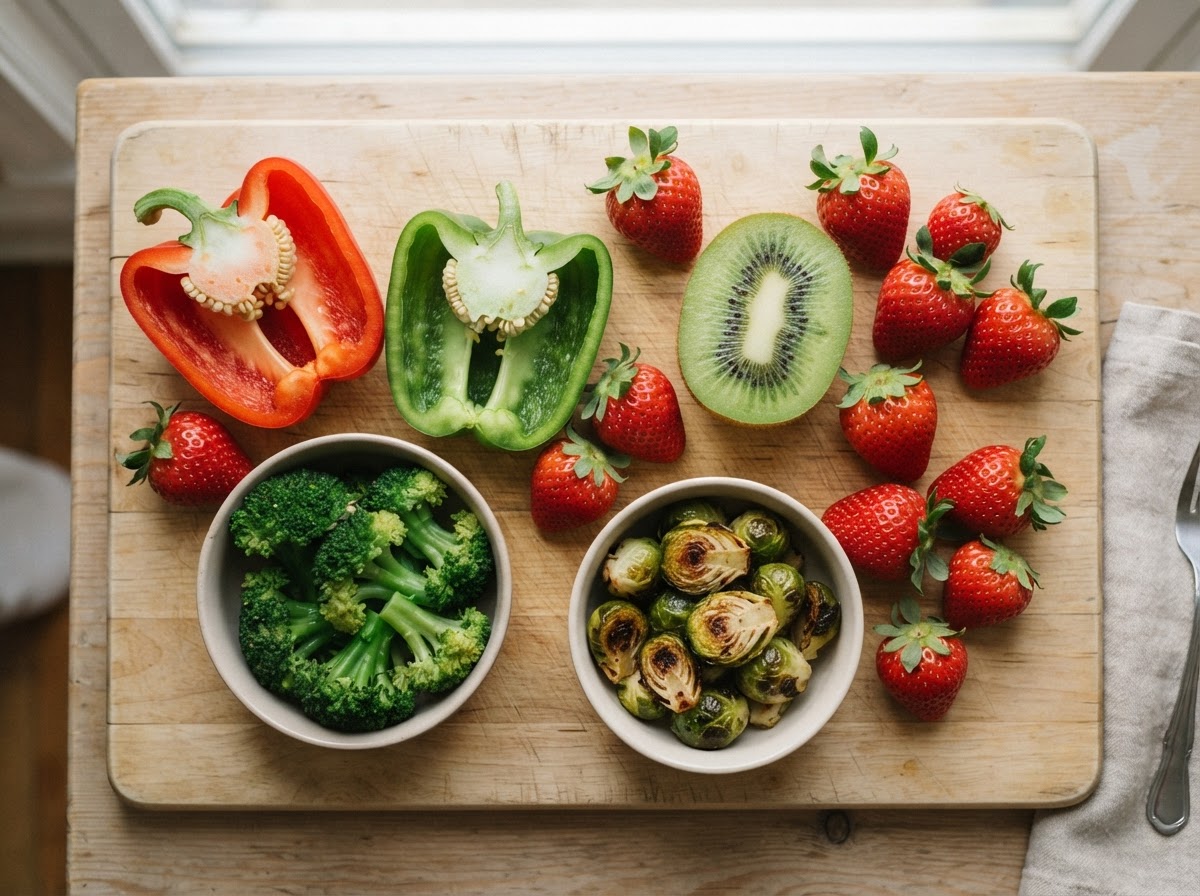
Four things in that table are worth pointing at.
Peppers win. Red beats every citrus entry; green beats half a grapefruit by 50%. If you want vitamin C from food, the produce aisle answer is a bell pepper, not an orange.
Cooked broccoli beats raw broccoli — 51 mg against 39. That looks wrong until you notice the serving is half a cup by volume, and cooked broccoli packs more densely into it. It is a good reminder that “raw is always better” is a rule of thumb, not a law.
Brussels sprouts (48 mg) sit essentially level with strawberries (49 mg), which almost nobody expects.
The boring foods matter. A baked potato carries 17 mg and cooked cabbage 28 mg. Those are not exciting numbers, but they are a large part of why scurvy is rare: ordinary food quietly covers the requirement.
One labeling note from the table’s own footnote: the FDA “does not require food labels to list vitamin C content unless vitamin C has been added to the food.” So the absence of a vitamin C line on a package tells you nothing.
How much you need
The adult RDA is 90 mg for men and 75 mg for women, rising to 85 mg in pregnancy and 120 mg while breastfeeding. Teenagers need 75 and 65 mg. Children 4–8 need 25 mg.
If you smoke, add 35 mg a day to those figures — ODS’s consumer sheet puts it exactly that way: “If you smoke, add 35 mg to the above values to calculate your total daily recommended amount.”
Most Americans already get there. ODS cites NHANES figures of 105.2 mg a day for adult men and 83.6 mg for adult women — from the 2001–2002 survey cycle, so treat it as a long-standing pattern rather than today’s number.
The upper limit for adults is 2,000 mg a day. Past it, the complaints ODS lists are “diarrhea, nausea, abdominal cramps, and other gastrointestinal disturbances due to the osmotic effect of unabsorbed vitamin C in the gastrointestinal tract.”
Colds: three different answers that everyone blurs into one
Here is where nearly every article goes wrong, by merging three separate findings. The figures below come from a 2007 Cochrane Review, which the NIH Office of Dietary Supplements reports — they are the review’s findings, not the Office of Dietary Supplements’ own.
1. Prevention, in ordinary people: no. “Prophylactic use of vitamin C did not significantly reduce the risk of developing a cold in the general population.” Taking vitamin C every day through the winter does not make you less likely to catch something.
2. Duration: a small, real effect. “In the general population, the use of prophylactic vitamin C modestly reduced cold duration by 8% in adults and 14% in children.” Keep the word “modestly”. Eight percent of a seven-day cold is about half a day.
3. Extreme physical stress: a large effect, in a narrow group. “However, in trials involving marathon runners, skiers, and soldiers who were exposed to extreme physical exercise and/or cold environments, prophylactic use of vitamin C in doses ranging from 250 mg/day to 1 g/day reduced cold incidence by 50%.” The dose range belongs with that number, and so does the population. NCCIH describes the same finding independently: in those groups, “taking vitamin C cut the number of colds in half.”
ODS elsewhere adds a fourth group to that exception — regular intake “may reduce the incidence of the common cold in people who exercise intensely, are exposed to cold environments, or have marginal vitamin C status.” If your intake is already poor, topping it up may help; if it is adequate, the review says it does not.
And the sentence that should change what you do
This is the best-supported claim in the article, stated by two federal sources independently.
ODS: “When taken after the onset of cold symptoms, vitamin C did not affect cold duration or symptom severity.”
NCCIH: “Taking vitamin C only after you start to feel cold symptoms doesn’t affect the length or severity of the cold.”
Which is to say: the entire ritual of reaching for a vitamin C sachet at the first tickle in your throat has no measured effect on how long the cold lasts or how bad it is. Whatever benefit exists belongs to people who were already taking it — and in the general population that benefit is 8%.
The use nobody markets: iron
The strongest practical case for vitamin C in your diet has nothing to do with winter. It is that vitamin C makes the iron in plant foods absorbable, and the Office of Dietary Supplements puts a number on it — on its iron fact sheet rather than its vitamin C one:
“The bioavailability of iron is approximately 14% to 18% from mixed diets that include substantial amounts of meat, seafood, and vitamin C (ascorbic acid, which enhances the bioavailability of nonheme iron) and 5% to 12% from vegetarian diets.”
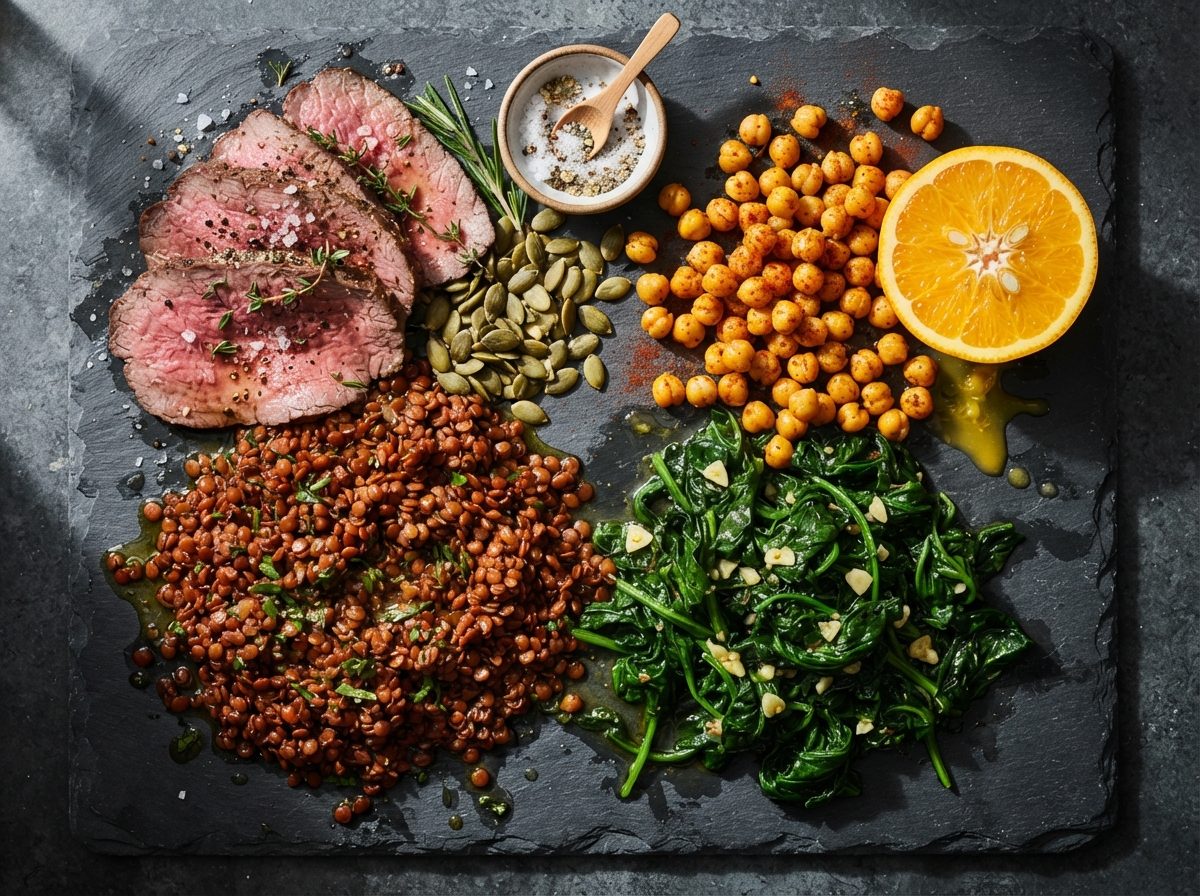
That is a roughly threefold difference at the low end, and it is actionable in a way the cold findings are not: put a vitamin C food with your iron-bearing plant food in the same meal. Peppers with beans. Strawberries with fortified oatmeal. Tomato with lentils. The ODS vitamin C sheet states the mechanism directly: “Vitamin C also improves the absorption of nonheme iron, the form of iron that is present in plant-based foods.”
One caveat, and ODS words it carefully: “a theoretical concern is that high vitamin C intakes might cause excess iron absorption.” For people with hemochromatosis, who store too much iron, that concern is real — ODS says high doses “could worsen iron overload and damage body tissues”, and NCCIH says such people “should avoid high doses of vitamin C.” For everyone else this is a feature, not a bug. Our article on iron-rich foods goes into the rest.
Supplements: what the evidence supports and what it does not
More is not better. ODS: “Approximately 70% to 90% of vitamin C is absorbed at moderate intakes of 30 to 180 milligrams (mg)/day. However, at doses above 1 gram (g)/day, absorption falls to less than 50%, and absorbed, unmetabolized ascorbic acid is excreted in the urine.” A 1,000 mg tablet is not ten times a 100 mg one; a large part of it leaves in your urine.
Supplements are not better than food. ODS: supplements contain ascorbic acid, “which has equivalent bioavailability to that of naturally occurring ascorbic acid in foods, such as orange juice and broccoli.”
Fancy forms are not better than plain ones. ODS covers mineral ascorbates, bioflavonoid-containing forms and Ester-C, and reports that the study authors concluded “simple ascorbic acid is the preferred source of supplemental vitamin C.” Note that this is those authors’ conclusion, reported by ODS, rather than the Office of Dietary Supplements’ own position. As for “liposomal” and “buffered” vitamin C — the terms that command the highest prices — neither appears anywhere on the ODS vitamin C fact sheet.
Cancer prevention: not supported. ODS: “Results from most clinical trials suggest that modest vitamin C supplementation alone or with other nutrients offers no benefit in the prevention of cancer.” The agency does note that higher fruit and vegetable consumption is associated with lower cancer risk, “perhaps, in part, due to their high vitamin C content” — which is a statement about produce, with two hedges, not about pills.
Kidney stones: genuinely unresolved, and the second half of the sentence matters. ODS: “High vitamin C intakes also have the potential to increase urinary oxalate and uric acid excretion, which could contribute to the formation of kidney stones, especially in individuals with renal disorders. However, the studies that have evaluated the effects of vitamin C intakes ranging from 30 mg to 10 g/day on urinary oxalate excretion have had conflicting results, so it is not clear whether vitamin C actually plays a role in the development of kidney stones.” Articles that quote only the first sentence turn a documented uncertainty into a warning.
Skin and collagen. Vitamin C is genuinely required to make collagen — but ODS frames that around wound healing, not appearance: “Collagen is an essential component of connective tissue, which plays a vital role in wound healing”, and “the lack of vitamin C impairs collagen synthesis, weakening connective tissues.” Nothing on the ODS fact sheets connects vitamin C to skin appearance or wrinkles.
Cooking, storage and scurvy
Vitamin C is fragile, and ODS says so without giving a number: “Vitamin C is water soluble and susceptible to heat, so cooking can reduce the vitamin C content of food”, and its content “may be reduced by prolonged storage and by cooking because ascorbic acid is water soluble and is destroyed by heat.” Its one practical tip: “Steaming or microwaving may lessen cooking losses.”
No federal source we consulted publishes a percentage for those losses, so neither will we. The useful conclusion is simpler anyway: most of the top foods on the table — peppers, kiwi, strawberries, citrus, tomato — are eaten raw, which sidesteps the problem entirely.
On deficiency: “Vitamin C deficiency causes scurvy, but this condition is rare in developed countries.” ODS puts the threshold remarkably low — symptoms “can appear within 1 month of consuming less than about 10 mg/day”, and overt deficiency occurs “only if vitamin C intake falls below approximately 10 mg/day for many weeks.” Ten milligrams is about a third of a small tomato. It is a genuinely hard requirement to miss on any varied diet, which is why the people affected in the US tend to be those with poor overall nutrition, particularly older adults.
A note on the Dietary Guidelines
Out of curiosity we checked the Dietary Guidelines for Americans, 2025–2030 page by page. Vitamin C is not mentioned once — while vitamins A, D, E, B6 and B12, riboflavin, niacin, calcium, iron, magnesium, potassium and zinc all are. The guidelines do give a produce target: three servings of vegetables and two of fruit a day. Two rows from the table above — half a cup of red pepper and half a cup of cooked broccoli — come to 146 mg, comfortably over any adult’s requirement, and use only two of those five servings. (That last sum is ours, not the government’s.)
FAQ
What food has the most vitamin C?
Of the 19 foods in the Office of Dietary Supplements’ table, raw red sweet pepper: 95 mg per half cup, 106% of the Daily Value. It beats orange juice, a whole orange, grapefruit and kiwi.
Does vitamin C prevent colds?
Not in the general population. A 2007 Cochrane Review reported by the Office of Dietary Supplements found regular use “did not significantly reduce the risk of developing a cold”. The exception is people under extreme physical stress — marathon runners, skiers, soldiers — where 250 mg to 1 g a day cut cold incidence by half.
Should I take vitamin C when I feel a cold starting?
Two federal sources say it will not help. ODS: taken after symptoms begin, vitamin C “did not affect cold duration or symptom severity”. NCCIH says the same in its own words.
How much vitamin C do I need a day?
90 mg for adult men, 75 mg for adult women, 85 mg in pregnancy, 120 mg while breastfeeding. Add 35 mg if you smoke. The upper limit for adults is 2,000 mg.
Is 1,000 mg of vitamin C a day too much?
It is below the 2,000 mg upper limit, but much of it is wasted: above 1 g a day absorption falls below 50% and the unmetabolized excess is excreted in the urine.
Is liposomal vitamin C better?
The NIH’s vitamin C fact sheet does not mention liposomal or buffered forms at all. What it does report, on the forms it covers, is that the study authors concluded simple ascorbic acid is the preferred source.
Does cooking destroy vitamin C?
It reduces it — ODS says ascorbic acid is water soluble and destroyed by heat, and that long storage reduces it too. No federal source gives a percentage. Steaming or microwaving loses less than boiling.
What to do with this
Eat a bell pepper. Half a cup of the raw red kind covers an adult’s entire daily requirement, which no supplement claim can improve on, and it costs less than the supplement. Kiwi, strawberries, broccoli and Brussels sprouts all do most of a day’s work too.
Pair it with iron. The 14–18% versus 5–12% absorption difference is the best-evidenced reason to care about vitamin C in the first place, and it costs nothing to act on: put something from the table above in the same meal as your beans, lentils or greens.
And on colds: if you already take vitamin C daily, expect about 8% off the length of one. If you do not, starting when your throat begins to hurt will not do anything the evidence can detect. That is not a reason to avoid vitamin C — it is a reason to get it from food all year rather than from a sachet in an emergency.
Related: iron-rich foods, foods high in zinc, foods high in potassium, what food label claims mean.
This content is for educational purposes only and is not medical advice. Always consult a qualified healthcare professional for personalised guidance.