Spices and Herbs

Nutrition Facts Mustard

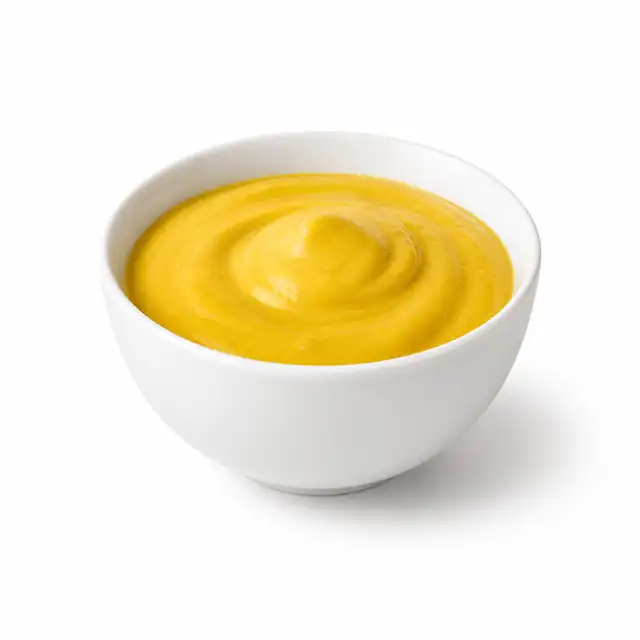
Mustard nutrition facts

Mustard is a seasoning normally used in small amounts, so the quantity added matters more than its dry-weight concentration. It provides dietary fiber, monounsaturated fat, potassium, and magnesium. Keep it tightly closed and dry, away from steam, direct sunlight, and strong odors.

Calories61
Protein4.3g
Carbs5.3g
Fat3.4g
Protein Carbs Fat

Nutrition for 100 g

Calories 61 kcal
Protein 4.25 g
Total Fat 3.38 g
Carbohydrates 5.3 g
Fiber 4.3 g
Total Sugars 1.42 g
Sodium 1100 mg

Nutrients

Full nutrient profile

Proximates
Water 83.7 g
Energy (Atwater General Factors) 69 kcal
Energy (Atwater Specific Factors) 61 kcal
Energy 61 kcal
Energy 254 kj
Nitrogen 0.68 g
Protein 4.25 g
Total lipid (fat) 3.38 g
Total fat (NLEA) 3.76 g
Ash 3.37 g
Carbohydrates
Carbohydrate, by difference 5.3 g
Carbohydrate, by summation 6.39 g
Fiber, total dietary 4.3 g
Sugars, Total 1.42 g
Sucrose 0.2 g
Glucose 0.48 g
Fructose 0.23 g
Lactose 0 g
Maltose 0 g
Galactose 0.52 g
Starch 0.65 g
Sugars, Total 0.92 g
Lipids
Fatty acids, total saturated 0.25 g
SFA 4:0 0 g
SFA 6:0 0 g
SFA 8:0 0 g
SFA 10:0 0.005 g
SFA 11:0 0 g
SFA 12:0 0.003 g
SFA 14:0 0.004 g
SFA 15:0 0.002 g
SFA 16:0 0.14 g
SFA 17:0 0.002 g
SFA 18:0 0.05 g
SFA 20:0 0.02 g
SFA 22:0 0.02 g
SFA 24:0 0.01 g
Fatty acids, total monounsaturated 2.59 g
MUFA 14:1 c 0 g
MUFA 15:1 0 g
MUFA 16:1 c 0.009 g
MUFA 17:1 0 g
MUFA 17:1 c 0 g
MUFA 18:1 c 0.92 g
MUFA 20:1 0.35 g
MUFA 20:1 c 0.35 g
MUFA 22:1 c 1.26 g
MUFA 24:1 c 0.06 g
Fatty acids, total polyunsaturated 0.9 g
PUFA 18:2 c 0.42 g
PUFA 18:2 n-6 c,c 0.42 g
PUFA 18:2 CLAs 0 g
PUFA 18:3 c 0.44 g
PUFA 18:3 n-3 c,c,c (ALA) 0.44 g
PUFA 18:3 n-6 c,c,c 0 g
PUFA 18:3i 0 g
PUFA 18:4 0 g
PUFA 20:2 c 0.01 g
PUFA 20:2 n-6 c,c 0.01 g
PUFA 20:3 c 0.02 g
PUFA 20:3 n-3 0.02 g
PUFA 20:3 n-6 0 g
PUFA 20:3 n-9 0 g
PUFA 20:4 0 g
PUFA 20:4c 0 g
PUFA 20:5c 0 g
PUFA 20:5 n-3 (EPA) 0 g
PUFA 22:2 0.01 g
PUFA 22:5 c 0 g
PUFA 22:4 0 g
PUFA 22:5 n-3 (DPA) 0 g
PUFA 22:6 c 0 g
PUFA 22:6 n-3 (DHA) 0 g
Fatty acids, total trans 0.01 g
Fatty acids, total trans-monoenoic 0.004 g
TFA 16:1 t 0 g
TFA 18:1 t 0.004 g
TFA 22:1 t 0 g
Fatty acids, total trans-dienoic 0.006 g
TFA 18:2 t not further defined 0.006 g
Cholesterol 0 mg
MUFA 14:1 0 g
MUFA 16:1 0.008 g
MUFA 18:1 0.78 g
PUFA 18:2 0.36 g
PUFA 18:3 0.37 g
PUFA 20:3 0.02 g
Fatty acids, total trans-polyenoic 0.005 g
MUFA 22:1 1.06 g
Amino acids
Tryptophan 0.01 g
Threonine 0.18 g
Isoleucine 0.16 g
Leucine 0.32 g
Lysine 0.29 g
Methionine 0.08 g
Cystine 0.08 g
Phenylalanine 0.18 g
Tyrosine 0.15 g
Valine 0.21 g
Arginine 0.28 g
Histidine 0.13 g
Alanine 0.18 g
Aspartic acid 0.43 g
Glutamic acid 0.79 g
Glycine 0.25 g
Proline 0.39 g
Serine 0.22 g
Hydroxyproline 0 g
Minerals
Calcium, Ca 63 mg
Iron, Fe 1.59 mg
Magnesium, Mg 47.7 mg
Phosphorus, P 108 mg
Potassium, K 150 mg
Sodium, Na 1100 mg
Zinc, Zn 0.64 mg
Copper, Cu 0.07 mg
Manganese, Mn 0.42 mg
Selenium, Se 34 ug
Fluoride, F 1.5 ug
Vitamins and other components
Vitamin C, total ascorbic acid 0.4 mg
Thiamin 0.19 mg
Riboflavin 0.07 mg
Niacin 0.56 mg
Pantothenic acid 0.26 mg
Vitamin B-6 0.07 mg
Folate, total 7 ug
Vitamin A, RAE 4 ug
Carotene, beta 31 ug
Carotene, alpha 1 ug
Cryptoxanthin, beta 27 ug
Lycopene 0 ug
Lutein + zeaxanthin 115 ug
Vitamin E (alpha-tocopherol) 0.35 mg
Tocopherol, beta 0.01 mg
Tocopherol, gamma 2.14 mg
Tocopherol, delta 0.08 mg
Tocotrienol, alpha 0.03 mg
Tocotrienol, beta 0 mg
Tocotrienol, gamma 0 mg
Tocotrienol, delta 0 mg
Vitamin K (phylloquinone) 1.5 ug
Vitamin K (Dihydrophylloquinone) 0 ug
Vitamin K (Menaquinone-4) 0 ug
Folic acid 0 ug
Vitamin D (D2 + D3), International Units 0 iu
Vitamin B-12 0 ug
Vitamin A, IU 109 iu
Retinol 0 ug
Vitamin E, added 0 mg
Vitamin B-12, added 0 ug
Choline, total 22.4 mg
Folate, DFE 7 ug
Betaine 0.2 mg
Folate, food 7 ug
Vitamin D (D2 + D3) 0 ug
Other nutrients
Alcohol, ethyl 0 g
Caffeine 0 mg
Theobromine 0 mg

Interesting fact

Cutting and cooking change crucifer chemistry

Breaking plant cells brings glucosinolates together with myrosinase, allowing isothiocyanates such as sulforaphane to form. Prolonged high heat can inactivate the enzyme; lightly cooking or adding a little raw mustard after cooking can preserve or restore myrosinase activity.

Recipes with this food

Use mustard in simple recipes

Recipes featuring this food will appear here when the recipe library is connected.

These nutrition values are provided for educational purposes only and are not medical advice. Values may vary depending on brand, preparation method, and serving size.