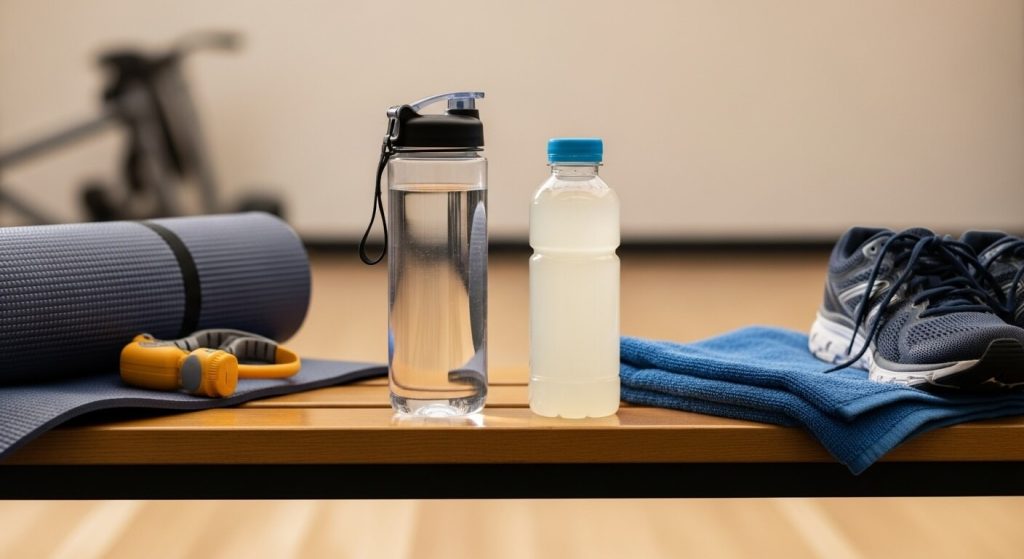
The question “water or electrolytes?” has an answer, and it is more specific than the marketing suggests. The joint position stand on nutrition and athletic performance from the Academy of Nutrition and Dietetics, Dietitians of Canada and the American College of Sports Medicine gives an actual threshold — and most training sits well below it.
This guide works from that document. Where a number appears below, it is quoted from a published position stand, not estimated.
The number that matters is a loss, not an intake
Performance does not depend on how much you drank. It depends on how much you are down.
The position stand: “fluid deficits of >2% BW can compromise cognitive function and aerobic exercise performances.” For anaerobic and high-intensity work the threshold is higher — decrements are “more commonly seen when 3% to 5% of BW is lost.”
For a 70 kg person, 2% is 1.4 kg. That is a lot of sweat for a normal gym session and quite achievable in a long ride in summer. Which is the point: the threshold tells you which sessions need a plan and which do not.
Find your own sweat rate — it takes one session
The position stand’s own method: “routine measurement of pre- and post-exercise BW…can help the athlete estimate sweat losses.”
Weigh yourself before and after a typical session, in minimal clothing, and account for anything you drank during it. Each kilogram lost is roughly a liter of sweat. Do this once for each kind of training you do — a winter treadmill run and a July long run are not the same event — and you will never need a generic formula again.
The protocol
| When | What the position stand says |
|---|---|
| Before | “5-10 ml/kg BW in the 2 to 4 hours before exercise” — for a 70 kg person, roughly 350–700 ml |
| During | Approximately “0.4 to 0.8 L/h”, adjusted to keep the deficit under 2% of bodyweight |
| After | “1.25-1.5 L fluid for every 1 kg BW lost” — 125–150% of the loss |
The after figure looks like overcorrection and is not: some of what you drink leaves as urine before it is absorbed, so replacing exactly what you lost leaves you short.
The during range is wide for a reason. 0.4 to 0.8 L/h is a doubling. Your sweat test tells you where in that range you sit; nobody else can tell you. Someone who loses 0.5 L/h in an air-conditioned gym and someone losing 1.5 L/h on a summer road ride are running different events.
When electrolytes actually matter
Here is the threshold. Sodium replacement during exercise is indicated for “athletes with high sweat rates (> 1.2 L/h)” or “prolonged exercise exceeding 2 hours.”
Below that, water and your next meal handle it. Sweat sodium “approximates 50 mmol/L (~1 g/L)” — so a 45-minute session losing half a liter of sweat costs you around half a gram of sodium, which any ordinary meal replaces several times over.
Potassium is the one people worry about without cause. NIH’s Office of Dietary Supplements notes that potassium is excreted mainly in urine and that “a very small amount is lost in sweat.”
Carbohydrate in the bottle
For longer efforts, the drink is also fuel. The position stand gives rates by duration: for endurance work of 1–2.5 hours, “30-60 g/h”; for ultra-endurance beyond about 2.5–3 hours, “up to 90 g/h.” It adds that “products providing multiple transportable carbohydrates (glucose:fructose mixtures) achieve high rates of oxidation.”
That last detail is why the higher rates are possible at all — a single sugar saturates its transporter, a mixture does not. This overlaps with race-day fuelling, which we cover in carbohydrate loading for athletes.
By training type
Applying the thresholds above to what people actually do:
| Session | What you need |
|---|---|
| 45–75 min resistance training, indoors | Water. Sweat rate is rarely near 1.2 L/h and duration is under 2 hours |
| 30–60 min run or ride, temperate | Water. Drink to thirst; a bottle is enough |
| 60–90 min class or session in heat | Water, but test your sweat rate — heat is what pushes people over 1.2 L/h |
| Endurance work 1–2.5 hours | Fluid at 0.4–0.8 L/h plus carbohydrate at 30–60 g/h; sodium if over two hours or a heavy sweater |
| Anything over 2.5 hours, or hot-weather endurance | Sodium replacement indicated; carbohydrate up to 90 g/h with mixed sugars |
| Multiple sessions in one day | Post-session replacement at 125–150% matters most here — you have limited time to recover the deficit |
Drinking too much is the more dangerous mistake
This deserves more prominence than it usually gets, because the failure mode is worse than being slightly under-hydrated.
The position stand identifies “over-drinking fluids in excess of sweat and urinary losses” as “the primary cause of hyponatremia (plasma sodium <135 mmol/L).” Its symptom list runs: “bloating, puffiness, weight gain, nausea, vomiting, headache, confusion, delirium, seizures, respiratory distress, loss of consciousness, and possibly death.”
CDC/NIOSH heat guidance for workers sets an explicit ceiling: “do not drink more than 48 oz (1½ quarts) per hour!” Its baseline advice for heat work is “drink 1 cup (8 ounces) of water every 15–20 minutes.”
Weight gain during a session is the warning sign. If you finish heavier than you started, you drank more than you sweated. That is the exact condition the position stand is describing — and it is why “drink as much as you can” is bad advice, not cautious advice.
What about hydration powders?
NIH’s Office of Dietary Supplements is narrow about who benefits: “athletes requiring endurance activities lasting more than an hour or performed in extreme environments (e.g., hot temperatures or high altitudes) might need to replace lost fluids and electrolytes and consume additional carbohydrates for energy.”
It also flags the evidence gap directly: “most studies to assess the potential value and safety of supplements to enhance exercise and athletic performance include only conditioned athletes. Therefore, it is often not clear whether the supplements discussed in this fact sheet may be of value to recreational exercisers.”
These products are dietary supplements, and FDA “does not have the authority to approve dietary supplements before they are marketed.” If you are in the group the position stand describes, a drink mix is a convenient delivery method. If you are not, it is flavored water with a claim on the label.
Practical checklist
- Measure once. Weigh before and after a typical session of each type you do.
- Keep the deficit under 2%. That is the performance threshold, and it is what the during-session rate is aimed at.
- Water is the default below 1.2 L/h sweat rate and under two hours.
- Add sodium above either of those thresholds.
- Add carbohydrate from about an hour of endurance work: 30–60 g/h, rising toward 90 g/h with mixed sugars for very long efforts.
- Replace 125–150% afterwards — 1.25–1.5 L per kilogram lost.
- Never finish heavier than you started.
For hydration outside training, see how much water you should actually drink daily, and for how fluid affects what you absorb from food, hydration and nutrient absorption.
FAQ
Do I need a sports drink for a gym session?
Almost certainly not. Sodium replacement during exercise is indicated for sweat rates above 1.2 L/h or sessions over two hours. A typical indoor resistance session meets neither condition.
How much should I drink during exercise?
Roughly 0.4 to 0.8 L per hour, adjusted so that you finish under 2% of bodyweight down. The range is wide because sweat rates vary that much — measure yours.
How do I calculate my sweat rate?
Weigh yourself before and after a session and add back anything you drank. Each kilogram lost is about a liter of sweat. Repeat for each type of training and weather condition.
Why replace 125–150% of what I lost?
Because some of what you drink is excreted before it is absorbed. Replacing exactly the loss leaves you in deficit; the position stand specifies 1.25–1.5 L per kilogram lost.
Can I drink too much during exercise?
Yes, and it is the more serious error. Over-drinking beyond sweat and urinary losses is described as the primary cause of exercise-associated hyponatremia, whose listed consequences include seizures and death. CDC/NIOSH caps intake at 48 oz per hour.
Do I lose much potassium in sweat?
No. the Office of Dietary Supplements states that only a very small amount of potassium is lost in sweat; it is excreted mainly in urine.
When should I add carbohydrate to my drink?
From roughly an hour of endurance work: 30–60 g/h for sessions of 1–2.5 hours, up to 90 g/h beyond that, using mixed glucose-fructose sources for the higher rates.
This content is for educational purposes only and is not medical advice. Always consult a qualified healthcare professional for personalised guidance.